AI Generated Quiz
Primary 1 Mathematics Money Quiz
Free AI-Generated Minimax M3 Primary 1 Mathematics Money quiz with questions and answers for Singapore students. This page is rendered as a direct URL so the questions and answers can be discovered without pressing in-page buttons.
These static practice materials are generated from the site's syllabus and paper-generation workflow, with source and model context shown so students and parents can evaluate the material before use.
Questions
Primary 1 Mathematics Quiz - Money
Name: ____________________ Class: ____________________ Date: ____________________ Score: ______ / 25
Duration: 30 minutes Total Marks: 25 Topic: Money (Singapore currency — coins and notes) Source basis: Syllabus-aligned, AI-inferred from the 2021 MOE Singapore Primary Mathematics Syllabus (P1–P6). This quiz is not derived from past-year papers.
Instructions:
- Read each question carefully before you write your answer.
- Show your working in the spaces provided for calculation questions.
- Use the correct unit: ¢ for cents and $ for dollars.
- For Section A, write the missing amounts in numerals.
- For Section B, write the correct number sentence and answer.
- For Section C, show your working clearly.
Section A — Recognising and counting money (1 mark each)
Write the amount of money in cents (¢).
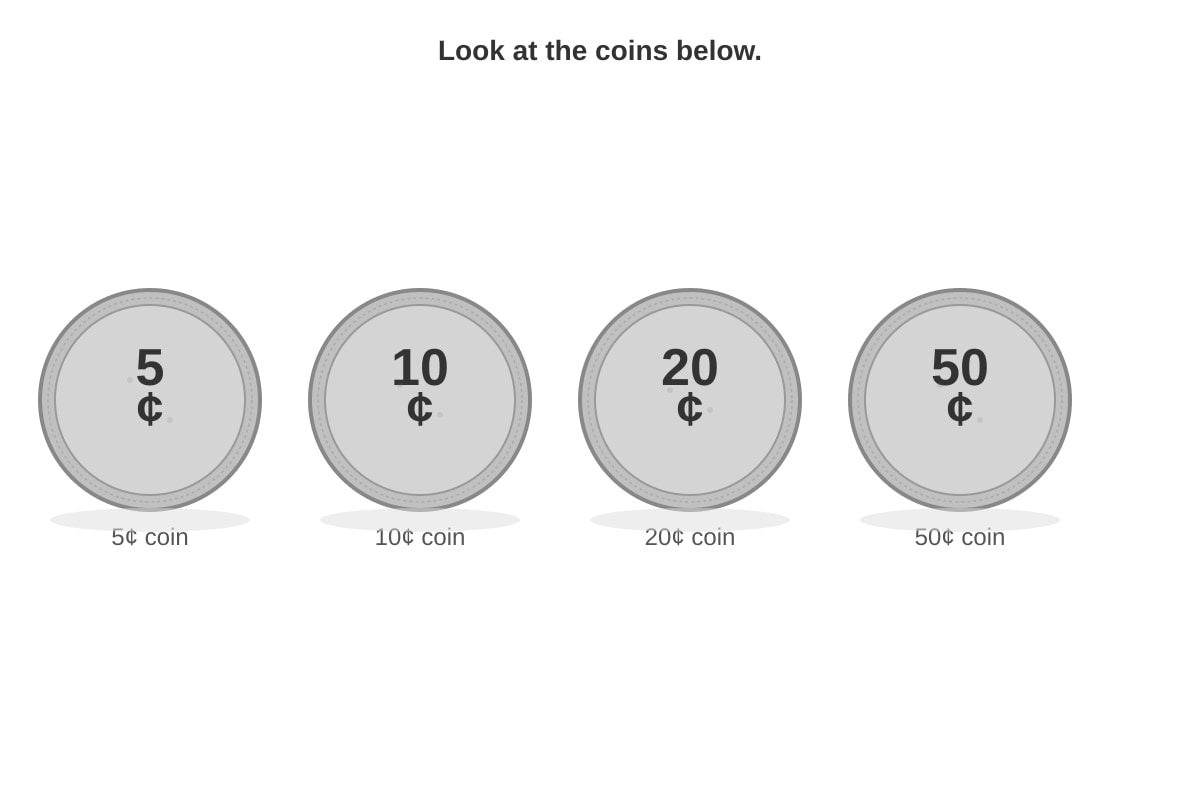
Question 1. Look at the coins below.
<image_placeholder> id: Q1-fig1 type: figure linked_question: Q1 description: A row of four Singapore coins shown left to right. labels: coin labels showing denominations values: one 5¢ coin, one 10¢ coin, one 20¢ coin, one 50¢ coin must_show: The four coins must be clearly identifiable as 5¢, 10¢, 20¢ and 50¢ from left to right; the symbol "¢" must appear on each coin. </image_placeholder>
How much money is there? Answer: ______ ¢
Question 2. Look at the coins below.
<image_placeholder> id: Q2-fig1 type: figure linked_question: Q2 description: A row of three Singapore coins. labels: coin denominations values: one 20¢ coin, one 20¢ coin, one 10¢ coin must_show: The three coins must be clearly identifiable as 20¢, 20¢ and 10¢ from left to right; the symbol "¢" must appear on each coin. </image_placeholder>
How much money is there? Answer: ______ ¢
Question 3. Look at the coins below.
<image_placeholder> id: Q3-fig1 type: figure linked_question: Q3 description: A row of four Singapore coins. labels: coin denominations values: two 50¢ coins, one 5¢ coin, one 5¢ coin must_show: The four coins must be clearly identifiable as 50¢, 50¢, 5¢ and 5¢ from left to right; the symbol "¢" must appear on each coin. </image_placeholder>
How much money is there? Answer: ______ ¢
Question 4. Look at the coins below.
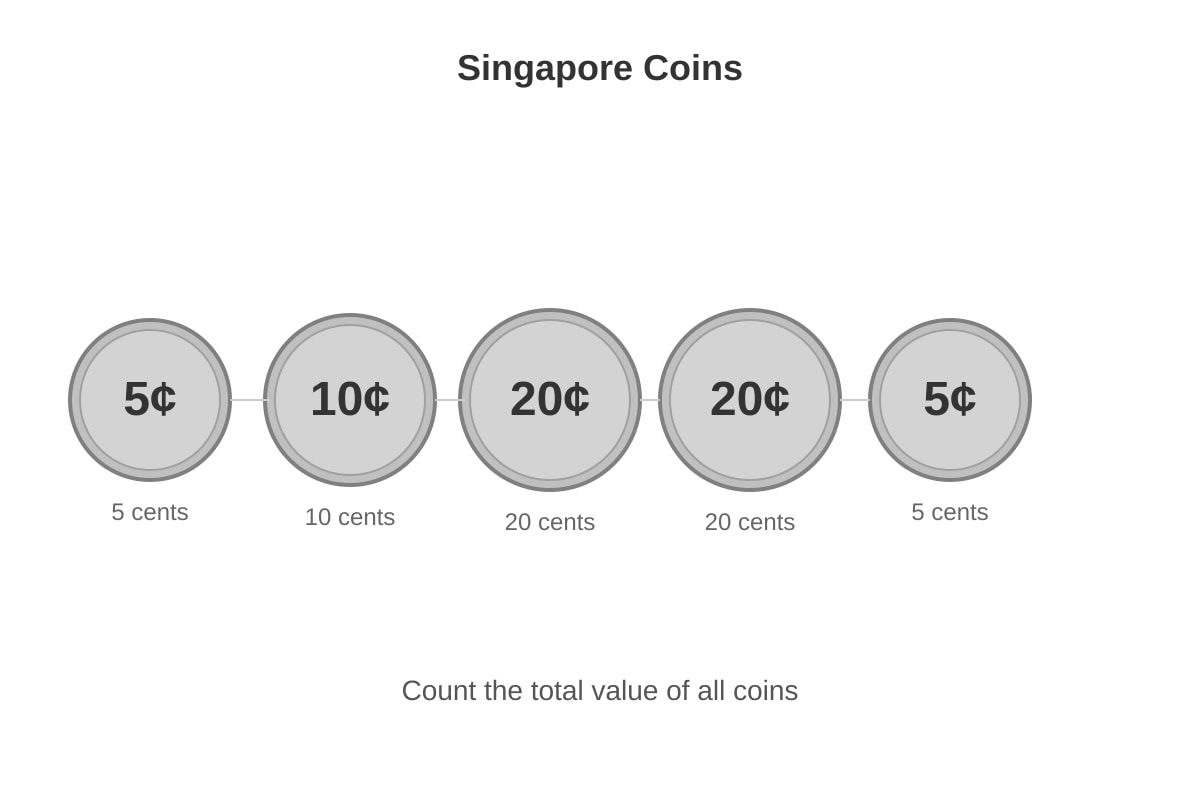
<image_placeholder> id: Q4-fig1 type: figure linked_question: Q4 description: A row of five Singapore coins. labels: coin denominations values: one 5¢ coin, one 10¢ coin, one 20¢ coin, one 20¢ coin, one 5¢ coin must_show: The five coins must be clearly identifiable as 5¢, 10¢, 20¢, 20¢ and 5¢ from left to right; the symbol "¢" must appear on each coin. </image_placeholder>
How much money is there? Answer: ______ ¢
Question 5. Look at the notes below.
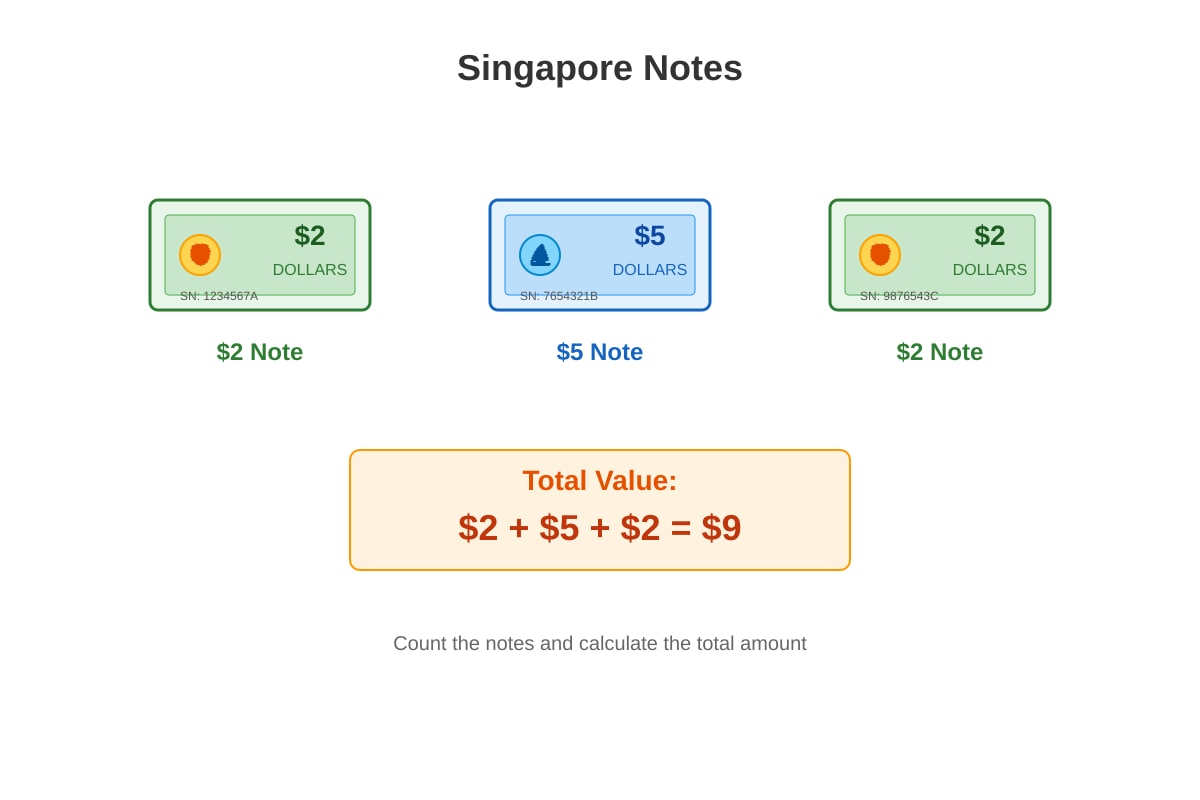
<image_placeholder> id: Q5-fig1 type: figure linked_question: Q5 description: A row of three Singapore notes. labels: note denominations values: one 5 note, one 2, 2 from left to right; the symbol "$" must appear on each note. </image_placeholder>
How much money is there? Answer: $______
Question 6. Look at the notes below.
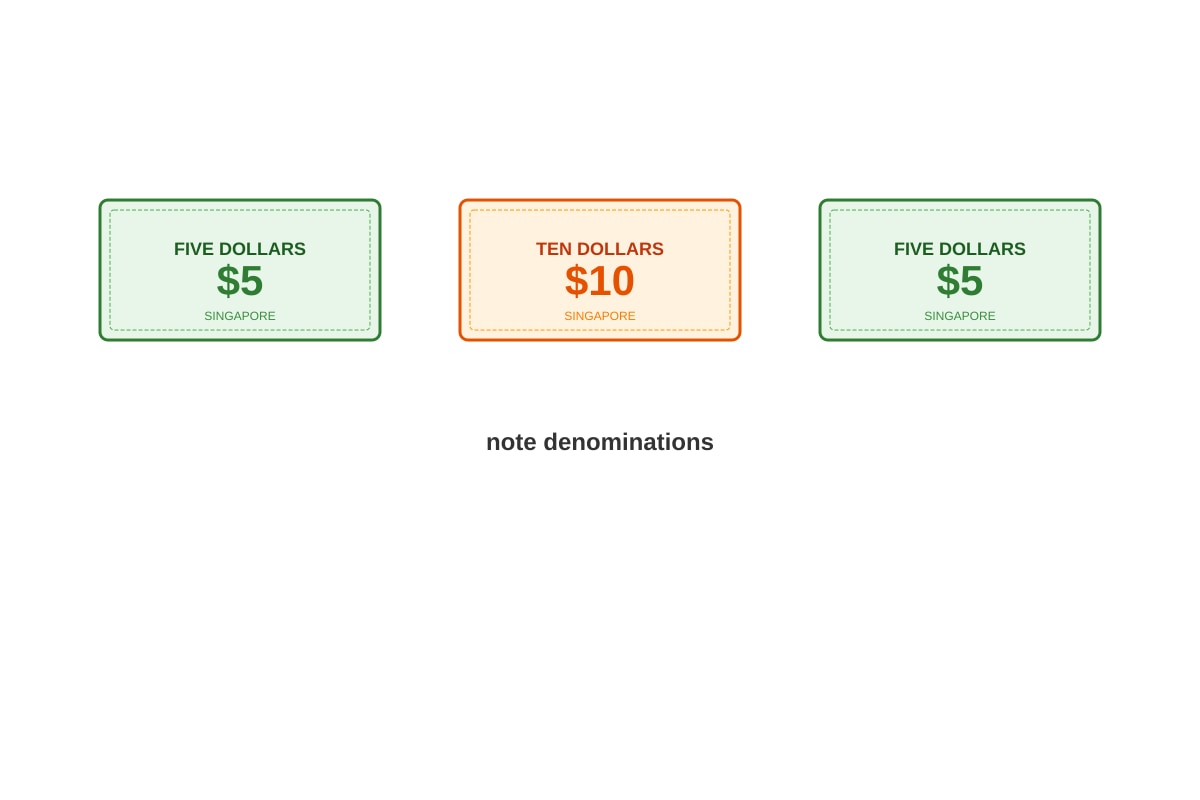
<image_placeholder> id: Q6-fig1 type: figure linked_question: Q6 description: A row of three Singapore notes. labels: note denominations values: one 10 note, one 5, 5 from left to right; the symbol "$" must appear on each note. </image_placeholder>
How much money is there? Answer: $______
Question 7. Look at the money below.
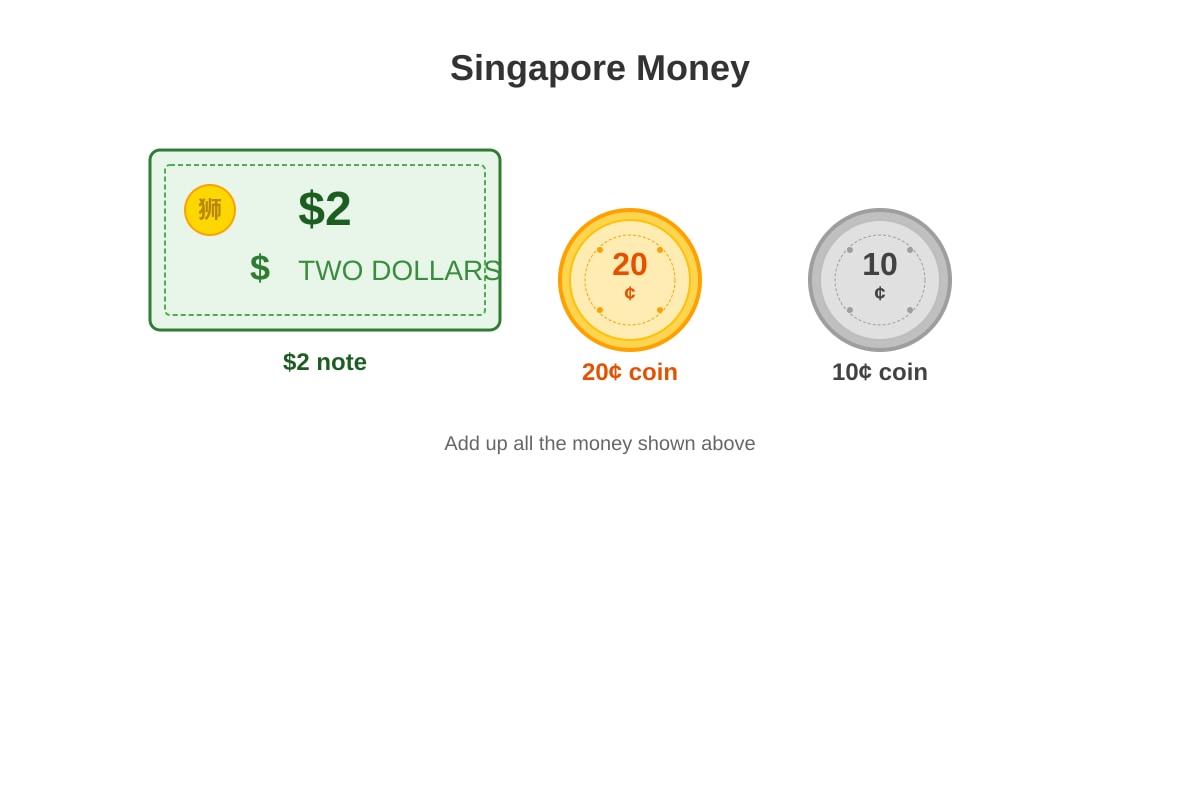
<image_placeholder> id: Q7-fig1 type: figure linked_question: Q7 description: A row of mixed Singapore money (coins and one note). labels: denominations of each item values: one 2 note must be drawn larger than the two coins; the symbol "$" on the note and "¢" on the coins must be clearly shown. </image_placeholder>
How much money is there? Answer: $______ and ______ ¢
Section B — Adding and subtracting money (2 marks each)
Show your number sentence and the final answer.
Question 8. Siti has 35¢. She finds 20¢ more in her bag. How much money does she have now?
Number sentence: ______ + ______ = ______ Answer: ______ ¢
Question 9. Ben has 80¢. He spends 30¢ on a sweet. How much money does he have left?
Number sentence: ______ − ______ = ______ Answer: ______ ¢
Question 10. Mei has 5 more. How much money does she have altogether?
Number sentence: ______ + ______ = ______ Answer: $______
Question 11. A pencil costs 60¢. Ali pays with a $1 coin. How much change should he get?
Working: ______ − ______ = ______ Answer: ______ ¢
Question 12. Three friends share equally. They have 90¢ in total. How much does each friend get?
Number sentence: ______ ÷ ______ = ______ Answer: ______ ¢
Question 13. Maya buys 2 ice-creams. Each ice-cream costs 25¢. How much does she pay altogether?
Number sentence: ______ × ______ = ______ Answer: ______ ¢
Section C — Mixed money problems (2 marks each)
Show all your working. Mark allocation: 1 mark for working/number sentence, 1 mark for final answer.
Question 14. Study the picture.
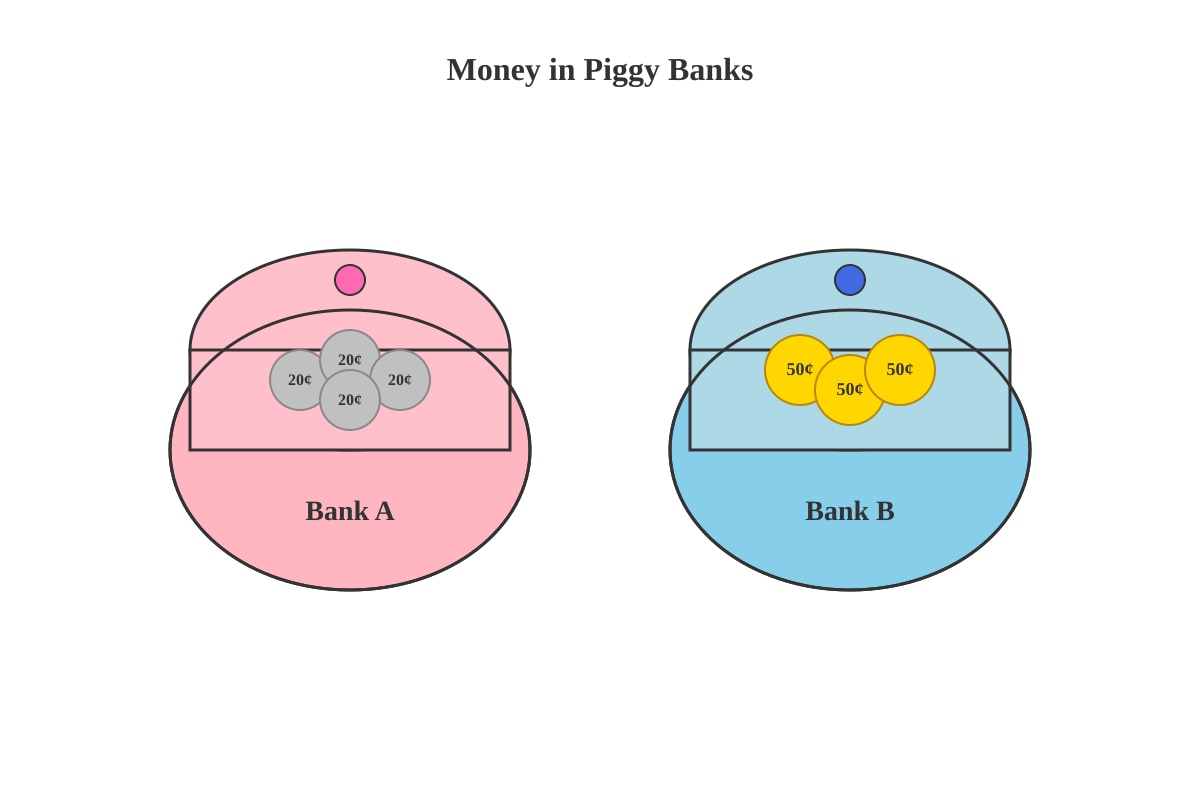
<image_placeholder> id: Q14-fig1 type: figure linked_question: Q14 description: Two piggy banks side by side labelled "Bank A" and "Bank B", each containing a stack of Singapore coins. labels: "Bank A", "Bank B" values: Bank A contains four 20¢ coins; Bank B contains three 50¢ coins must_show: The coins inside Bank A and Bank B must be countable; the values "20¢" on each coin in Bank A and "50¢" on each coin in Bank B must be readable. </image_placeholder>
Which bank has more money, and by how much?
Bank ______ has more money. Difference: ______ ¢
Question 15. A book costs 5 note and a $2 note. Does he have enough money to buy the book? Show your working.
Tom's money: ______ Cost of book: ______ Tom ______ (has / does not have) enough money.
Question 16. Study the picture.
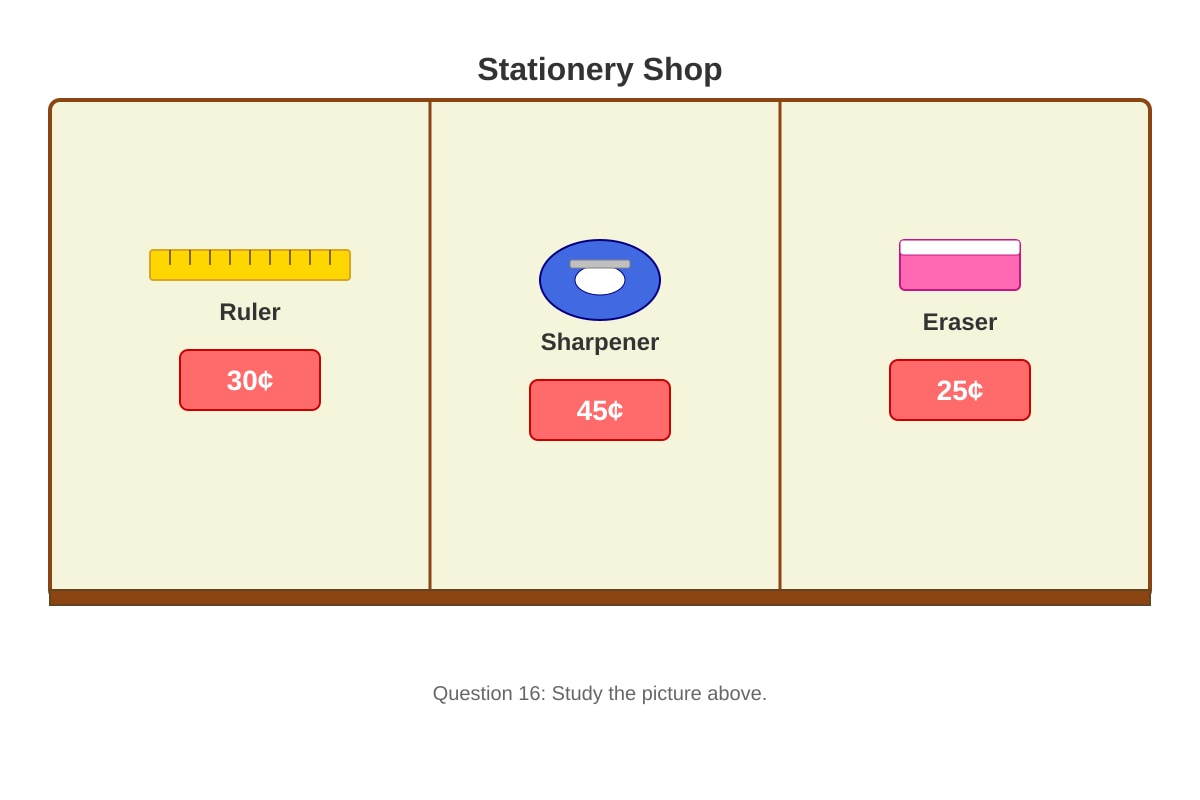
<image_placeholder> id: Q16-fig1 type: figure linked_question: Q16 description: A shop shelf showing three items with price tags: a ruler, a sharpener and an eraser. labels: "ruler — 30¢", "sharpener — 45¢", "eraser — 25¢" values: ruler 30¢, sharpener 45¢, eraser 25¢ must_show: The three items must be drawn in a row with clear price tags and the "¢" symbol on every price. </image_placeholder>
A pupil buys one ruler and one eraser. What is the total cost?
Number sentence: ______ + ______ = ______ Answer: ______ ¢
Question 17. Study the picture in Question 16. The same pupil pays with a $1 coin. How much change does the pupil get?
Working: ______ − ______ = ______ Answer: ______ ¢
Question 18. Aunty Rose has three 25. How much money does she have left?
Step 1: ______ × ______ Step 2: ______ − 25 = ______ Answer: ______
Question 19. Study the picture.
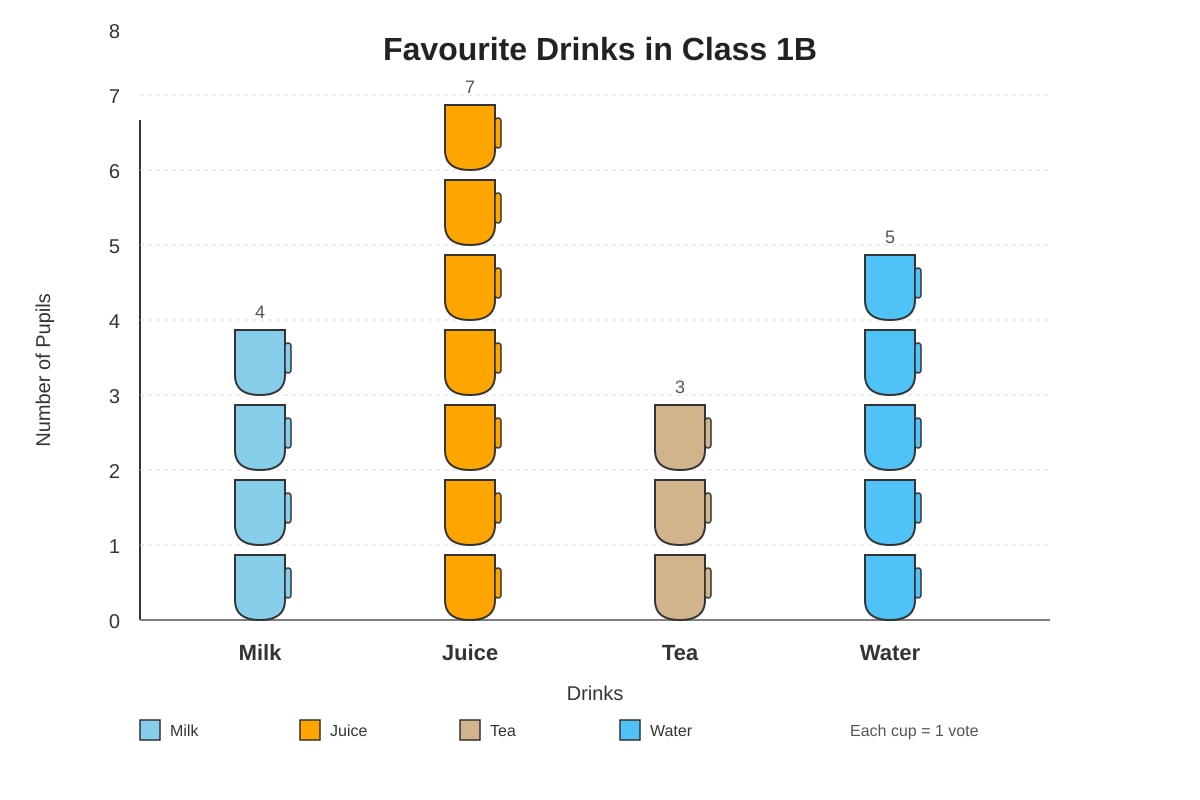
<image_placeholder> id: Q19-fig1 type: figure linked_question: Q19 description: A simple picture graph titled "Favourite Drinks in Class 1B" with four drink labels on the x-axis and stacks of cup icons above each label. labels: x-axis labels "Milk", "Juice", "Tea", "Water"; y-axis numbers 0 to 8; title "Favourite Drinks in Class 1B" values: Milk 4 cups, Juice 7 cups, Tea 3 cups, Water 5 cups must_show: Each cup must represent 1 vote; the height of each stack must match the values given; the title and axis labels must be readable. </image_placeholder>
Which drink is the most popular? How many pupils chose it?
Most popular drink: ______ Number of pupils: ______
Question 20. Using the picture in Question 19, find the total number of pupils who chose Juice and Water.
Number sentence: ______ + ______ = ______ Answer: ______ pupils
Answers
Primary 1 Mathematics Quiz - Money — Answer Key
Topic: Money (Singapore currency — coins and notes) Source basis: Syllabus-aligned, AI-inferred from the 2021 MOE Singapore Primary Mathematics Syllabus (P1–P6). This answer key is not derived from past-year papers. Total marks: 25
Teaching note for students new to money:
- Coins in Singapore are written with the symbol ¢ (cents): 5¢, 10¢, 20¢, 50¢ and $1.
- Notes are written with the symbol **2, 10.
- **100¢ = 1.
- To add, start with the largest amount and count on; to subtract, take away the smaller amount from the larger amount.
Section A — Recognising and counting money (1 mark each)
Question 1 — Coins: 5¢ + 10¢ + 20¢ + 50¢
Step-by-step:
- Identify each coin: 5¢, 10¢, 20¢, 50¢.
- Add the ones first or add by tens: 5 + 10 = 15; 15 + 20 = 35; 35 + 50 = 85. Final answer: 85¢ Mark: 1 mark for 85¢. Common mistake: Forgetting to write the unit "¢".
Question 2 — Coins: 20¢ + 20¢ + 10¢
Step-by-step:
- Add the two 20¢ coins first: 20 + 20 = 40¢.
- Add the 10¢ coin: 40 + 10 = 50¢. Final answer: 50¢ Mark: 1 mark for 50¢. Common mistake: Counting only two coins instead of three.
Question 3 — Coins: 50¢ + 50¢ + 5¢ + 5¢
Step-by-step:
- 50 + 50 = 100¢.
- 5 + 5 = 10¢.
- 100 + 10 = 110¢. Change 100¢ into 1 and 10¢ left over. Final answer: 1 and 10¢ (accept 110¢ only if the child has not been taught the 100¢ = 1.
Question 4 — Coins: 5¢ + 10¢ + 20¢ + 20¢ + 5¢
Step-by-step:
- 5 + 5 = 10¢.
- 10 + 10 = 20¢.
- 20 + 20 = 40¢.
- 20 + 40 = 60¢. Final answer: 60¢ Mark: 1 mark for 60¢. Common mistake: Counting coins twice or missing the second 20¢ coin.
Question 5 — Notes: 5 + $2
Step-by-step:
- 2 = $4.
- 5 = 9 Mark: 1 mark for " symbol.
Question 6 — Notes: 10 + $5
Step-by-step:
- 5 = $10.
- 10 = 20 Mark: 1 mark for 5 notes.
Question 7 — Mixed: $2 + 20¢ + 10¢
Step-by-step:
- Count the coins: 20¢ + 10¢ = 30¢.
- Combine with the note: 2 and 30¢ Mark: 1 mark for "2.30 only if the child is comfortable with decimal notation, but P1 should use 2.30 or just "2.30" without the symbols.
Section B — Adding and subtracting money (2 marks each)
Question 8 — Siti: 35¢ + 20¢ = ?
Concept: "Finds more" means we add. Step-by-step:
- 35 + 20 = 55. Number sentence: 35 + 20 = 55 Final answer: 55¢ Marks: 1 mark for number sentence, 1 mark for 55¢. Common mistake: Using subtraction instead of addition because of the word "finds".
Question 9 — Ben: 80¢ − 30¢ = ?
Concept: "Spends" means we subtract. Step-by-step:
- 80 − 30 = 50. Number sentence: 80 − 30 = 50 Final answer: 50¢ Marks: 1 mark for number sentence, 1 mark for 50¢. Common mistake: Adding instead of subtracting.
Question 10 — Mei: 5 = ?
Concept: "Gives her more" means we add dollars. Step-by-step:
- 4 + 5 = 9. Number sentence: 4 + 5 = 9 Final answer: 9. Common mistake: Writing "9 dollars" without the "$" symbol.
Question 11 — Change from $1 for a 60¢ pencil
Concept: Change = money given − cost. Step-by-step:
- Convert: $1 = 100¢.
- 100 − 60 = 40. Working: 100 − 60 = 40 Final answer: 40¢ Marks: 1 mark for working, 1 mark for 40¢. Common mistake: Forgetting to change $1 into 100¢ before subtracting.
Question 12 — 90¢ shared equally by 3 friends
Concept: "Share equally" means division; each friend gets the same amount. Step-by-step:
- 90 ÷ 3 = 30. (3 × 30 = 90) Number sentence: 90 ÷ 3 = 30 Final answer: 30¢ Marks: 1 mark for number sentence, 1 mark for 30¢. Common mistake: Using multiplication instead of division.
Question 13 — 2 ice-creams at 25¢ each
Concept: "Each" and "altogether" mean multiplication as repeated addition: 25 + 25. Step-by-step:
- 2 × 25 = 50. Number sentence: 2 × 25 = 50 Final answer: 50¢ Marks: 1 mark for number sentence, 1 mark for 50¢. Common mistake: Writing 2 + 25 = 27 instead of multiplication.
Section C — Mixed money problems (2 marks each)
Question 14 — Compare Bank A and Bank B
Visual check: Bank A has 4 × 20¢ = 80¢. Bank B has 3 × 50¢ = 150¢. Step-by-step:
- Bank A: 4 × 20 = 80¢.
- Bank B: 3 × 50 = 150¢.
- Difference: 150 − 80 = 70¢. Final answers: Bank B has more money. Difference: 70¢. Marks: 1 mark for "Bank B"; 1 mark for 70¢. Common mistake: Reading the number of coins instead of the value of the coins (4 coins vs 3 coins).
Question 15 — Does Tom have enough money?
Step-by-step:
- Tom's money: 2 = $7.
- Cost of book: $7.
- 7, so he has exactly enough. Final answers:
- Tom's money: $7
- Cost of book: $7
- Tom has enough money. Marks: 1 mark for correct comparison; 1 mark for stating "has" and showing 7. Common mistake: Saying "does not have enough" because the amounts are the same.
Question 16 — Ruler 30¢ + Eraser 25¢
Visual check: ruler 30¢, eraser 25¢. Step-by-step:
- 30 + 25 = 55. Number sentence: 30 + 25 = 55 Final answer: 55¢ Marks: 1 mark for number sentence, 1 mark for 55¢. Common mistake: Picking the sharpener's price instead of the eraser's price.
Question 17 — Change from $1 for 55¢
Visual check: total cost from Q16 is 55¢. Step-by-step:
- $1 = 100¢.
- 100 − 55 = 45. Working: 100 − 55 = 45 Final answer: 45¢ Marks: 1 mark for working, 1 mark for 45¢. Common mistake: Subtracting 55 from 10 instead of 100.
Question 18 — Aunty Rose's change
Step-by-step:
- Total money: 3 × 30.
- Change: 25 = $5. Final answers:
- Step 1: 3 × 30
- Step 2: 25 = $5
- Answer: 5. Common mistake: Writing 25 = $15 (subtracting tens incorrectly).
Question 19 — Most popular drink
Visual check: Milk 4, Juice 7, Tea 3, Water 5. The highest stack is Juice. Step-by-step:
- Compare the four heights: 4, 7, 3, 5. The greatest is 7. Final answers: Most popular drink: Juice. Number of pupils: 7. Marks: 1 mark for "Juice"; 1 mark for 7. Common mistake: Reading "Water" because 5 is the second largest.
Question 20 — Total of Juice and Water
Visual check: Juice 7, Water 5. Step-by-step:
- 7 + 5 = 12. Number sentence: 7 + 5 = 12 Final answer: 12 pupils Marks: 1 mark for number sentence, 1 mark for 12. Common mistake: Using subtraction instead of addition because the question says "total".