AI Generated Quiz
Primary 1 Mathematics Length Quiz
Free P1 Maths Length quiz, Nemo3 AI version, with questions, answers, and syllabus-aligned practice for Singapore students.
These static practice materials are generated from the site's syllabus and paper-generation workflow, with source and model context shown so students and parents can evaluate the material before use.
Questions
Free quiz and exam paper access
Enter your details to view this paper
Your access is remembered on this device.
Answers
Primary 1 Mathematics Quiz - Length (Answer Key)
Total Marks: 20
Section A: Multiple Choice Questions (Questions 1–8, 8 marks)
1. Answer: B (centimetre / cm)
Marks: 1
Explanation: A pencil is a small object, typically 10–20 cm long. Centimetre (cm) is the appropriate unit for measuring small objects like pencils, books, and toys. Metre (m) is for longer lengths (e.g., height of a door), kilometre (km) is for very long distances (e.g., between towns), and millimetre (mm) is for very tiny lengths (e.g., thickness of a coin).
Common mistake: Choosing metre (m) because it is a familiar unit.
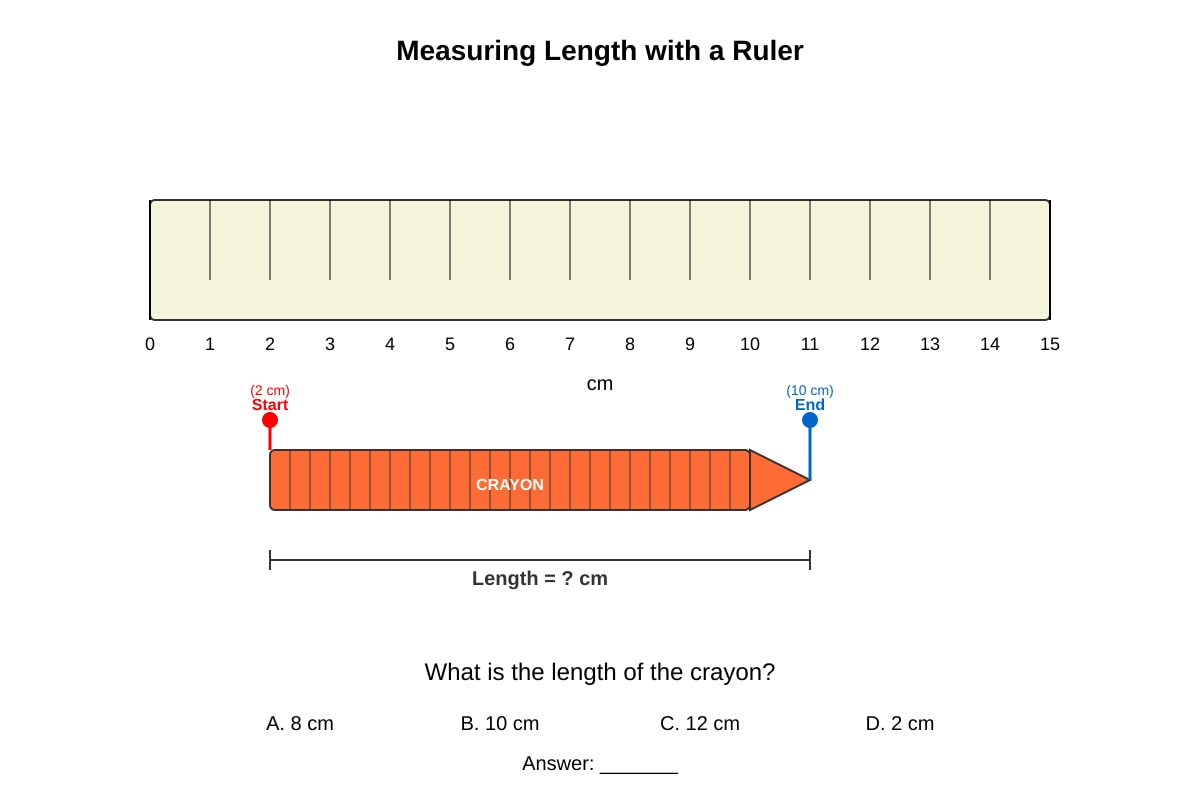
2. Answer: A (8 cm)
Marks: 1
Explanation: The crayon starts at the 2 cm mark and ends at the 10 cm mark. To find the length, subtract the starting mark from the ending mark: 10 cm – 2 cm = 8 cm.
Key concept: When an object does not start at 0 cm, length = end reading – start reading.
Common mistake: Reading the end mark (10 cm) directly as the length.
3. Answer: B (A pencil (15 cm))
Marks: 1
Explanation: Compare the given lengths: paper clip = 3 cm, pencil = 15 cm, eraser = 4 cm, sharpener = 2 cm. The greatest number is 15 cm, so the pencil is the longest.
Key concept: To find the longest, compare the numerical values of the lengths.
4. Answer: A (8 cm)
Marks: 1
Explanation: "How much longer" means find the difference. Length of book = 20 cm, length of notebook = 12 cm. Difference = 20 cm – 12 cm = 8 cm.
Key concept: Difference = longer length – shorter length.
5. Answer: A (18 cm)
Marks: 1
Explanation: Original string = 30 cm. Cut off = 12 cm. Remaining = 30 cm – 12 cm = 18 cm.
Key concept: Remaining length = original length – length cut off.
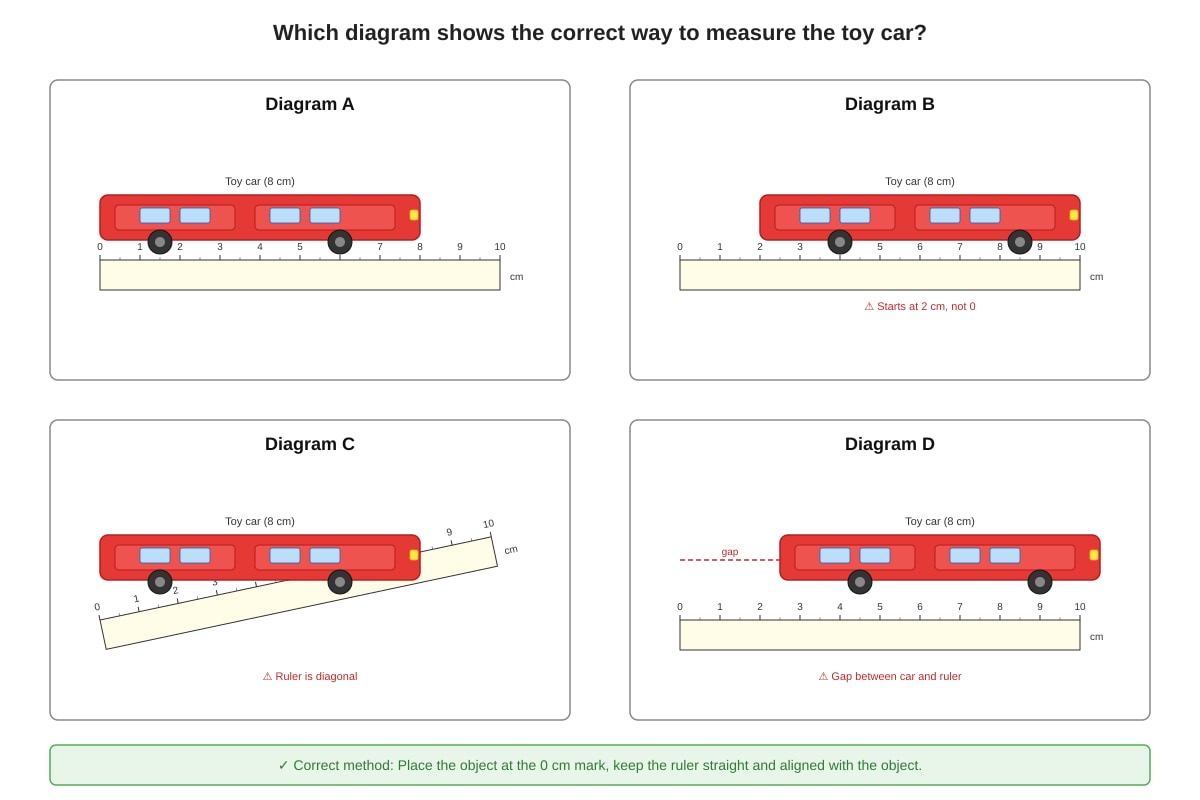
6. Answer: A (Diagram A)
Marks: 1
Explanation: The correct way to measure length with a ruler:
- Place the ruler straight alongside the object.
- Align the start of the object with the 0 cm mark (not 1 cm or 2 cm).
- Ensure no gap between the object and the ruler.
- Read the marking at the end of the object.
Diagram A shows all these correct steps. Diagram B starts at 2 cm (would need subtraction). Diagram C has the ruler placed diagonally (inaccurate). Diagram D has a gap at the start (inaccurate).
7. Answer: A (3 cm, 5 cm, 9 cm, 12 cm)
Marks: 1
Explanation: Arrange from smallest (shortest) to largest (longest): 3 < 5 < 9 < 12. So the order is 3 cm, 5 cm, 9 cm, 12 cm.
8. Answer: C (65 cm)
Marks: 1
Explanation: "Total length" means add the two lengths together. Ribbon = 25 cm, Rope = 40 cm. Total = 25 cm + 40 cm = 65 cm.
Section B: Short Answer Questions (Questions 9–16, 8 marks)
9. Answer: m (metre)
Marks: 1
Explanation: A standard door height is about 2 metres (200 cm). Using centimetres would give 200 cm, which is an unnecessarily large number for everyday description. The unit "metre" is used for longer lengths like height of a room, length of a bed, or width of a classroom.
10. Answer: cm (centimetre)
Marks: 1
Explanation: A paper clip is a very small object, about 3 cm long. Using metres would give 0.03 m, which is not practical for describing such a tiny length. Centimetre is the standard unit for small objects like stationery, toys, and hand spans.
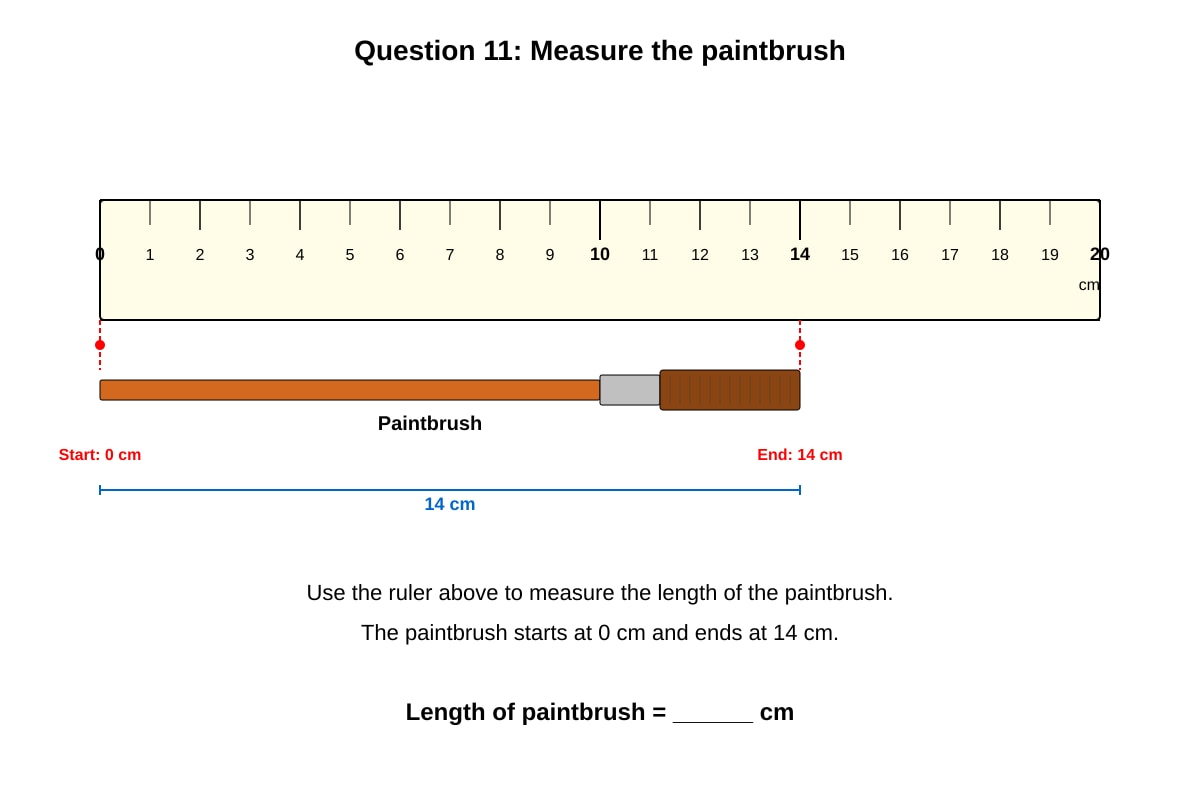
11. Answer: 14 cm
Marks: 1
Explanation: The paintbrush starts at the 0 cm mark and ends at the 14 cm mark. Since it starts at 0, the length is simply the end reading: 14 cm.
Key concept: When an object starts at 0 cm, length = end reading.
12. Answer: 4 cm
Marks: 1
Working: 14 cm – 10 cm = 4 cm
Explanation: The pen is 14 cm, the pencil is 10 cm. To find how much longer, subtract: 14 – 10 = 4 cm.
13. Answer: 25 cm
Marks: 1
Working: 18 cm + 7 cm = 25 cm
Explanation: "Total length" means addition. First piece = 18 cm, second piece = 7 cm. Total = 18 + 7 = 25 cm.
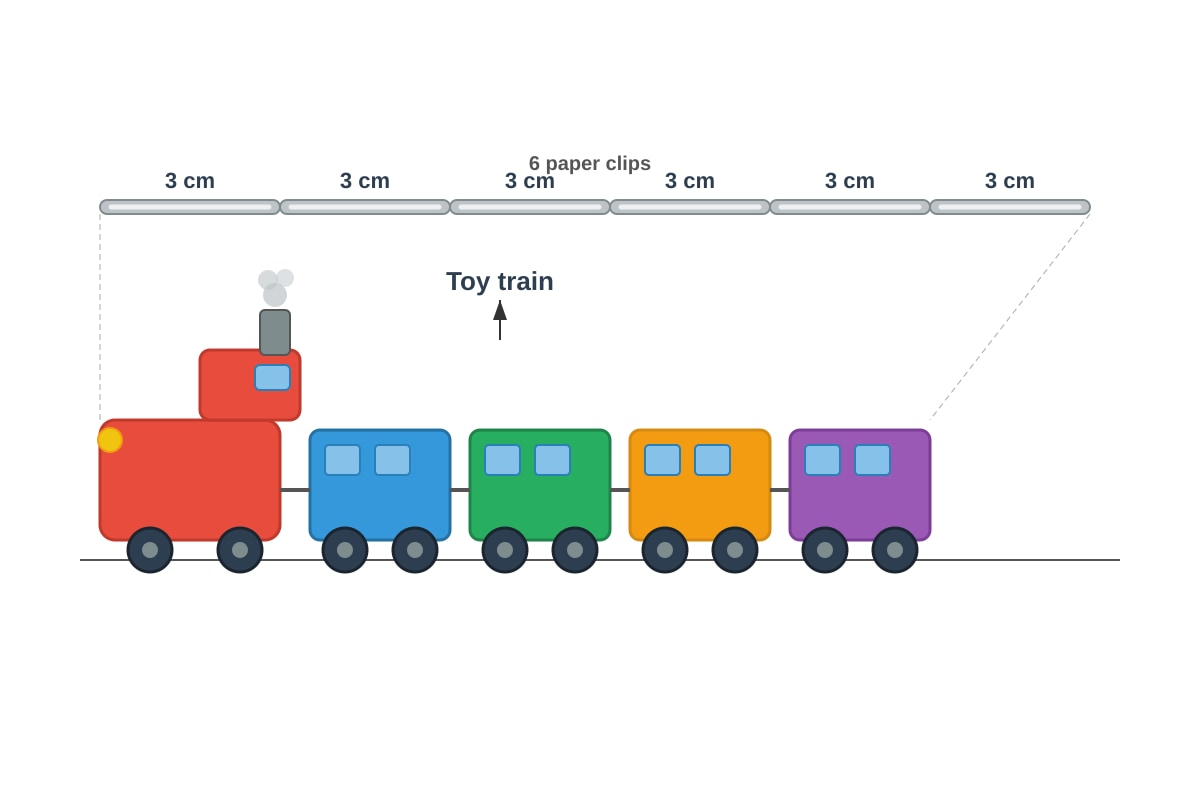
14. Answer: 18 cm
Marks: 1
Working: 6 paper clips × 3 cm each = 18 cm
Explanation: There are 6 paper clips placed end-to-end. Each is 3 cm. Total length = 3 + 3 + 3 + 3 + 3 + 3 = 18 cm (or 6 × 3 = 18 cm). This introduces the idea of repeated addition / multiplication for equal groups.
15. Answer: 35 cm
Marks: 1
Working: 50 cm – 15 cm = 35 cm
Explanation: Original ribbon = 50 cm. Used = 15 cm. Left = 50 – 15 = 35 cm.
16. Answer: 50 cm
Marks: 1
Working: 100 cm – 50 cm = 50 cm
Explanation: Table = 100 cm, Chair = 50 cm. Difference = 100 – 50 = 50 cm. The table is 50 cm longer than the chair.
Section C: Word Problems (Questions 17–20, 4 marks)
17. Answer: 35 cm
Marks: 1
Working:
Total length of cloth = 60 cm
Length of first piece = 25 cm
Length of second piece = 60 cm – 25 cm = 35 cm
Explanation: When a whole is cut into two parts, the whole = part 1 + part 2. To find the missing part, subtract the known part from the whole: 60 – 25 = 35 cm.
Marking note: 1 mark for correct answer with or without working shown. Accept "35 cm" or "35".
18. Answer: 47 cm
Marks: 1
Working:
Length of red rope = 35 cm
Blue rope is 12 cm longer = 35 cm + 12 cm = 47 cm
Explanation: "12 cm longer than" means add 12 cm to the given length. 35 + 12 = 47 cm.
Common mistake: Subtracting instead of adding (35 – 12 = 23).
Marking note: 1 mark for correct answer with or without working shown.
19. Answer: 15 cm
Marks: 1
Working:
Total length of stick = 40 cm
First piece = 15 cm
Second piece = 10 cm
Length of first two pieces = 15 cm + 10 cm = 25 cm
Third piece = 40 cm – 25 cm = 15 cm
Explanation: The stick is broken into 3 pieces. Total = sum of all 3 pieces. Add the two known pieces (15 + 10 = 25), then subtract from the total (40 – 25 = 15).
Marking note: 1 mark for correct answer. Award mark if working shows 40 – 15 – 10 = 15 or 40 – (15 + 10) = 15.
20. Answer: 8 m
Marks: 1
Working:
Length of ruler = 1 m
Number of times placed = 8
Length of classroom = 8 × 1 m = 8 m
Explanation: Each placement of the 1-metre ruler covers 1 metre. Placing it 8 times end-to-end gives 8 metres. This connects repeated addition (1+1+1+1+1+1+1+1) to multiplication (8 × 1).
Marking note: 1 mark for correct answer. Accept "8 m" or "8 metres".
End of Answer Key