AI Generated Quiz

Primary 1 Mathematics Length Quiz

Free AI-Generated Minimax M3 Primary 1 Mathematics Length quiz with questions and answers for Singapore students. This page is rendered as a direct URL so the questions and answers can be discovered without pressing in-page buttons.

These static practice materials are generated from the site's syllabus and paper-generation workflow, with source and model context shown so students and parents can evaluate the material before use.

Primary 1 Mathematics AI Generated Generated by Minimax M3 Updated 2026-06-04

Questions

<!-- TuitionGoWhere generation metadata: stage=5-1; model=minimax/minimax-m3; model_label=MiniMax M3; generated=2026-06-04; Sources: Stage 4-0 LLM templates, syllabus context, and Stage 2 evidence where available. -->

Primary 1 Mathematics Quiz - Length

Name: ______________________ Class: _____________________ Date: ______________________ Score: ______ / 25 marks

Duration: 35 minutes Total Marks: 25 marks Topic: Length (measuring in centimetres, comparing and ordering lengths, drawing line segments)

Instructions:

  • Read each question carefully before answering.
  • Show your working clearly where it is asked.
  • Write your answers in the spaces provided.
  • Remember to include the unit "cm" when needed.

Section A: Multiple Choice (1 mark each)

Choose the correct answer and write its number (1, 2, 3 or 4) in the bracket.

1. A pencil is placed next to a ruler. The pencil lines up with 0 cm at one end and 12 cm at the other end. What is the length of the pencil?

(1) 10 cm (2) 12 cm (3) 14 cm (4) 22 cm

Answer: ( )

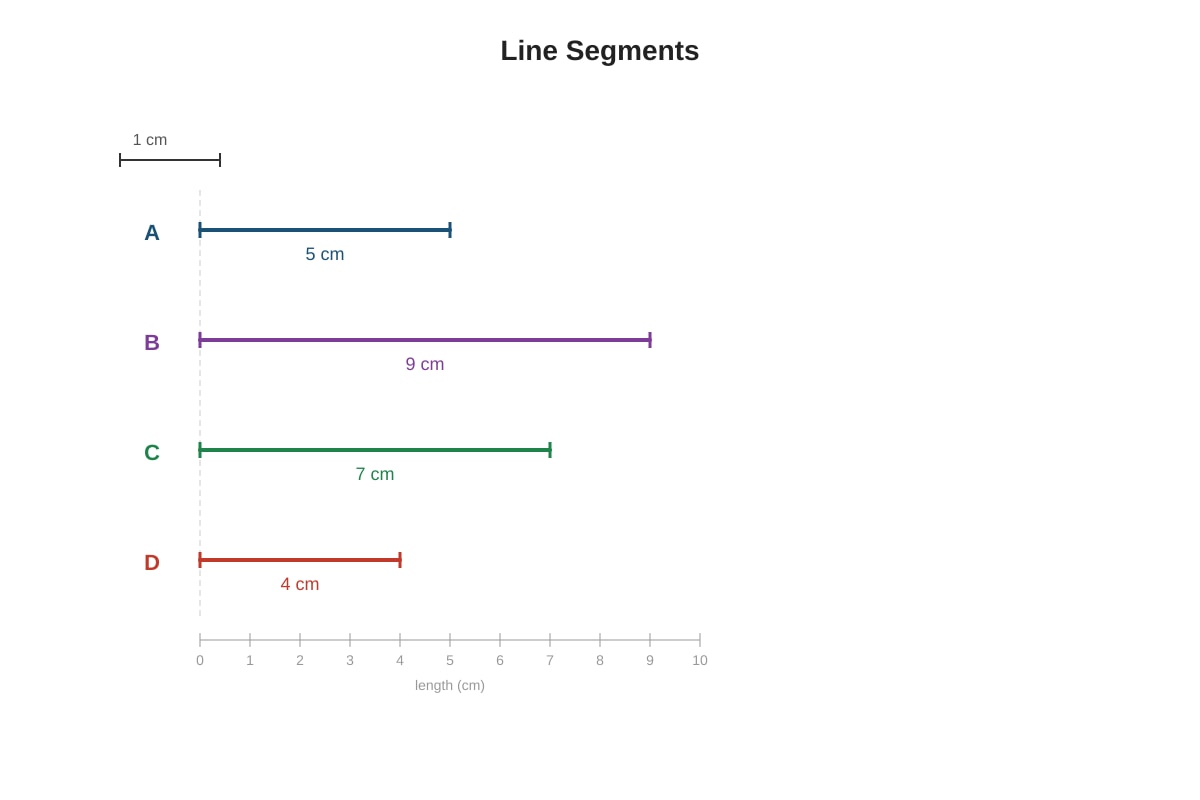
2. Which line segment is the longest?

<image_placeholder> id: Q2-fig1 type: figure linked_question: Q2 description: Four horizontal line segments stacked vertically, labelled A, B, C, D from top to bottom. Each line starts at the same left edge so lengths can be compared visually. labels: A, B, C, D values: A = 5 cm, B = 9 cm, C = 7 cm, D = 4 cm must_show: All four lines share the same left starting point; lengths must be visibly different; a small 1-cm scale bar shown for reference. </image_placeholder>

(1) A (2) B (3) C (4) D

Answer: ( )

3. Which unit should we use to measure the length of a classroom whiteboard?

(1) cm (2) m (3) kg (4) °C

Answer: ( )

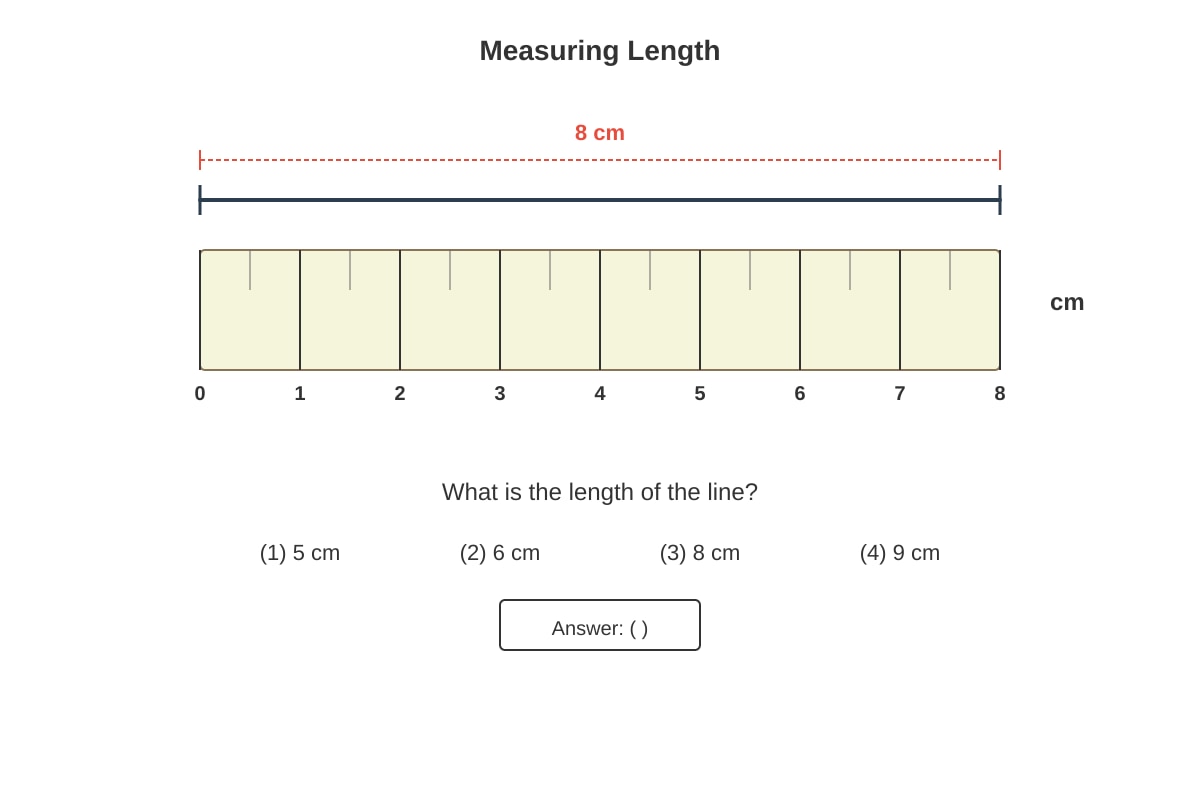
4. The line below is measured with a centimetre ruler. What is its length?

<image_placeholder> id: Q4-fig1 type: figure linked_question: Q4 description: A horizontal line segment drawn directly above a ruler. The line starts at the 0 cm mark and ends at the 8 cm mark. labels: 0, 1, 2, 3, 4, 5, 6, 7, 8 (cm) on the ruler values: length = 8 cm must_show: The line must begin exactly at 0 and end at 8 cm, with all whole-centimetre tick marks labelled. </image_placeholder>

(1) 5 cm (2) 6 cm (3) 8 cm (4) 9 cm

Answer: ( )

5. A red ribbon is 14 cm long. A blue ribbon is 9 cm long. How much longer is the red ribbon than the blue ribbon?

(1) 5 cm (2) 6 cm (3) 14 cm (4) 23 cm

Answer: ( )


Section B: Short Answer (1 mark each)

Write your answer in the space provided. Remember to include the unit "cm" when needed.

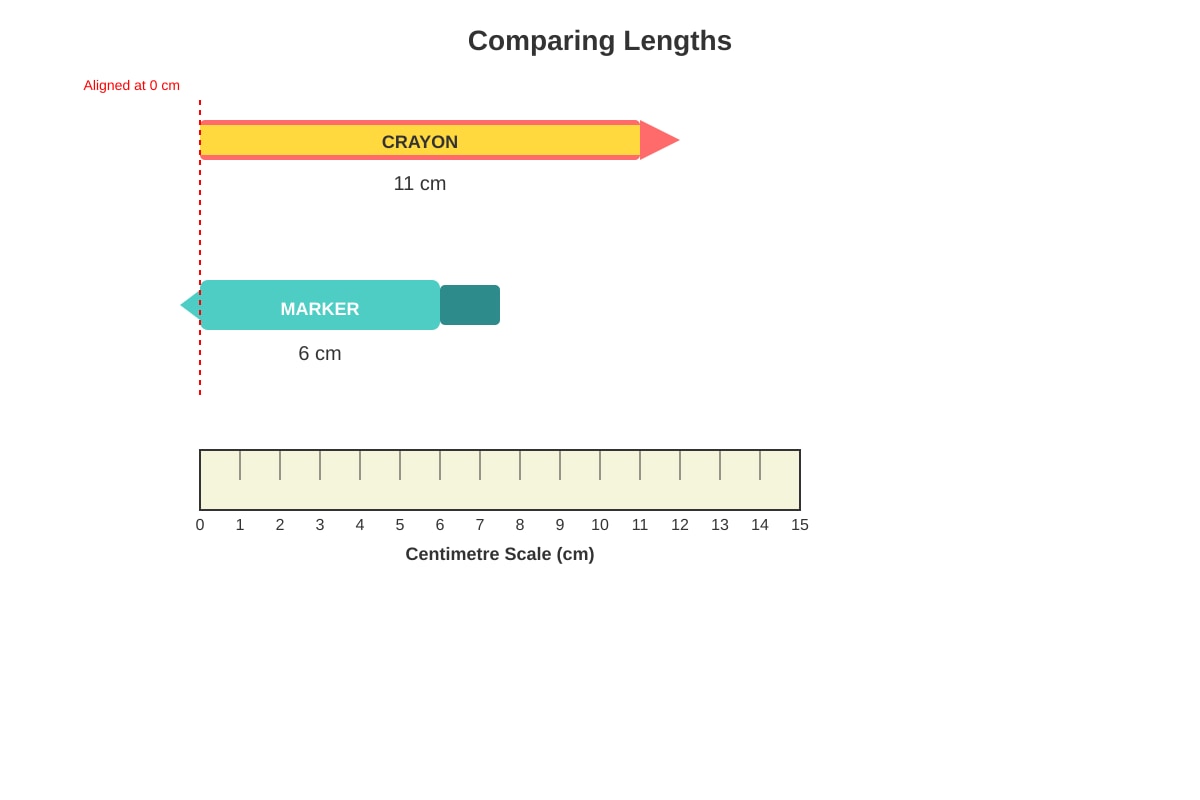
6. A crayon is 11 cm long. A marker pen is 6 cm long. Which object is longer?

Answer: ____________________

<image_placeholder> id: Q6-fig1 type: figure linked_question: Q6 description: A crayon drawn at the top and a marker pen drawn below it, both shown above a small cm scale for visual support. labels: "crayon", "marker pen", 0–15 cm scale values: crayon = 11 cm, marker pen = 6 cm must_show: Both objects aligned to the same 0 cm starting point so the difference in length is clear. </image_placeholder>

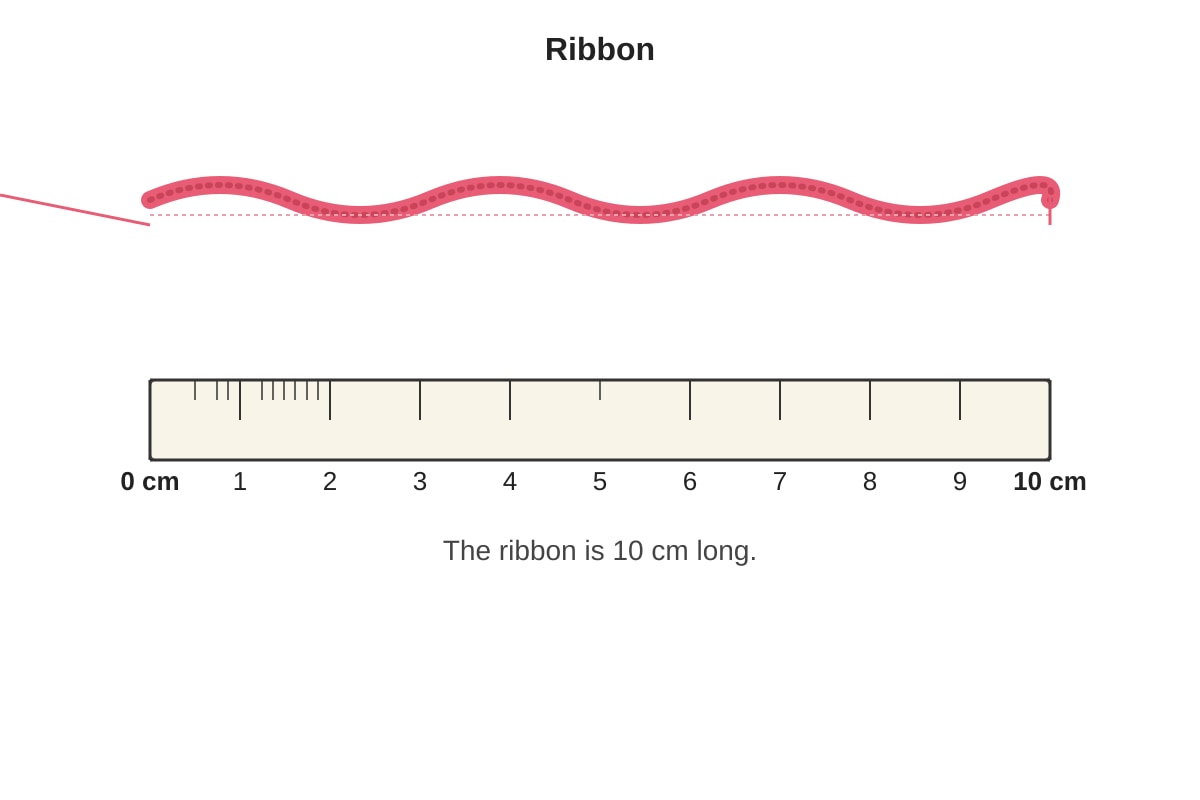
7. Measure the length of the ribbon. Write your answer in cm.

<image_placeholder> id: Q7-fig1 type: figure linked_question: Q7 description: A wavy ribbon drawn above a centimetre ruler. The left end of the ribbon lines up with 0 cm; the right end lines up with 10 cm. labels: 0 to 10 cm on the ruler values: ribbon = 10 cm must_show: Ruler tick marks at every whole centimetre; ribbon ends aligned with 0 and 10. </image_placeholder>

Answer: ____________________

8. Arrange these lengths from the shortest to the longest: 6 cm, 14 cm, 9 cm.

Answer: ____________________ , ____________________ , ____________________

9. A string is 17 cm long. Sam cuts off 8 cm. How long is the string now?

Answer: ____________________


Section C: Drawing and Measuring (2 marks each)

Show your working where it is asked. Remember to include the unit "cm".

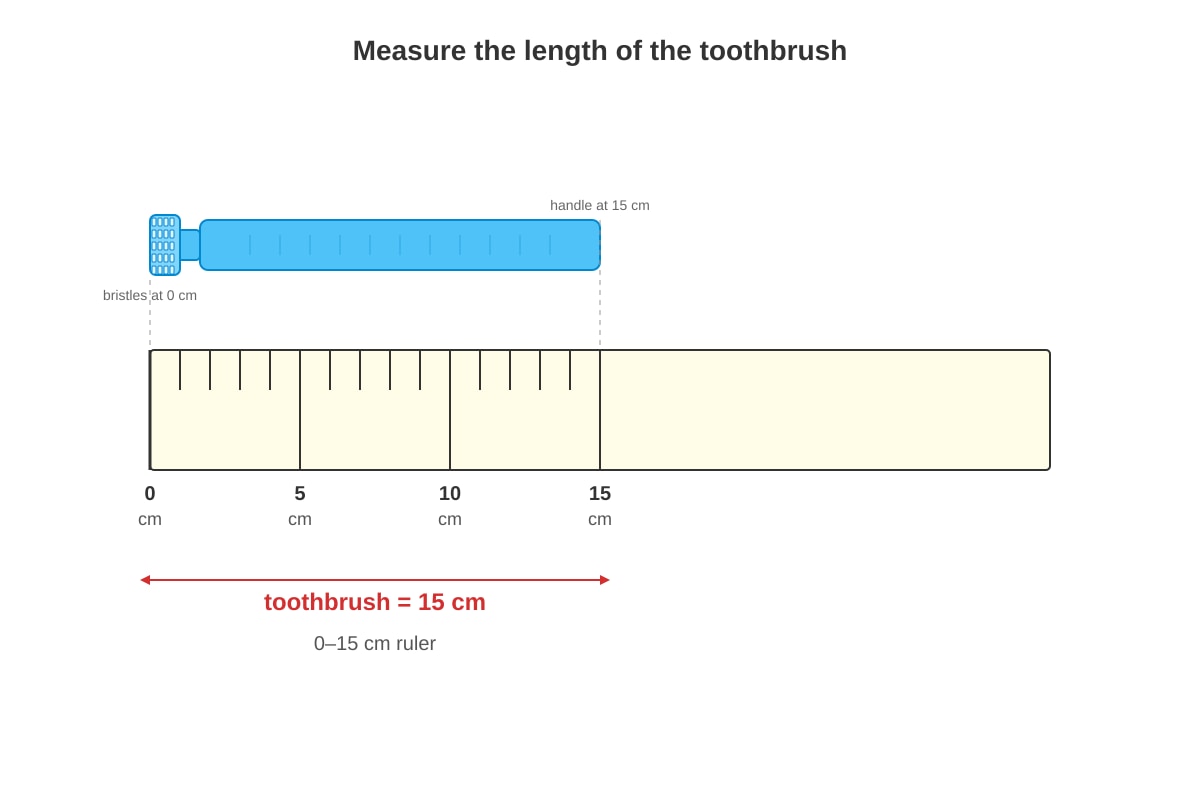
10. Measure the length of the toothbrush.

<image_placeholder> id: Q10-fig1 type: figure linked_question: Q10 description: A simple drawing of a toothbrush laid horizontally above a centimetre ruler. The bristles end lines up with 0 cm; the handle end lines up with 15 cm. labels: 0–15 cm ruler values: toothbrush = 15 cm must_show: Toothbrush aligned to 0 cm; ruler tick marks labelled at every whole centimetre. </image_placeholder>

Answer: ____________________

11. Draw a line segment that is 7 cm long, starting from the dot "•" below. Use a ruler.

•________________________________________________

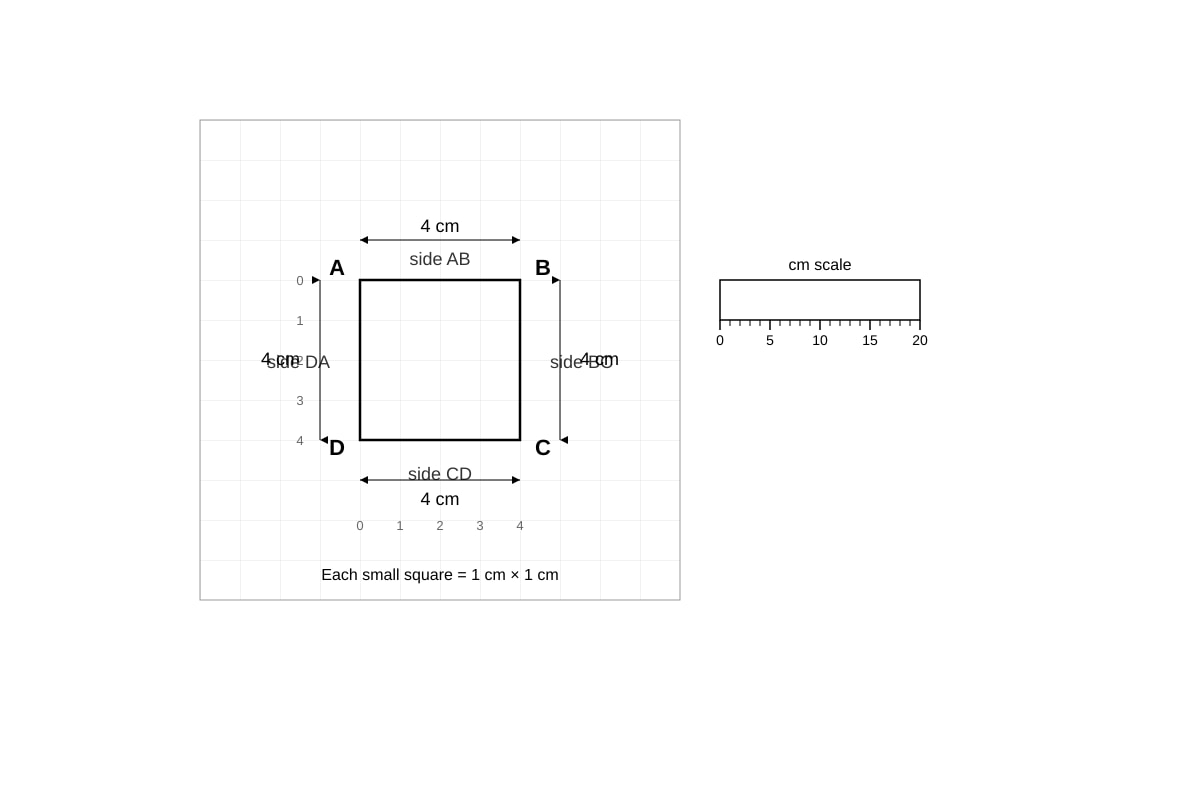
12. Measure the length of each side of the square. Write all four lengths.

<image_placeholder> id: Q12-fig1 type: figure linked_question: Q12 description: A small square drawn on a 1-cm grid. Each side of the square measures 4 cm. A small cm scale is shown beside the square. labels: side AB, side BC, side CD, side DA values: each side = 4 cm must_show: Square with four equal sides; grid lines visible so 4 cm can be verified. </image_placeholder>

Answer: AB = _______ cm, BC = _______ cm, CD = _______ cm, DA = _______ cm

13. A book is 20 cm long. A pencil is 12 cm long. What is the total length of the book and the pencil?

Working:

Answer: ____________________

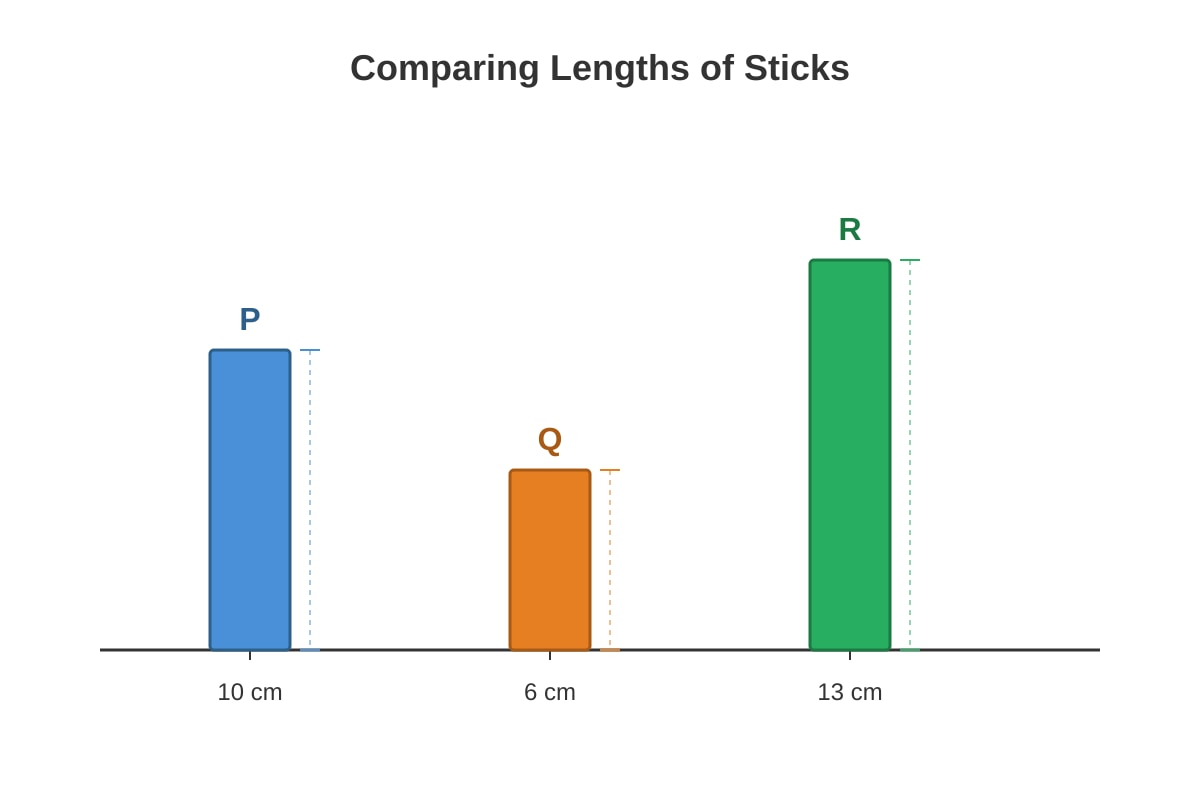
14. The picture shows three sticks. Arrange them from the longest to the shortest.

<image_placeholder> id: Q14-fig1 type: figure linked_question: Q14 description: Three vertical sticks drawn side by side, all starting from the same bottom baseline. Sticks are labelled Stick P, Stick Q and Stick R. labels: P, Q, R values: P = 10 cm, Q = 6 cm, R = 13 cm must_show: All three sticks share the same baseline so lengths can be compared by eye. </image_placeholder>

Answer: (Longest) ____________________ , ____________________ , ____________________ (Shortest)


Section D: Word Problems (2 marks each)

Read carefully. Show your number sentence and your answer with the unit "cm".

15. A piece of rope is 18 cm long. Mother cuts off 5 cm. How long is the rope now?

Number sentence: ____________________

Answer: ____________________

16. Bala has a 9-cm straw. Devi has a 13-cm straw. How much longer is Devi's straw than Bala's?

Number sentence: ____________________

Answer: ____________________

17. A green ribbon is 11 cm long. A yellow ribbon is 7 cm long. Mei joins the two ribbons together end to end. How long are the two ribbons altogether?

Number sentence: ____________________

Answer: ____________________

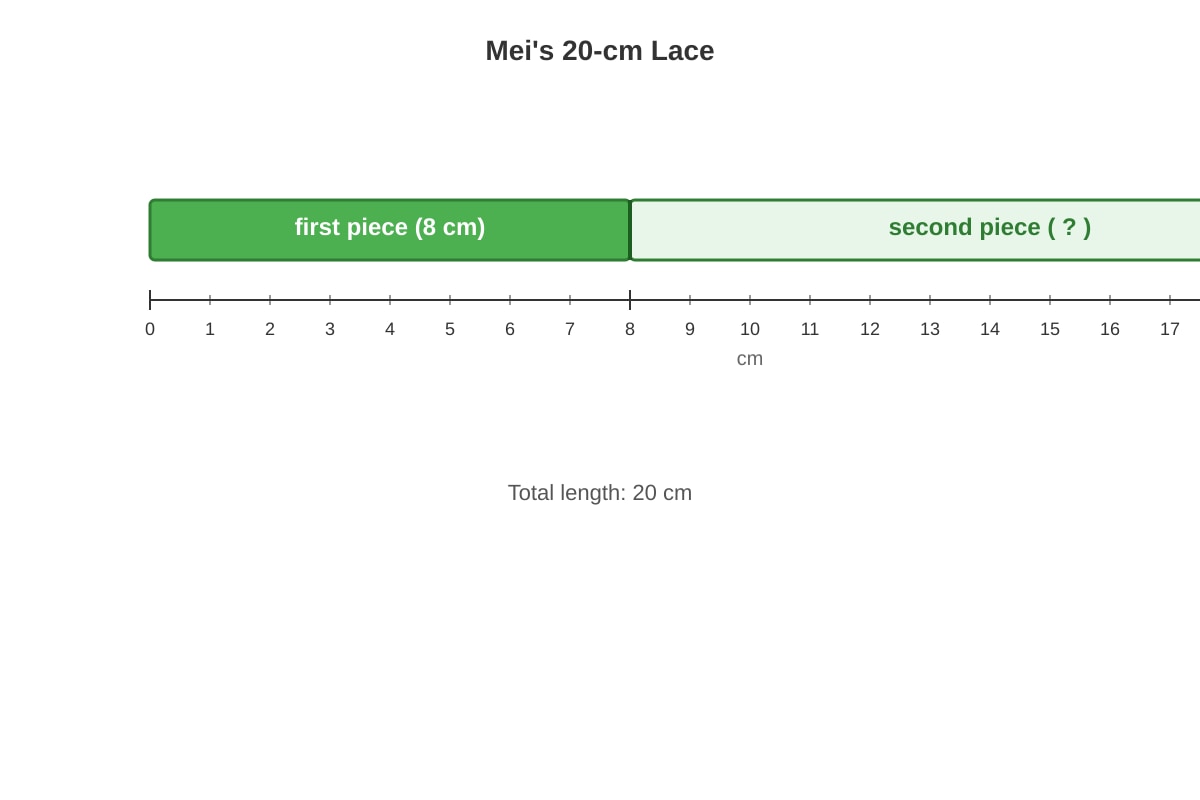
18. Look at the picture. Mei has a 20-cm lace. She cuts it into two pieces: one piece is 8 cm long. How long is the other piece?

<image_placeholder> id: Q18-fig1 type: figure linked_question: Q18 description: A 20-cm lace drawn as a horizontal bar. The first 8 cm is shaded (first piece) and the rest is left unshaded (second piece). A small cm scale is shown below. labels: "first piece (8 cm)", "second piece ( ? )", 0–20 cm scale values: total = 20 cm, first piece = 8 cm must_show: Lace is drawn as one continuous bar split into two clearly marked parts. </image_placeholder>

Number sentence: ____________________

Answer: ____________________

19. A pencil is 5 cm shorter than an eraser. The eraser is 14 cm long. How long is the pencil?

Number sentence: ____________________

Answer: ____________________

20. Meiling measured three ribbons:

  • Ribbon A is 16 cm long.
  • Ribbon B is 9 cm long.
  • Ribbon C is 12 cm long.

(a) How much longer is Ribbon A than Ribbon B?

Number sentence: ____________________

Answer: ____________________

(b) What is the total length of Ribbon B and Ribbon C?

Number sentence: ____________________

Answer: ____________________


End of Quiz

Answers

<!-- TuitionGoWhere generation metadata: stage=5-1; model=minimax/minimax-m3; model_label=MiniMax M3; generated=2026-06-04; Sources: Stage 4-0 LLM templates, syllabus context, and Stage 2 evidence where available. -->

Primary 1 Mathematics Quiz - Length — Answer Key

Topic: Length Total Marks: 25 Note: Past-paper evidence for P1 Mathematics is not available. This answer key follows the Stage 4 LLM-inferred templates and the 2021 MOE Singapore Primary Mathematics Syllabus (P1–P6).


Section A: Multiple Choice (1 mark each)

1. (2) 12 cm The pencil starts at 0 cm and ends at 12 cm, so its length is read directly from the ruler: 12 cm.

  • Common mistake: adding 0 + 12 to get 22 cm. Teach students to read the end mark, not to add.

2. (2) B Line B is 9 cm, which is longer than A (5 cm), C (7 cm) and D (4 cm). The longest line is B.

3. (1) cm At Primary 1, only centimetres (cm) are introduced for length. (Metres are introduced later.) The correct unit is cm.

4. (3) 8 cm The line begins at 0 and ends at the 8-cm mark. The length is read as 8 cm.

5. (1) 5 cm Compare by subtraction: 14 cm − 9 cm = 5 cm. The red ribbon is 5 cm longer.


Section B: Short Answer (1 mark each)

6. The crayon is longer (11 cm > 6 cm). When we compare two lengths, we look at which number is greater. 11 cm is greater than 6 cm, so the crayon is longer.

  • Common mistake: choosing the shorter object because it "looks bigger". Always compare the actual cm values.

7. 10 cm The ribbon starts at 0 cm and ends at 10 cm. The length is read directly from the ruler: 10 cm.

8. 6 cm, 9 cm, 14 cm From smallest to largest: 6 < 9 < 14. The shortest is 6 cm and the longest is 14 cm.

9. 9 cm 17 cm − 8 cm = 9 cm. After cutting, the string is 9 cm long.


Section C: Drawing and Measuring (2 marks each)

10. 15 cm (1 mark for the number, 1 mark for the unit "cm") The toothbrush starts at 0 cm and ends at 15 cm. The length is 15 cm.

  • The unit "cm" is required for full credit.

11. A line of 7 cm, drawn with a ruler starting at "•". Marking:

  • 1 mark: line begins at the dot.
  • 1 mark: line ends exactly at 7 cm (aligned with the 7 cm mark on a ruler).

12. AB = 4 cm, BC = 4 cm, CD = 4 cm, DA = 4 cm (1 mark for correctly measuring all four sides; 1 mark for stating the same length on every side, demonstrating that a square has equal sides). A square has four equal sides, and the grid confirms each side is 4 cm.

13. 32 cm Working: 20 cm + 12 cm = 32 cm. (1 mark for the number sentence; 1 mark for the correct answer with the unit "cm".)

14. R (13 cm), P (10 cm), Q (6 cm) From longest to shortest: 13 > 10 > 6. So the order is R, P, Q.


Section D: Word Problems (2 marks each)

15. 13 cm

  • Number sentence: 18 cm − 5 cm = 13 cm
  • The rope was 18 cm long. After cutting off 5 cm, the remaining rope is 13 cm.
  • Marking: 1 mark for the correct number sentence; 1 mark for the correct answer with the unit "cm".

16. 4 cm

  • Number sentence: 13 cm − 9 cm = 4 cm
  • To find how much longer, subtract the shorter length from the longer length: 13 − 9 = 4.
  • Marking: 1 mark for the correct number sentence; 1 mark for the correct answer with the unit "cm".
  • Common mistake: adding the two lengths. The question asks for the difference, so we subtract.

17. 18 cm

  • Number sentence: 11 cm + 7 cm = 18 cm
  • Joining two lengths means adding them together: 11 + 7 = 18.
  • Marking: 1 mark for the correct number sentence; 1 mark for the correct answer with the unit "cm".

18. 12 cm

  • Number sentence: 20 cm − 8 cm = 12 cm
  • The lace is 20 cm in total. One piece is 8 cm, so the other piece is 20 − 8 = 12 cm.
  • The image shows the lace as one bar split into the 8 cm piece and the unknown piece, reinforcing the subtraction model.
  • Marking: 1 mark for the correct number sentence; 1 mark for the correct answer with the unit "cm".

19. 9 cm

  • Number sentence: 14 cm − 5 cm = 9 cm
  • The pencil is 5 cm shorter than the eraser. Eraser = 14 cm, so pencil = 14 − 5 = 9 cm.
  • Marking: 1 mark for the correct number sentence; 1 mark for the correct answer with the unit "cm".
  • Common mistake: adding 14 + 5. The word "shorter" means the pencil is less, so we subtract.

20.

  • (a) 7 cm. Number sentence: 16 cm − 9 cm = 7 cm. (1 mark for the number sentence; 1 mark for the answer with the unit "cm".)
  • (b) 21 cm. Number sentence: 9 cm + 12 cm = 21 cm. (1 mark for the number sentence; 1 mark for the answer with the unit "cm".)

Marking Summary

QuestionMarksSection
1–51 each = 5A
6–91 each = 4B
10–142 each = 10C
15–202 each = 12D
Total25 marks

Visual notes for placeholders:

  • Q2: Four lines of different lengths, same starting point; B is the longest.
  • Q4: Line from 0 to 8 cm on a centimetre ruler.
  • Q6: Crayon (11 cm) and marker (6 cm) on a cm scale.
  • Q7: Ribbon from 0 to 10 cm.
  • Q10: Toothbrush from 0 to 15 cm.
  • Q12: Square on a 1-cm grid, each side = 4 cm.
  • Q14: Three sticks P (10 cm), Q (6 cm), R (13 cm) on a shared baseline.
  • Q18: A 20-cm lace with the first 8 cm shaded as the first piece.

All lengths used are within the P1 scope (whole centimetres) and reinforce the cm-only measurement focus from the syllabus.


End of Answer Key