AI Generated Quiz
Primary 1 Mathematics Addition Subtraction Quiz
Free P1 Maths Addition Subtraction quiz, Nemo3 AI version, with questions, answers, and syllabus-aligned practice for Singapore students.
These static practice materials are generated from the site's syllabus and paper-generation workflow, with source and model context shown so students and parents can evaluate the material before use.
Questions


Free quiz and exam paper access
Enter your details to view this paper
Your access is remembered on this device.
Answers
Primary 1 Mathematics Quiz - Addition Subtraction (Answer Key)
Total Marks: 30
Section A: Multiple Choice Questions (5 × 1 mark = 5 marks)
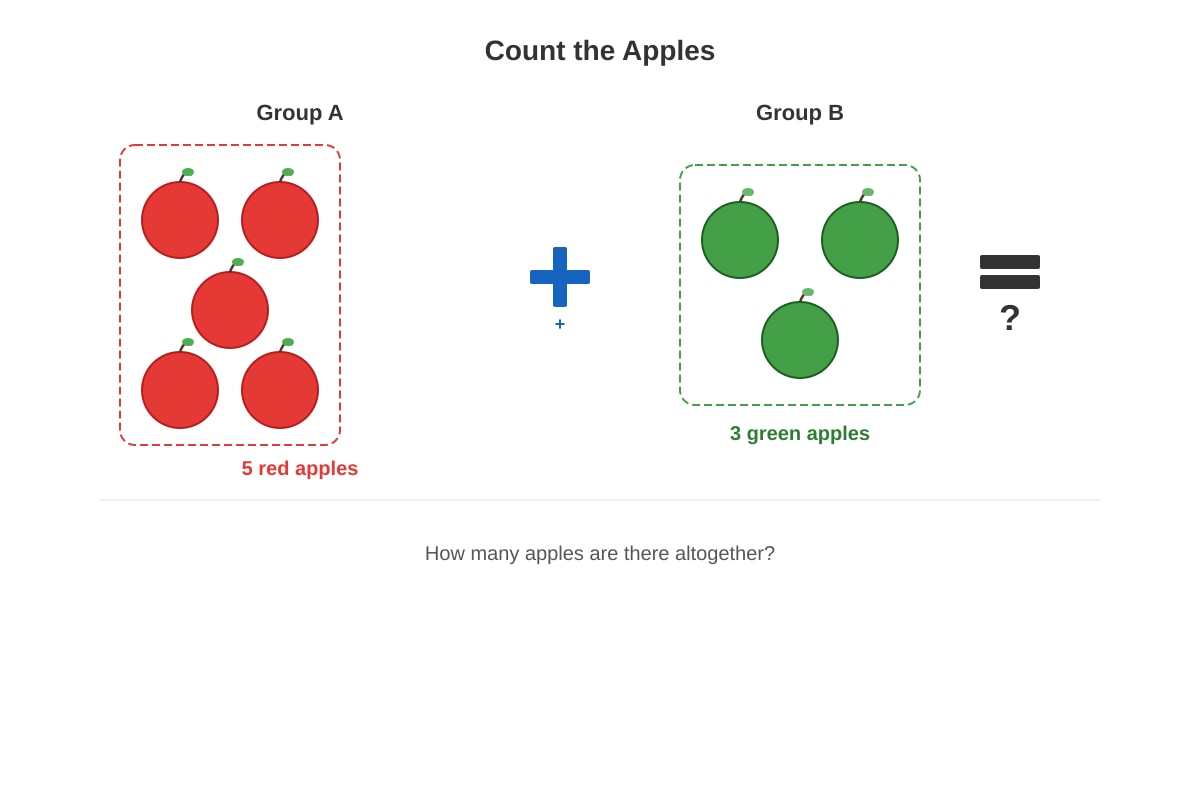
1. Answer: (3) 8
Explanation: Count the apples in both groups. Group A has 5 red apples. Group B has 3 green apples. To find the total, add: 5 + 3 = 8.
Method: Count all objects in both groups.
Common mistake: Counting only one group or miscounting the total.
2. Answer: (2) 4 + 6 = 10
Explanation: The question asks for a number sentence showing 6 + 4. Addition is commutative, so 6 + 4 = 4 + 6 = 10. Option (2) shows 4 + 6 = 10, which is equivalent. Option (4) is incorrect because 6 + 4 = 10, not 11.
Key concept: Commutative property of addition (order does not change the sum).
3. Answer: (2) 5
Explanation: Start with 9 balloons. 4 burst (are taken away). Subtract: 9 − 4 = 5 balloons left.
Method: Subtraction as "taking away".
Common mistake: Adding instead of subtracting (9 + 4 = 13, option 1).
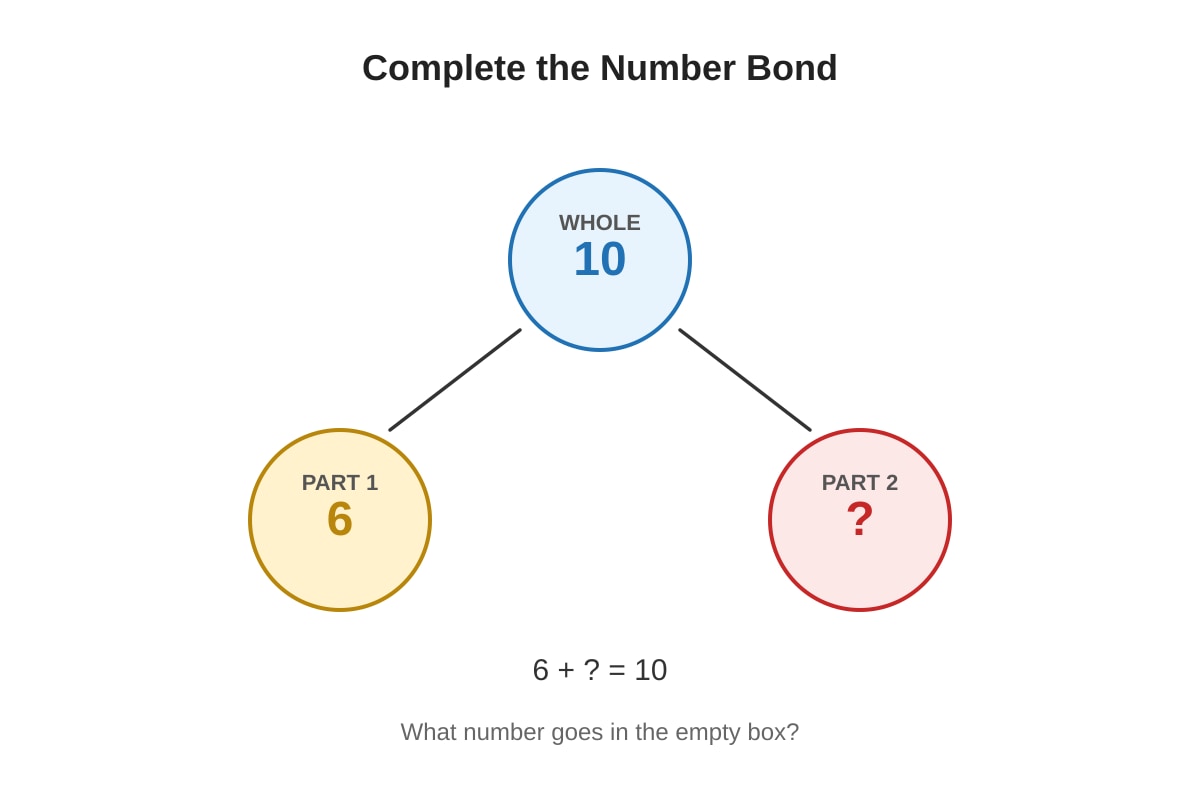
4. Answer: (2) 4
Explanation: In a number bond, the whole (10) is split into two parts. One part is 6. The other part is 10 − 6 = 4. Check: 6 + 4 = 10.
Method: Part = Whole − Known Part.
Key concept: Number bonds show part-part-whole relationships.
5. Answer: (3) 8
Explanation: 15 − 7 = 8. Count back 7 from 15: 14, 13, 12, 11, 10, 9, 8. Or use number bond: 15 = 7 + 8.
Method: Counting back or using known number bonds to 10/20.
Section B: Short Answer Questions (10 × 2 marks = 20 marks)
6. (a) 8 + 5 = 13
(b) 12 − 4 = 8
Explanation:
(a) Count on 5 from 8: 9, 10, 11, 12, 13. Or make 10: 8 + 2 = 10, then +3 = 13.
(b) Count back 4 from 12: 11, 10, 9, 8. Or 12 = 4 + 8.
Marks: 1 mark each correct answer.
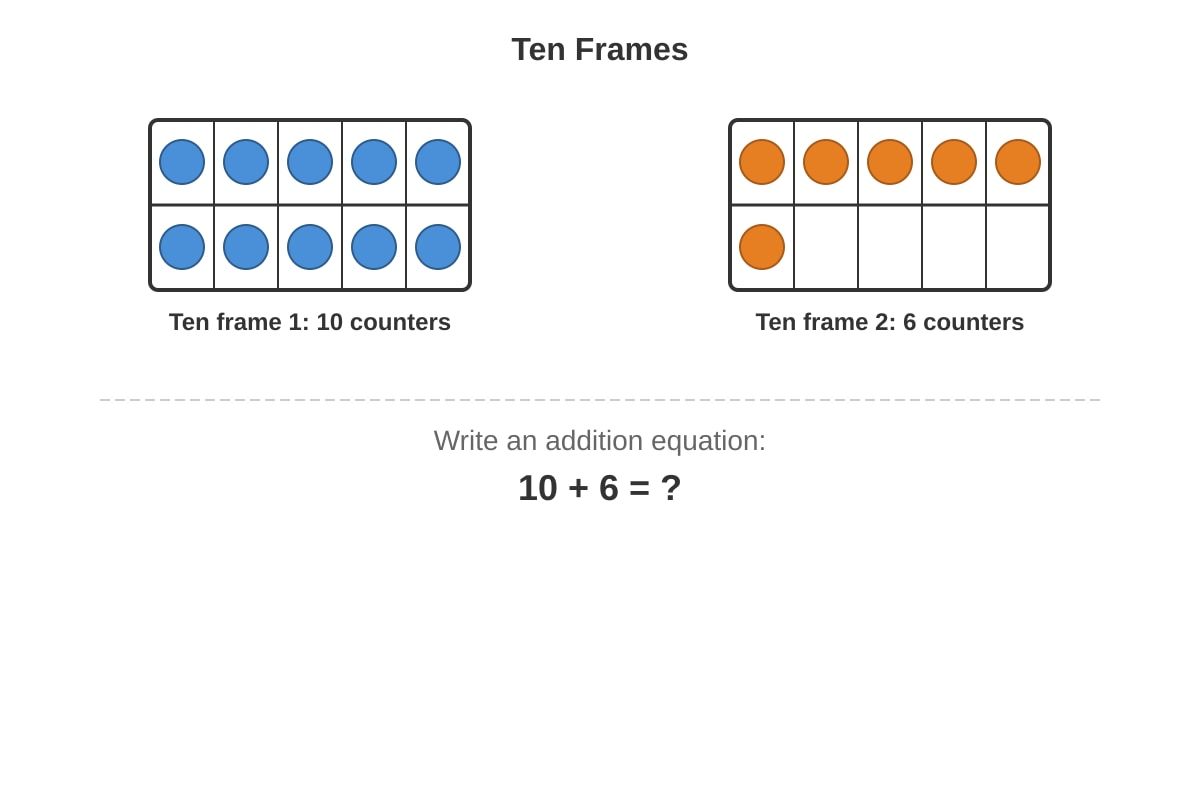
7. 10 + 6 = 16
Explanation: The first ten frame is full (10 counters). The second ten frame has 6 counters. Total = 10 + 6 = 16.
Method: Use ten frames to visualise tens and ones.
Marks: 1 mark for correct numbers in blanks, 1 mark for correct total.
8. 11, 9
Explanation: The pattern decreases by 1 each time: 14, 13, 12, 11, 10, 9.
Method: Identify the rule (subtract 1) and continue.
Marks: 1 mark each correct number.
9. 6 stickers
Working: 11 − 5 = 6
Explanation: Mary starts with 11 stickers. She gives away 5. Subtract to find how many left: 11 − 5 = 6.
Key phrase: "gives away" or "left" signals subtraction.
Marks: 1 mark for working (11 − 5), 1 mark for correct answer with unit.
10. 15 children
Working: 7 + 8 = 15
Explanation: 7 boys and 8 girls. "Altogether" means add the two groups: 7 + 8 = 15.
Method: Make 10: 7 + 3 = 10, then +5 = 15. Or count on from 8.
Marks: 1 mark for working (7 + 8), 1 mark for correct answer with unit.
11. (a) 7
(b) 14
Explanation:
(a) 9 + ? = 16 → ? = 16 − 9 = 7. Check: 9 + 7 = 16.
(b) ? − 6 = 8 → ? = 8 + 6 = 14. Check: 14 − 6 = 8.
Method: Use inverse operations (subtraction for missing addend, addition for missing minuend).
Marks: 1 mark each.
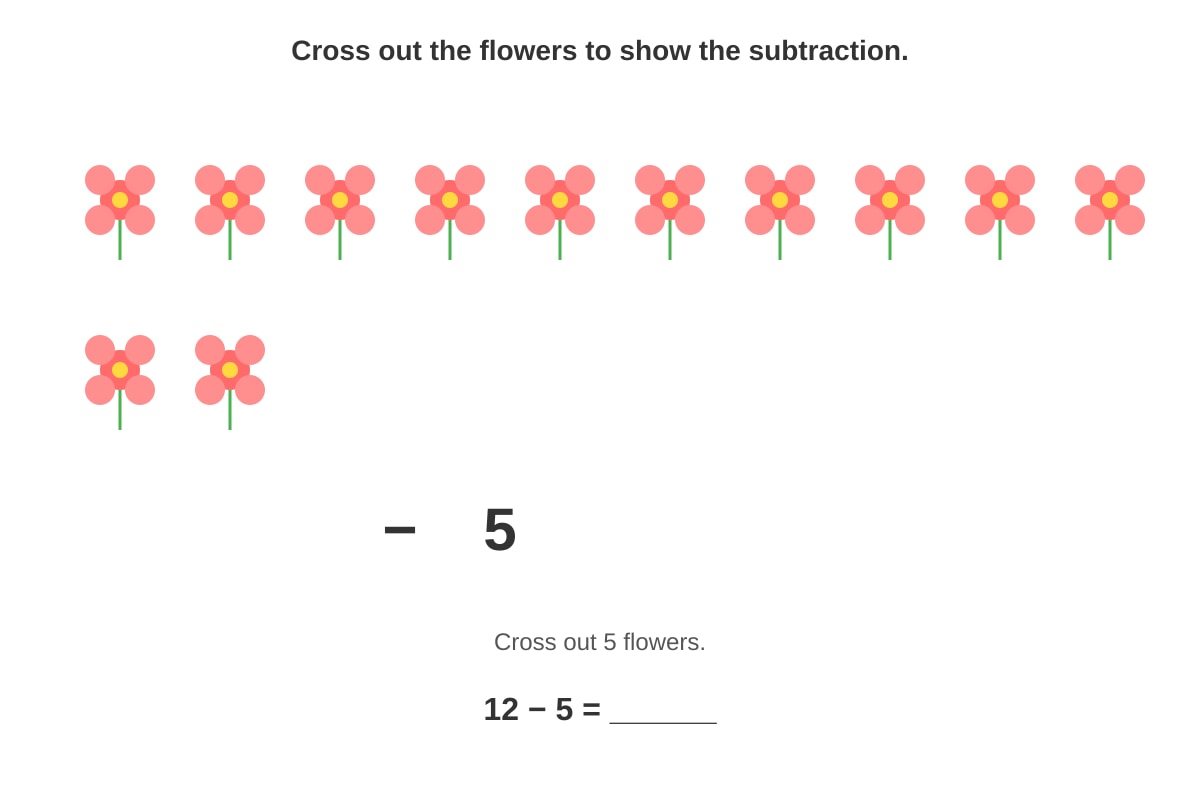
12. 7
Working: 12 − 5 = 7
Explanation: Cross out 5 flowers from 12. Count remaining: 7. Equation: 12 − 5 = 7.
Visual method: Crossing out models subtraction as taking away.
Marks: 1 mark for crossing out 5 flowers (implied), 1 mark for correct answer.
13. 9 + 6 = 15
6 + 9 = 15
15 − 9 = 6
15 − 6 = 9
Explanation: From the number bond (whole = 15, parts = 9 and 6), we can write 2 addition and 2 subtraction equations (fact family).
Key concept: Fact families — related addition and subtraction equations using the same three numbers.
Marks: ½ mark each correct equation (4 equations × ½ = 2 marks). Accept equations in any order.
14. 7 marbles
Working: 18 − 11 = 7
Explanation: Tom started with 18 marbles. After losing some, he has 11. To find how many lost: subtract the remaining from the original: 18 − 11 = 7.
Method: Missing subtrahend: Original − Remaining = Lost.
Marks: 1 mark for working (18 − 11), 1 mark for correct answer with unit.
15. (a) 12
(b) 8
Explanation:
(a) 20 = ? + 8 → ? = 20 − 8 = 12. Check: 12 + 8 = 20.
(b) 17 − ? = 9 → ? = 17 − 9 = 8. Check: 17 − 8 = 9.
Method: Inverse operations.
Marks: 1 mark each.
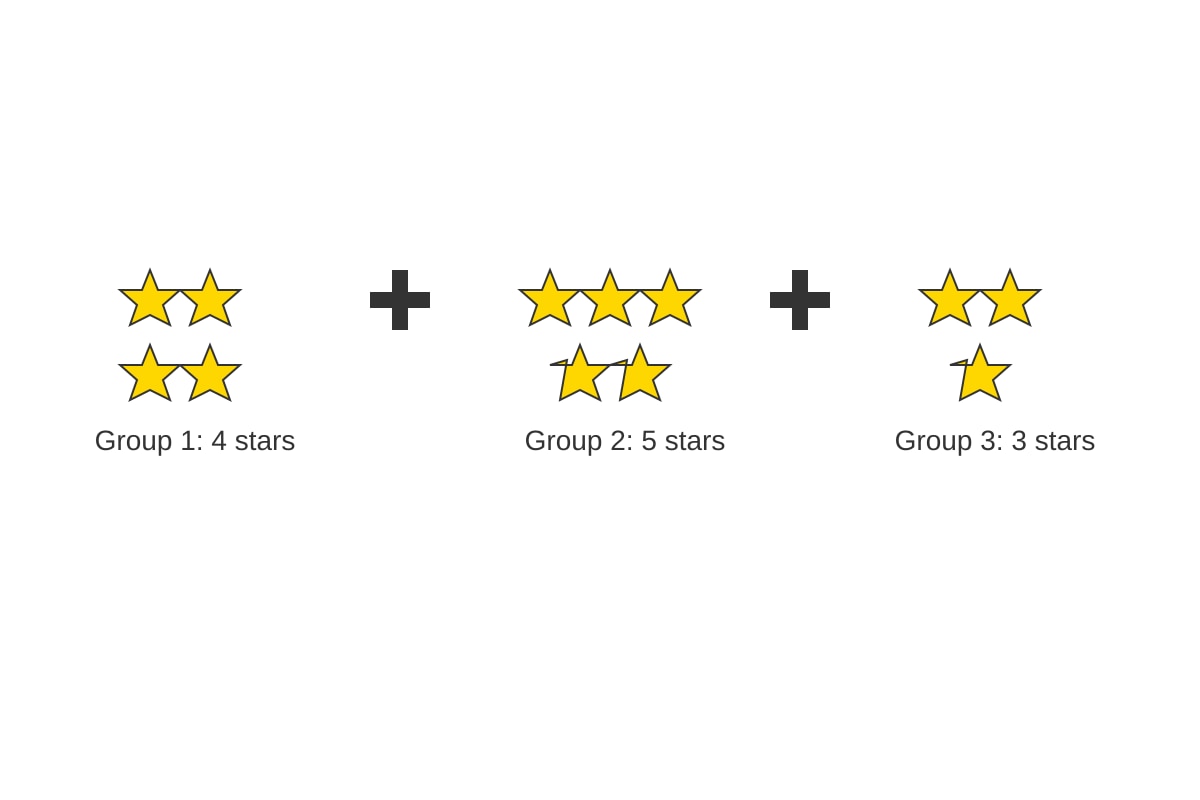
16. 4 + 5 + 3 = 12
Explanation: Count the stars in each group: Group 1 has 4 stars, Group 2 has 5 stars, Group 3 has 3 stars. Add all three groups: 4 + 5 + 3 = 12.
Method: Add three numbers by grouping: (4 + 5) + 3 = 9 + 3 = 12, or 4 + (5 + 3) = 4 + 8 = 12.
Marks: 1 mark for correct numbers in blanks, 1 mark for correct total.
17. 18
Working: 13 + 5 = 18
Explanation: Start at 13 on the number line. Jump forward 5 steps: 14, 15, 16, 17, 18. Land on 18.
Method: Counting on using a number line.
Marks: 1 mark for working (using number line or 13 + 5), 1 mark for correct answer.
18. 6 and 4 (or 3 and 7, or 8 and 2)
Explanation: Pairs that make 10: 6 + 4 = 10, 3 + 7 = 10, 8 + 2 = 10. Circle any one correct pair.
Key concept: Number bonds to 10.
Marks: 1 mark for identifying a correct pair, 1 mark for writing the pair correctly.
19. 7 cupcakes
Working: 16 − 9 = 7
Explanation: Start with 16 cupcakes. 9 are eaten (taken away). Subtract: 16 − 9 = 7 cupcakes left.
Method: Count back 9 from 16, or use number bond: 16 = 9 + 7.
Marks: 1 mark for working (16 − 9), 1 mark for correct answer with unit.
20. Example story: "There are 14 pencils in a box. 6 pencils are taken out. How many pencils are left in the box?"
Explanation: A subtraction story for 14 − 6 = 8 must have a starting amount of 14, an action of taking away 6, and a question asking for the remaining amount (8). Accept any reasonable context (pencils, apples, children, etc.) that matches the equation.
Marks: 1 mark for correct starting amount (14), 1 mark for correct action (take away 6), 1 mark for correct question/ending (8 left).
Section C: Word Problems (2 × 2 marks + 1 × 3 marks = 7 marks)
16. There are 11 birds on the tree now.
Working:
14 − 6 = 8 (birds left after 6 fly away)
8 + 3 = 11 (3 more birds come)
Or: 14 − 6 + 3 = 11
Explanation: Two-step problem. First subtract the birds that flew away (14 − 6 = 8). Then add the birds that came (8 + 3 = 11).
Marks: 1 mark for first step (14 − 6 = 8), 1 mark for second step (8 + 3 = 11) and correct final answer in a sentence.
17. There are 7 yellow crayons.
Working:
5 + 4 = 9 (red and blue crayons)
16 − 9 = 7 (yellow crayons)
Explanation: First find total red and blue crayons: 5 + 4 = 9. Then subtract from total crayons to find yellow: 16 − 9 = 7.
Alternative: 16 − 5 = 11, then 11 − 4 = 7.
Marks: 1 mark for finding red + blue (5 + 4 = 9), 1 mark for subtracting from total (16 − 9 = 7) and correct final answer in a sentence.
18. Mrs Tan had 8 cookies left.
Working:
7 + 5 = 12 (cookies given away)
20 − 12 = 8 (cookies left)
Or: 20 − 7 = 13, then 13 − 5 = 8
Explanation: Two-step problem. First find total cookies given away: 7 + 5 = 12. Then subtract from original: 20 − 12 = 8.
Marks: 1 mark for total given away (7 + 5 = 12), 1 mark for subtracting from total (20 − 12 = 8), 1 mark for correct final answer in a complete sentence.
Total: 30 marks
Marking Notes:
- Accept correct working even if final answer is missing unit, but deduct ½ mark for missing unit in word problems (Section C).
- For fact family (Q13), accept any order of the four equations.
- For multi-step word problems, award method marks for correct intermediate steps even if final answer has a calculation error.
- Encourage students to show working using number bonds, counting on/back, or making ten strategies.
- For Q18 (subtraction story), accept any context that correctly represents 14 − 6 = 8.
- For Q18 (circle numbers making 10), accept any valid pair: (6,4), (3,7), or (8,2).