AI Generated Quiz
Primary 1 Mathematics Addition Subtraction Quiz
Free P1 Maths Addition Subtraction quiz, MiniMax AI version, with questions, answers, and syllabus-aligned practice for Singapore students.
These static practice materials are generated from the site's syllabus and paper-generation workflow, with source and model context shown so students and parents can evaluate the material before use.
Questions
Free quiz and exam paper access
Enter your details to view this paper
Your access is remembered on this device.
Answers
Primary 1 Mathematics Quiz - Addition Subtraction — Answer Key
Total Marks: 30
Topic: Addition and Subtraction (within 100, no renaming)
Note for marker: All addition and subtraction questions in this quiz are designed to be solved without regrouping across tens (e.g., 34 + 25 is fine because 4 + 5 = 9 with no carry, and 7 + 8 in Q18 is a valid ones-digit sum without borrowing). Each question's working is shown below.
Section A — Mental Addition Within 20 (Questions 1–5) [5 marks]
1. 7 + 3 = 10
- Concept: "Adding on" combines two sets; 7 and 3 together make a friendly ten.
- Method: Count on from 7: 8, 9, 10. (1 mark)
2. 6 + 5 = 11
- Concept: Reinforces that 6 + 5 crosses a ten, building a known fact.
- Method: 6 + 4 = 10, then + 1 more = 11. (1 mark)
3. 9 + 4 = 13
- Concept: Doubles-plus-one style: 9 is close to 10.
- Method: 9 + 1 = 10, then 10 + 3 = 13. (1 mark)
4. 8 + 8 = 16
- Concept: Doubles (8 + 8) fact; useful anchor for later sums.
- Method: Double 8 = 16. (1 mark)
5. 2 + 7 + 5 = 14
- Concept: Adding more than two single-digit numbers; commutative property — reorder to make a ten.
- Method: 2 + 7 + 5 = (7 + 3) + (2 + 2) = 10 + 4 = 14. (1 mark)
- Common mistake: Counting all from 1 each time instead of "adding on."
Section B — Mental Subtraction Within 20 (Questions 6–10) [5 marks]
6. 10 − 4 = 6
- Concept: "Taking away" from a ten.
- Method: Count back 4 from 10: 9, 8, 7, 6. (1 mark)
7. 13 − 5 = 8
- Concept: Counting back, or using the inverse: 8 + 5 = 13.
- Method: 13 − 3 = 10, then 10 − 2 = 8. (1 mark)
8. 15 − 7 = 8
- Concept: Subtraction crosses a ten.
- Method: 15 − 5 = 10, then 10 − 2 = 8. (1 mark)
9. 11 − 6 = 5
- Concept: Inverse relationship with addition: 5 + 6 = 11.
- Method: Count back 6 from 11: 10, 9, 8, 7, 6, 5. (1 mark)
10. 18 − 9 = 9
- Concept: Half of 18; reinforces the 18 = 9 + 9 doubles fact.
- Method: 18 − 8 = 10, then 10 − 1 = 9. (1 mark)
Section C — Addition Within 100 (No Renaming) (Questions 11–15) [8 marks]
11. 24 + 5 = 29
- Concept: Adding a 1-digit number to a 2-digit number (ones only).
- Method: Ones: 4 + 5 = 9; Tens stay 2 → 29. (1 mark)
12. 36 + 20 = 56
- Concept: Adding tens to a 2-digit number; ones digit is unchanged.
- Method: 3 + 2 = 5 tens; ones digit remains 6 → 56. (1 mark)
13. 41 + 32 = 73
- Concept: Adding two 2-digit numbers without renaming.
- Method: Ones: 1 + 2 = 3; Tens: 4 + 3 = 7 → 73. (1 mark)
- Check: No regrouping is needed because 1 + 2 = 3 (less than 10) and 4 + 3 = 7 (less than 10).
14. Mei Ling: 25 + 14 = 39 stickers.
- Concept: Word problem — "altogether" means add.
- Method:
- Number sentence: 25 + 14 = 39 (1 mark)
- Final answer: 39 stickers (1 mark)
- Teaching note: Encourage students to underline key words like "altogether" and "more" to choose the operation.
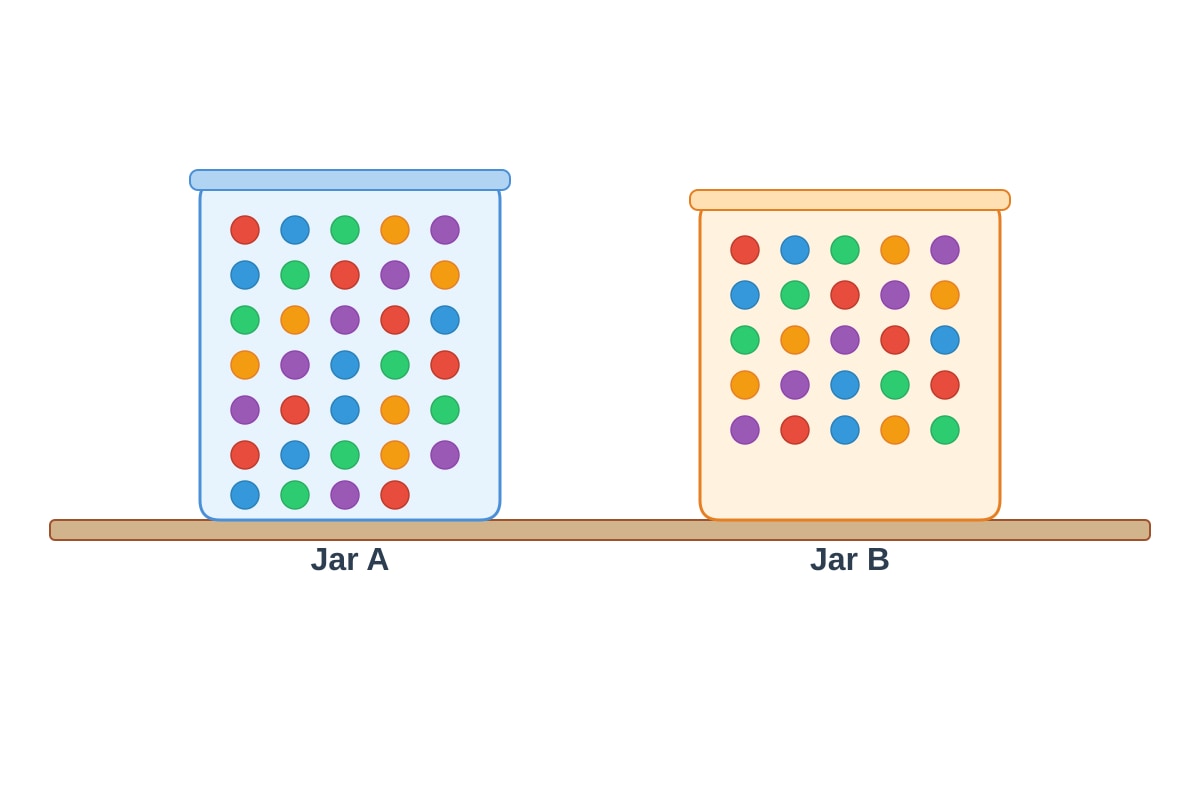
15. Picture question — Jar A (34) + Jar B (25) = 59 marbles.
- Visual required: Two jars labelled "Jar A" (34 marbles) and "Jar B" (25 marbles).
- Method: 34 + 25 → Ones: 4 + 5 = 9; Tens: 3 + 2 = 5 → 59 marbles. (2 marks)
- Common mistake: Reading "thirty-four" as "thirteen" — emphasise the "ty" in tens (3 tens, 4 ones).
Section D — Subtraction Within 100 (No Renaming) (Questions 16–20) [12 marks]
16. 58 − 3 = 55
- Concept: Subtracting a 1-digit number from a 2-digit number (ones only).
- Method: Ones: 8 − 3 = 5; Tens stay 5 → 55. (1 mark)
17. 67 − 40 = 27
- Concept: Subtracting tens from a 2-digit number; ones digit is unchanged.
- Method: 6 − 4 = 2 tens; ones stay 7 → 27. (1 mark)
18. 89 − 25 = 64
- Concept: Subtracting two 2-digit numbers without renaming.
- Method: Ones: 9 − 5 = 4; Tens: 8 − 2 = 6 → 64. (1 mark)
- Check: 9 − 5 = 4 (no borrowing needed because 9 ≥ 5); 8 − 2 = 6 (no borrowing needed).
19. Bala: 63 − 21 = 42 stamps.
- Concept: Word problem — "left" and "gives away" mean subtract.
- Method:
- Number sentence: 63 − 21 = 42 (1 mark)
- Final answer: 42 stamps (1 mark)
- Teaching note: Have students retell the problem in their own words: "Bala started with 63 stamps, gave 21 away, so 42 remain."
20. Oranges: 75 − 43 = 32 oranges.
- Concept: Real-life context — "left" means subtract.
- Method:
- Number sentence: 75 − 43 = 32 (1 mark)
- Final answer: 32 oranges (1 mark)
- Step-by-step:
- Ones: 5 − 3 = 2.
- Tens: 7 − 4 = 3.
- Combine: 32.
- Common mistake: Subtracting 43 from 75 as "75 − 40 − 3" but losing the ones place; or writing 75 − 43 as 32 by mistake as 22. Encourage lining up the place values.
Mark Allocation Summary
| Section | Topic | Questions | Marks |
|---|---|---|---|
| A | Mental addition within 20 | 1–5 | 5 |
| B | Mental subtraction within 20 | 6–10 | 5 |
| C | Addition within 100 | 11–15 | 8 |
| D | Subtraction within 100 | 16–20 | 12 |
| Total | 20 | 30 |