AI Generated Exam Paper
Primary 1 Mathematics Practice Paper 5
Free P1 Maths Practice Paper 5, Kimi2.6 AI version, with questions, answers, and syllabus-aligned practice for Singapore students.
These static practice materials are generated from the site's syllabus and paper-generation workflow, with source and model context shown so students and parents can evaluate the material before use.
Questions
Free quiz and exam paper access
Enter your details to view this paper
Your access is remembered on this device.
Answers
TuitionGoWhere Practice Paper - Mathematics Primary 1
Answer Key with Marking Scheme
Version: 5 of 5
Total Marks: 50 marks
Section A: Counting and Number Recognition (10 marks)
Q1. (2 marks)
Expected visual: 2 rows of 5 stars and 1 row of 3 stars (13 stars total)
Working:
- Count all stars: 5 + 5 + 3 = 13
Answer: 13 stars (accept "13")
Marking: 2 marks for correct answer. Deduct 1 mark if answer given without "stars" unit (accept either). Deduct 1 mark if counting error.
Teaching note: Encourage students to count systematically from left to right, top to bottom, touching or marking each star to avoid double-counting or missing any.
Q2. (2 marks)
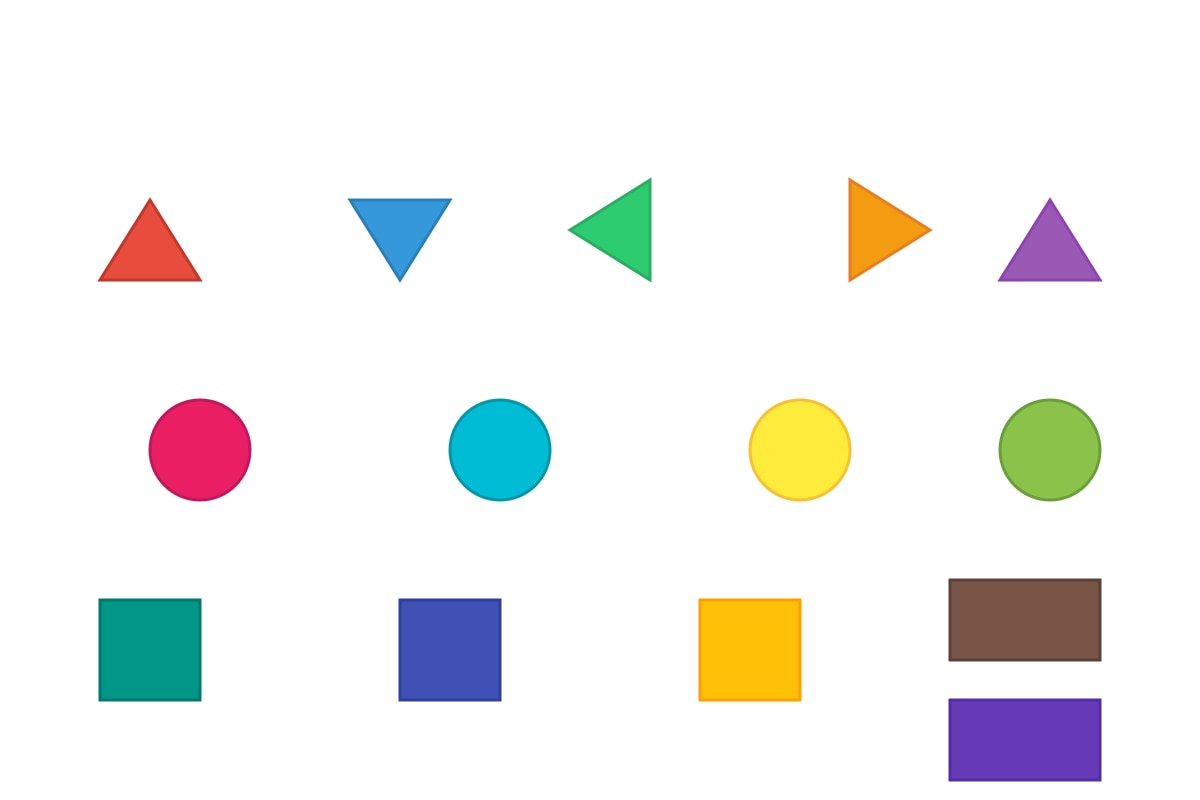
Expected visual features from image placeholder (Q2-fig1): Various shapes including 5 triangles among other shapes (4 circles, 3 squares, 2 rectangles)
Working:
- Identify triangles: shapes with exactly 3 sides and 3 corners
- Count carefully: 1, 2, 3, 4, 5
Answer: 5 triangles (accept "5")
Marking: 2 marks for correct answer. 1 mark if student correctly identifies triangles but counts incorrectly (e.g., counts 4 or 6).
Teaching note: Emphasize that triangles always have 3 sides and 3 corners, regardless of orientation. Common mistake: confusing triangles with other pointed shapes or counting shapes with 4 sides.
Q3. (2 marks)
Working:
- "Just after" means the next number when counting up
- Count up from 29: 29, 30, 31...
- Alternatively: 29 + 1 = 30
Answer: 30
Marking: 2 marks for correct answer.
Teaching note: Distinguish "just after" (next number, +1) from "between" or "just before." Common mistake: writing 31 (counting two steps) or 28 (confusing with "before").
Q4. (2 marks)
Working:
- 56 = 5 tens and 6 ones
- In words: "fifty" + "six" = fifty-six
Answer: Fifty-six (accept "fifty six" without hyphen)
Marking: 2 marks for correct spelling. 1 mark if numerals "56" are written instead of words, or if minor spelling error that still conveys correct reading.
Teaching note: Connect place value to word form: the tens word (fifty) comes first, then the ones word (six), with a hyphen typically used. Common mistake: writing "fivety-six" or "fifty-6" mixing formats.
Q5. (2 marks)
Working:
- Compare each number: 38, 83, 33, 88
- Method: Look at tens digit first
- 33 and 38 have 3 tens (smaller group)
- 83 and 88 have 8 tens (bigger group)
- Compare within smaller group: 33 vs 38, ones digits 3 < 8
- Therefore 33 is smallest
Answer: 33
Marking: 2 marks for correct answer. No partial marks as this is a straightforward comparison.
Teaching note: Standard method: compare tens digits first, then ones digits if tens are equal. Common mistake: choosing 38 because it "sounds smaller" or comparing digits left to right without attending to place value (thinking 83 is smaller because 8 < 3... which is wrong).
Section B: Place Value and Number Patterns (10 marks)
Q6. (2 marks)
Working:
- In 64, digit 6 is in the tens place
- Value = 6 × 10 = 60
- (Not "6" — that would be the digit itself, not its value)
Answer: 60 (accept "6 tens")
Marking: 2 marks for correct value. 1 mark if answer is "6" (confused digit with value). Deduct 1 mark if answer "tens" without the value.
Teaching note: Key concept — "digit" refers to the symbol (6), "value" or "place value" refers to what that digit represents (60 because it's in tens place). Common mistake: answering "6" or "tens" instead of calculating the actual value.
Q7. (2 marks)
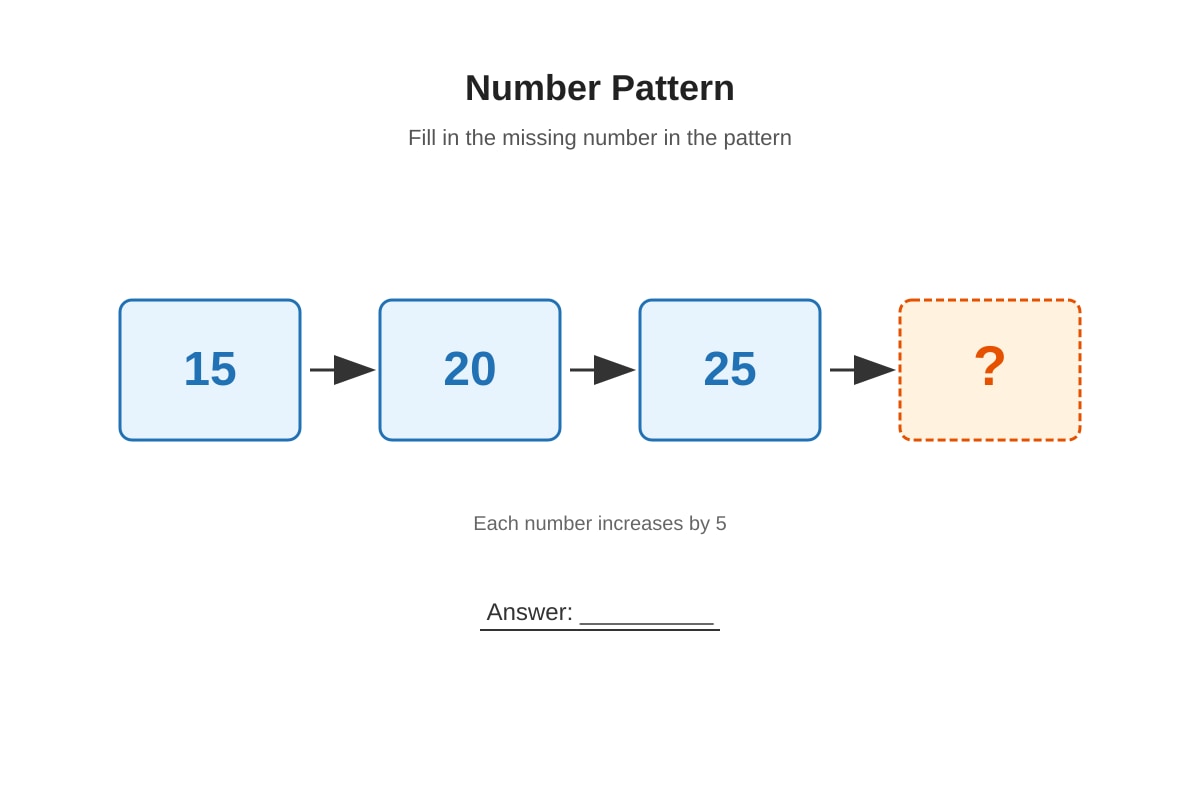
Expected visual features from image placeholder (Q7-fig1): Number boxes showing 15 → 20 → 25 → ?
Working:
- Find the pattern: 20 − 15 = 5, and 25 − 20 = 5
- Pattern rule: add 5 each time
- 25 + 5 = 30
Answer: 30
Marking: 2 marks for correct answer. 1 mark if student identifies pattern as "adding 5" but makes arithmetic error.
Teaching note: Finding the difference between consecutive terms reveals the pattern rule. Students can verify by checking: does 20 − 15 = 25 − 20? Common mistake: guessing without checking consistency, leading to answers like 26 (adding 1 each time after seeing 15, 20...).
Q8. (2 marks)
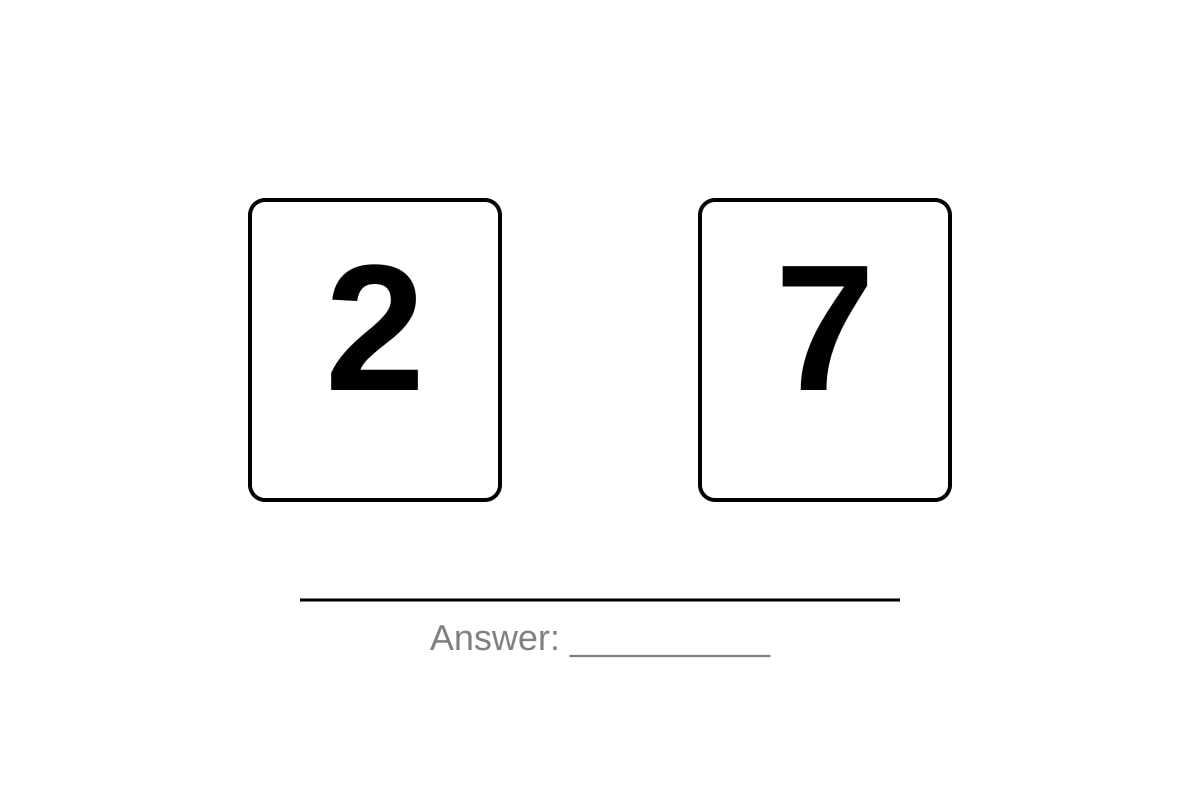
Expected visual features from image placeholder (Q8-fig1): Two digit cards showing 2 and 7
Working:
- Possible 2-digit numbers: 27 or 72
- Compare: 27 < 72
- Smallest is 27
Answer: 27
Marking: 2 marks for correct answer. 1 mark if student writes both 27 and 72 but doesn't identify which is smallest, or if writes only 72 (the largest).
Teaching note: To make the smallest number, put the smaller digit (2) in the tens place. To make the largest, put the larger digit (7) in the tens place. Common mistake: putting smaller digit in ones place (72) thinking "smaller digit means smaller number" without considering place value.
Q9. (2 marks)
Working:
- "10 more than" means add 10
- 45 + 10 = 55
- Using place value: 4 tens + 1 ten = 5 tens, ones stay 5, so 55
Answer: 55
Marking: 2 marks for correct answer. 1 mark if method shows understanding but arithmetic error (e.g., 46, 56).
Teaching note: Adding 10 increases the tens digit by 1 while ones digit stays the same. This is a key pattern for mental calculation. Common mistake: adding 10 to ones place (getting 45 + 10 = 415, or错误地 55 written as 56 by adding to wrong place).
Q10. (2 marks)
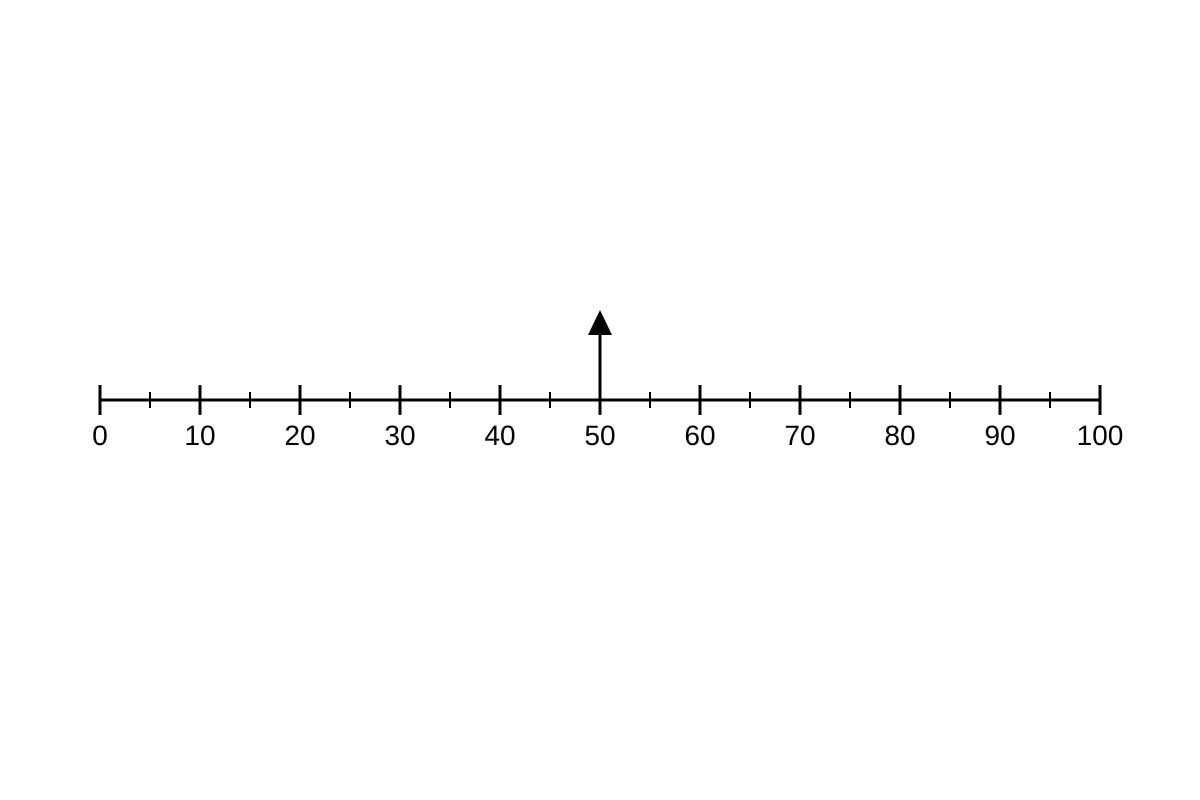
Expected visual features from image placeholder (Q10-fig1): Number line 0–100 with marks every 10, arrow pointing to midpoint between 50 and 60
Working:
- Major marks: 50 and 60
- Arrow is halfway between them
- Halfway between 50 and 60 is 55
Answer: 55
Marking: 2 marks for correct answer. 1 mark if answer is 50 or 60 (identifies nearest marked number but misses estimation). Deduct 1 mark if 54 or 56 (close but not precise enough for this level).
Teaching note: On a number line with intervals of 10, the midpoint represents 5 more than the lower mark. Students should recognize that the arrow position relative to marked numbers helps estimate. Common mistake: reading the nearest labeled number (50 or 60) instead of estimating the position.
Section C: Comparing and Ordering Numbers (10 marks)
Q11. (2 marks)
Working:
- Compare tens digits first: 11 and 17 have 1 ten; 71 and 77 have 7 tens
- So 11 and 17 are smaller than 71 and 77
- Compare 11 and 17: ones digits 1 < 7, so 11 < 17
- Compare 71 and 77: ones digits 1 < 7, so 71 < 77
- Order: 11, 17, 71, 77
Answer: 11, 17, 71, 77 (accept without commas if spaces used: 11 17 71 77)
Marking: 2 marks for fully correct order. 1 mark if three numbers in correct relative order but one misplaced, or if reversed order (largest to smallest) with correct relative ordering.
Teaching note: Systematic comparison using tens-then-ones prevents errors. Common mistake: ordering by ones digit (11, 71, 17, 77) or treating 71 as smaller than 17 because 7 < 1 without considering place value.
Q12. (2 marks)
Working:
- Compare 89 and 98
- Tens digits: 8 < 9
- Therefore 89 < 98, so 98 is greater
Answer: 98
Marking: 2 marks for correct answer.
Teaching note: The common phrase "bigger number has bigger first digit" works when comparing same-length numbers (both 2-digit). Common mistake: choosing 89 because 9 > 8 in ones place, ignoring that tens place determines magnitude first.
Q13. (2 marks)
Working:
- Mary: 34 stickers
- John: 43 stickers
- Compare: 34 < 43 (3 tens < 4 tens)
- "Fewer" means smaller quantity
- Mary has fewer
Answer: Mary has fewer stickers. (accept "Mary")
Marking: 2 marks for correct name with correct reason implicit. 1 mark if answer "Mary" without "has fewer stickers" phrase. 0 marks if wrong person named.
Teaching note: "Fewer" is used for countable items (stickers), "less" for uncountable quantities. At P1, focus on recognizing that fewer means smaller number. Common mistake: choosing John because he has "more" and student misreads "fewer" as "more."
Q14. (2 marks)
Working:
- 52 vs 25
- Tens digits: 5 > 2
- Therefore 52 > 25
Answer: 52 > 25
Marking: 2 marks for correct symbol. 1 mark if answer written as "52 is greater than 25" in words instead of symbol.
Teaching note: The "open end" of > or < faces the bigger number, like a mouth eating the bigger number. Common mistake: reversing symbol (<), especially if student reads left-to-right without checking which number is larger.
Q15. (2 marks)
Working:
- 2-digit numbers range from 10 to 99
- Biggest 2-digit number has largest possible tens and ones digits
- Largest digit is 9, so 99
Answer: 99
Marking: 2 marks for correct answer.
Teaching note: Generalizable: biggest n-digit number is n nines (99, 999, etc.). Smallest n-digit number is 1 followed by zeros (10, 100, etc.). Common mistake: 100 (smallest 3-digit, not 2-digit) or 90 (forgetting ones digit can also be 9).
Section D: Addition and Subtraction within 100 (15 marks)
Q16. (3 marks)
Working:
- Start: 28 birds
- Add: 15 more birds
- Calculation: 28 + 15
Step-by-step:
- Add ones: 8 + 5 = 13 ones = 1 ten and 3 ones
- Write down 3, carry 1 ten to tens column
- Add tens: 2 + 1 + 1 (carried) = 4 tens
- Answer: 43
Or decomposition method:
- 28 + 15 = 28 + 10 + 5 = 38 + 5 = 43
Answer: 43 birds
Marking: 3 marks total
- 1 mark: correct method shown (appropriate addition setup)
- 1 mark: correct working with no arithmetic errors
- 1 mark: correct final answer with unit
Deduct 1 mark if answer 43 without "birds" unit. 2 marks if correct method but arithmetic error with carried ten.
Teaching note: The standard algorithm requires understanding place value carrying. Decomposition method (breaking 15 into 10+5) is often more intuitive at P1. Common mistake: forgetting to carry the ten, answering 33 (8+5=13, write 3 but forget carry: 2+1=3, giving 33).
Q17. (3 marks)
Working:
- Start: 50 sweets
- Subtract: 23 sweets given away
- Calculation: 50 − 23
Step-by-step:
- Ones: 0 − 3, need to regroup
- Regroup: 50 = 4 tens and 10 ones
- Ones: 10 − 3 = 7
- Tens: 4 − 2 = 2
- Answer: 27
Or:
- 50 − 23 = 50 − 20 − 3 = 30 − 3 = 27
Answer: 27 sweets
Marking: 3 marks total
- 1 mark: correct method shown
- 1 mark: correct working with regrouping evident
- 1 mark: correct final answer with unit
2 marks if correct method but regrouping not shown clearly. Deduct 1 mark without unit.
Teaching note: Regrouping (borrowing) is challenging. Concrete representation with base-ten blocks helps before abstract algorithm. Common mistake: 50 − 23 = 33 (subtracting smaller from larger digit regardless of position: 5−2=3, 0−3... treating as 3−0=3).
Q18. (3 marks)
Working:
- Start: 37 marbles
- End: 62 marbles
- Find: amount added
- Calculation: 62 − 37 = ?
Or: ? + 37 = 62
Step-by-step:
- 62 − 37
- Ones: 2 − 7, need to regroup
- 62 = 5 tens and 12 ones
- Ones: 12 − 7 = 5
- Tens: 5 − 3 = 2
- Answer: 25
Verification: 37 + 25 = 62 ✓
Answer: 25 marbles
Marking: 3 marks total
- 1 mark: correct subtraction setup identified (or correct missing addend approach)
- 1 mark: correct working with regrouping
- 1 mark: correct final answer with unit
2 marks if method correct but arithmetic error. Award 1 mark if student writes 37 + ? = 62 but cannot solve.
Teaching note: This "change unknown" problem type is harder than result unknown. Subtraction finds the difference between start and end. Alternatively, counting up from 37 to 62 works well: 37 to 40 is 3, 40 to 60 is 20, 60 to 62 is 2, total 25. Common mistake: adding 37 + 62 = 99 (wrong operation choice) or 62 − 37 = 35 (regrouping error).
Q19. (4 marks total)
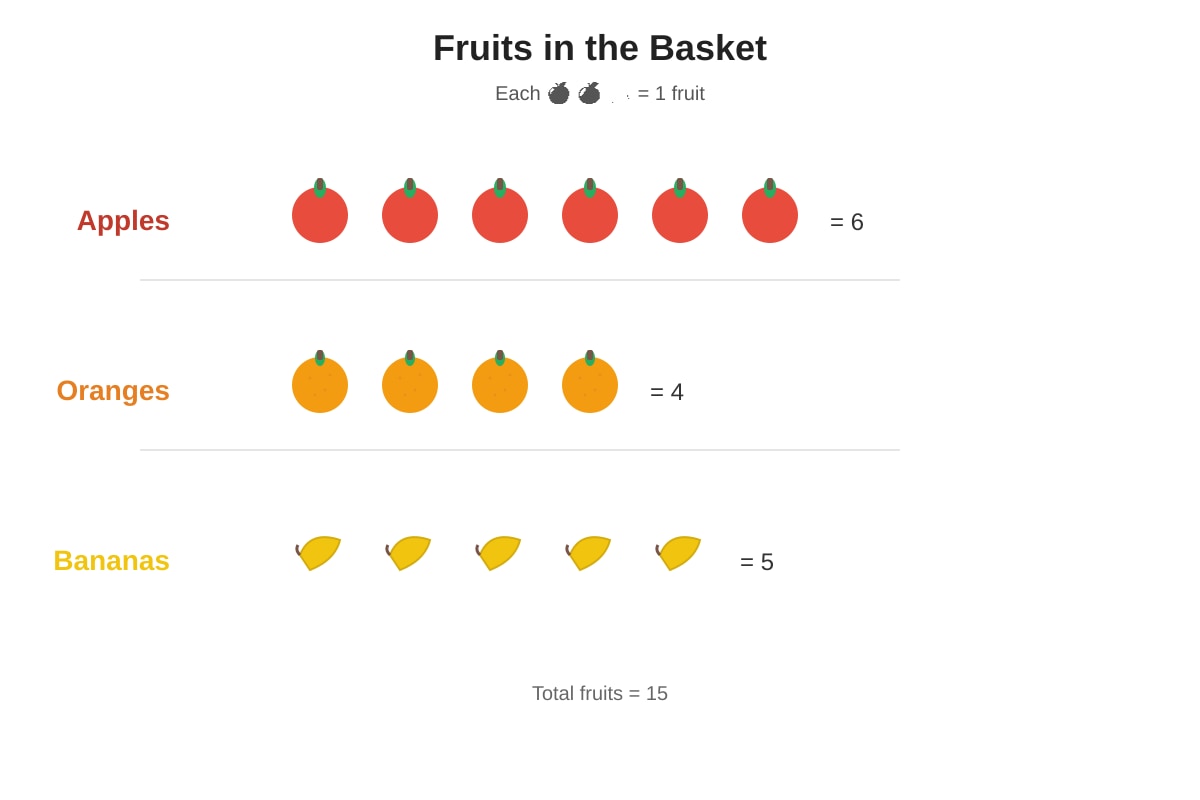
Expected visual features from image placeholder (Q19-fig1): Pictograph with Apples: 6 symbols, Oranges: 4 symbols, Bananas: 5 symbols; one symbol = one fruit
(a) (1 mark)
Working:
- Count apple symbols: 1, 2, 3, 4, 5, 6
Answer (a): 6 apples (accept "6")
Marking: 1 mark for correct answer.
(b) (2 marks)
Working:
- Bananas: 5
- Oranges: 4
- Difference: 5 − 4 = 1
Answer (b): 1 more banana (accept "1")
Marking: 2 marks total
- 1 mark: correct values identified from graph (5 bananas, 4 oranges)
- 1 mark: correct subtraction and answer
1 mark if correct subtraction setup but arithmetic error.
Teaching note: "How many more" requires comparison (subtraction), not just reading values. Common mistake: answering "5" (just stating banana count) or "1" without showing it's bananas compared to oranges.
(c) (1 mark)
Working:
- Apples: 6
- Oranges: 4
- Bananas: 5
- Total: 6 + 4 + 5 = 15
Or count all symbols: 6 + 4 + 5 = 15
Answer (c): 15 fruits (accept "15")
Marking: 1 mark for correct total. Deduct 1 mark if method shown but arithmetic error.
Teaching note: "Altogether" signals addition of all categories. Common mistake: adding only two categories or repeating count from part (a).
Q20. (4 marks)
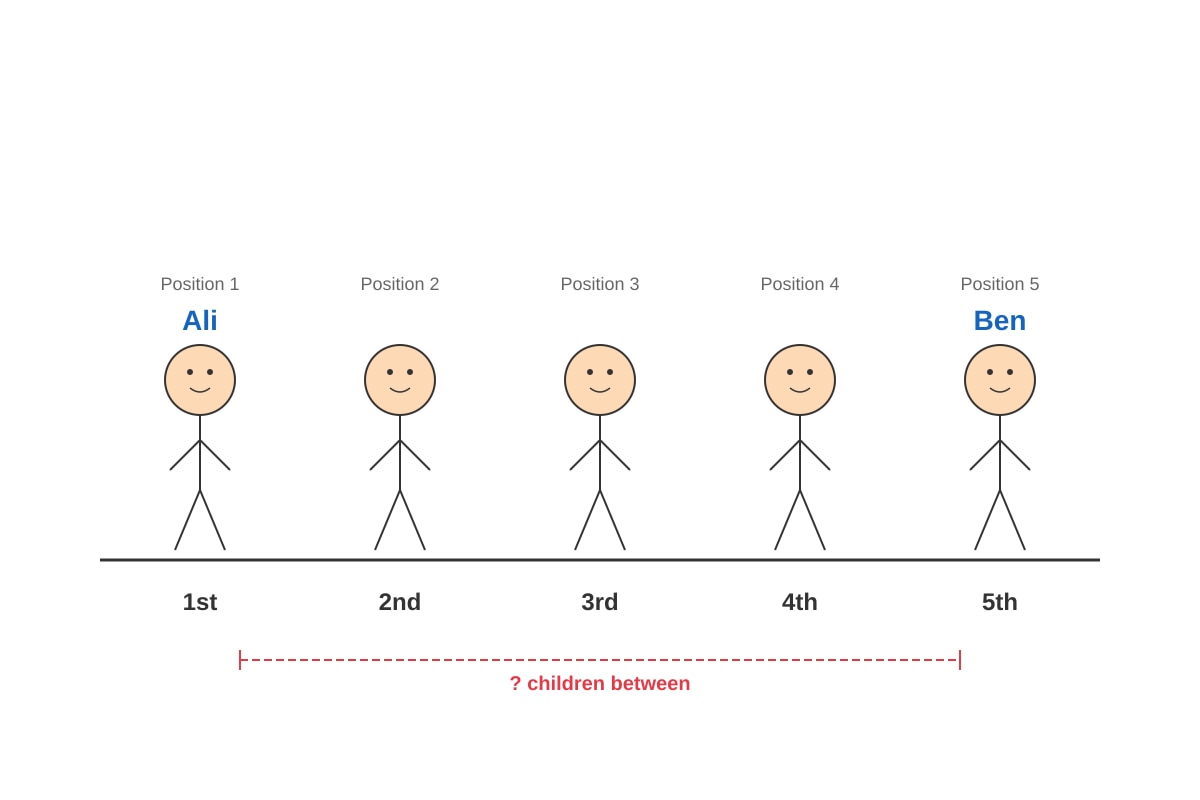
Expected visual features from image placeholder (Q20-fig1): Five children in line, Ali 1st, Ben 5th, blank figures at 2nd, 3rd, 4th
Working:
- Ali is at position 1
- Ben is at position 5
- Positions between them: 2nd, 3rd, 4th
- Count: 3 children
Alternative method:
- 5 − 1 − 1 = 3 (subtract Ali's position and exclude Ben himself, or simply: 5 − 1 = 4 positions from Ali to Ben inclusive, minus Ben = 3, or 5 − 2 = 3 excluding both ends)
Direct counting from diagram:
- Between 1st and 5th: positions 2, 3, 4 → 3 children
Answer: 3 children
Marking: 4 marks total
- 1 mark: correct understanding that "between" excludes endpoints
- 2 marks: correct method shown (counting positions, subtraction with adjustment, or diagram reference)
- 1 mark: correct final answer with unit
3 marks if answer 3 with minimal working but correct. 2 marks if answer 4 (counting Ben or Ali as "between") with otherwise sound method. 1 mark if answer 5 (total in line, misunderstanding question).
Teaching note: "Between" is a crucial vocabulary word — it excludes the endpoints. Many students answer 4 (5 − 1) or 5 (counting all). The visual diagram scaffolds correct counting. Counting actual positions between (2nd, 3rd, 4rd) is most reliable at this level. Common mistakes: 4 (5−1, forgetting to exclude Ben too), 5 (total children in line to 5th position), 2 (rough estimate).
Summary Mark Distribution
| Section | Questions | Marks | Focus |
|---|---|---|---|
| A | 1–5 | 10 | Counting, number recognition, basic number writing |
| B | 6–10 | 10 | Place value, patterns, number line |
| C | 11–15 | 10 | Comparing, ordering, relational language |
| D | 16–20 | 20 (3+3+3+4+4) | Operations, problem solving, data interpretation |
| Total | 1–20 | 50 |
Total marks: 50
Duration: 45 minutes
Average time per mark: ~0.9 minutes
Pedagogical Notes for Version 5
This version maintains consistent cognitive demand with versions 1–4 while varying:
- Contexts: birds (Q16), sweets (Q17), marbles (Q18), fruits (Q19), children in line (Q20)
- Number choices: emphasis on regrouping situations (Q16: 28+15; Q17: 50−23; Q18: 62−37)
- Visual complexity: pictograph with three categories requiring multi-step analysis
All questions align with MOE Primary 1 Mathematics syllabus (2021) for Whole Numbers up to 100.