AI Generated Exam Paper
Primary 1 Mathematics Practice Paper 4
Free P1 Maths Practice Paper 4, Kimi2.6 AI version, with questions, answers, and syllabus-aligned practice for Singapore students.
These static practice materials are generated from the site's syllabus and paper-generation workflow, with source and model context shown so students and parents can evaluate the material before use.
Questions

Free quiz and exam paper access
Enter your details to view this paper
Your access is remembered on this device.
Answers
TuitionGoWhere Practice Paper - Mathematics Primary 1
Answer Key and Marking Scheme
Version: 4 of 5
Total Marks: 40
Section A: Counting and Number Recognition (Questions 1–8)
Question 1 (2 marks)
Answer: 17 (numerals); seventeen (words)
Working/Method:
- Count the stars one by one, or group them to count more easily
- 17 is a two-digit number: 1 ten and 7 ones
- In words: e-lev-en-teen → seventeen (join "seven" and "teen")
Marking notes:
- 1 mark for correct numeral 17
- 1 mark for correct word seventeen (accept minor spelling errors if phonetically reasonable, e.g., "seventen" — use professional judgment)
Common mistake: Writing "70" by reversing digits, or writing "seven teen" as two words.
Question 2 (2 marks)
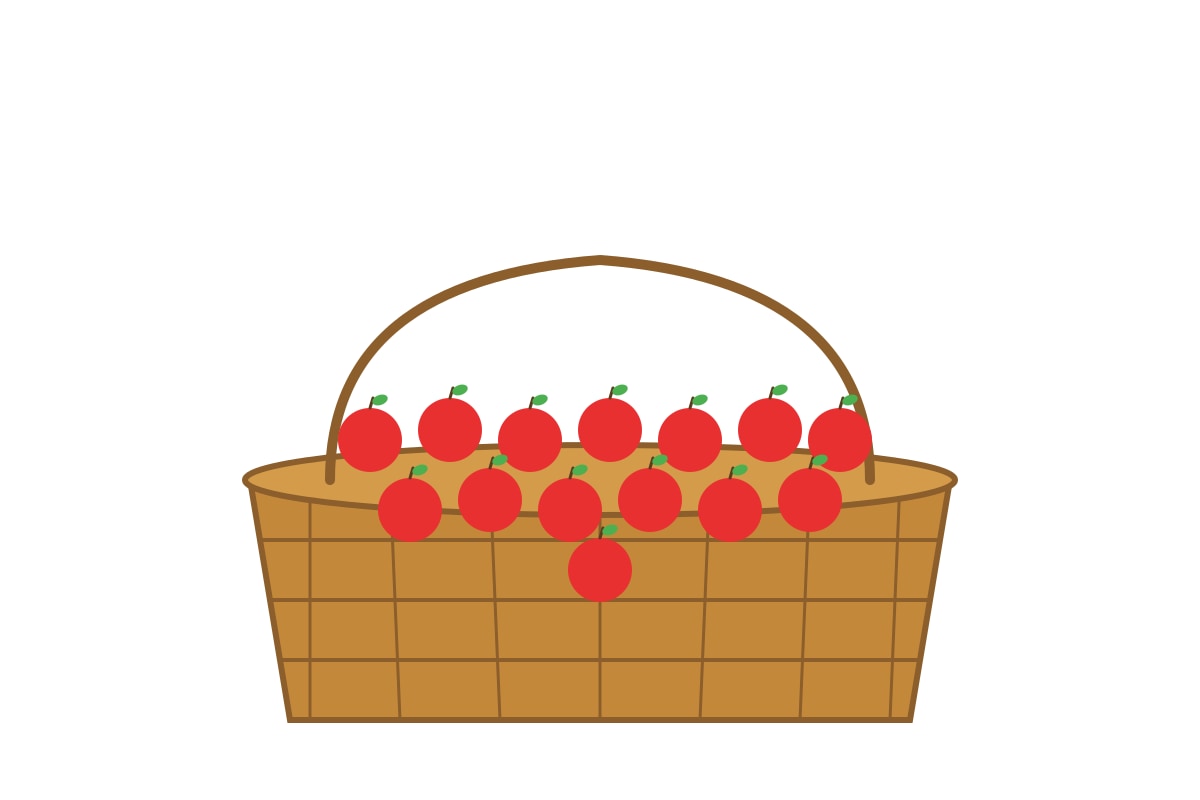
Answer: 6 more apples
Working/Method:
- Step 1: Count the apples shown = 14 apples
- Step 2: The target is 20 apples
- Step 3: Find the difference: 20 − 14 = 6
- "How many more" means we need to subtract to find what's missing
Marking notes:
- 2 marks for correct answer 6 (or "6 more apples")
- 1 mark if method shown correctly but arithmetic error made
Common mistake: Adding 14 + 20 = 34 instead of subtracting; misreading the question as "how many altogether."
Question 3 (2 marks)
Answer: 35; sevens (or "7s")
Working/Method:
- Pattern: 7, 14, 21, 28, ...
- Differences: 14 − 7 = 7, 21 − 14 = 7, 28 − 21 = 7
- This is the 7 times table: counting in sevens
- Next number: 28 + 7 = 35
Marking notes:
- 1 mark for correct next number 35
- 1 mark for identifying pattern as "sevens" or "7s" or "counting in 7s"
Common mistake: Saying "adding 7" instead of "counting in sevens"; answer of 30 (adding 2 to each digit).
Question 4 (2 marks)
Answer: 17, 32, 45, 50, 89
Working/Method:
- Compare tens first: 17 (1 ten), 32 (3 tens), 45 (4 tens), 50 (5 tens), 89 (8 tens)
- Since all have different tens digits, order by tens: 1 < 3 < 4 < 5 < 8
- Order: 17, 32, 45, 50, 89
Marking notes:
- 2 marks for fully correct sequence
- 1 mark if four numbers in correct order (one number misplaced)
- 0 marks if fewer than four correct
Common mistake: Looking at units digit first (e.g., thinking 89 is smallest because 9 is small); writing 50 before 45 because 5 = 5.
Question 5 (2 marks)
Answer: 60 (or 6 tens)
Working/Method:
- In 64, the digits are 6 and 4
- 6 is in the tens place
- Value of 6 in tens place = 6 × 10 = 60
- The digit is 6; the value is 60
Marking notes:
- 2 marks for 60 or 6 tens
- 1 mark for answer "6" (confusing digit with value — common early error, note for teaching)
- 0 marks for "4" or "40"
Key concept: Distinguishing digit (the symbol) from value (what it represents due to position).
Question 6 (2 marks)
Answer: Biggest: 72 (circled); Smallest: 7 (underlined)
Working/Method:
- Compare all numbers: 72, 27, 70, 7
- 72: 7 tens 2 ones
- 27: 2 tens 7 ones
- 70: 7 tens 0 ones
- 7: 0 tens 7 ones (or 7 ones)
- Biggest: 72 (more ones than 70)
- Smallest: 7 (no tens at all)
Marking notes:
- 1 mark for correctly circling 72
- 1 mark for correctly underlining 7
- If student marks are unclear but reasoning evident, accept
Common mistake: Circling 70 as biggest (same tens digit, not checking ones); confusing 7 and 27.
Question 7 (1 mark)
Answer: 66
Working/Method:
- "10 more than" means add 10
- 56 + 10 = 66
- When adding 10, the tens digit increases by 1, ones stay the same
Marking notes:
- 1 mark for 66
Common mistake: 57 (adding 1 instead of 10); 156 (not understanding place value limits).
Question 8 (2 marks)
Answer:
(a) 3 tens 4 ones
(b) 58
Working/Method: (a) 34 = 30 + 4, so 3 tens and 4 ones (b) 5 tens = 50, 8 ones = 8, so 50 + 8 = 58
Marking notes:
- 1 mark for each part correct
- For (a): both digits must be correct ("3" and "4")
- For (b): must write full number 58, not "5 tens 8 ones"
Key concept: Place value — position of digit determines its value.
Section B: Addition and Subtraction Within 100 (Questions 9–16)
Question 9 (2 marks)
Answer: 43
Working/Method:
  28
+ 15
----
  43
- Step 1: Add ones: 8 + 5 = 13 ones = 1 ten and 3 ones
- Write 3 in ones place, carry 1 ten to tens column
- Step 2: Add tens: 2 + 1 + 1 (carried) = 4 tens
Full working should show:
- 8 + 5 = 13, regroup 10 ones as 1 ten
- 2 tens + 1 ten + 1 ten = 4 tens
Marking notes:
- 2 marks for correct answer with working shown
- 1 mark for correct method but arithmetic error (e.g., answer 33 from missing carry)
Common mistake: 313 (writing 13 without regrouping); 33 (forgetting to add carried ten).
Question 10 (2 marks)
Answer: 44
Working/Method:
  73
- 29
----
  44
- Step 1: Ones column: 3 − 9 (can't do, need to borrow/regroup)
- Take 1 ten from 7 tens → 6 tens left
- 3 ones becomes 13 ones
- 13 − 9 = 4 ones
- Step 2: Tens column: 6 − 2 = 4 tens
Marking notes:
- 2 marks for correct answer with working shown
- 1 mark for correct method but subtraction error
Common mistake: 54 (forgetting to reduce tens after borrowing); 44 but no working shown — award 1 mark if answer only.
Question 11 (2 marks)
Answer: 24 stickers
Working/Method:
- "Gives away" means subtraction (taking away)
- 42 − 18 = ?
  42
- 18
----
  24
- Borrow: 2 → 12 ones, 12 − 8 = 4
- 3 − 1 = 2 tens
Marking notes:
- 2 marks for correct answer with working or clear reasoning
- 1 mark for correct method, calculation error
Common mistake: 42 + 18 = 60 (not reading "gives away" as subtraction).
Question 12 (2 marks)
Answer: 42 children
Working/Method:
- "Altogether" means addition
- 23 + 19 = ?
  23
+ 19
----
  42
- 3 + 9 = 12, write 2, carry 1
- 2 + 1 + 1 = 4 tens
Marking notes:
- 2 marks for correct answer with working
- 1 mark for correct identification of operation but calculation error
Question 13 (2 marks)
Answer: 27
Working/Method:
- "What plus 45 makes 72?" → 72 − 45 = ?
- Check: 45 + 27 = 72 ✓
Alternative:
  45 + ? = 72
  ? = 72 - 45 = 27
- 2 − 5 can't do, borrow: 12 − 5 = 7, 6 − 4 = 2
Marking notes:
- 2 marks for 27
- 1 mark for method shown correctly
Question 14 (2 marks)
Answer: 48 cm
Working/Method:
- "Cut off" means subtraction (taking away)
- 85 − 37 = ?
  85
- 37
----
  48
- 5 − 7 can't do, borrow: 15 − 7 = 8
- 7 − 3 = 4
Marking notes:
- 2 marks for 48 (with or without unit, but encourage "cm")
- 1 mark for working shown correctly
Common mistake: 85 + 37 = 122; forgetting "cut off" indicates subtraction.
Question 15 (2 marks)
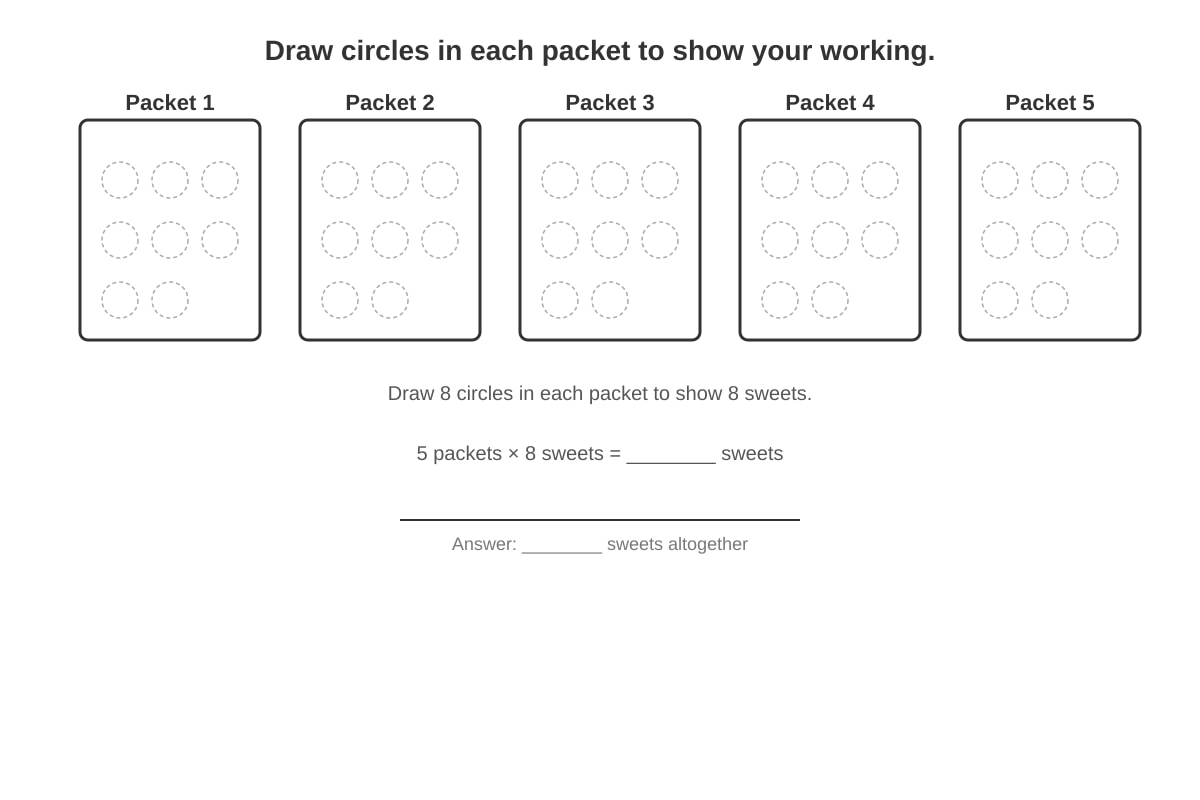
Answer: 40 sweets
Working/Method:
- Method 1 (repeated addition): 8 + 8 + 8 + 8 + 8 = 40
- Method 2 (multiplication concept): 5 groups of 8 = 5 × 8 = 40
Student drawing should show:
- 5 packets with 8 circles/sweets in each
- Total counted: 8, 16, 24, 32, 40
Marking notes:
- 2 marks for correct answer with drawing or working shown
- 1 mark for correct method (drawing 5 groups of 8) but counting error
Key concept: Multiplication as repeated addition or equal groups.
Question 16 (2 marks)
Answer: 5 cupcakes
Working/Method:
- "Equally into 6 boxes" → sharing/division
- 30 ÷ 6 = ?
- Think: 6 × ? = 30
- 6 × 5 = 30, so 30 ÷ 6 = 5
Or repeatedly subtract: 30 − 6 − 6 − 6 − 6 − 6 = 0 (5 sixes)
Marking notes:
- 2 marks for 5 (accept "5 cupcakes")
- 1 mark for method shown (repeated subtraction or multiplication fact)
Common mistake: 30 + 6 = 36 or 30 − 6 = 24 (not understanding "equally").
Section C: Applying Your Knowledge (Questions 17–20)
Question 17 (2 marks)
Answer:
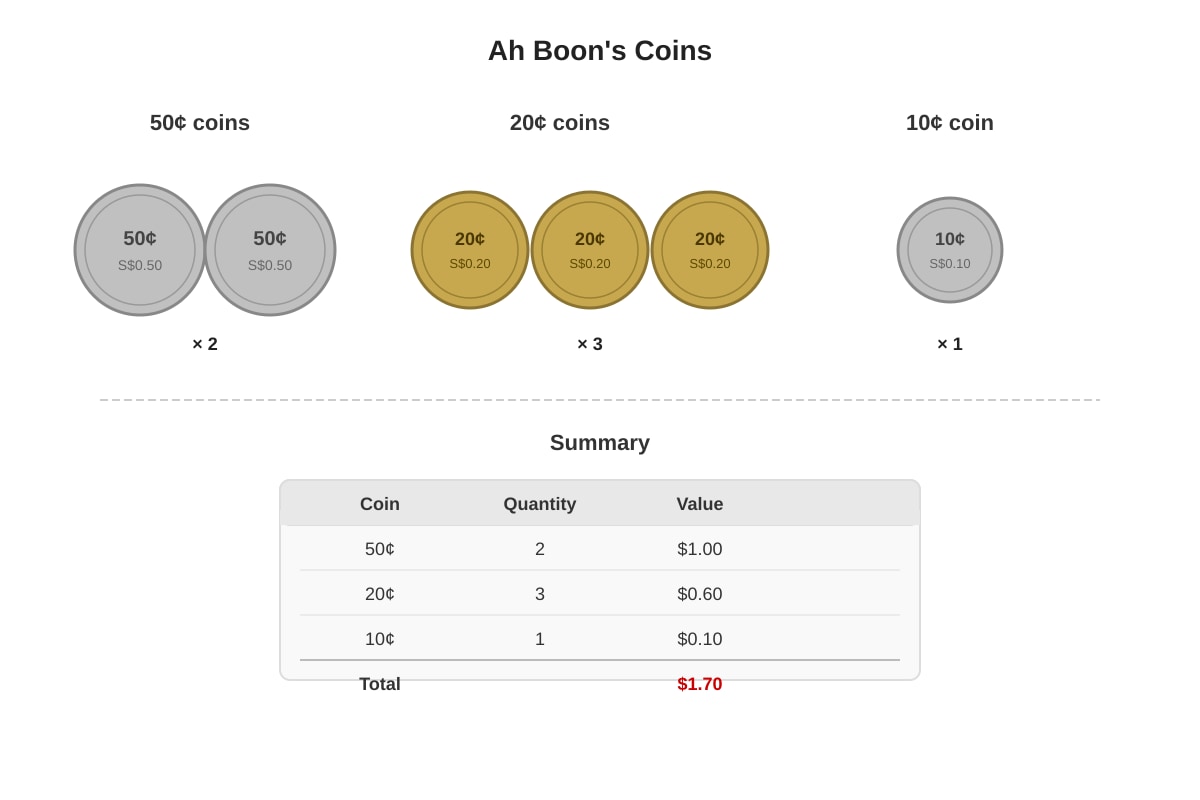
(a) $1.60 (or 160¢)
(b) Yes (circled)
Working/Method: (a)
- Two 50¢ coins: 50¢ + 50¢ = 100¢ = $1.00
- Three 20¢ coins: 20¢ + 20¢ + 20¢ = 60¢
- One 10¢ coin: 10¢
- Total: 0.60 + 1.60** (or 160 cents)
(b) 1.00, so Yes, he has enough.
Marking notes:
- 1 mark for (a): $1.60 or 160¢
- 1 mark for (b): circling Yes
- For (a): accept 1.60 for money notation
Common mistake: Counting coins instead of values (saying "6 coins"); misreading 20¢ as 50¢.
Question 18 (4 marks)
Answer:
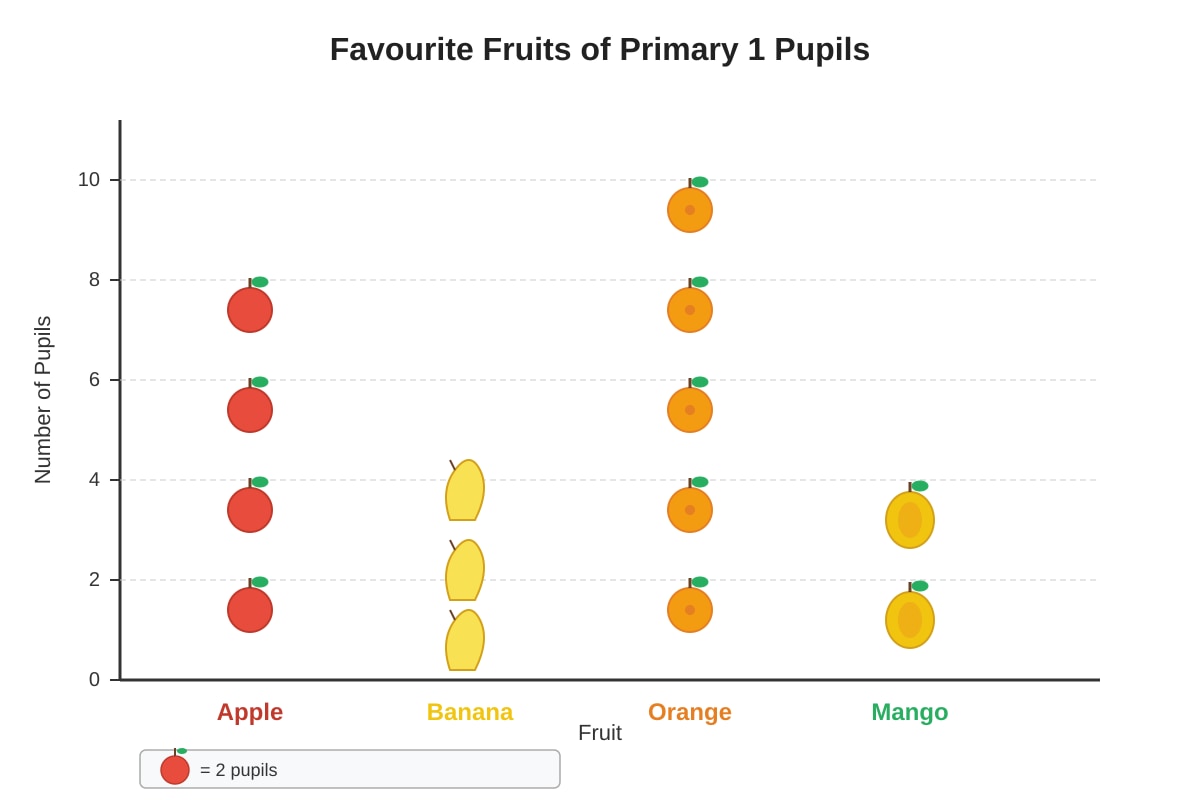
(a) 10 pupils
(b) Orange
(c) 6 pupils
Working/Method:
- Key: Each icon = 2 pupils
(a) Orange: 5 icons × 2 = 10 pupils
(b) Apple: 4 × 2 = 8 pupils
Banana: 3 × 2 = 6 pupils
Orange: 10 pupils
Mango: 2 × 2 = 4 pupils
Orange has the highest number (10 pupils)
(c) Orange − Mango = 10 − 4 = 6 pupils Or: (5 − 2) × 2 = 3 × 2 = 6
Marking notes:
- 1 mark for (a): 10
- 1 mark for (b): Orange
- 2 marks for (c): 6 (1 mark for method: finding difference in icons or pupils; 1 mark for correct answer)
Common mistake: Ignoring the key and counting icons directly (answering 5 for orange instead of 10).
Question 19 (1 mark)
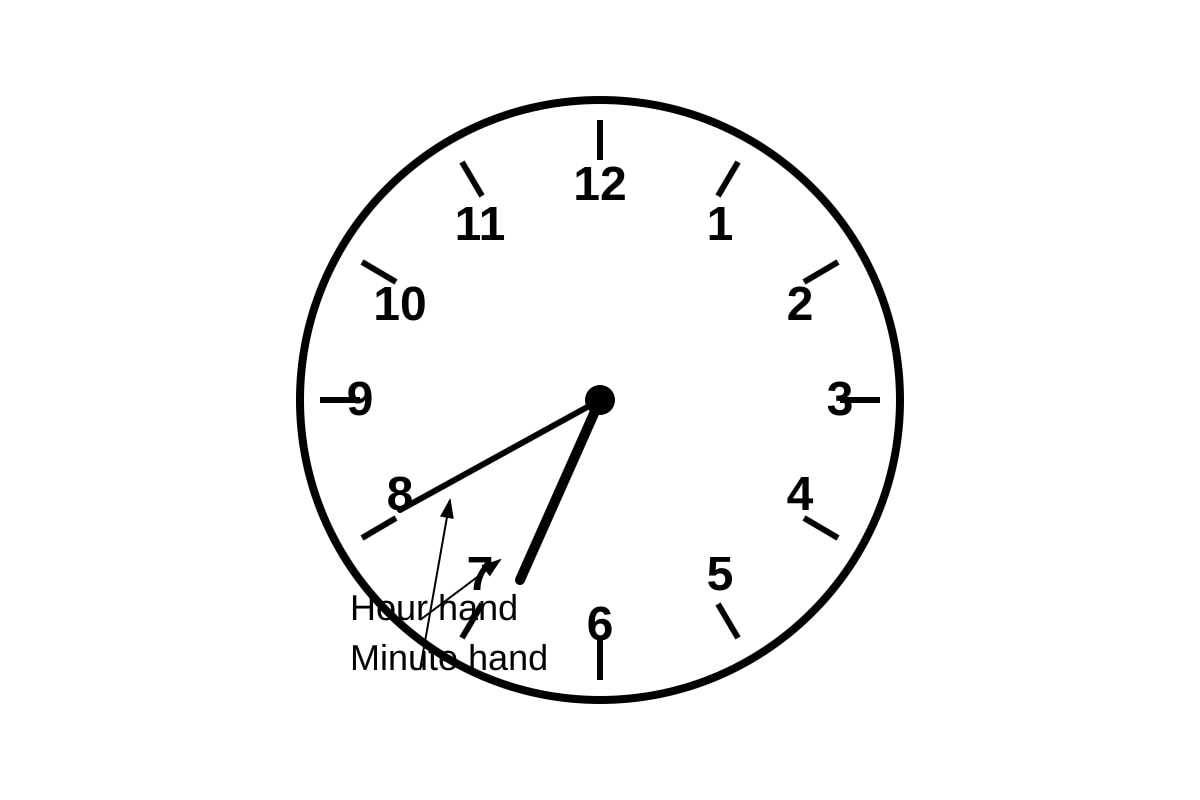
Answer: 6 : 40 (or 6.40)
Working/Method:
- Minute hand at 8: 8 × 5 = 40 minutes
- Hour hand just past 6: 6 o'clock
- Time: 6:40
Marking notes:
- 1 mark for correct time notation
- Accept "6.40" or "6:40" or "6 40"
- Reject "8:30" or other incorrect readings
Common mistake: Thinking minute hand at 8 means "8 minutes"; reading hour hand as pointing to next hour.
Question 20 (1 mark)
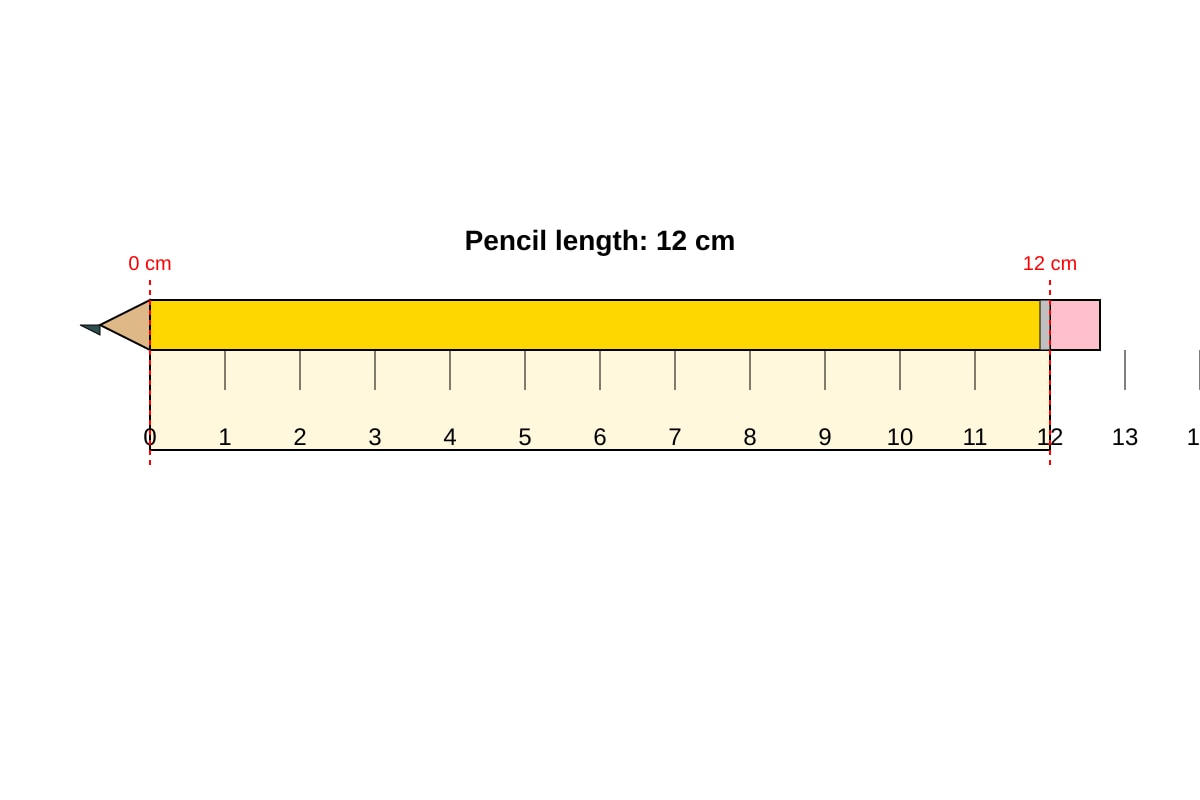
Answer: 12 cm
Working/Method:
- Pencil starts at 0 cm mark
- Pencil ends at 12 cm mark
- Length = end position − start position = 12 − 0 = 12 cm
Marking notes:
- 1 mark for 12 (or "12 cm")
- Accept reasonable visual estimation if image rendering slightly off; answer should be based on stated values in placeholder
Common mistake: Reading end of pencil at 11 or 13 (not aligning carefully); saying "12" without unit.
Summary Marking Table
| Question | Marks | Topic Skill |
|---|---|---|
| 1 | 2 | Counting, numerals and words |
| 2 | 2 | "How many more" subtraction |
| 3 | 2 | Number patterns, skip counting |
| 4 | 2 | Ordering numbers |
| 5 | 2 | Place value (value of digit) |
| 6 | 2 | Comparing numbers |
| 7 | 1 | Adding 10 (place value) |
| 8 | 2 | Place value decomposition |
| 9 | 2 | Addition with regrouping |
| 10 | 2 | Subtraction with regrouping |
| 11 | 2 | Subtraction word problem |
| 12 | 2 | Addition word problem |
| 13 | 2 | Inverse (missing addend) |
| 14 | 2 | Subtraction word problem |
| 15 | 2 | Multiplication as equal groups |
| 16 | 2 | Division as equal sharing |
| 17 | 2 | Money calculation, comparison |
| 18 | 4 | Picture graph interpretation |
| 19 | 1 | Telling time |
| 20 | 1 | Measuring length |
| Total | 40 |
END OF ANSWER KEY