AI Generated Exam Paper
Primary 1 Mathematics Practice Paper 3
Free P1 Maths Practice Paper 3, MiniMax AI version, with questions, answers, and syllabus-aligned practice for Singapore students.
These static practice materials are generated from the site's syllabus and paper-generation workflow, with source and model context shown so students and parents can evaluate the material before use.
Questions
Free quiz and exam paper access
Enter your details to view this paper
Your access is remembered on this device.
Answers
TuitionGoWhere Practice Paper - Mathematics Primary 1 (Version 3 of 5) — Answer Key
Total Marks: 25
Section A: Multiple Choice (4 marks)
1. What is the value of the digit 5 in the number 58?
- Answer: B. 50
- Explanation: In the number 58, the digit 5 is in the tens place. Each ten is worth 10, so 5 tens = 50. The digit 8 is in the ones place and is worth 8 ones.
- Marks: 1
2. Which number comes just after 69?
- Answer: B. 70
- Explanation: Counting on from 69 gives 70. "Just after" means the next whole number in the count.
- Marks: 1
3. Which set of numbers is arranged from the smallest to the greatest?
- Answer: C. 24, 31, 42
- Explanation: 24 is the smallest (2 tens), 31 is in the middle (3 tens), and 42 is the greatest (4 tens). When tens are different, the number with fewer tens is smaller.
- Marks: 1
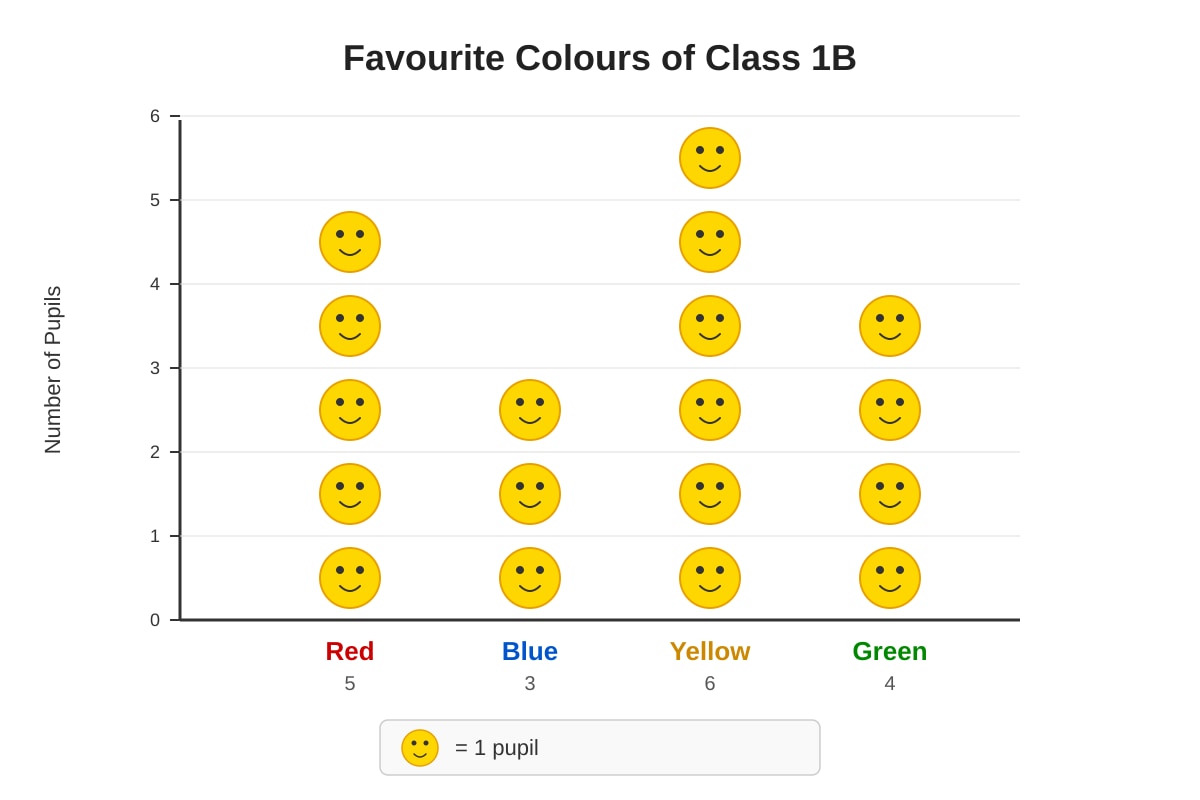
4. How many pupils like blue?
- Answer: A. 3
- Explanation: The picture graph shows 3 smiley faces above "Blue". Each smiley stands for 1 pupil, so 3 pupils like blue.
- Marks: 1
Section B: Short Answers (12 marks)
5. Write "sixty-three" in numerals.
- Answer: 63
- Explanation: "Sixty" = 60 and "three" = 3, so 60 + 3 = 63.
- Marks: 1
6. (a) Digit in the tens place of 47: 4; (b) Digit in the ones place: 7
- Explanation: In 47, the first digit (4) tells us how many tens there are, and the second digit (7) tells us how many ones. So 47 = 4 tens + 7 ones.
- Marks: 1
7. Fill in the missing number: 20, 30, 40, ___, 60, 70
- Answer: 50
- Explanation: The pattern counts up by 10 each time. After 40 comes 50.
- Marks: 1
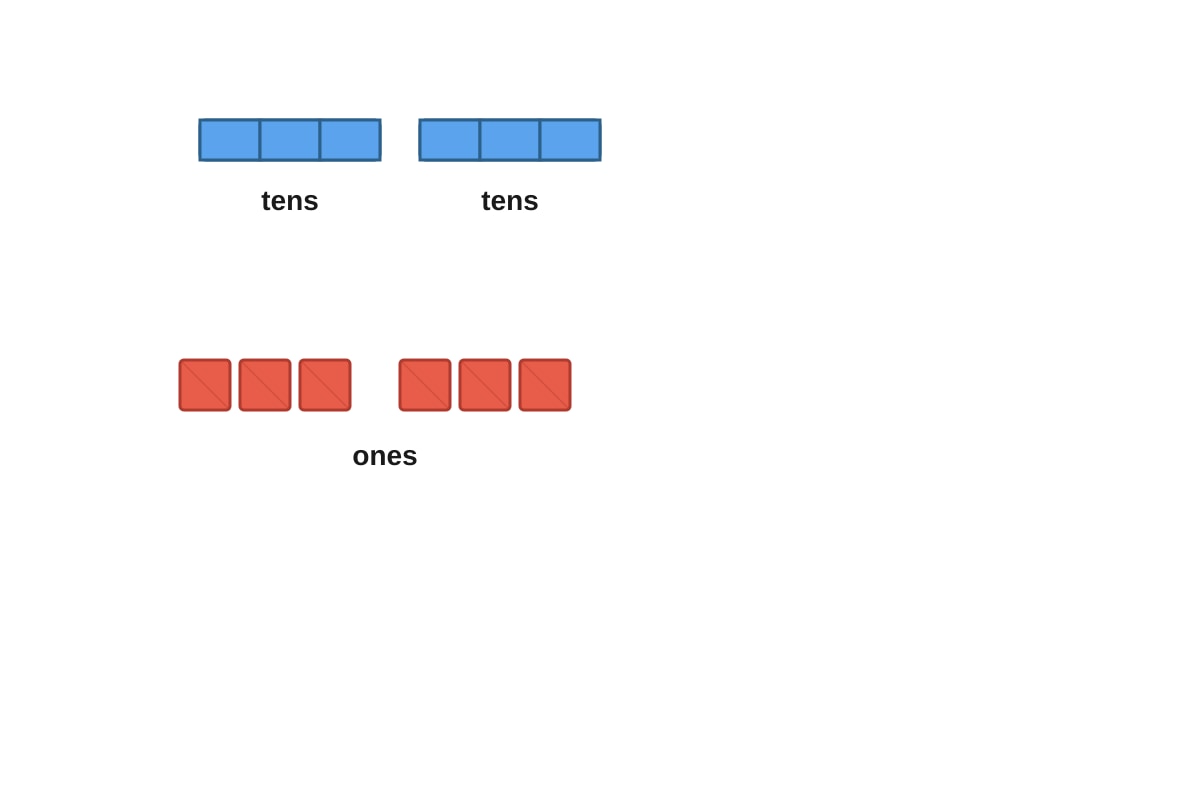
8. Number shown by 2 tens and 6 ones
- Answer: 26
- Explanation: 2 tens = 20, and 6 ones = 6. Adding them: 20 + 6 = 26.
- Marks: 1
9. Compare 35 and 53
- Answer: 35 < 53
- Explanation: Both numbers have 3 and 5 as digits, but the tens digit is different. 35 has 3 tens; 53 has 5 tens. Since 3 < 5, the number 35 is smaller.
- Marks: 1
10. Arrange 71, 17, 47 from greatest to smallest
- Answer: 71, 47, 17
- Explanation: Compare the tens digits first. 71 (7 tens) > 47 (4 tens) > 17 (1 ten).
- Marks: 1
11. Circle the even number(s): 12, 15, 18, 21, 24
- Answer: 12, 18, 24 (students should circle these)
- Explanation: Even numbers end in 0, 2, 4, 6 or 8. 12 ends in 2, 18 ends in 8, 24 ends in 4. The numbers 15 and 21 end in 5 and 1, so they are odd.
- Marks: 1
12. Mei Ling has 3 bags, 6 oranges in each bag. Total?
- Number sentence: 3 × 6 = 18
- Answer: 18 oranges
- Explanation: Multiplication can be read as "3 groups of 6". Counting: 6 + 6 + 6 = 18.
- Mark breakdown: 1 mark for the multiplication sentence, 1 mark for the final answer.
- Marks: 2
13. 20 stickers shared equally among 4 friends.
- Number sentence: 20 ÷ 4 = 5
- Answer: 5 stickers
- Explanation: Sharing equally means each friend gets the same amount. 20 ÷ 4 means how many groups of 4 are in 20, which is 5. Each friend gets 5 stickers.
- Mark breakdown: 1 mark for the division sentence, 1 mark for the final answer.
- Marks: 2
Section C: Show Your Working (9 marks)
14. Apples: 45 → sells 12 → receives 8. Total at end of day?
- Working:
- Step 1: 45 − 12 = 33 (apples left after selling)
- Step 2: 33 + 8 = 41 (apples after receiving 8 more)
- Answer: 41 apples
- Explanation: First, subtract the apples sold (12) from the original 45 to find what's left. Then add the new apples received (8). This is a two-step problem.
- Mark breakdown: 1 mark for the correct first number sentence, 1 mark for the correct second number sentence, 1 mark for the correct final answer with unit.
- Common mistake: Students sometimes do 12 + 8 = 20 first, then subtract from 45 to get 25, which is wrong because the operations happen in a different order than the problem describes.
- Marks: 3
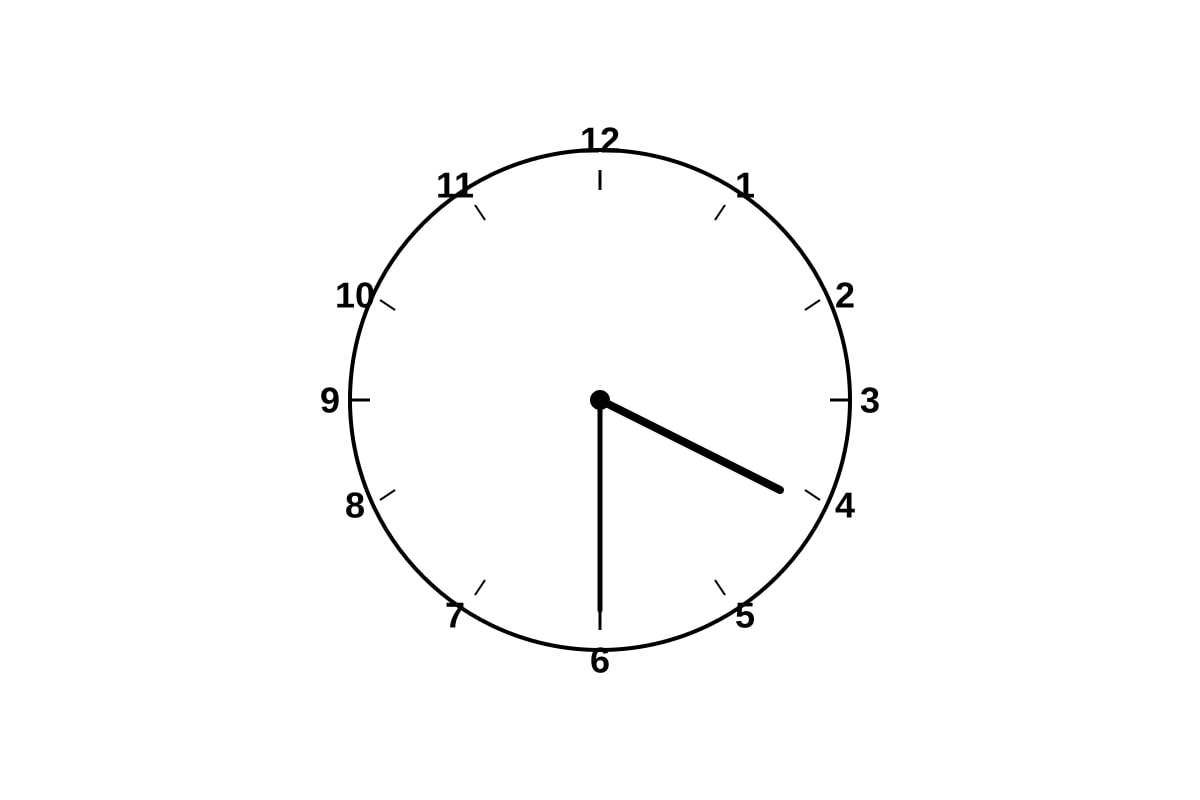
15. What time is shown on the clock? (Hour hand at 4, minute hand at 6)
- Answer: 4 h 30 min (or 4:30, "half past four")
- Explanation: When the minute hand points to 6, it shows 30 minutes past the hour. The hour hand between 4 and 5 (closer to 4) confirms it is 4:30. At Primary 1 level, students are expected to read to 5-minute intervals.
- Mark breakdown: 1 mark for the hour (4), 1 mark for the minutes (30 min).
- Marks: 2
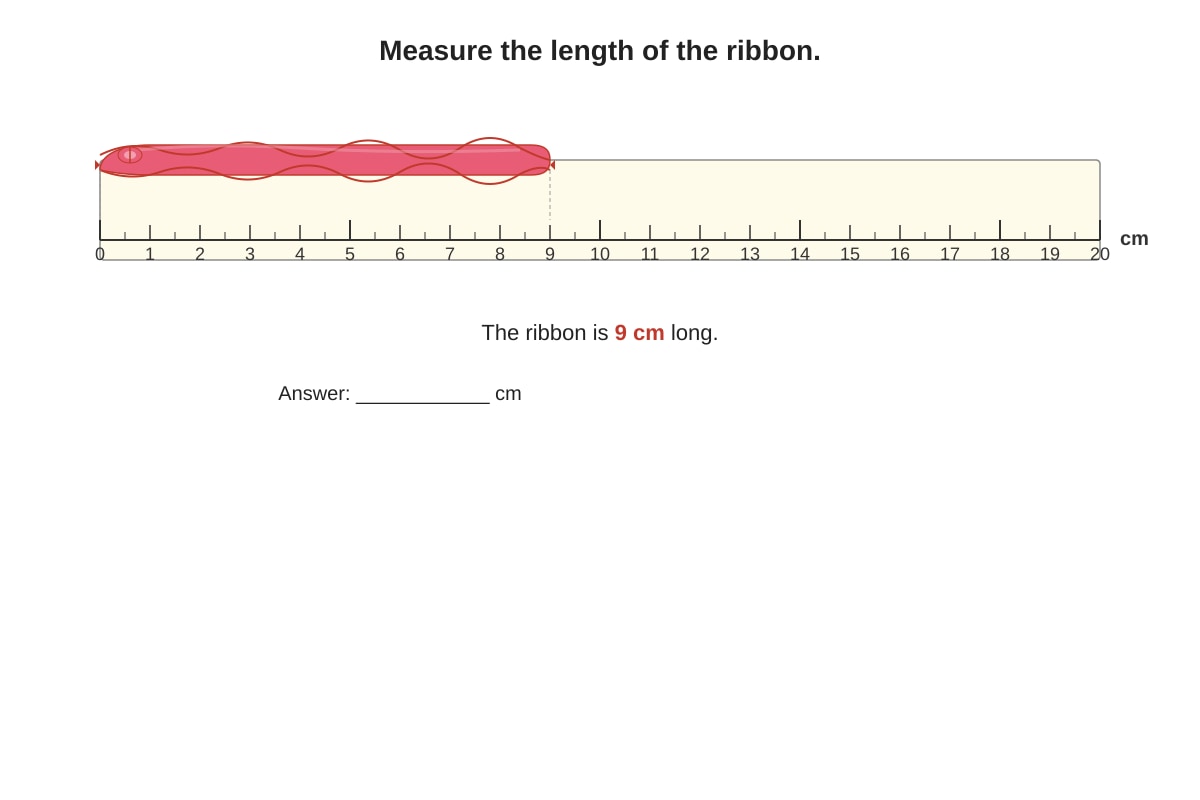
16. Length of the ribbon in cm
- Answer: 9 cm
- Explanation: Place the end of the ribbon at the 0 mark on the ruler. The other end lines up with 9. The measurement is read in whole centimetres, and the abbreviation "cm" must be written.
- Mark breakdown: 1 mark for the number 9, 1 mark for the correct unit "cm".
- Common mistake: Some students may misread 9 as 6 or 8; encourage them to start measuring from 0 each time.
- Marks: 2
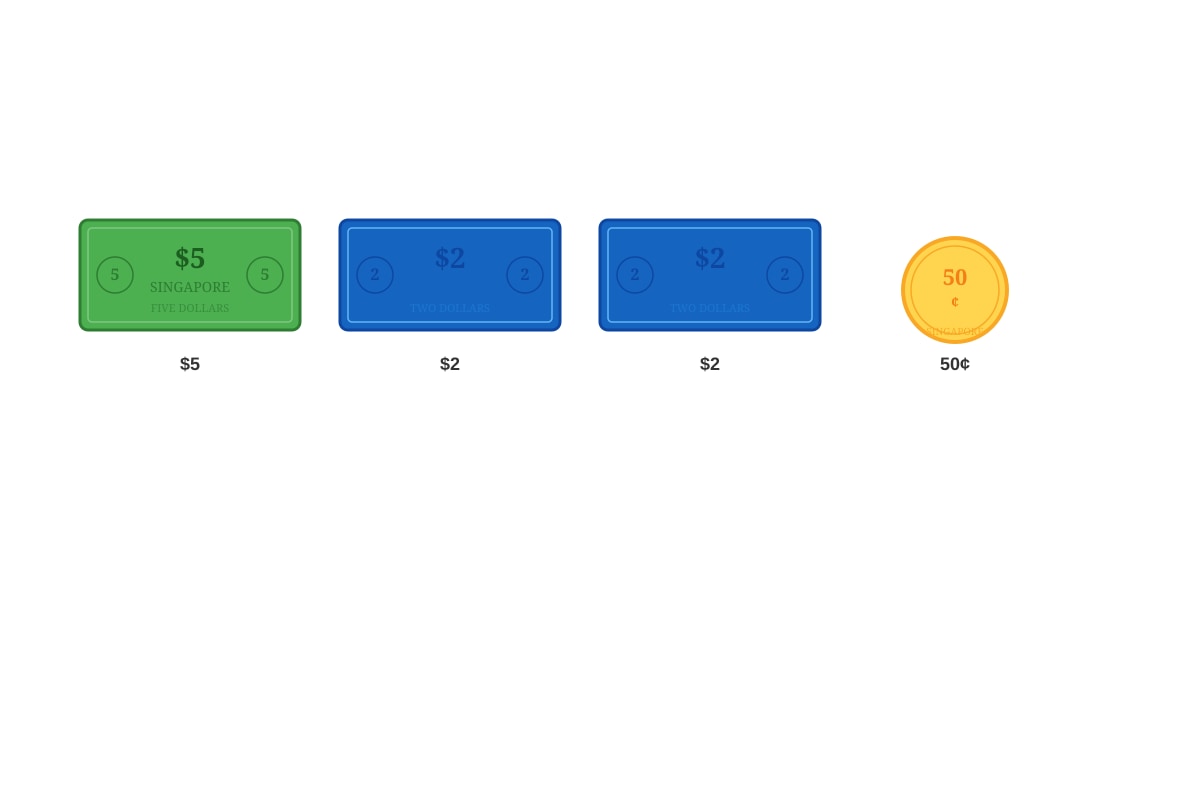
17. Count the money: 1 × 2 + 1 × 50¢
- Working:
- Notes: 2 + 9
- Coin: 50¢
- Total: 9.50
- Answer: $9.50
- Explanation: First add the notes in dollars. Then add the coin. Convert 50¢ to $0.50 when writing the final total. The total is nine dollars and fifty cents.
- Mark breakdown: 1 mark for correct working, 1 mark for the correct final amount written with the $ symbol and two decimal places (or with ¢ symbol clearly).
- Marks: 2
Marking Summary
| Section | Question(s) | Marks |
|---|---|---|
| A | 1–4 | 4 |
| B | 5–11 | 7 |
| B | 12–13 | 4 |
| C | 14 | 3 |
| C | 15 | 2 |
| C | 16 | 2 |
| C | 17 | 2 |
| Total | 25 |
Note to teachers and parents: This paper is AI-generated and syllabus-aligned to the 2021 MOE Singapore Primary Mathematics Syllabus. It is not derived from any past-year paper. Use it as a formative practice tool to check concept coverage in the Numbers topic and related early-Primary-1 strands. The visuals referenced (base-10 blocks, picture graph, clock, ruler, money) must be generated from the <image_placeholder> tags before this paper is used with students.