AI Generated Exam Paper
Primary 1 Mathematics Practice Paper 2
Free P1 Maths Practice Paper 2, MiniMax AI version, with questions, answers, and syllabus-aligned practice for Singapore students.
These static practice materials are generated from the site's syllabus and paper-generation workflow, with source and model context shown so students and parents can evaluate the material before use.
Questions


Free quiz and exam paper access
Enter your details to view this paper
Your access is remembered on this device.
Answers
TuitionGoWhere Practice Paper - Mathematics Primary 1 — Answer Key (Version 2 of 5)
Subject: Mathematics Level: Primary 1 Paper: Practice Paper (Version 2 of 5) Total Marks: 25
Marking notes: This is an AI-generated practice paper. All answers reflect the P1 syllabus scope. Where a question uses a visual placeholder, the answer key describes the data that must be visible in the rendered image for the answer to be correct.
Section A — Whole Numbers
Q1. Value of the digit 5 in 52 (1 mark)
Answer: 5 (ones) — value 5
Teaching notes:
- In the number 52, the digits are 5 (tens) and 2 (ones).
- "Value of the digit 5" means we look at the place of the digit 5: it is in the tens place, so its value is 5 tens = 50.
- Acceptance note: If the student writes only "5", they may lose a mark under stricter marking. The fully correct answer is 50 (or "5 tens"). The 1 mark is for identifying the value of the digit in its place.
- Correct answer for marking: 50 (full 1 mark). Accept "5 tens" as a 1-mark equivalent.
Q2. Write the numeral for the base-10 blocks (1 mark)
Visual required: 4 tens-rods + 6 ones-cubes (declared in the <image_placeholder> for Q2).
Answer: 46
Teaching notes:
- Each long rod is a "ten". 4 rods = 4 tens = 40.
- Each small cube is a "one". 6 cubes = 6 ones = 6.
- Add them: 40 + 6 = 46.
- Common mistake: Students may write "410" (reading the rod as a 10 and adding 6 to it incorrectly) or "64" (reversing tens and ones). Emphasise that the rods are 10s, not 1s.
- 1 mark for 46.
Q3. Arrange 34, 19, 47 from smallest to greatest (1 mark)
Answer: 19, 34, 47
Teaching notes:
- Compare the tens digits first: 1 (in 19) < 3 (in 34) < 4 (in 47).
- So the order is 19, then 34, then 47.
- 1 mark for the correct sequence.
Q4. Missing number in 68, 70, 72, ____, 76 (1 mark)
Answer: 74
Teaching notes:
- The pattern is +2 each time: 68 → 70 → 72 → 74 → 76.
- 1 mark for 74.
Q5. Mei Ling is 5th in the queue — how many in front of her? (1 mark)
Answer: 4
Teaching notes:
- Mei Ling is the 5th person. The people before her are 1st, 2nd, 3rd, 4th = 4 people.
- Concept: ordinal numbers. The "n-th" position has (n − 1) people in front of it.
- 1 mark for 4.
Q6. Compare 55 and 45 (1 mark)
Answer: 55 > 45 (or simply ">")
Teaching notes:
- Compare tens first: 5 tens vs 4 tens. 5 tens is greater.
- So 55 is greater than 45, written as 55 > 45.
- 1 mark for the correct sign (or full statement).
Q7. Write "sixty-three" in numerals (1 mark)
Answer: 63
Teaching notes:
- "sixty" = 60, "three" = 3. Combine: 60 + 3 = 63.
- 1 mark for 63.
Q8. Count by 5s: 25, 30, ____, 40, ____ (1 mark)
Answer: 35 and 45
Teaching notes:
- Counting by 5s: 25, 30, 35, 40, 45.
- The first blank is 35 (30 + 5), the second blank is 45 (40 + 5).
- 1 mark for both blanks correct. If only one is correct, award 0 (or use partial credit per blank: ½ mark each is acceptable per school policy).
Q9. 7 apples + 4 more apples (2 marks)
Mark breakdown:
- 1 mark for the number sentence 7 + 4 = 11 (or equivalent, e.g., 4 + 7 = 11).
- 1 mark for the answer 11 apples (with units, if required).
Answer:
- Number sentence: 7 + 4 = 11
- Answer: 11 apples
Teaching notes:
- "Altogether" signals addition. Combine 7 and 4.
- Emphasise the unit "apples" in the final sentence.
Q10. 18 stickers − 9 stickers (2 marks)
Mark breakdown:
- 1 mark for the number sentence 18 − 9 = 9 (or equivalent).
- 1 mark for the answer 9 stickers.
Answer:
- Number sentence: 18 − 9 = 9
- Answer: 9 stickers
Teaching notes:
- "Gives away" signals subtraction (take away).
- Common mistake: students may write 18 + 9 = 27. Reinforce the meaning of "left".
Section B — Addition and Subtraction
Q11. (a) 36 + 20 = ? and (b) 58 − 24 = ? (2 marks)
Answers:
- (a) 56
- (b) 34
Teaching notes:
- (a) Add tens: 3 tens + 2 tens = 5 tens = 50. Then add ones: 50 + 6 = 56. No renaming needed.
- (b) Subtract tens: 5 tens − 2 tens = 3 tens = 30. Subtract ones: 8 − 4 = 4. Combine: 34.
- 1 mark per correct part.
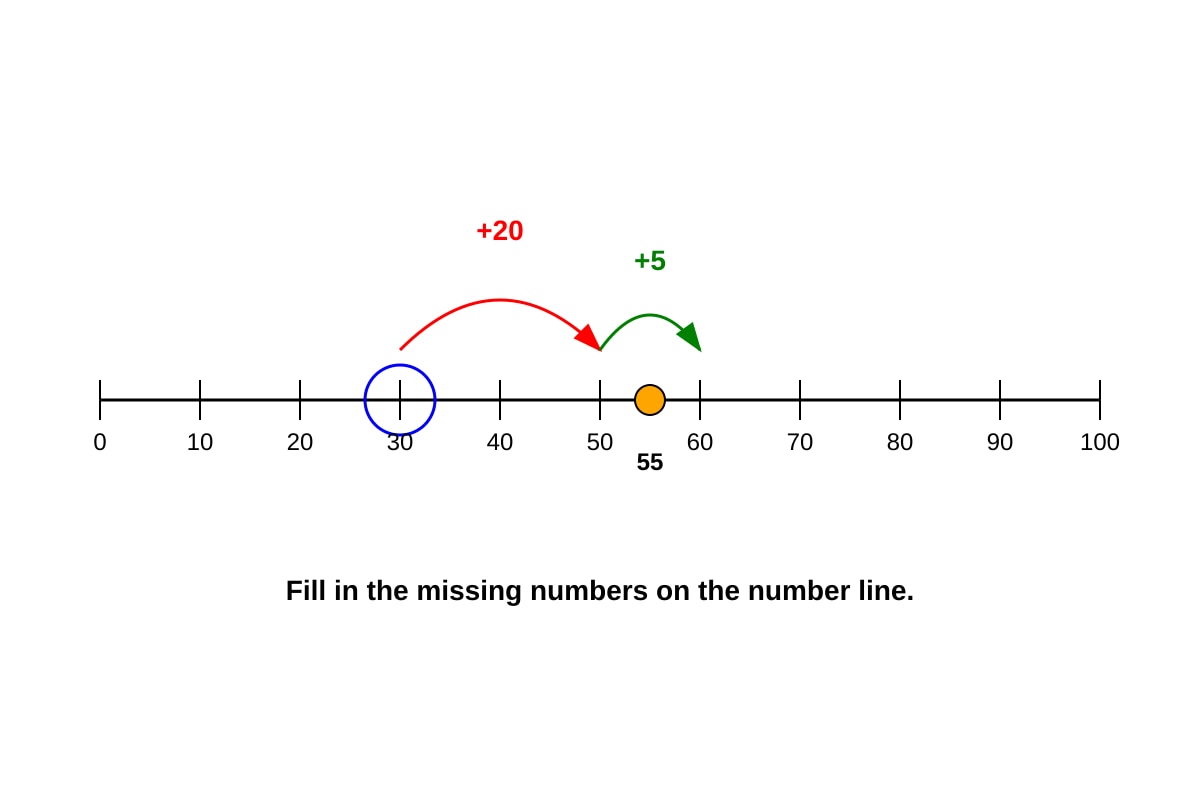
Q12. Number-line jumps (2 marks)
Visual required: A number line 0–100 with arrows showing 30 → +20 → 50 → +5 → 55.
Answers:
- (a) 30 + 20 + 5 = 55
- (b) 30 + 20 = 50; 50 + 5 = 55. (Accept "30 + 25 = 55" as a combined number sentence.)
Mark breakdown:
- 1 mark for (a) 55.
- 1 mark for a correct number sentence in (b) — e.g., 30 + 20 = 50, 50 + 5 = 55 (or 30 + 25 = 55).
Teaching notes:
- The number line supports the idea of "adding on". The student sees two jumps and combines them.
- This question is a bridge between the number-line model and the standard addition algorithm.
Q13. 24 + 35 = ? (word problem) (2 marks)
Answers:
- Number sentence: 24 + 35 = 59
- Answer: 59 marbles
Mark breakdown:
- 1 mark for the number sentence.
- 1 mark for the answer 59 (with "marbles" in the answer sentence).
Teaching notes:
- Add tens: 2 tens + 3 tens = 5 tens = 50.
- Add ones: 4 + 5 = 9.
- Combine: 50 + 9 = 59. No renaming required.
- Common mistake: students may line up the digits incorrectly. Emphasise tens under tens, ones under ones.
Q14. 67 − 32 = ? (word problem) (2 marks)
Answers:
- Number sentence: 67 − 32 = 35
- Answer: 35 toys
Mark breakdown:
- 1 mark for the number sentence.
- 1 mark for the answer 35 (with "toys" in the answer sentence).
Teaching notes:
- Subtract tens: 6 tens − 3 tens = 3 tens = 30.
- Subtract ones: 7 − 2 = 5.
- Combine: 30 + 5 = 35. No renaming required.
- Reinforce: "were sold" → take away → subtraction.
Section C — Money and Word Problem
Q15. Count the coins (2 marks)
Visual required: 1 × 50¢, 2 × 20¢, 1 × 10¢ (in that order, with cents symbols labelled under each coin).
Answer: 100¢ or 1.00)
Mark breakdown:
- 1 mark for the working: 50 + 20 + 20 + 10 = 100.
- 1 mark for the final amount in correct form: 100¢ (or equivalent $1).
Teaching notes:
- Add the coins step by step: 50 + 20 = 70; 70 + 20 = 90; 90 + 10 = 100 cents.
- 100 cents = **1.00).
- Common mistake: students may write "$10" or "10¢" because they misread the last coin. Reinforce: the small coin is 10 cents, not 10 dollars.
Q16. Sam has 7 (2 marks)
Answers:
- Number sentence: 7 = $3
- Answer: $3
Mark breakdown:
- 1 mark for the number sentence (with $ symbols on each number).
- 1 mark for $3 as the answer.
Teaching notes:
- "Has left" → subtraction.
- 1 ten-dollar note minus 7 dollars leaves 3 dollars.
- The unit "$" must be in the number sentence and the answer.
Q17. Two-step word problem (3 marks)
Question recap: 28 children at the playground + 9 more came − 12 went home = ?
Mark breakdown:
- 1 mark for Step 1 number sentence: 28 + 9 = 37
- 1 mark for Step 2 number sentence: 37 − 12 = 25
- 1 mark for the final answer in a sentence: 25 children were at the playground in the end.
Full working:
- Step 1: 28 + 9 = 37 (28 + 2 = 30, 30 + 7 = 37)
- Step 2: 37 − 12 = 25 (37 − 10 = 27, 27 − 2 = 25)
- Answer: 25 children
Teaching notes:
- Two-step problems must be solved in the correct order. Read carefully: first children are added, then children are taken away.
- Encourage a clear, written plan: "First I add, then I subtract."
- Common mistake: students sometimes subtract 12 first (28 − 12 = 16, then 16 + 9 = 25). The final number is the same here by accident, but the order of operations is the learning point. Award full credit if the final answer is 25 and the number sentences match the steps the student performed; if a school marks strictly on order, the model answer above is the reference.
Mark Summary
| Section | Question numbers | Marks |
|---|---|---|
| A — Whole Numbers | Q1–Q10 | 10 |
| B — Addition and Subtraction | Q11–Q14 | 8 |
| C — Money and Word Problem | Q15–Q17 | 7 |
| Total | 25 |
All section marks and question marks add up exactly to the stated Total Marks: 25.