AI Generated Exam Paper

Primary 1 Mathematics Practice Paper 1

Free AI-Generated NVIDIA Nemotron 3 Ultra 550B A55B Free Primary 1 Mathematics Practice Paper 1 practice paper with questions and answers for Singapore students. This page is rendered as a direct URL so the questions and answers can be discovered without pressing in-page buttons.

These static practice materials are generated from the site's syllabus and paper-generation workflow, with source and model context shown so students and parents can evaluate the material before use.

Primary 1 Mathematics AI Generated Generated by NVIDIA Nemotron 3 Ultra 550B A55B Free Updated 2026-06-06

Questions

<!-- TuitionGoWhere generation metadata: stage=5-2; model=nvidia/nemotron-3-ultra-550b-a55b:free; model_label=NVIDIA Nemotron 3 Ultra 550B A55B Free; generated=2026-06-05; Sources: Stage 4-0 LLM templates, syllabus context, and Stage 2 evidence where available. -->

TuitionGoWhere Practice Paper - Mathematics Primary 1

TuitionGoWhere Practice Paper (AI)
Subject: Mathematics
Level: Primary 1
Paper: Practice Paper 1 (Version 1)
Duration: 45 minutes
Total Marks: 40

Name: _______________________
Class: _______________________
Date: _______________________


Instructions to Candidates

  1. Do not open this booklet until you are told to do so.
  2. Follow all instructions carefully.
  3. Answer all questions.
  4. Write your answers in this booklet.
  5. The number of marks is given in brackets [ ] at the end of each question or part question.
  6. The total marks for this paper is 40.

Section A: Multiple Choice Questions (10 marks)

Questions 1 to 10 carry 1 mark each. Choose the correct answer and write its number (1, 2, 3 or 4) in the brackets provided.

1. Count the stars below. How many stars are there altogether?

<image_placeholder> id: Q1-fig1 type: figure linked_question: Q1 description: 18 stars arranged in 3 rows of 6 labels: None values: 18 stars total must_show: 18 distinct star symbols in a clear grid </image_placeholder>

(1) 16
(2) 17
(3) 18
(4) 19

Answer: (_____) [1]

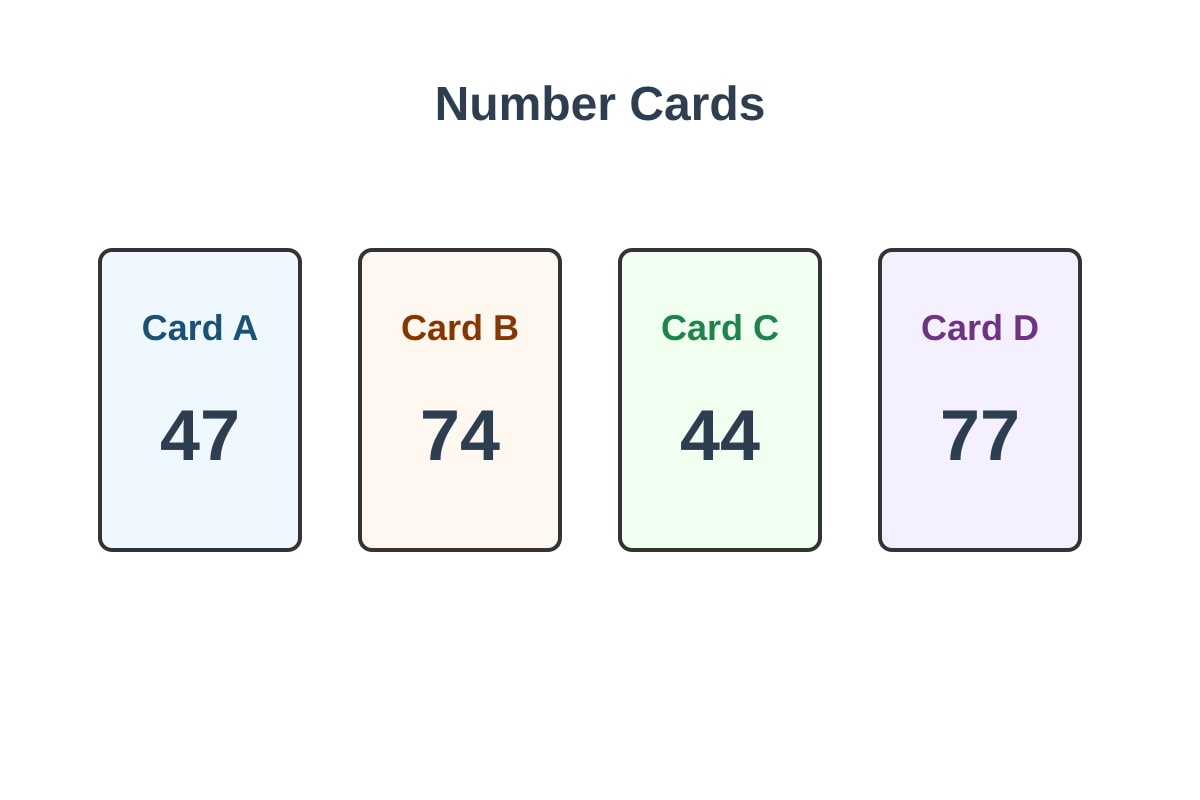
2. What is the value of the digit 5 in the number 58?

(1) 5
(2) 8
(3) 50
(4) 58

Answer: (_____) [1]

3. Which of the following numbers is the smallest?

(1) 42
(2) 24
(3) 34
(4) 43

Answer: (_____) [1]

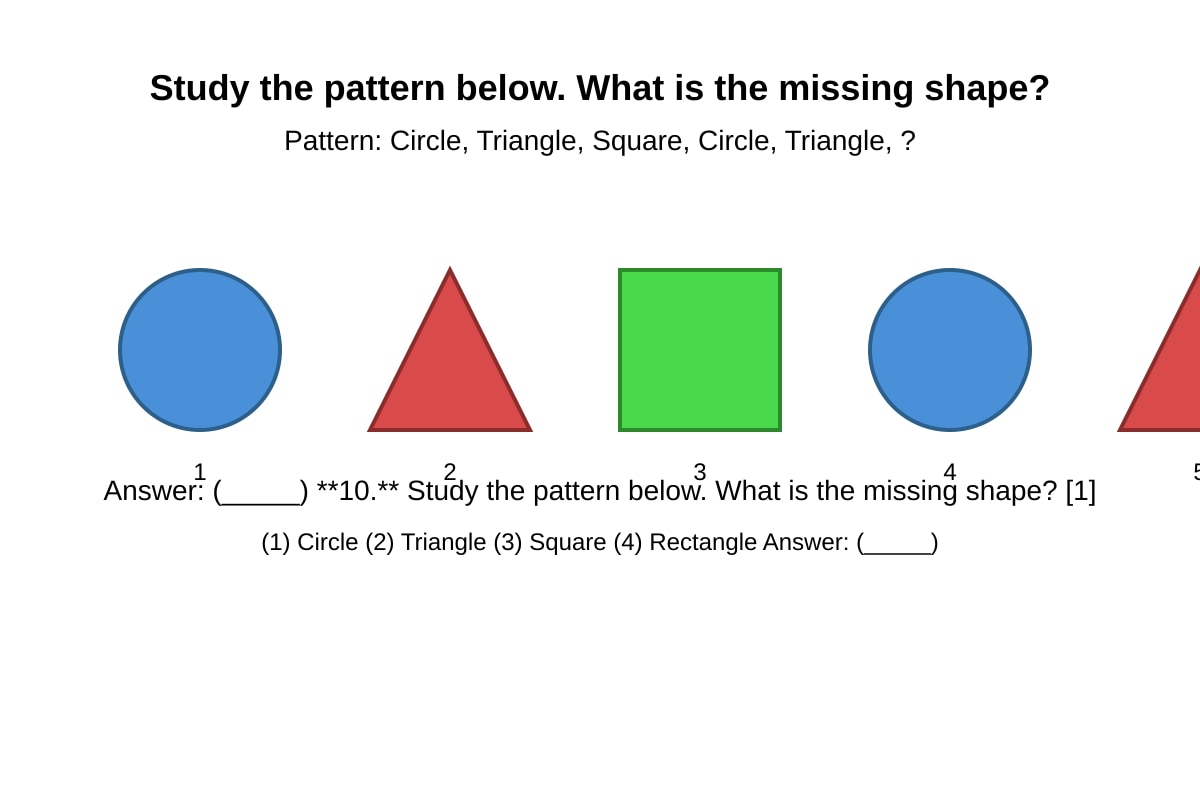
4. Look at the number pattern below. What is the missing number?

12, 14, 16, _____, 20, 22

(1) 17
(2) 18
(3) 19
(4) 21

Answer: (_____) [1]

5. Which number comes just before 50?

(1) 48
(2) 49
(3) 51
(4) 52

Answer: (_____) [1]

6. In the number 73, which digit is in the ones place?

(1) 3
(2) 7
(3) 73
(4) 30

Answer: (_____) [1]

7. Arrange the following numbers from the smallest to the biggest.

65, 56, 46, 64

(1) 46, 56, 64, 65
(2) 46, 64, 56, 65
(3) 56, 46, 64, 65
(4) 65, 64, 56, 46

Answer: (_____) [1]

8. What is the missing number in the box?

35 = 3 tens + _____ ones

(1) 3
(2) 5
(3) 30
(4) 35

Answer: (_____) [1]

9. There are 24 children in a class. 12 are boys. How many are girls?

(1) 10
(2) 11
(3) 12
(4) 13

Answer: (_____) [1]

10. Which of the following shows the number forty-six in numerals?

(1) 46
(2) 64
(3) 406
(4) 460

Answer: (_____) [1]


Section B: Short Answer Questions (20 marks)

Questions 11 to 20 carry 2 marks each. Show your working clearly and write your answers in the spaces provided.

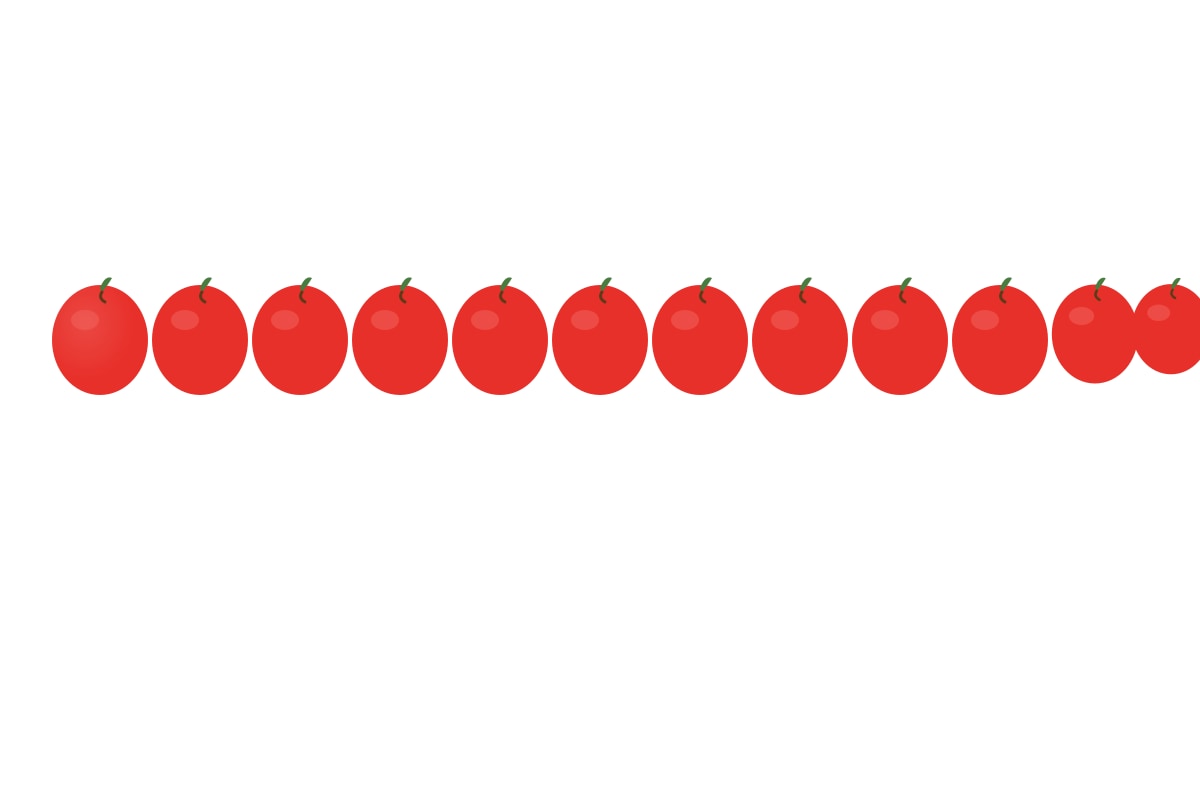
11. Count the apples and write the number in numerals and in words.

<image_placeholder> id: Q11-fig1 type: figure linked_question: Q11 description: 27 apples arranged in groups labels: None values: 27 apples total must_show: 27 distinct apple symbols, grouped for easier counting </image_placeholder>

Numerals: _______________
Words: _______________________________ [2]

12. Fill in the blanks.

(a) 48 = _____ tens + _____ ones
(b) 60 = _____ tens + _____ ones

[2]

13. Circle the bigger number in each pair.

(a) 29 or 92
(b) 57 or 75

[2]

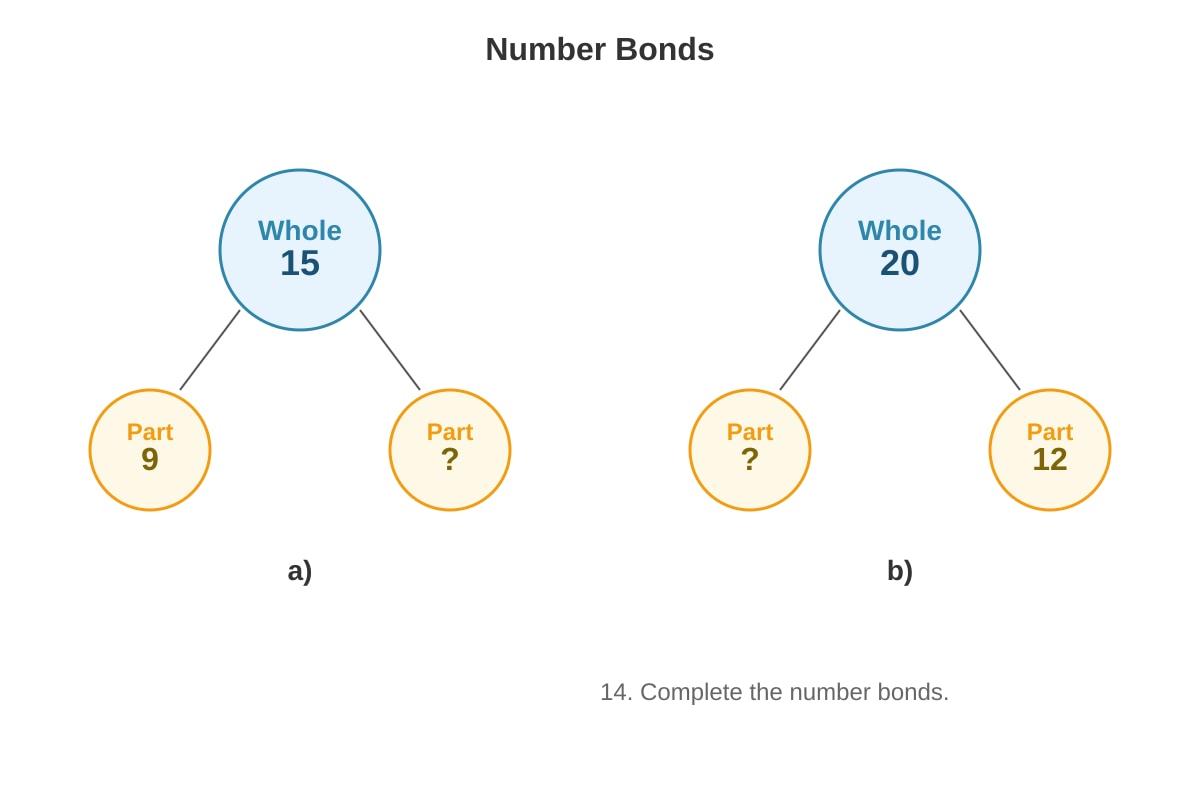
14. Complete the number patterns.

(a) 5, 10, 15, _____, 25, _____
(b) 40, 35, 30, _____, _____, 15

[2]

15. Write the missing numbers in the boxes.

(a) 1 more than 39 is _____
(b) 1 less than 50 is _____
(c) 10 more than 26 is _____
(d) 10 less than 83 is _____

[2]

16. Look at the numbers below.

38, 45, 29, 52, 41

(a) Which is the biggest number? _____
(b) Which is the smallest number? _____

[2]

17. Fill in the blanks with the correct ordinal numbers.

(a) The _____ (5th / fifth) day of the week is Friday.
(b) My birthday is on the _____ (8th / eighth) of June.

[2]

18. There are 36 stickers in a packet. Ali uses 14 stickers. How many stickers are left?

Working:
Answer: _____ stickers [2]

19. Mrs Tan has 45 cupcakes. She bakes 23 more cupcakes. How many cupcakes does she have altogether?

Working:
Answer: _____ cupcakes [2]

20. Study the picture below and answer the question.

<image_placeholder> id: Q20-fig1 type: figure linked_question: Q20 description: Two groups of objects for comparison - Group A has 15 pencils, Group B has 22 erasers labels: Group A, Group B values: Group A: 15 pencils, Group B: 22 erasers must_show: Clear visual separation between Group A and Group B with countable objects </image_placeholder>

How many more erasers than pencils are there?

Working:
Answer: _____ more erasers [2]


Section C: Word Problems (10 marks)

Questions 21 to 25 carry 2 marks each. Read each question carefully. Show your working clearly and write your answers in the spaces provided.

21. Sam has 28 marbles. He gives 15 marbles to his brother. How many marbles does Sam have left?

Working:
Answer: _____ marbles [2]

22. There are 17 red balloons and 24 blue balloons at a party. How many balloons are there altogether?

Working:
Answer: _____ balloons [2]

23. A book has 50 pages. Mary reads 12 pages on Monday and 15 pages on Tuesday. How many pages does she have left to read?

Working:
Answer: _____ pages [2]

24. There are 4 boxes of crayons. Each box has 10 crayons. How many crayons are there in total?

Working:
Answer: _____ crayons [2]

25. Farmer Lee has 36 chickens. He sells 18 chickens and buys 5 more chickens. How many chickens does he have now?

Working:
Answer: _____ chickens [2]


END OF PAPER
Total Marks: 40

Answers

<!-- TuitionGoWhere generation metadata: stage=5-2; model=nvidia/nemotron-3-ultra-550b-a55b:free; model_label=NVIDIA Nemotron 3 Ultra 550B A55B Free; generated=2026-06-05; Sources: Stage 4-0 LLM templates, syllabus context, and Stage 2 evidence where available. -->

TuitionGoWhere Practice Paper - Mathematics Primary 1 (Answer Key)

Subject: Mathematics
Level: Primary 1
Paper: Practice Paper 1 (Version 1)
Total Marks: 40


Section A: Multiple Choice Questions (10 marks)

1. Answer: (3) 18 [1]
Count all stars carefully. There are 3 rows of 6 stars each. 6 + 6 + 6 = 18.

2. Answer: (3) 50 [1]
In 58, the digit 5 is in the tens place. Its value is 5 tens = 50. The digit 8 is in the ones place with value 8.

3. Answer: (2) 24 [1]
Compare the tens digit first: 24 has 2 tens, 42 has 4 tens, 34 has 3 tens, 43 has 4 tens. 2 tens is the smallest.

4. Answer: (2) 18 [1]
The pattern increases by 2 each time: 12, 14, 16, 18, 20, 22. 16 + 2 = 18.

5. Answer: (2) 49 [1]
The number before 50 is one less: 50 - 1 = 49.

6. Answer: (1) 3 [1]
In 73, the rightmost digit (3) is in the ones place. The left digit (7) is in the tens place.

7. Answer: (1) 46, 56, 64, 65 [1]
Compare tens first: 46 (4 tens), 56 (5 tens), 64 (6 tens), 65 (6 tens). For 64 and 65, compare ones: 4 < 5.

8. Answer: (2) 5 [1]
35 = 3 tens + 5 ones. The digit in the ones place is 5.

9. Answer: (3) 12 [1]
Total children = 24, Boys = 12. Girls = 24 - 12 = 12.

10. Answer: (1) 46 [1]
Forty-six = 4 tens and 6 ones = 46. Option (2) is sixty-four, (3) and (4) are three-digit numbers.


Section B: Short Answer Questions (20 marks)

11. Numerals: 27
Words: twenty-seven [2]
Count the apples: 27. In words, numbers 21-99 use a hyphen: twenty-seven.

12. (a) 48 = 4 tens + 8 ones
(b) 60 = 6 tens + 0 ones [2]
For 48: 4 in tens place = 40, 8 in ones place = 8. For 60: 6 in tens place = 60, 0 in ones place = 0.

13. (a) 92 (b) 75 [2]
Compare tens digit: 92 has 9 tens, 29 has 2 tens → 92 is bigger. 75 has 7 tens, 57 has 5 tens → 75 is bigger.

14. (a) 5, 10, 15, 20, 25, 30
(b) 40, 35, 30, 25, 20, 15 [2]
(a) Pattern adds 5 each time (counting in fives). (b) Pattern subtracts 5 each time (counting back in fives).

15. (a) 40 (b) 49 (c) 36 (d) 73 [2]
(a) 39 + 1 = 40. (b) 50 - 1 = 49. (c) 26 + 10 = 36 (add 1 ten). (d) 83 - 10 = 73 (subtract 1 ten).

16. (a) 52 (b) 29 [2]
Compare all numbers: 29 (2 tens), 38 (3 tens), 41 (4 tens), 45 (4 tens), 52 (5 tens). Biggest = 52, Smallest = 29.

17. (a) fifth (b) eighth [2]
Ordinal numbers for position: 5th = fifth, 8th = eighth. Spell out the words as requested.

18. Working: 36 - 14 = 22
Answer: 22 stickers [2]
Subtract the stickers used from the total: 36 - 10 = 26, 26 - 4 = 22. Or: 36 - 14 = 22 directly.

19. Working: 45 + 23 = 68
Answer: 68 cupcakes [2]
Add the cupcakes baked to the original amount: 45 + 20 = 65, 65 + 3 = 68. Or: 45 + 23 = 68 directly.

20. Working: 22 - 15 = 7
Answer: 7 more erasers [2]
Group B has 22 erasers, Group A has 15 pencils. To find "how many more", subtract: 22 - 15 = 7.


Section C: Word Problems (10 marks)

21. Working: 28 - 15 = 13
Answer: 13 marbles [2]
Sam gives away marbles, so subtract: 28 - 10 = 18, 18 - 5 = 13. Sam has 13 marbles left.

22. Working: 17 + 24 = 41
Answer: 41 balloons [2]
"Altogether" means add: 17 + 20 = 37, 37 + 4 = 41. Total balloons = 41.

23. Working: 12 + 15 = 27 (pages read), 50 - 27 = 23
Answer: 23 pages [2]
Step 1: Find total pages read: 12 + 15 = 27. Step 2: Subtract from total pages: 50 - 27 = 23 pages left.

24. Working: 4 × 10 = 40 (or 10 + 10 + 10 + 10 = 40)
Answer: 40 crayons [2]
4 boxes of 10 crayons each. This is 4 groups of 10. Add: 10 + 10 + 10 + 10 = 40. Or multiply: 4 × 10 = 40.

25. Working: 36 - 18 = 18, 18 + 5 = 23
Answer: 23 chickens [2]
Step 1: Subtract chickens sold: 36 - 18 = 18. Step 2: Add chickens bought: 18 + 5 = 23 chickens now.


Total Marks: 40

Marking Notes for Teachers/Parents:

  • Section A (MCQ): 1 mark each. No partial credit. Accept the option number written in brackets.
  • Section B (Short Answer): 2 marks each. Award 1 mark for correct method with calculation error, 2 marks for fully correct answer. For Q11, 1 mark for correct numerals, 1 mark for correct words (hyphen required for twenty-seven).
  • Section C (Word Problems): 2 marks each. Award 1 mark for correct first step (e.g., Q23: correct addition of pages read), 2 marks for complete correct solution with answer. Working must be shown for full marks.
  • Common Errors: Confusing "value of digit" vs "digit itself" (Q2), reversing numbers when comparing (Q3, Q7), wrong operation for "how many more" (Q20), missing steps in two-step problems (Q23, Q25).