AI Generated Exam Paper
Primary 1 Mathematics Practice Paper 1
Free P1 Maths Practice Paper 1, MiniMax AI version, with questions, answers, and syllabus-aligned practice for Singapore students.
These static practice materials are generated from the site's syllabus and paper-generation workflow, with source and model context shown so students and parents can evaluate the material before use.
Questions
Free quiz and exam paper access
Enter your details to view this paper
Your access is remembered on this device.
Answers
TuitionGoWhere Practice Paper 1 - Mathematics Primary 1 (Answers)
Paper: Practice Paper 1 (Version 1 of 5) Total Marks: 25 Note: This answer key matches the question numbering exactly. Step-by-step working and teaching notes are provided for each item.
Section A: Counting and Place Value (5 marks)
Question 1 (1 mark) Answer: 4 (ones)
Teaching note: In the number 42, the digit 4 is in the tens place, but the question asks for the value of the digit, which is the digit itself (4). The digit 4 is in the ones place. Some marking schemes accept just "4" while others require "4 ones" for full clarity. For P1 students, the place value concept is being introduced: the first digit from the right is the ones place, the second digit from the right is the tens place. In 42, the 2 is in the ones place and the 4 is in the tens place. So the digit 4 has a place value of "tens" but the digit itself is 4. The "value" of the digit 4 in 42 is 40 (4 tens), but for P1 level, the answer expected is identifying the digit 4 in its place. Accept "4" or "4 ones" based on the school's marking convention. Common mistake: Students often say "4 tens" when asked for the digit, confusing the digit with its place value.
Question 2 (1 mark) Answer: 60 (or 6 tens)
Teaching note: In the number 67, the digit 7 is in the ones place. The value of 7 ones is 7. However, the digit 6 is in the tens place. The value of 6 tens is 60. For P1, the answer is 7 (ones) if asking about digit 7, or 60 (six tens) if asking about the value. The question asks for the value of the digit 7, which is 7 ones = 7. Common mistake: Students may write "7 tens" by mistake.
Question 3 (1 mark) Answer: 38
Teaching note: 3 tens = 30, and 8 ones = 8. So 30 + 8 = 38. This reinforces the concept that a two-digit number is made up of tens and ones. Common mistake: Students may write 308 (treating each group as a separate digit) or 11 (adding 3 + 8). Emphasize that 3 tens means 30, not 3.
Question 4 (1 mark) Answer: 5
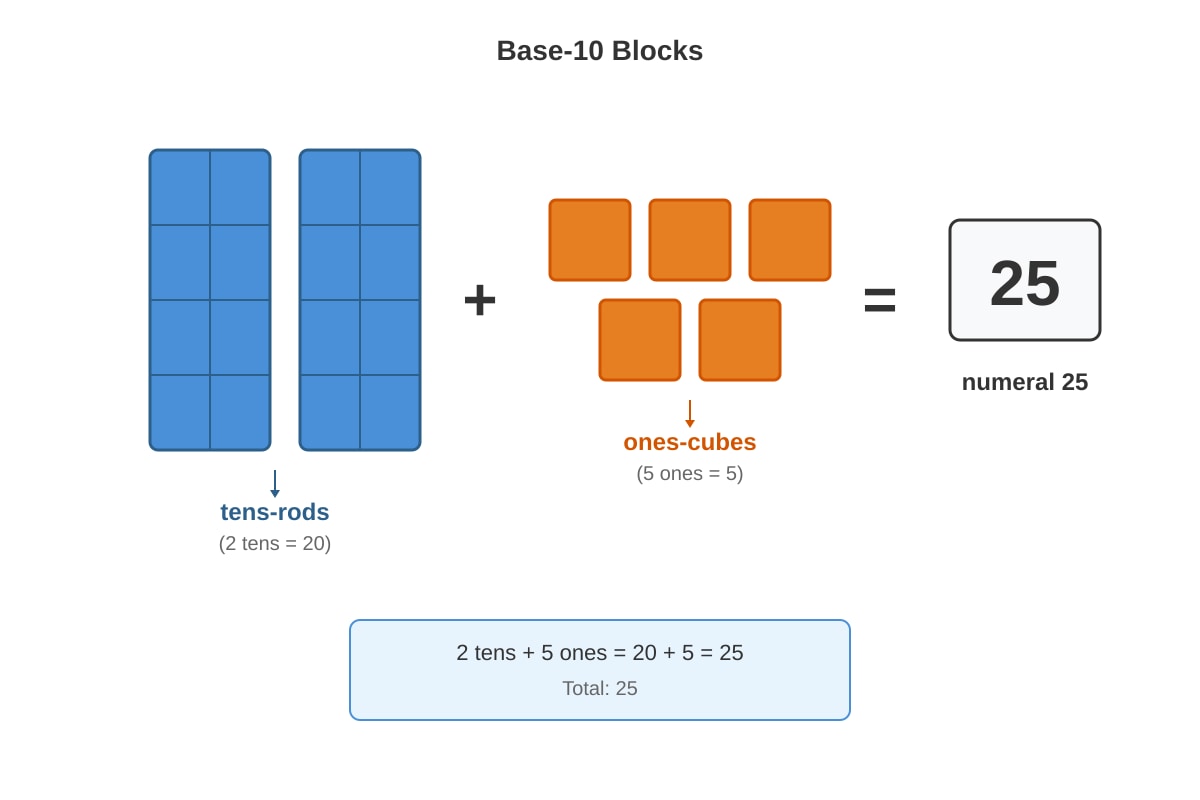
Teaching note: The image shows 2 tens-rods and 5 ones-cubes, representing the number 25. The question asks only for the number of ones cubes, which is 5. Students should learn to distinguish between tens-rods (long blocks) and ones-cubes (small cubes) in base-10 representations. Common mistake: Students may count the tens-rods as ones or give the total number of blocks (7).
Question 5 (1 mark) Answer: 3
Teaching note: The number 30 has 3 tens. Since 30 = 10 + 10 + 10, there are 3 tens in 30. This reinforces the place value concept. Common mistake: Students may say 30 tens or write 3 ones instead of 3 tens.
Section B: Comparing and Ordering Numbers (5 marks)
Question 6 (1 mark) Answer: <
Teaching note: When comparing 56 and 65, look at the tens place first. 5 tens vs 6 tens. Since 5 is less than 6, 56 is less than 65. The symbol < means "less than" (the smaller number is on the left side of the open mouth). Common mistake: Students may use > because 65 has a 5 in it too, or confuse which number is larger.
Question 7 (1 mark) Answer: =
Teaching note: 34 and 34 are the same number, so the comparison sign is = (equal to). Common mistake: Some students may use < or > because they expect a "fun" symbol, not recognizing equality.
Question 8 (1 mark) Answer: 17, 49, 82
Teaching note: To arrange from smallest to greatest, compare the tens place first. 17 has 1 ten, 49 has 4 tens, 82 has 8 tens. So the order is 17, 49, 82. Common mistake: Students may look at the ones digit first. Always teach to compare the tens (or the highest place value) first.
Question 9 (1 mark) Answer: 90, 61, 47, 23
Teaching note: To arrange from greatest to smallest, compare the tens place. 90 has 9 tens, 61 has 6 tens, 47 has 4 tens, 23 has 2 tens. So the order is 90, 61, 47, 23. Common mistake: Students may mix up ascending vs descending order.
Question 10 (1 mark) Answer: 40
Teaching note: The number between 39 and 41 is 40. This is a simple sequencing question. 39 → 40 → 41. Common mistake: Students may say 39.5 or a number not in the sequence.
Section C: Number Patterns and Number Bonds (5 marks)
Question 11 (1 mark) Answer: 60
Teaching note: The pattern increases by 5 each time: 45, 50, 55, 60, 65. Students should recognize counting by 5s. Common mistake: Students may add 10 instead of 5, getting 65.
Question 12 (1 mark) Answer: 70
Teaching note: The pattern decreases by 10 each time: 100, 90, 80, 70, 60. Students should recognize counting down by 10s. Common mistake: Students may subtract 5 or 20 instead of 10.
Question 13 (1 mark) Answer: 12
Teaching note: 7 + 5 = 12. This is a basic number bond / addition fact. Students should know this from their number bond practice within 20. Common mistake: Students may write 11 (off by one) or confuse + with ×.
Question 14 (1 mark) Answer: 8
Teaching note: 6 + 8 = 14, so the missing number is 8. This reinforces number bonds to 14. Students can think: 6 + 4 = 10, then 10 + 4 = 14, so 6 + 8 = 14. Common mistake: Students may say 9 (thinking 6 + 9 = 15) or other incorrect sums.
Question 15 (1 mark) Answer: 10
Teaching note: The pattern increases by 2 each time: 2, 4, 6, 8, 10. This is counting by 2s (even numbers). Common mistake: Students may continue with 8 + 2 = 10 correctly, but some may write 9 or 12.
Section D: Word Problems with Numbers (5 marks)
Question 16 (2 marks) Answer: Sam has 38 marbles altogether.
Marking scheme:
- 1 mark: Correct number sentence (23 + 15 = 38)
- 1 mark: Correct final answer with units (38 marbles)
Teaching note: This is an addition word problem. Students need to identify that "altogether" and "more" indicate addition. 23 + 15 = 38. The working should show the addition. Common mistake: Students may subtract instead of add, or add incorrectly (e.g., 23 + 15 = 33 by only adding the ones digits).
Question 17 (2 marks) Answer: There are 26 blue crayons.
Marking scheme:
- 1 mark: Correct number sentence (50 − 24 = 26)
- 1 mark: Correct final answer with units (26 blue crayons)
Teaching note: This is a subtraction word problem. Total crayons = 50. Red crayons = 24. Blue crayons = 50 − 24 = 26. Students need to identify that "the rest" indicates subtraction. Common mistake: Students may add (50 + 24 = 74) instead of subtract.
Question 18 (1 mark) Answer: 87
Teaching note: Compare 78 and 87. Look at the tens place: 7 tens vs 8 tens. 8 is greater than 7, so 87 > 78. Common mistake: Students may say 78 is greater because 78 comes first, or look only at the ones digit (8 vs 7).
Section E: Ordinal Numbers and Position (5 marks)
Question 19 (1 mark) Answer: 2nd
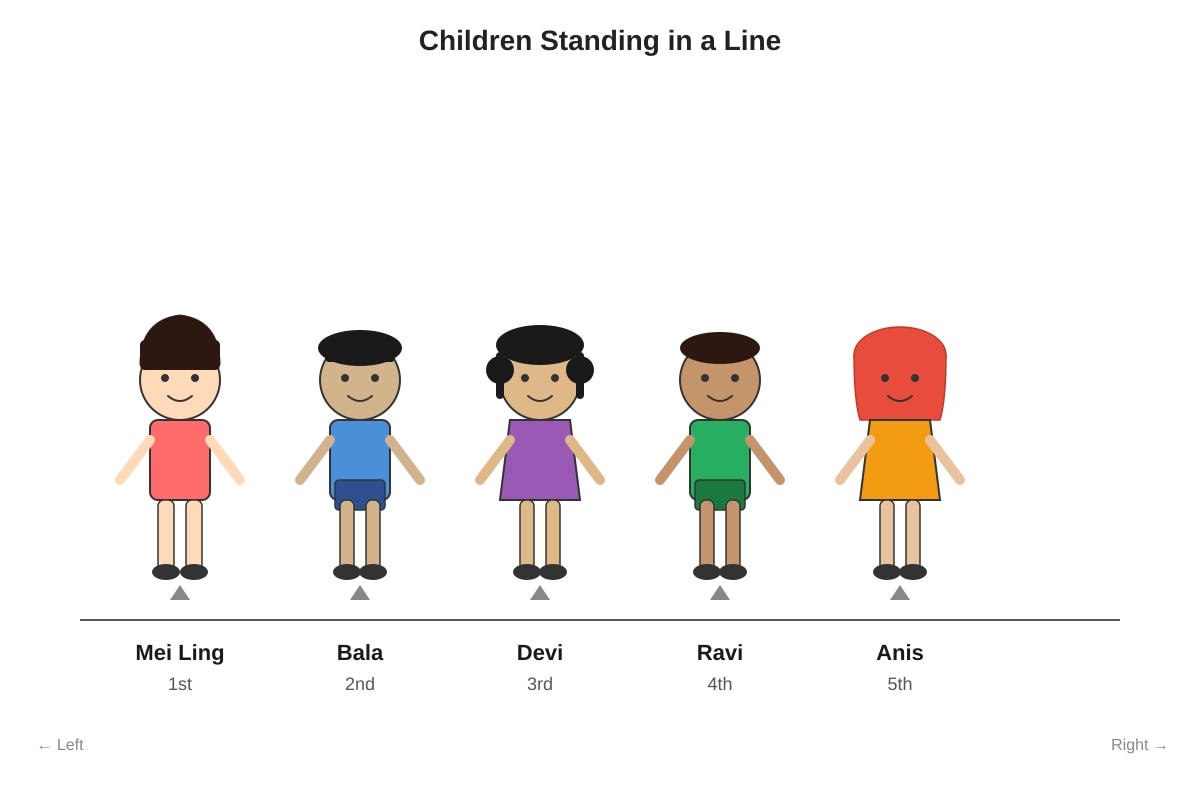
Teaching note: In the picture, five children stand in a row from left to right: Mei Ling (1st), Bala (2nd), Devi (3rd), Ravi (4th), Anis (5th). Bala is in the 2nd position from the left. Common mistake: Students may count Mei Ling as 0th or confuse left/right.
Question 20 (1 mark) Answer: Ravi
Teaching note: The 4th position from the left is Ravi. Based on the order: Mei Ling (1st), Bala (2nd), Devi (3rd), Ravi (4th), Anis (5th). Common mistake: Students may count from the right or miscount positions.
Question 21 (1 mark) Answer: 5th
Teaching note: The ordinal numbers are: 1st, 2nd, 3rd, 4th, 5th, 6th. The missing ordinal is 5th. Common mistake: Students may write "5" without the "th" suffix, which is technically the cardinal number, not the ordinal.
Question 22 (1 mark) Answer: 2nd
Teaching note: If Mei Ling finished in 1st place, the child behind her finished in 2nd place. "Behind" in a race means the next position. Common mistake: Students may write 3rd (skipping a position) or confuse 2nd with 2.
Question 23 (1 mark) Answer: 6
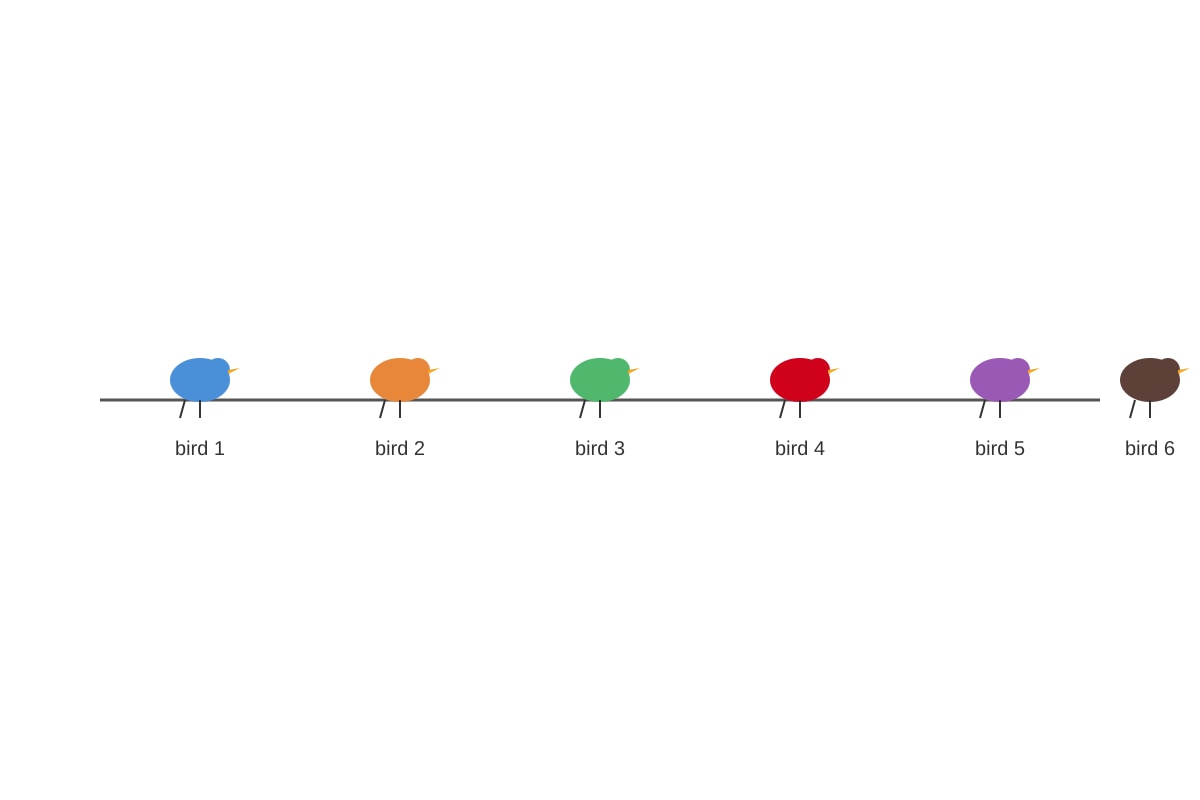
Teaching note: The picture shows 6 birds in a row. Students simply count the birds: 1, 2, 3, 4, 5, 6. Common mistake: Students may miscount or skip a bird.
End of Answer Key