AI Generated Exam Paper
Primary 1 Mathematics Practice Paper 1
Free P1 Maths Practice Paper 1, Kimi2.6 AI version, with questions, answers, and syllabus-aligned practice for Singapore students.
These static practice materials are generated from the site's syllabus and paper-generation workflow, with source and model context shown so students and parents can evaluate the material before use.
Questions

Free quiz and exam paper access
Enter your details to view this paper
Your access is remembered on this device.
Answers
TuitionGoWhere Practice Paper - Mathematics Primary 1
Answer Key and Marking Scheme Version: 1 of 5
Section A: Multiple Choice (10 marks)
1. B) 50 [1 mark]
Teaching note: "After" means the next number when counting forwards. Count: 47, 48, 49, 50. The number after 49 is 50. Common mistake: Choosing 48 (the number before 49).
2. B) 70 [1 mark]
Teaching note: In 73, the digit 7 is in the tens place. The value of a digit depends on where it sits. The 7 does not mean 7 ones; it means 7 tens, which equals 70. The digit 3 is in the ones place and has value 3.
3. C) 22 [1 mark]
Teaching note: Compare tens first, then ones if needed. 22 has 2 tens; 28 has 2 tens (ones are bigger, so 28 > 22); 82 and 88 have 8 tens (much bigger). So 22 is smallest. Method: Look at the tens digit first — smaller tens digit means smaller number.
4. B) 10 [1 mark]
Teaching note: This is a counting in 2s pattern (even numbers). 2, 4, 6, 8, 10, 12... The gap between each number is +2. Calculate: 8 + 2 = 10.
5. A) 5 [1 mark]
Teaching note: 56 = 5 tens and 6 ones. The question asks "how many tens" (the count of tens), not "what is the value of the tens." There are 5 tens in 56. The value of those 5 tens is 50.
6. C) 64 [1 mark]
Teaching note: "Sixty-four" = sixty (60) + four (4) = 64. Break the word into parts: "sixty" tells you the tens (6), "four" tells you the ones (4). Common mistake: 46 (reverses digits).
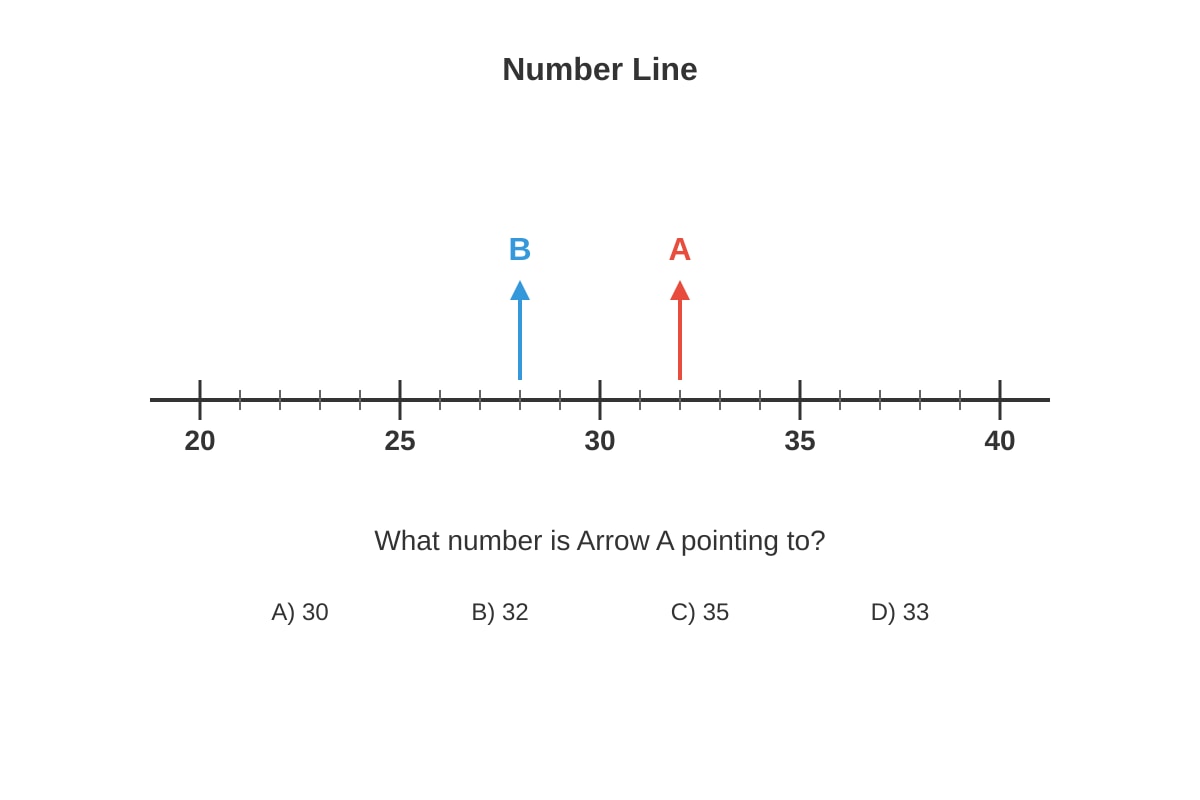
7. B) 32 [1 mark]
Teaching note: The number line shows marks at 20, 25, 30, 35, 40. Each big gap is 5. Between 30 and 35, Arrow A sits 2 small steps after 30, so 30 + 2 = 32. Count by ones from 30: 31, 32.
8. A) 3 tens and 5 ones [1 mark]
Teaching note: 35 = 30 + 5 = 3 tens and 5 ones. The digit 3 is in tens place (value 30 = 3 tens), digit 5 is in ones place (value 5 = 5 ones).
9. B) 12, 21, 23, 32 [1 mark]
Teaching note: Check each option is truly in ascending order (smallest to largest).
- A) 45, 54, 45, 65 — 45 appears twice, and 45 > 54 is false; not ordered
- B) 12 < 21 < 23 < 32 ✓ Correct!
- C) 89, 98... starts big, not smallest to largest
- D) 67, 76, 75... 75 < 76, so not ordered correctly
10. C) 100 [1 mark]
Teaching note: The greatest 2-digit number is 99 (you cannot have 100 with only two digits). "1 more than 99" = 99 + 1 = 100. This is also the smallest 3-digit number.
Section B: Short Answer (18 marks)
11.
(a) Numerals: 24 [1 mark]; Words: twenty-four [1 mark]
Teaching note: Count by grouping — 4 rows of 6: 6, 12, 18, 24. Or count in 6s: 6, 12, 18, 24. For writing words: "twenty" (2 tens) + "four" (4 ones), with a hyphen.
(b) 6 [1 mark]
Teaching note: Need 30, have 24. Difference: 30 − 24 = 6. Or count on from 24: 25, 26, 27, 28, 29, 30 — that's 6 more numbers. Common mistake: Answering 54 (adding instead of finding difference).
12.
(a) 50 [1 mark]
Teaching note: The digit 5 in 58 is in the tens place. Value = 5 × 10 = 50.
(b) 8 [1 mark]
Teaching note: The digit 8 in 58 is in the ones place. Value = 8 × 1 = 8.
13. [1 mark each; 3 marks total]
(a) 30, 40
Teaching note: Pattern counts in 5s (+5 each time). 15, 20, 25, 30, 35, 40. 25 + 5 = 30; 35 + 5 = 40.
(b) 65, 60
Teaching note: Pattern counts backwards in 5s (−5 each time). 80, 75, 70, 65, 60, 55. 70 − 5 = 65; 65 − 5 = 60.
(c) 12, 18
Teaching note: Pattern counts in 3s (+3 each time, three times table). 3, 6, 9, 12, 15, 18. 9 + 3 = 12; 15 + 3 = 18.
14. [1 mark each; 3 marks total]
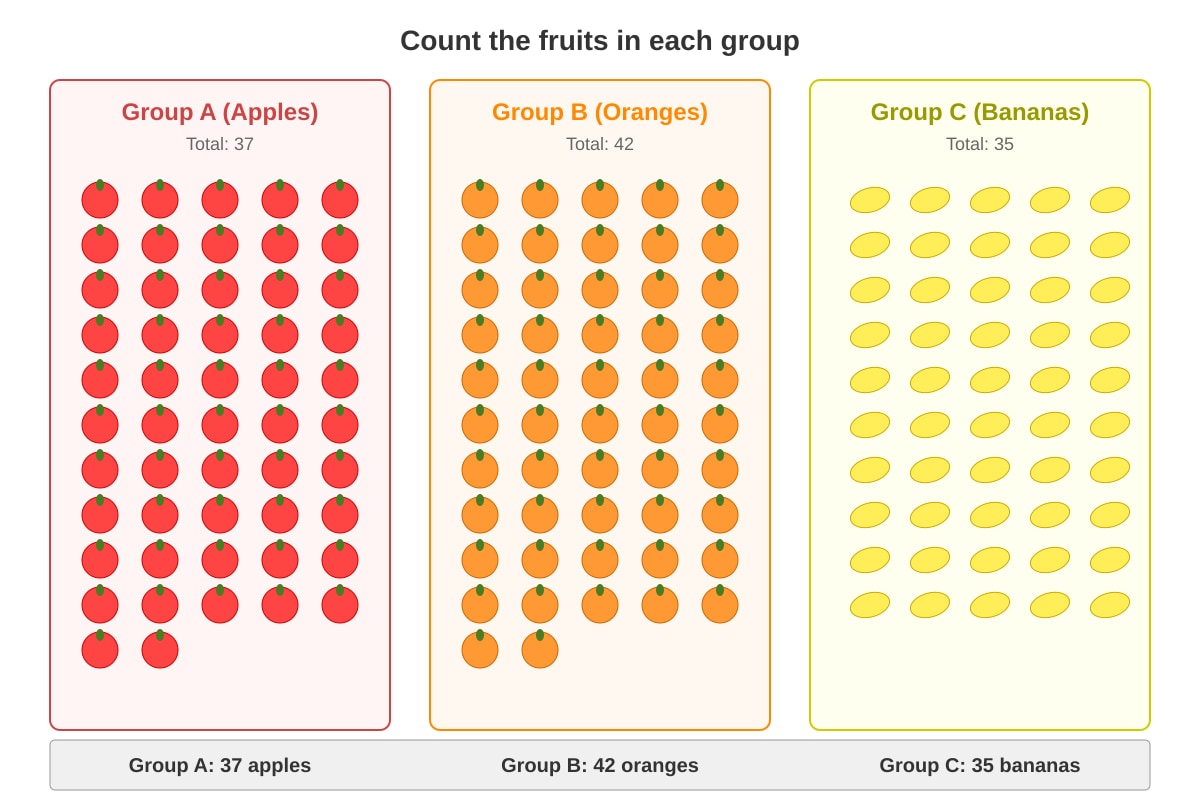
(a) Group B / Oranges / 42 [1 mark]
Teaching note: Compare 37, 42, 35. All have tens digits 3, 4, 3. Since 4 > 3, 42 is biggest. Group B with 42 oranges has the most.
(b) Group C / Bananas / 35 [1 mark]
Teaching note: Compare remaining: 35 vs 37. 35 < 37, so 35 is smallest. Group C with 35 bananas has the least.
(c) 35, 37, 42 [1 mark]
Teaching note: Order from smallest: 35 < 37 < 42. Compare tens: both 35 and 37 have 3 tens, so compare ones: 5 < 7, so 35 < 37. Then 42 has 4 tens, so it's biggest.
15. [1 mark each; 3 marks total]
(a) ninety-one
Teaching note: 91 = 90 + 1 = "ninety" + "one" = ninety-one. Hyphen needed between ninety and one.
(b) sixty
Teaching note: 60 = 6 tens, zero ones. When ones are 0, we just say the tens: sixty. Not "sixty-zero."
(c) seventeen
Teaching note: 17 = 10 + 7 = "seventeen" = seventeen. Notice the "teen" ending for numbers 13–19.
16. [1 mark each; 3 marks total]
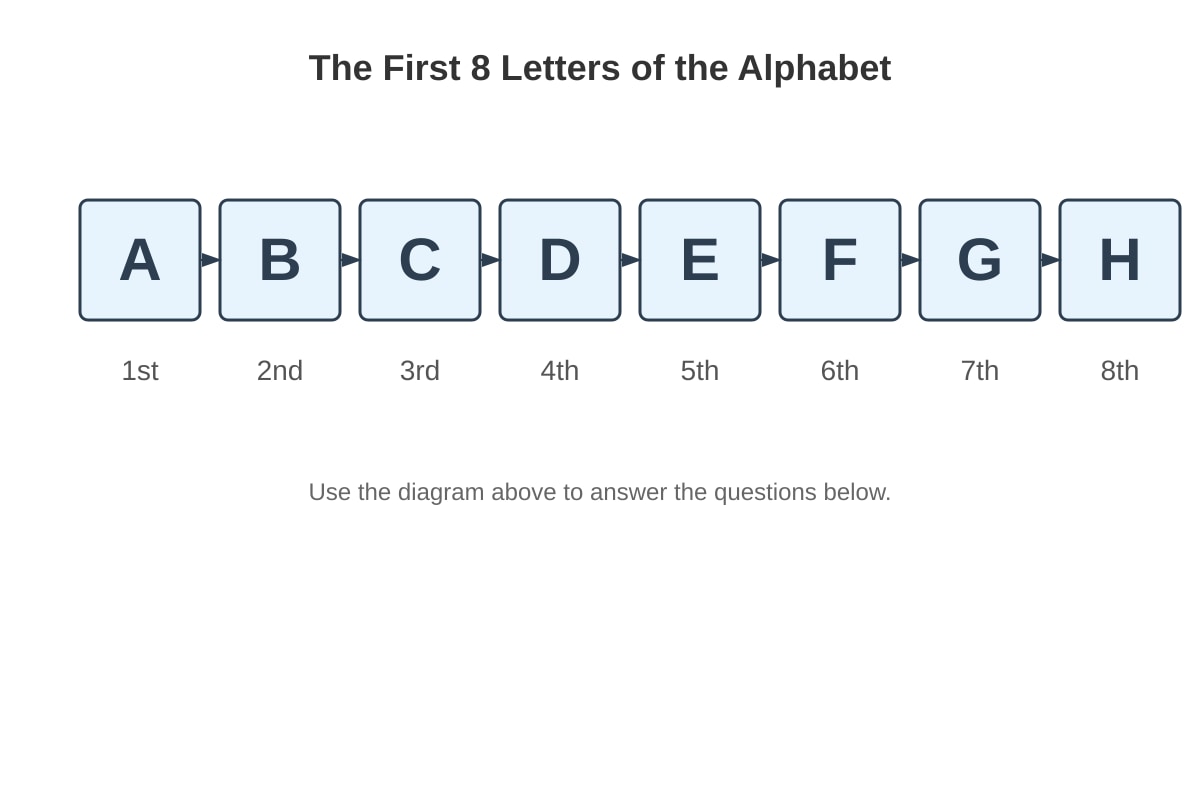
(a) E [1 mark]
Teaching note: Count positions: 1st-A, 2nd-B, 3rd-C, 4th-D, 5th-E. The 5th letter is E.
(b) H [1 mark]
Teaching note: Continue counting: 6th-F, 7th-G, 8th-H. The letter in position 8 is H.
(c) 3rd position [1 mark]
Teaching note: Find C and count: A(1st), B(2nd), C(3rd). The letter C is in the 3rd position.
Section C: Problem Solving (22 marks)
17.
(a) 43 stickers [2 marks]
Working:
- Tom has 28 stickers
- Mary has 15 more than Tom
- 28 + 15 = 43
Step by step:
- 28 + 10 = 38
- 38 + 5 = 43
Teaching note: "More than" means addition. Start with Tom's amount and add 15. Break 15 into 10 + 5 for easier mental calculation.
(b) 71 stickers [2 marks]
Working:
- Tom has 28 stickers
- Mary has 43 stickers
- 28 + 43 = 71
Step by step:
- 20 + 40 = 60
- 8 + 3 = 11
- 60 + 11 = 71
Or: 28 + 43
- 28 + 40 = 68
- 68 + 3 = 71
Teaching note: "Altogether" means addition. Add both children's stickers. Common mistake: Using answer from (a) alone (43) instead of adding both quantities.
[Mark breakdown: (a) correct method and answer: 2 marks; (b) correct method and answer: 2 marks]
18.
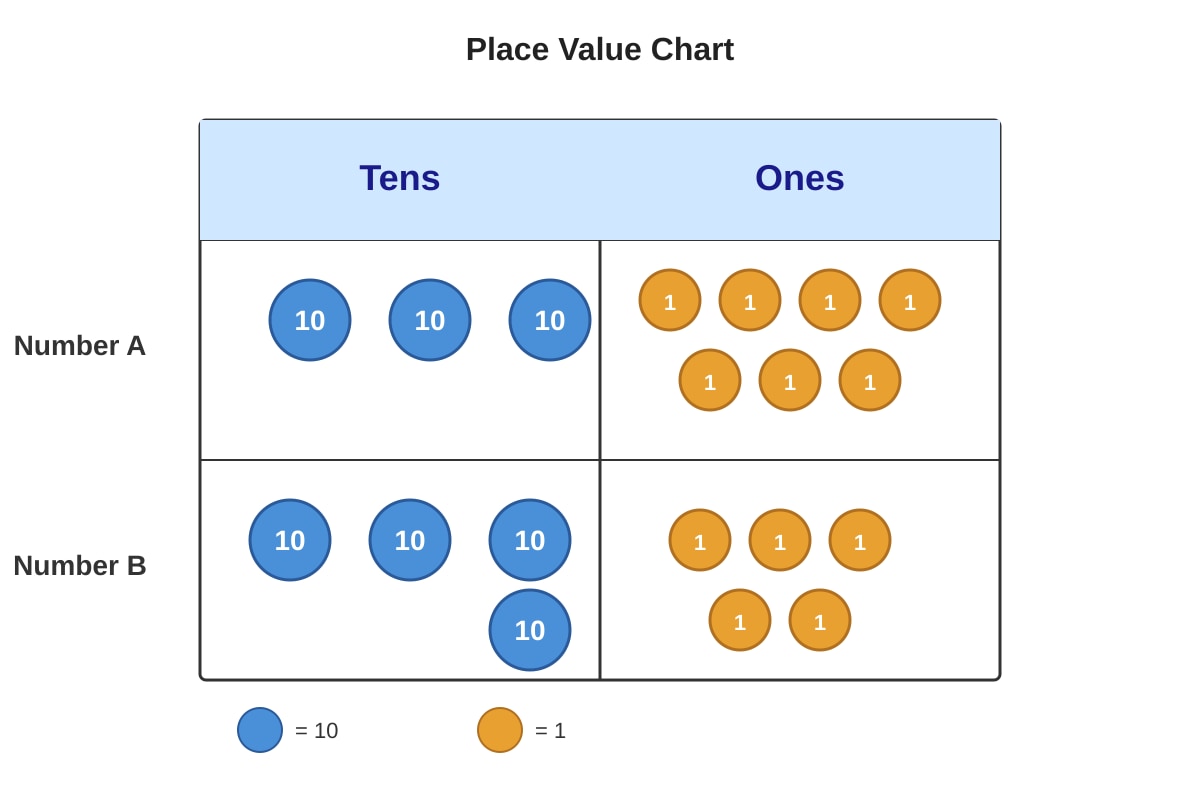
(a) Numerals: 37 [1 mark]; Words: thirty-seven [1 mark]
Teaching note: 3 tens discs + 7 ones discs = 30 + 7 = 37. In words: "thirty" (3 tens) + "seven" (7 ones) = thirty-seven (hyphen needed).
(b) Numerals: 45 [1 mark]; Words: forty-five [1 mark]
Teaching note: 4 tens discs + 5 ones discs = 40 + 5 = 45. In words: "forty" (4 tens, note spelling: f-o-r-t-y, not fourty) + "five" = forty-five.
(c) Number B is bigger by 8 [2 marks]
Working:
- Number A = 37
- Number B = 45
- Compare: 45 > 37, so Number B is bigger
- Difference: 45 − 37 = 8
Step by step for subtraction:
- 45 − 30 = 15
- 15 − 7 = 8
Or: 37 + ? = 45 → 37 + 3 = 40, 40 + 5 = 45, so 3 + 5 = 8
Teaching note: "How much bigger" asks for the difference (subtract smaller from bigger). Common mistake: Saying Number A is bigger (wrong direction) or answering 8 without naming which number is bigger.
[Mark breakdown: (a) 2 marks; (b) 2 marks; (c) 1 mark for identifying B, 1 mark for correct difference]
19.
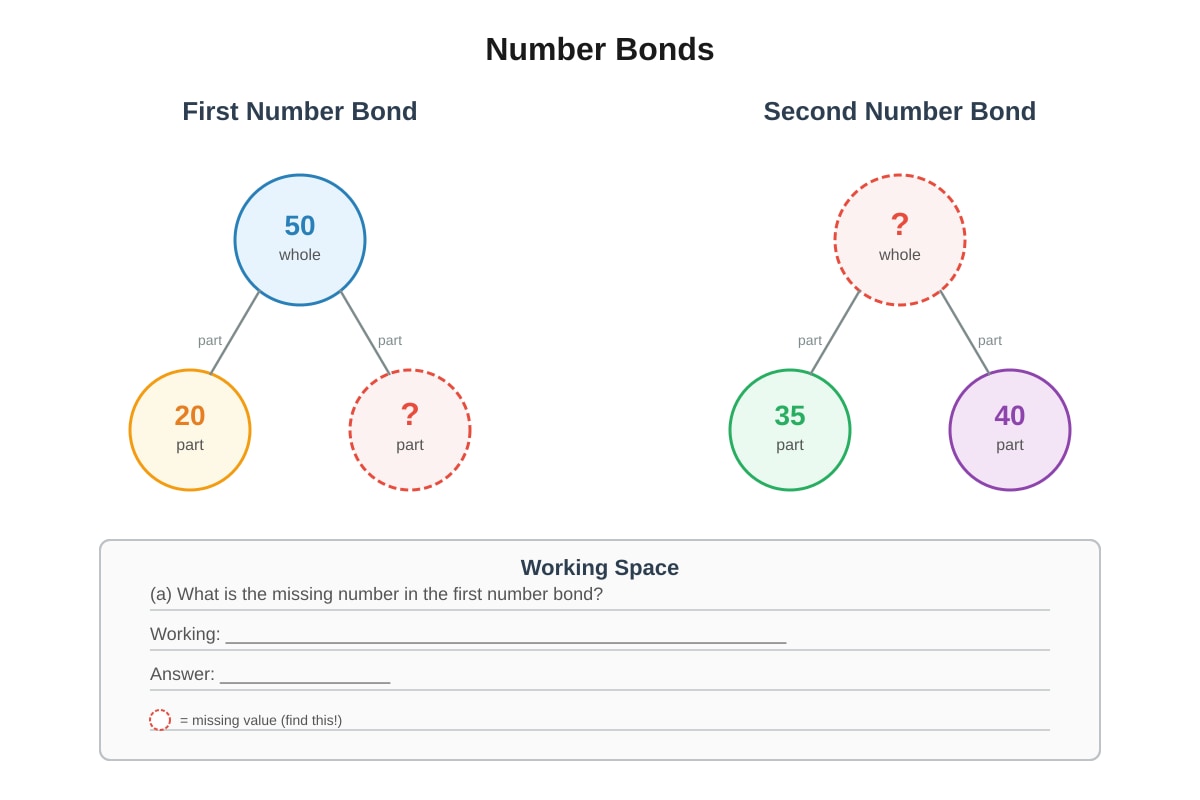
(a) 30 [2 marks]
Working:
- Whole = 50, one part = 20, other part = ?
- Part + Part = Whole
- 20 + ? = 50
- ? = 50 − 20 = 30
Or: 50 − 20 = 30
Teaching note: In a number bond, two parts make the whole. If you know the whole and one part, subtract to find the other part. 50 can be split into 20 and 30.
(b) 75 [2 marks]
Working:
- Whole = ?, part = 35, other part = 40
- Whole = Part + Part
- ? = 35 + 40 = 75
Step by step:
- 30 + 40 = 70
- 5 + 0 = 5
- 70 + 5 = 75
Teaching note: When both parts are known, add them to find the whole. 35 + 40: add tens (30+40=70), then add ones (5+0=5), then combine.
(c) Addition: 35 + 40 = 75 [0.5 mark] Subtraction: 75 − 35 = 40 or 75 − 40 = 35 [0.5 mark]
Teaching note: A number bond shows the relationship between parts and whole. If 35 + 40 = 75, then from the whole you can subtract either part to get the other part. This demonstrates inverse operations — addition and subtraction undo each other.
[Mark breakdown: (a) 2 marks; (b) 2 marks; (c) 1 mark total]
20.
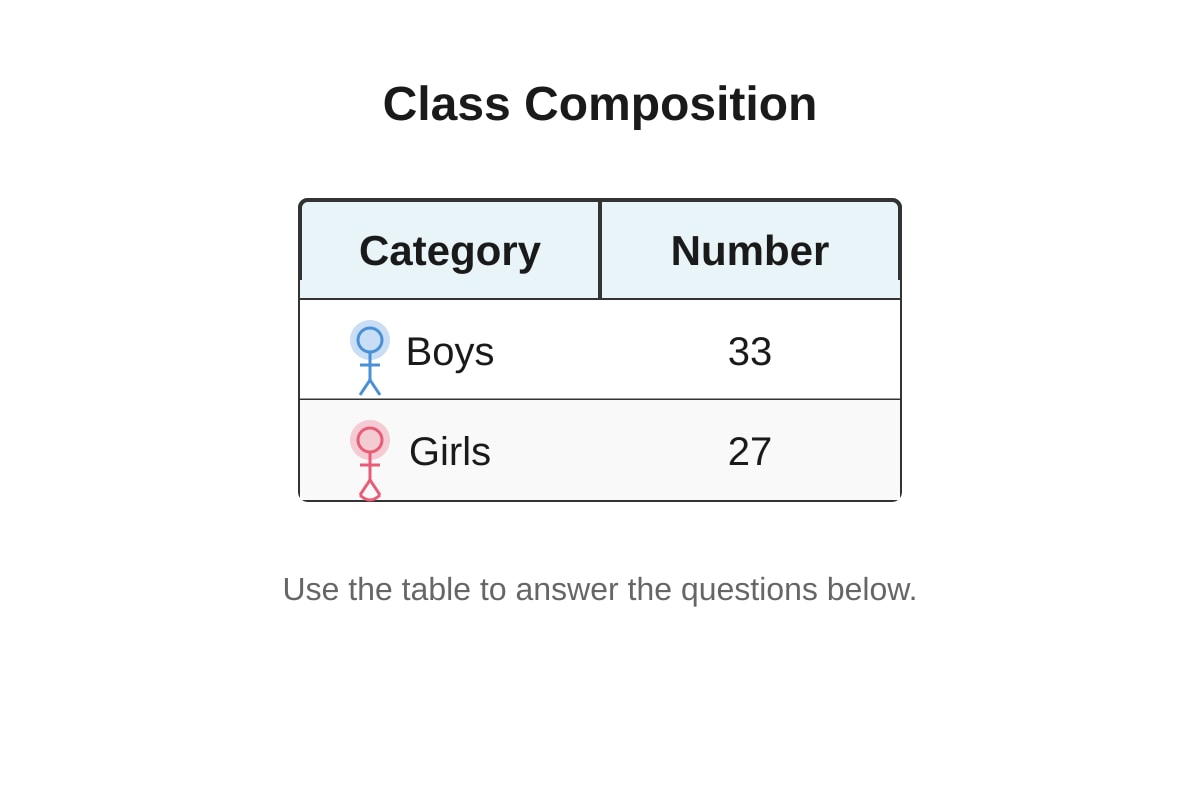
(a) 60 children [2 marks]
Working:
- Boys = 33
- Girls = 27
- Altogether: 33 + 27 = 60
Step by step:
- 30 + 20 = 50
- 3 + 7 = 10
- 50 + 10 = 60
Or: 33 + 27
- 33 + 20 = 53
- 53 + 7 = 60
Teaching note: "Altogether" = addition. Add boys and girls to find total children. This uses "make ten" strategy: 3 + 7 = 10, making the calculation easier.
(b) 6 more boys [2 marks]
Working:
- Boys = 33
- Girls = 27
- Difference: 33 − 27 = 6
Step by step:
- 33 − 20 = 13
- 13 − 7 = 6
Or: 27 + ? = 33 → 27 + 3 = 30, 30 + 3 = 33, so 3 + 3 = 6
Teaching note: "How many more" asks for difference — subtract smaller from larger. Common mistake: Adding instead of subtracting, or giving 27 as answer (the number of girls, not the difference).
(c) 35 girls [2 marks]
Working:
- Originally: 27 girls
- New girls join: + 8
- Now: 27 + 8 = 35
Step by step:
- 27 + 3 = 30 (make ten)
- 30 + 5 = 35
Teaching note: "Join" means add. Use "make ten" for efficient calculation: 27 needs 3 to reach 30, so split 8 into 3 + 5.
(d) 68 children [2 marks]
Working:
- Method 1: Original total + new girls = 60 + 8 = 68
- Method 2: New boys + new girls = 33 + 35 = 68
Step by step (Method 1):
- From (a), total was 60
- 8 new girls join
- 60 + 8 = 68
Teaching note: Two valid approaches. Method 1 uses the total from (a) and adds just the new girls. Method 2 recalculates with new girl count. Both should give 68 — this is a good check for correctness!
[Mark breakdown: 2 marks each part]
Total Marks Summary
| Section | Questions | Marks |
|---|---|---|
| A | 1–10 | 10 |
| B | 11–16 | 18 |
| C | 17–20 | 22 |
| Total | 20 questions | 50 marks |
Key Concepts Covered:
- Number recognition and counting (Questions 1, 7, 11)
- Place value — tens and ones (Questions 2, 5, 8, 12, 18)
- Comparing and ordering numbers (Questions 3, 9, 14)
- Number patterns and sequences (Questions 4, 13)
- Number words and numerals (Questions 6, 15)
- Ordinal numbers (Question 16)
- Number bonds and part-whole relationships (Question 19)
- Addition and subtraction word problems (Questions 17, 20)
Cognitive Level Distribution:
- Knowledge/Recall: ~20% (Q2, Q5, Q6, Q8)
- Understanding/Application: ~50% (Q1, Q3, Q4, Q7, Q9, Q10, Q11, Q12, Q13, Q15, Q16)
- Problem Solving/Reasoning: ~30% (Q14, Q17, Q18, Q19, Q20)
This practice paper is syllabus-aligned content generated for TuitionGoWhere. It is not derived from official Ministry of Education examination papers. It is designed for practice and learning purposes based on the Singapore Primary Mathematics syllabus (2021 edition, P1-P6).