AI Generated Quiz
Primary 1 Malay Language Use Quiz
Free P1 Malay Language Use quiz, Kimi2.6 AI version, with questions, answers, and syllabus-aligned practice for Singapore students.
These static practice materials are generated from the site's syllabus and paper-generation workflow, with source and model context shown so students and parents can evaluate the material before use.
Questions

Free quiz and exam paper access
Enter your details to view this paper
Your access is remembered on this device.
Answers
Primary 1 Malay Quiz - Language Use: Answer Key
Total Marks: 20
Section A: Choose the Correct Word
1. Answer: B) air (1 mark)
Explanation: The verb "minum" means "to drink." We drink liquids. "Air" means water. "Nasi" (rice), "roti" (bread), and "buku" (book) are not things we drink. This tests understanding of common verbs and their logical objects.
2. Answer: B) nasi (1 mark)
Explanation: The phrase "memasak di dapur" means "cooking in the kitchen." "Nasi" (rice) is food that can be cooked. "Baju" (shirt), "buku" (book), and "kasut" (shoes) are not cooked. This tests knowledge of household activities and context.
3. Answer: B) surat khabar (1 mark)
Explanation: The verb "membaca" means "to read." A "surat khabar" (newspaper) is something we read. "Televisyen" (television) is watched, "radio" is listened to, and "kereta" (car) is driven. This tests collocation—words that naturally go together.
4. Answer: B) pensel (1 mark)
Explanation: "Menulis dengan" means "to write with." A "pensel" (pencil) is a writing tool. "Makanan" (food), "bantal" (pillow), and "meja" (table) cannot be used to write. This tests understanding of tools and their functions.
5. Answer: A) taman (1 mark)
Explanation: "Bermain" means "to play." A "taman" (park/garden) is a place where children play. "Cermin" (mirror), "tingkap" (window), and "pintu" (door) are parts of a building, not places for play. This tests knowledge of locations and activities.
Section B: Match the Words
6. Answer: D (1 mark)
Explanation: "Rumah" means house. A house (D: tempat tinggal keluarga) is where a family lives. The other options are a school, field, shop, and bedroom—each has a different function.
7. Answer: C (1 mark)
Explanation: "Sekolah" means school. A school (C: tempat belajar bersama kawan-kawan) is where we learn with friends. This tests recognition of common places and their purposes.
8. Answer: A (1 mark)
Explanation: "Padang" means field. A field (A: tempat berlari dan bermain bola) is where we run and play football. This tests understanding of outdoor spaces.
9. Answer: E (1 mark)
Explanation: "Kedai" means shop. A shop (E: tempat membeli barang) is where we buy things. This tests recognition of commercial places.
10. Answer: B (1 mark)
Explanation: "Bilik tidur" means bedroom. A bedroom (B: tempat tidur di malam hari) is where we sleep at night. This tests compound word understanding (bilik + tidur) and room functions.
Section C: Fill in the Blanks
11. Answer: guru (1 mark)
Explanation: "Bekerja sebagai seorang" means "working as a." "Guru" (teacher) is a profession. "Pelukan" means hug or embrace, which is not a job. This tests distinguishing between nouns (job titles) and other words.
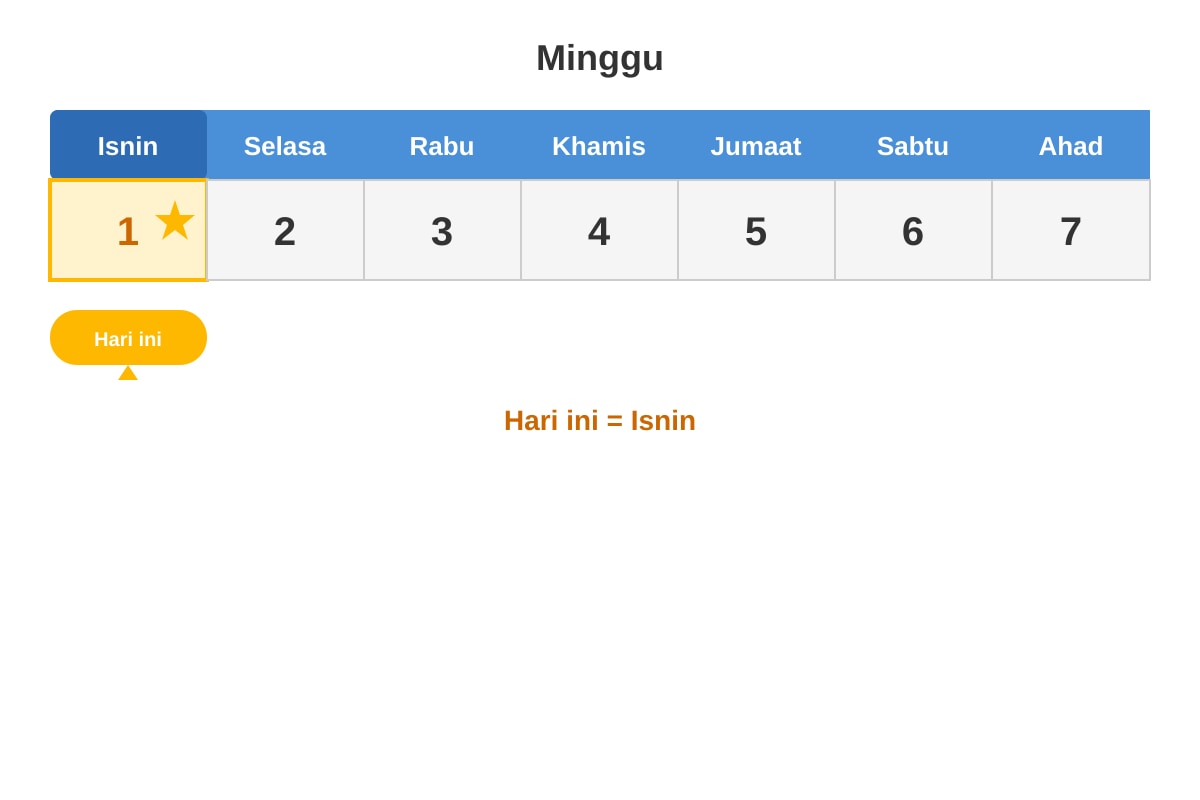
12. Answer: Isnin (1 mark)
Explanation: The image shows a calendar with "Hari ini = Isnin" highlighted. "Isnin" is Monday, a day of the week. "Dua" means two, which is a number, not a day name. This tests reading visual information and day names.
13. Answer: hitam (1 mark)
Explanation: "Berwarna" means "in color." "Hitam" (black) is a color. "Panas" (hot) describes temperature, not color. This tests distinguishing color words from other adjectives.
14. Answer: oren (1 mark)
Explanation: "Makan" means to eat—it is already a verb, so "makan makan" is grammatically incorrect. "Oren" (orange) is a food item we can eat. This tests identifying correct word categories (noun vs. verb).
15. Answer: kereta (1 mark)
Explanation: "Memandu" means to drive. A "kereta" (car) is driven. A "basikal" (bicycle) is ridden ("naiki" or "tunggang," not "memandu"). This tests correct verb-noun collocation for transportation.
Section D: Choose the Correct Sentence
16. Answer: B) Ali sedang membaca buku di bilik. (2 marks)
Explanation: The image shows: a boy at a desk with an open book, a lamp, and evening time (clock ~8:00). These visual cues indicate reading in a room.
- (1 mark) Correct sentence identification
- (1 mark) Valid reason: The picture shows a boy with a book/lamp/desk, which matches "membaca buku di bilik" (reading a book in a room)
Other options are wrong: A) playing in park—no outdoor scene; C) cooking in kitchen—no kitchen items; D) watching TV in living room—no television shown.
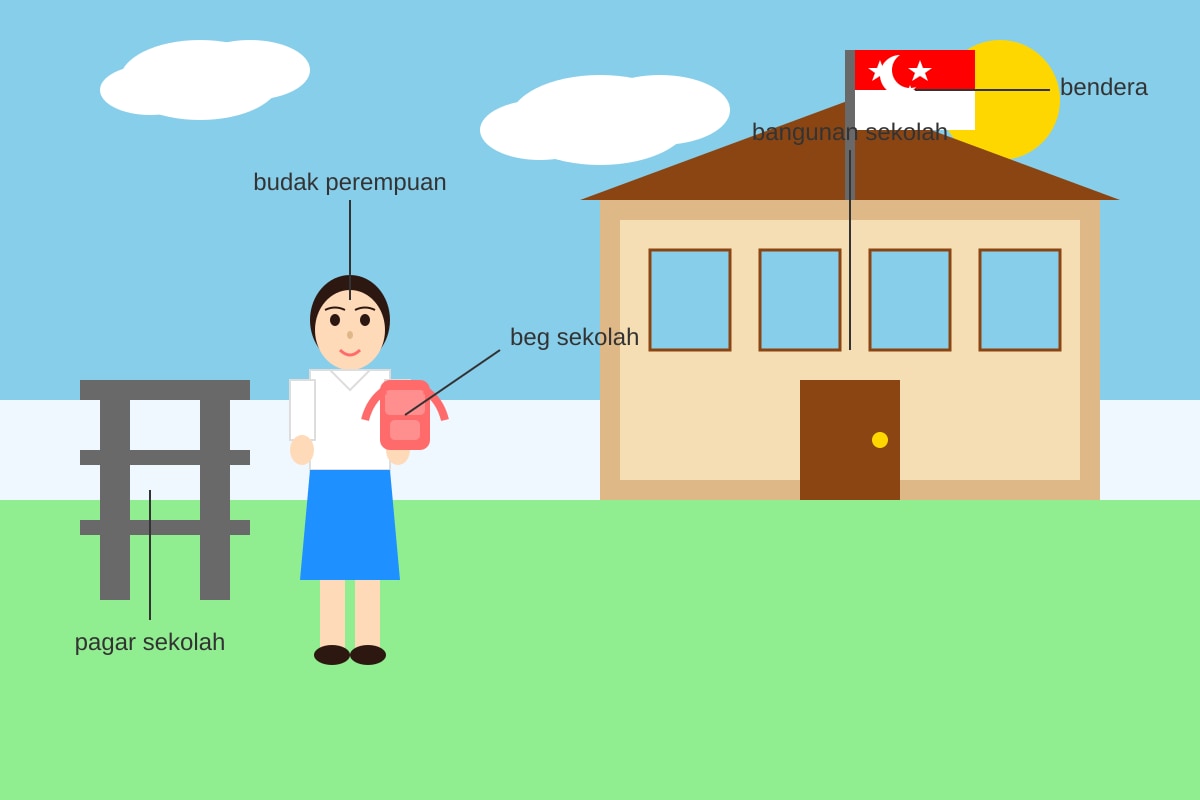
17. Answer: C) Siti sedang berada di sekolah. (2 marks)
Explanation: The image shows: a girl in school uniform with backpack at a school gate with school building and flag.
- (1 mark) Correct sentence identification
- (1 mark) Valid reason: The picture shows school uniform, backpack, school gate, and school building, which match "di sekolah"
Other options are wrong: A) at home—no house; B) at playground—no play equipment; D) at shop—no shop signs or goods.
Section E: Simple Comprehension
18. Answer: C) empat orang (2 marks)
Explanation: The passage states "Keluarga saya ada empat orang. Ada ayah, ibu, abang, dan saya."
- (1 mark) Correct answer choice
- (1 mark) Evidence from text: four family members named (father, mother, brother, and Aisyah herself)
19. Answer: B) ayah (2 marks)
Explanation: The passage states "Ayah hantar saya ke sekolah dengan kereta."
- (1 mark) Correct answer choice
- (1 mark) Evidence: "Ayah" (father) is explicitly named as the person who sends her to school
20. Answer: B) bermain di padang (2 marks)
Explanation: The passage states "Kami suka bermain di padang semasa waktu rehat."
- (1 mark) Correct answer choice
- (1 mark) Evidence: "bermain di padang" matches exactly with option B; "waktu rehat" means break time/recess
END OF ANSWER KEY
Marking notes:
- For Section E, accept equivalent Malay answers if students write their own response instead of selecting option.
- Deduct half mark if answer is correct but spelling has minor errors that do not impede meaning.