AI Generated Exam Paper
Primary 1 Malay Practice Paper 5
Free P1 Malay Practice Paper 5, Kimi2.6 AI version, with questions, answers, and syllabus-aligned practice for Singapore students.
These static practice materials are generated from the site's syllabus and paper-generation workflow, with source and model context shown so students and parents can evaluate the material before use.
Questions
Free quiz and exam paper access
Enter your details to view this paper
Your access is remembered on this device.
Answers
TuitionGoWhere Practice Paper - Malay Primary 1
Answer Key and Marking Scheme Version 5
Section A: Vocabulary and Comprehension (25 marks)
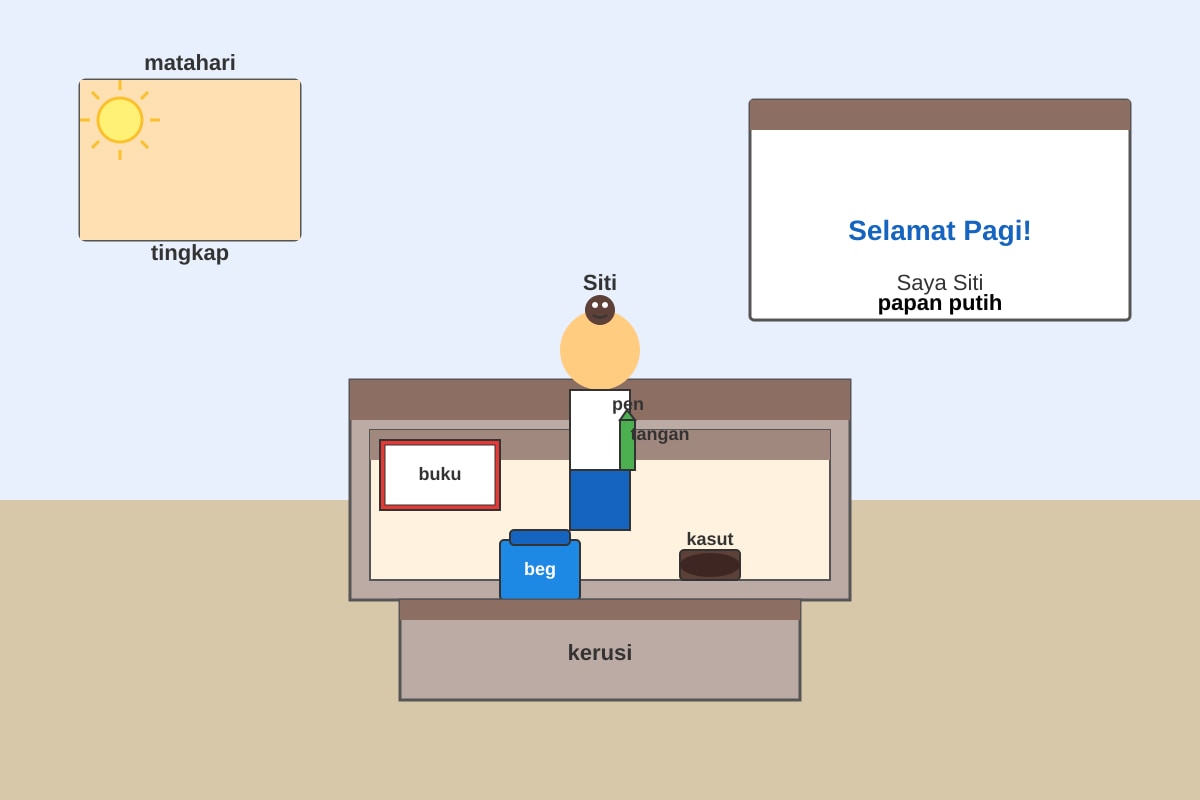
Visual reference for Questions 1–5: The picture shows Siti in her classroom with five labelled objects: red buku (book), green pen (pen) in her hand, blue beg (bag) on floor, brown kasut (shoe), white papan putih (whiteboard) behind her.
1. What is Siti holding in her hand?
Answer: pen / pen hijau / satu pen
Marking: 1 mark for correct object name in Malay. Accept "pen" or "pen hijau". Reject English-only answers ("pen" as borrowed word is acceptable in P1 context).
Teaching note: pen means "pen" in Malay. At Primary 1, students learn classroom objects. The green colour (hijau) is extra detail from the picture.
2. Name the object on the floor near Siti.
Answer: beg / beg sekolah
Marking: 1 mark for correct object name. Accept "beg" or "beg sekolah".
Teaching note: beg means "bag". The blue bag on the floor is a school bag (beg sekolah). Students should recognise this as an item they use daily.
3. What colour is the book in the picture?
Answer: merah
Marking: 1 mark for correct colour word. Must be in Malay.
Teaching note: Colours are foundational P1 vocabulary. merah = red; hijau = green; biru = blue; kuning = yellow; hitam = black; putih = white. Common error: confusing merah with kuning.
4. Where is the whiteboard?
Answer: B) Behind Siti / Di belakang Siti
Marking: 1 mark for correct choice.
Teaching note: Prepositions of place are taught in P1: di atas (on top), di bawah (under), di depan (in front), di belakang (behind), di dalam (inside), di luar (outside). The whiteboard is di belakang Siti.
5. Circle three things Siti uses for school.
Answer: buku, pen, kasut (in any order)
Marking: 1 mark each for correct item; 3 marks total. Deduct 1 mark per wrong/extra selection.
Teaching note: tingkap (window) and matahari (sun) are not school items. meja (table) is classroom furniture but not personally "used" for school in the same way. Accept reasoned answers if student selects meja with explanation.
6. Match colour words to meanings.
| Malay | English |
|---|---|
| merah | red |
| biru | blue |
| hijau | green |
| kuning | yellow |
| hitam | black |
Marking: 1 mark per correct match; 5 marks total.
Teaching note: These are the five core colours taught in P1 Malay. The matching format tests recognition without requiring spelling production. Common error: kuning (yellow) confused with hijau (green) due to similar syllable structure—emphasise initial sounds /k/ vs /h/.
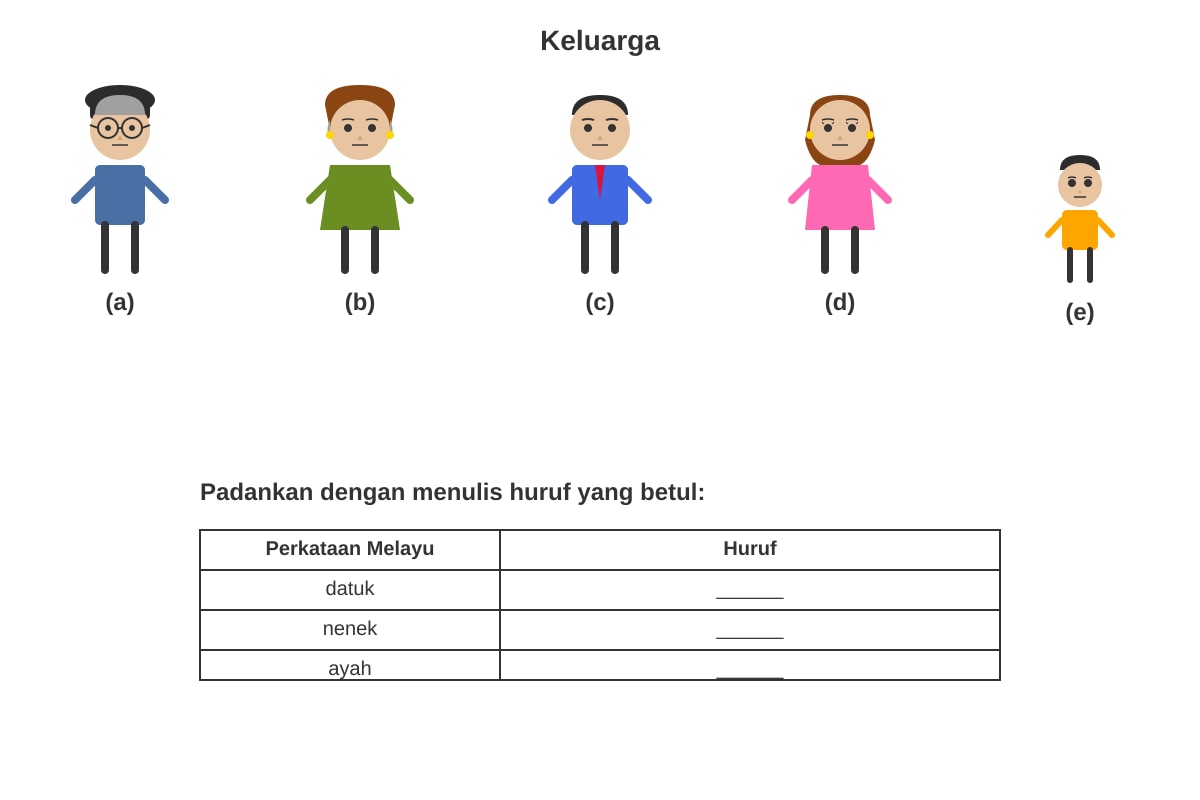
7. Match family words to picture letters.
| Malay Word | Letter |
|---|---|
| datuk | (a) — elderly man with songkok |
| nenek | (b) — elderly woman with headscarf |
| ayah | (c) — man in 30s |
| ibu | (d) — woman in 30s |
| adik | (e) — small child |
Marking: 1 mark per correct letter; 5 marks total.
Teaching note: datuk = grandfather; nenek = grandmother; ayah = father; ibu = mother; adik = younger sibling. In Malay culture, datuk often wears a songkok (traditional cap), helping visual identification. Emphasise generational differences: old = grandparents, middle-aged = parents, young = sibling.
8. Match number words to numerals.
| Malay Word | Numeral |
|---|---|
| satu | 1 |
| lima | 5 |
| sepuluh | 10 |
| dua belas | 12 |
| dua puluh | 20 |
Marking: 1 mark per correct match; 5 marks total.
Teaching note: P1 Malay numbers 1–20. Pattern recognition: sepuluh (10) = se- (one) + puluh (ten); dua belas (12) = dua + belas; dua puluh (20) = dua + puluh. Common error: confusing belas (-teen) with puluh (-ty). Teach that belas = 11-19, puluh = multiples of 10.
9. Match animals to where they live.
| Animal | Place |
|---|---|
| ayam | ladang (farm) |
| ikan | sungai (river) |
| burung | pokok/pokok (tree) |
| kambing | ladang (farm) |
| kucing | rumah (house) |
Marking: 1 mark per correct match; 5 marks total. Accept "pokok" or "langit" for burung; accept "ladang" for both ayam and kambing.
Teaching note: ayam (chicken) and kambing (goat) are farm animals — ladang. ikan (fish) lives in water — sungai (river). burung (bird) lives in pokok (tree) or flies in langit (sky). kucing (cat) is a pet — rumah (house/common error: students may put kucing in sungai due to English "catfish" association—clarify this does not apply in Malay!).
10. Match body parts to functions.
| Body Part | Function |
|---|---|
| mata | — we use this to see |
| telinga | — we use this to hear |
| hidung | — we use this to smell |
| mulut | — we use this to eat and speak |
| tangan | — we use this to hold things |
Marking: 1 mark per correct match; 5 marks total.
Teaching note: mata = eye (see = melihat); telinga = ear (hear = mendengar); hidung = nose (smell = menghidu); mulut = mouth (eat = makan, speak = bercakap); tangan = hand (hold = memegang). Common error: confusing hidung with mulut for eating—clarify mulut is for putting food in, but hidung is only for smell.
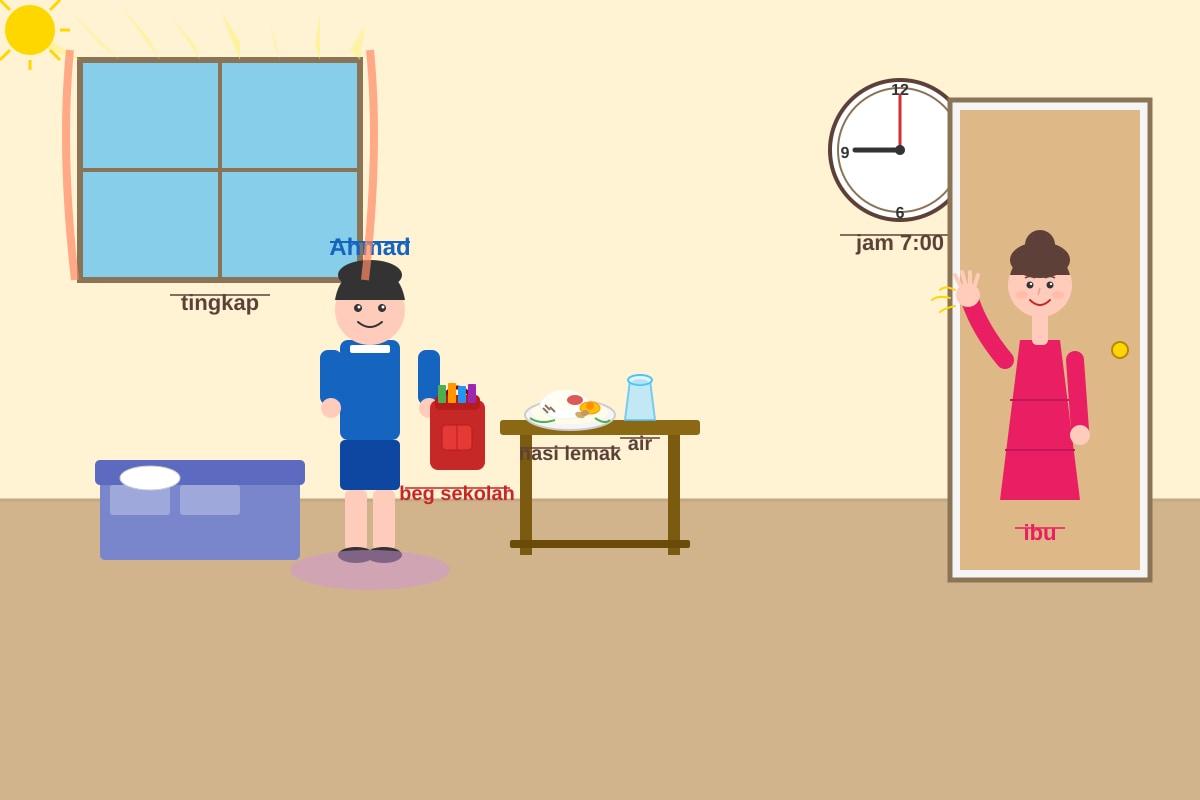
11. Blank one: Ahmad wakes up early in the _____
Answer: pagi
Marking: 1 mark. Must be spelled correctly; accept minor spelling variations if recognisable (e.g., "pagi" with one g).
Teaching note: pagi = morning. Time words in P1: pagi (morning), petang (afternoon), malam (night). The clock shows 7:00 with sunlight = pagi context.
12. Blank two: The sun shines through the _____
Answer: tingkap
Marking: 1 mark.
Teaching note: tingkap = window. From the picture: sunlight streams through the tingkap. Common confusion with pintu (door)—emphasise glass/see-through quality.
13. Blank three: Ahmad eats his _____
Answer: sarapan
Marking: 1 mark.
Teaching note: sarapan = breakfast. The meal shown is nasi lemak (coconut rice, a traditional Malay breakfast), confirming this is morning food, not makan tengah hari (lunch) or makan malam (dinner).
14. Blank four: Then he _____ his bag.
Answer: berkemas
Marking: 1 mark.
Teaching note: berkemas = to pack/tidy up. The root kemas = tidy; ber- prefix makes it a verb. Context: putting books into school bag. Common error: "membawa" (brings)—accept if student explains carrying action, but berkemas is the intended preparation action.
15. Blank five: His _____ says goodbye.
Answer: ibu
Marking: 1 mark.
Teaching note: ibu = mother. From picture: mother waving at door. Alternative: emak (also mother, regional variation—accept if used in student's home context).
16. Ahmad walks to _____
Answer: sekolah (ticked)
Marking: 1 mark for correct tick.
Teaching note: Context clues from passage: wakes up, breakfast, packs bag, mother says goodbye = going to sekolah (school), not rumah (home—he's already home), taman (park), or kedai (shop).
17. Circle the action word in: "Siti makan nasi lemak di kantin."
Answer: makan (circled)
Marking: 1 mark.
Teaching note: Kata kerja = action word/verb. makan = to eat. Sentence structure: [Who] [does what] [what] [where] = Siti [makan] [nasi lemak] [di kantin]. Other words: Siti (noun/name), nasi lemak (noun/food), di (preposition), kantin (noun/place).
18. Choose correct action word: "Ali _______ bola di padang."
Answer: B) main
Marking: 1 mark.
Teaching note: main = to play. Bola (ball) + padang (field) = playing context. tidur = sleep (wrong place); makan = eat (cannot eat a ball); minum = drink (wrong object). Main bola = play football — common P1 phrase.
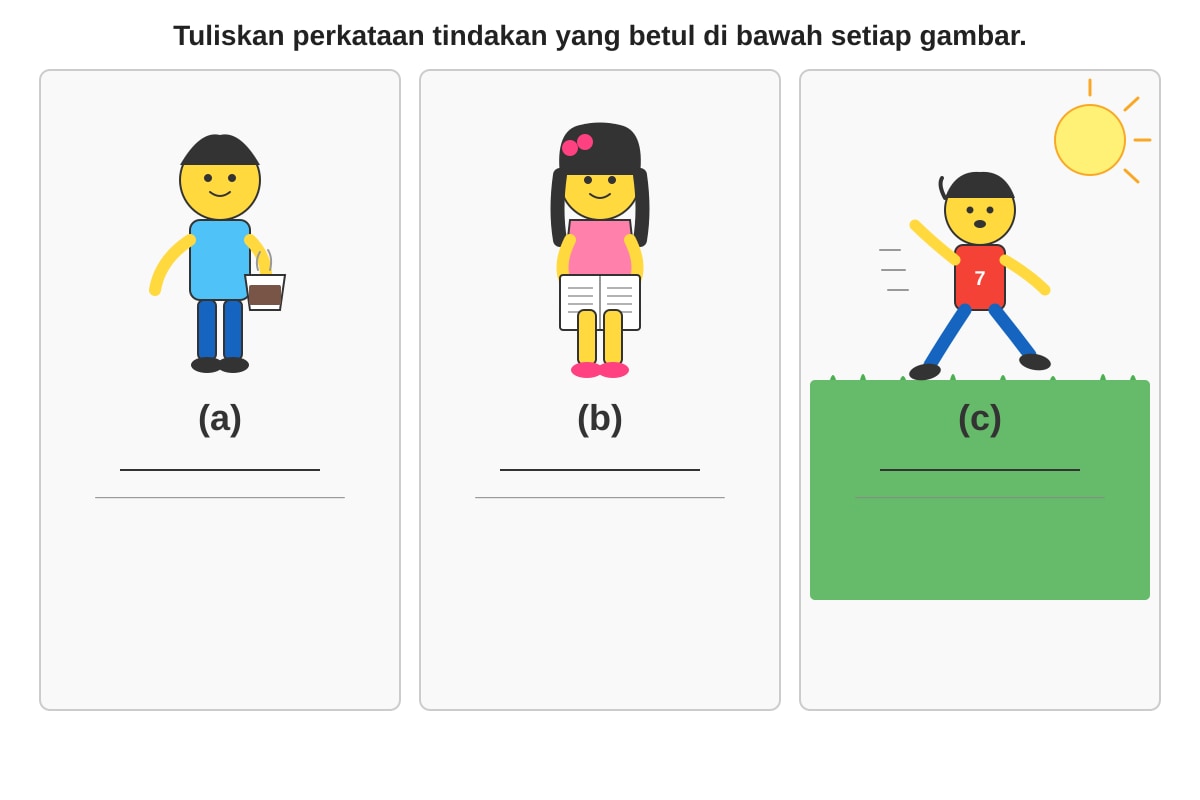
19. Write correct action word for each picture.
(a) Picture: boy drinking from cup
Answer: minum
(b) Picture: girl reading a book
Answer: membaca / baca
(c) Picture: boy running on field
Answer: berlari / lari
Marking: 1 mark each; 3 marks total. Accept base form or ber- prefixed form.
Teaching note:
- minum = to drink. Picture cue: cup with liquid.
- membaca/baca = to read. Picture cue: book. Ber- prefix for "reading activity", base form for simple action.
- berlari/lari = to run. Picture cue: field, running posture.
Common error: "minum" vs "meminum" — at P1, base forms expected. Accept berlari but lari is simpler.
20. Write two things you do in the morning before school. Use action words.
Sample answers: (i) Saya bangun tidur. / Saya mandi. / Saya makan sarapan. / Saya berkemas beg. (ii) Saya pakai pakaian sekolah. / Saya berus gigi. / Saya minum susu. / Saya berjalan ke sekolah.
Marking: 1 mark per appropriate sentence with correct action word; 2 marks total.
Teaching note: Accept any reasonable morning routine with action word (kata kerja). Must be Malay and grammatically intelligible for P1 level. Common acceptable answers: bangun tidur (wake up), mandi (bathe), makan sarapan (eat breakfast), berkemas beg (pack bag), pakai pakaian (wear clothes), berus gigi (brush teeth). Deduct if no action word present or answer is not morning-appropriate.
Section B: Writing and Application (15 marks)
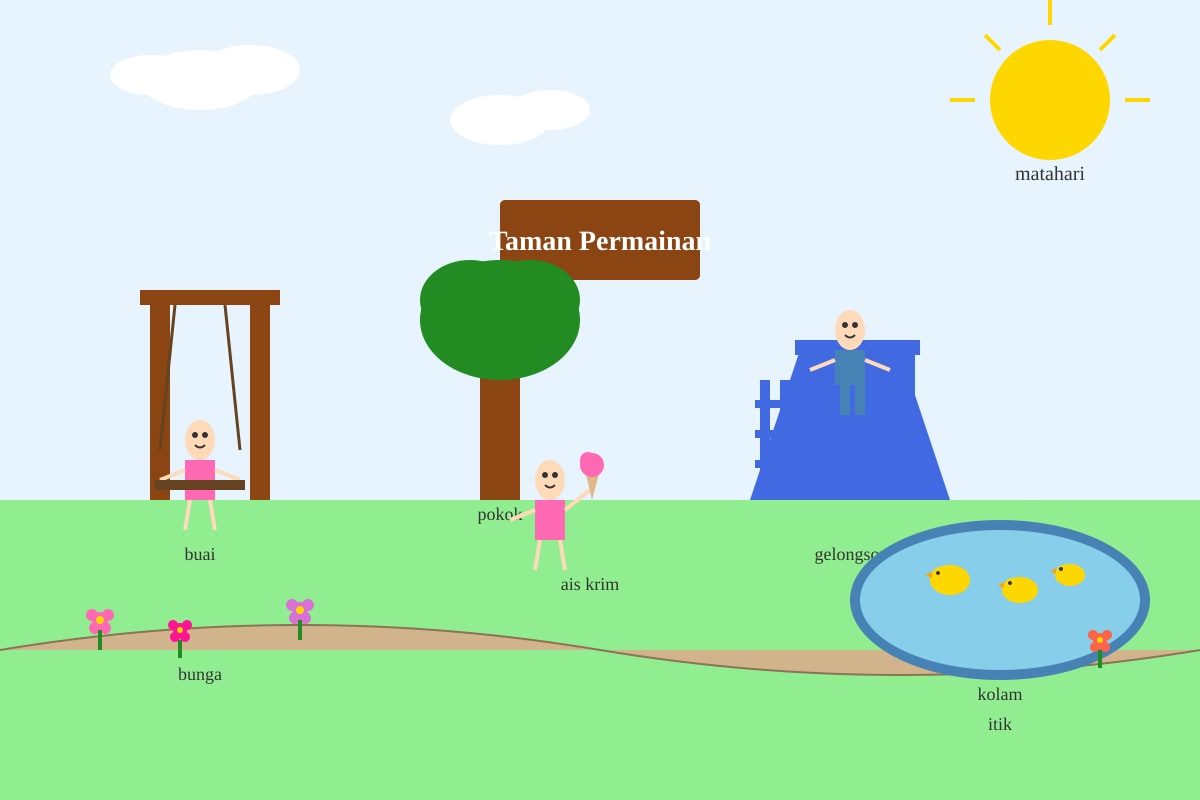
Visual reference for Question 21: Park scene with three children: girl on swing (buai), boy on slide (gelongsor), girl eating ice cream under tree. Background: pond with ducks (kolam, itik), flowers (bunga), sun (matahari), sign "Taman Permainan".
21. Write three sentences about what you see.
Sample answer:
- Budak perempuan buai di buai. / Seorang budak perempuan sedang bermain buai.
- Budak lelaki main gelongsor. / Seorang budak lelaki sedang meluncur gelongsor.
- Budak perempuan makan ais krim di bawah pokok. / Ada itik di dalam kolam.
Marking breakdown: 2 marks per sentence; 6 marks total.
- 2 marks: Complete sentence with subject, action/verb, and relevant detail from picture
- 1 mark: Attempted sentence with some correct elements but incomplete or grammatical errors
- 0 marks: Irrelevant or no attempt
Teaching note: P1 writing focuses on simple sentence construction: [Siapa] + [Buat apa] + [Di mana] (Who + What + Where). Accept sedang (progressive marker) as bonus but not required. Key vocabulary: buai (swing), gelongsor (slide), ais krim (ice cream), pokok (tree), kolam (pond), itik (duck), bunga (flower). Common error: confusing buai (noun, swing) with berbuai (verb, to swing)—accept either structure.
22. Write four sentences about yourself using: nama, saya, suka, makan, minum.
Sample answer: (i) Nama saya Ali. / Saya nama Aminah. (ii) Saya seorang murid Tahun Satu. (iii) Saya suka makan nasi lemak. / Saya suka makan buah. (iv) Saya minum air. / Saya suka minum susu.
Marking breakdown: 1 mark per sentence with correct word usage; 4 marks total.
- Must use at least three of the five given words across the four sentences
- Each sentence must be intelligible and self-referential (about "yourself")
Teaching note: This tests guided writing with mandatory vocabulary. nama = name; saya = I/me; suka = like; makan = eat; minum = drink. Sentence patterns:
- Self-introduction: Nama saya... / Saya...
- Preferences: Saya suka [makan/minum]...
- Simple statements: Saya [makan/minum]...
Common error: Using all words in one sentence — remind students to spread across four sentences. Another error: "Saya suka makan minum" as one phrase — needs separate food and drink items or separate sentences.
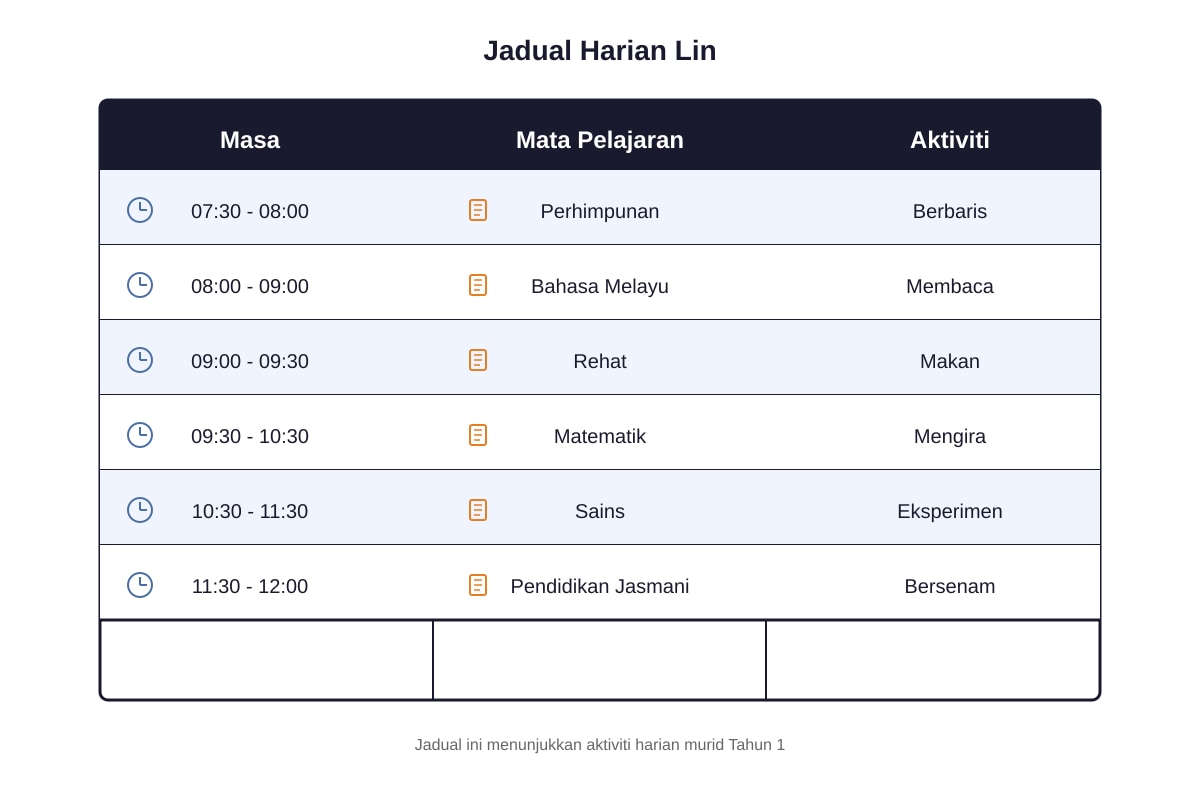
23. Timetable questions about Lin's school day.
Visual reference: Timetable with six time slots from 7:30–12:00 showing subjects and activities.
(a) What does Lin do at 7:30?
Answer: Dia berbaris. / Dia menghadiri perhimpunan. / Dia berbaris di padang.
Marking: 1 mark.
Teaching note: 7:30–8:00 = Perhimpunan (assembly), activity berbaris (line up/parade). Accept any description of morning assembly routine. Berbaris = to line up in rows, a common P1 school start.
(b) Which subject at 8:00?
Answer: Bahasa Melayu
Marking: 1 mark.
Teaching note: 8:00–9:00 = Bahasa Melayu lesson. Tests reading the Malay subject name, not English translation.
(c) When does Lin eat?
Answer: 9:00 / Pukul 9:00 / 9:00–9:30 / Semasa rehat
Marking: 1 mark.
Teaching note: 9:00–9:30 = Rehat (break), activity makan (eat). Accept time or activity description. Rehat = rest/break time.
(d) Name one activity Lin does in the morning.
Answer: membaca / mengira / eksperimen / bersenam / berbaris / makan (any one from timetable)
Marking: 1 mark.
Teaching note: Activities listed: berbaris (line up), membaca (reading), makan (eating), mengira (counting/calculating), eksperimen (experiment), bersenam (exercise/gym). Any one correct answer accepted.
(e) Write one sentence about what Lin likes to do in school.
Sample answer: Lin suka membaca. / Saya suka bersenam di sekolah. / Dia suka eksperimen Sains. / Lin suka berbaris dengan kawan-kawan.
Marking: 1 mark for complete sentence with school activity.
Teaching note: Uses suka (like) + school activity from timetable or general school context. Tests transfer from third-person (Lin) to first-person expression (saya suka) or maintaining third person. Accept either perspective as long as school context is clear.
Mark Summary
| Section | Marks |
|---|---|
| Section A | 25 |
| Section B | 15 |
| Total | 40 |
Assessment Notes for Teachers/Parents
This Version 5 Practice Paper emphasises:
- Visual literacy: Strong picture-to-word connections for P1 learners
- Functional vocabulary: School objects, colours, family, numbers, animals, body parts, time, routines
- Grammar awareness: Kata kerja (verbs) recognition and production
- Sentence building: From single words to three-four sentence paragraphs
Caveat: This content is syllabus-aligned and LLM-inferred for Primary 1 Malay. No past-year paper templates were available for this level. The format follows Singapore's P1 continuous assessment approach (no weighted exams, portfolio and observation-based) while providing standardised practice materials. Question patterns reflect typical classroom assessment styles found in Malay language teaching resources for Singapore primary schools.
Time check: Estimated 45 minutes = 25 min Section A + 20 min Section B, allowing 5-minute review buffer for early finishers.