AI Generated Exam Paper
Primary 1 Malay Practice Paper 4
Free P1 Malay Practice Paper 4, Kimi2.6 AI version, with questions, answers, and syllabus-aligned practice for Singapore students.
These static practice materials are generated from the site's syllabus and paper-generation workflow, with source and model context shown so students and parents can evaluate the material before use.
Questions







Free quiz and exam paper access
Enter your details to view this paper
Your access is remembered on this device.
Answers
TuitionGoWhere Practice Paper - Malay Primary 1
Answer Key and Marking Scheme
Subject: Malay Language
Level: Primary 1
Paper: Practice Paper
Version: 4 of 5
Total Marks: 40 marks
Section A: Choose the Correct Word (Pilih Perkataan yang Betul)
10 marks
| Question | Answer | Explanation |
|---|---|---|
| 1 | (b) budak perempuan | The picture shows a young girl with a school bag. Budak perempuan means "girl." (a) budak laki-laki = boy; (c) ibu = mother (adult). Key visual cue: long hair, pinafore dress typical for Singapore primary school girls. |
| 2 | (a) epal | The picture shows a red round fruit with a stem — an apple. Epal = apple. (b) pisang = banana (long, curved, yellow); (c) oren = orange (orange color, textured skin). |
| 3 | (b) pisang | The picture shows a yellow curved fruit — a banana. Pisang = banana. (a) epal = apple (round, red); (c) betik = papaya (larger, oval, orange flesh inside). |
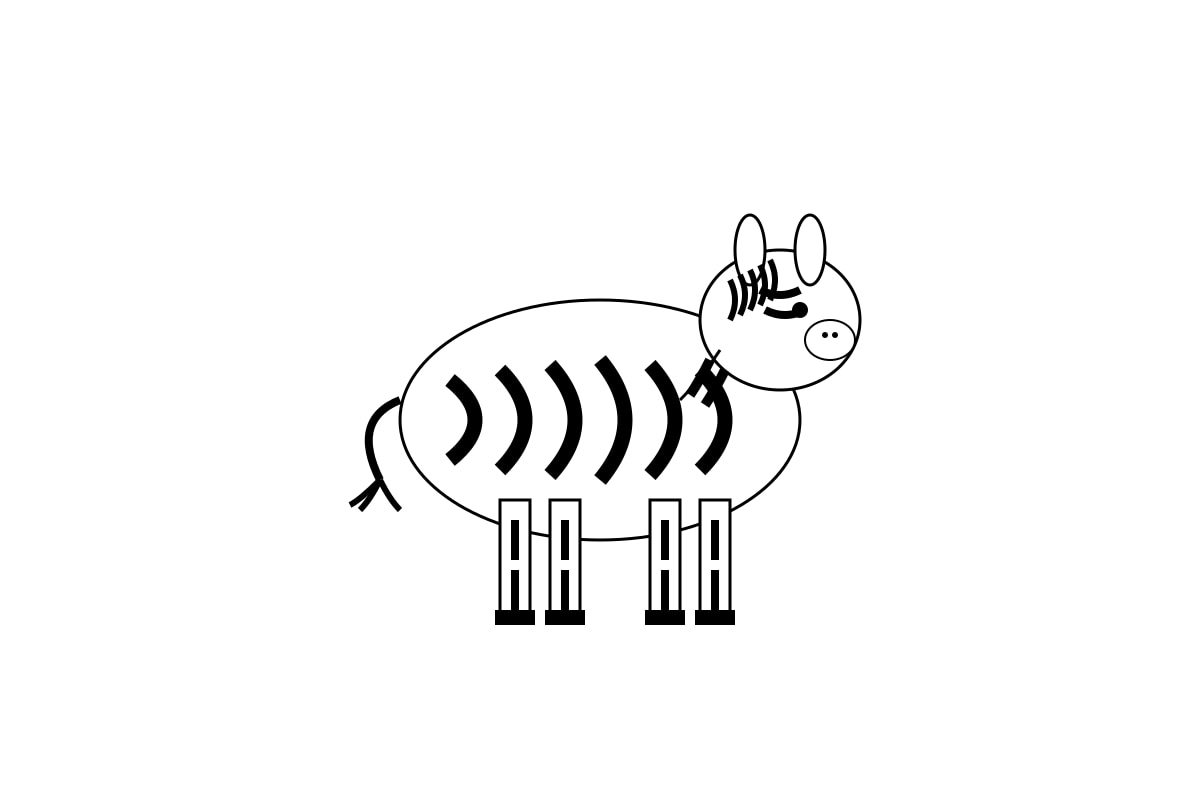
| 4 | (c) zebra | The picture shows a horse-shaped animal with black and white stripes. Zebra is the only striped animal among the choices. (a) harimau = tiger (orange with black stripes); (b) kuda = horse (no stripes, usually brown). Key visual cue: black AND white stripes specifically. |
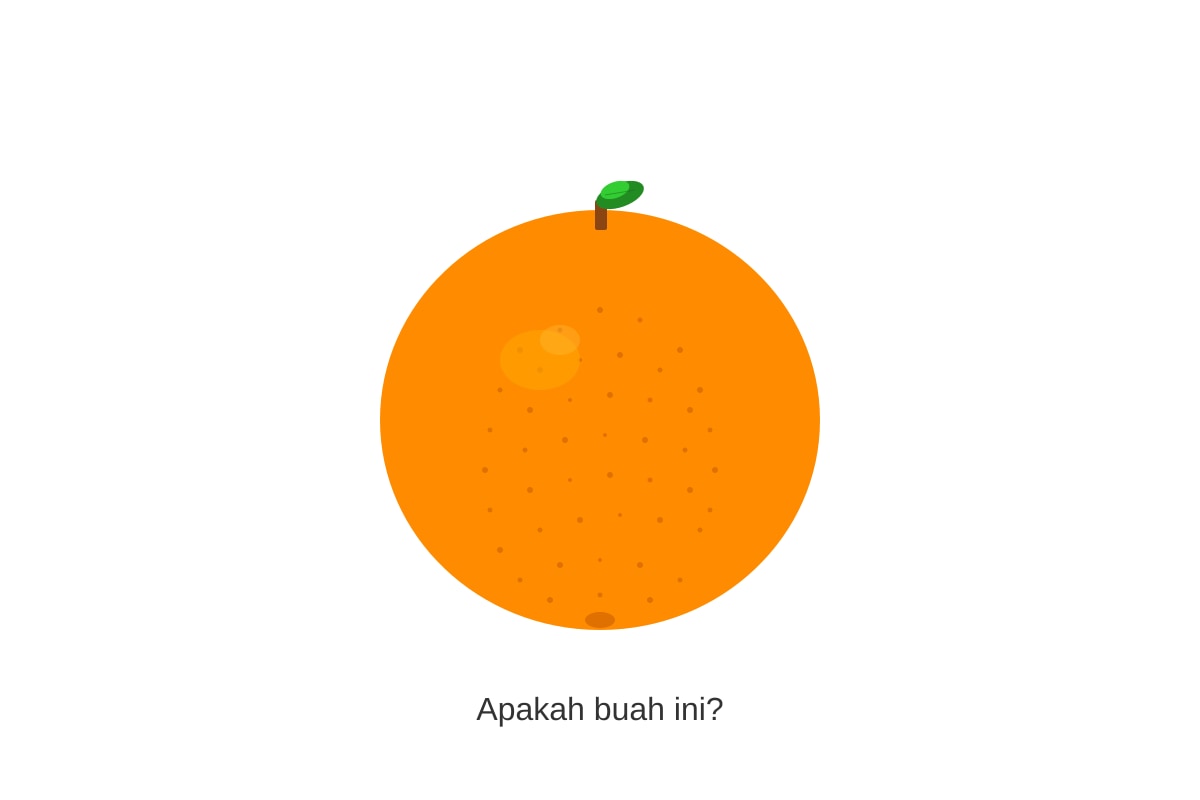
| 5 | (b) oren | The picture shows a round orange-colored fruit with textured skin. Oren = orange (the fruit). (a) limau = lime (smaller, green); (c) kuning = yellow (color, not a fruit name). Note: In Malay, oren refers to the orange fruit; kuning is the color yellow. |
| 6 | (b) ibu | The picture shows an adult woman wearing a baju kurung (traditional Malay dress). Ibu = mother. (a) ayah = father (male); (c) adik = younger sibling (child). Key visual cue: adult female, traditional dress, maternal appearance. |
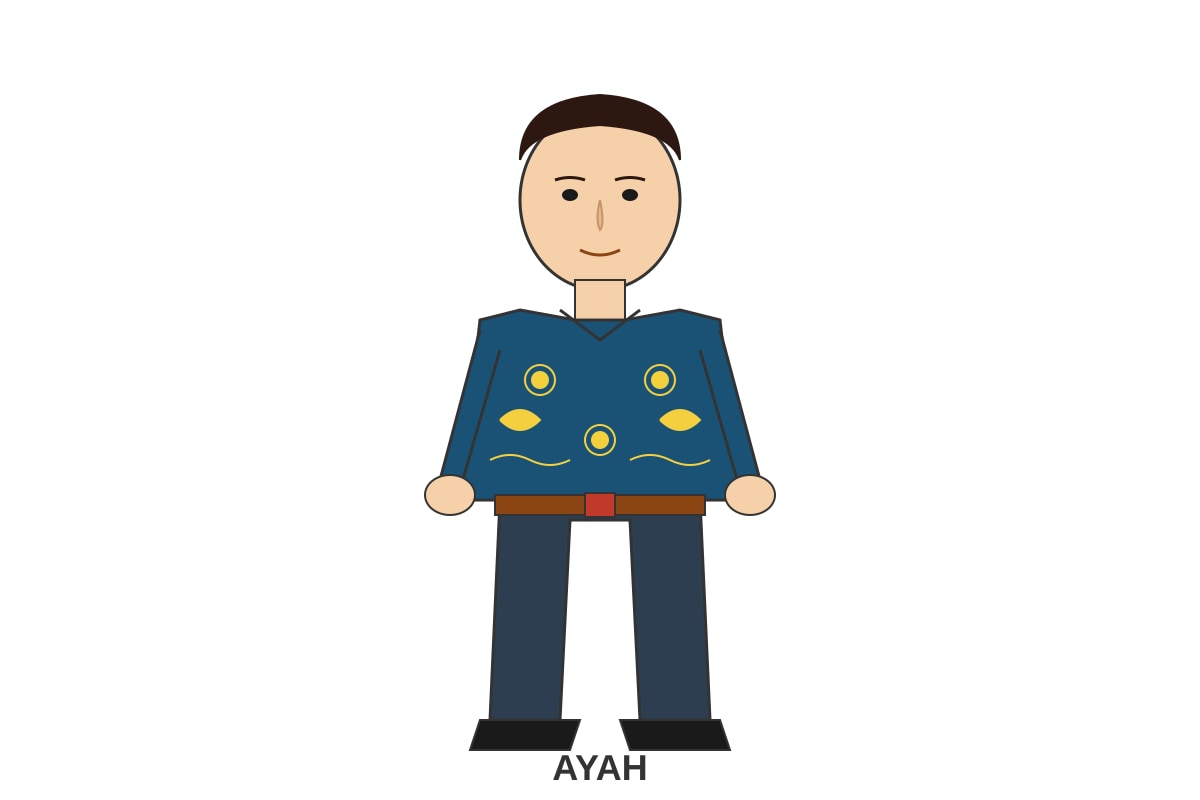
| 7 | (b) ayah | The picture shows an adult man wearing a batik shirt. Ayah = father. (a) emak = mother (another word for ibu, female); (c) nenek = grandmother (elderly). Key visual cue: adult male, batik shirt associated with Malay men. |
| 8 | (b) rumah | The picture shows a building with a triangular roof, door, windows, and chimney with smoke — a house. Rumah = house. (a) sekolah = school (larger building, many windows, bell, gate); (c) taman = park (outdoor, playground, trees, no building). Key visual cue: domestic home features like chimney smoke. |
| 9 | (c) matahari | The picture shows a bright yellow sun with radiating rays and a smiling face. Matahari = sun. (a) bulan = moon (appears at night, crescent or round white, no rays); (b) bintang = star (small, pointy, in the night sky). Key visual cue: radiating rays = sun characteristic. |
| 10 | (b) bulan | The picture shows a white crescent moon against a dark background with small stars. Bulan = moon. (a) matahari = sun (bright yellow, day time, rays); (c) awan = cloud (fluffy, grey or white, in the sky). Key visual cue: crescent shape + dark background + stars = night scene with moon. |
Section A Total: 10 marks
Section B: Match the Words (Padankan Perkataan)
15 marks
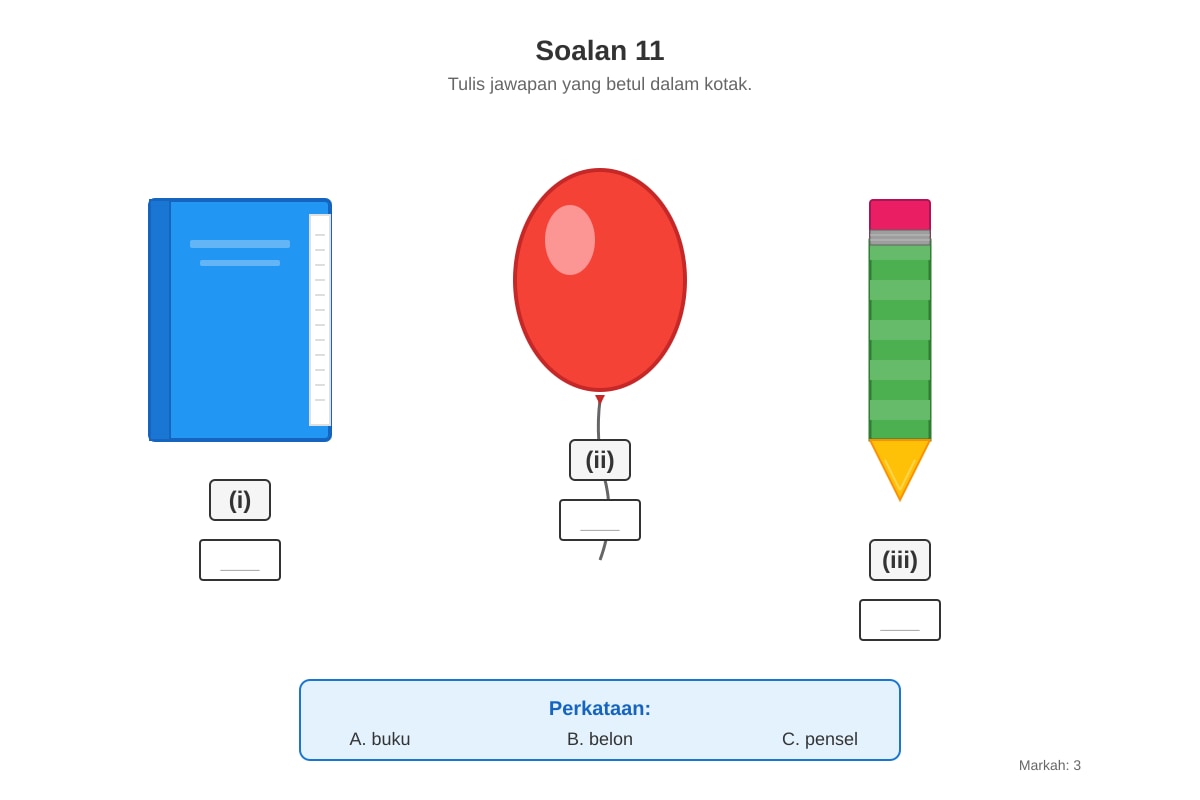
Question 11 (3 marks)
| Part | Answer | Explanation |
|---|---|---|
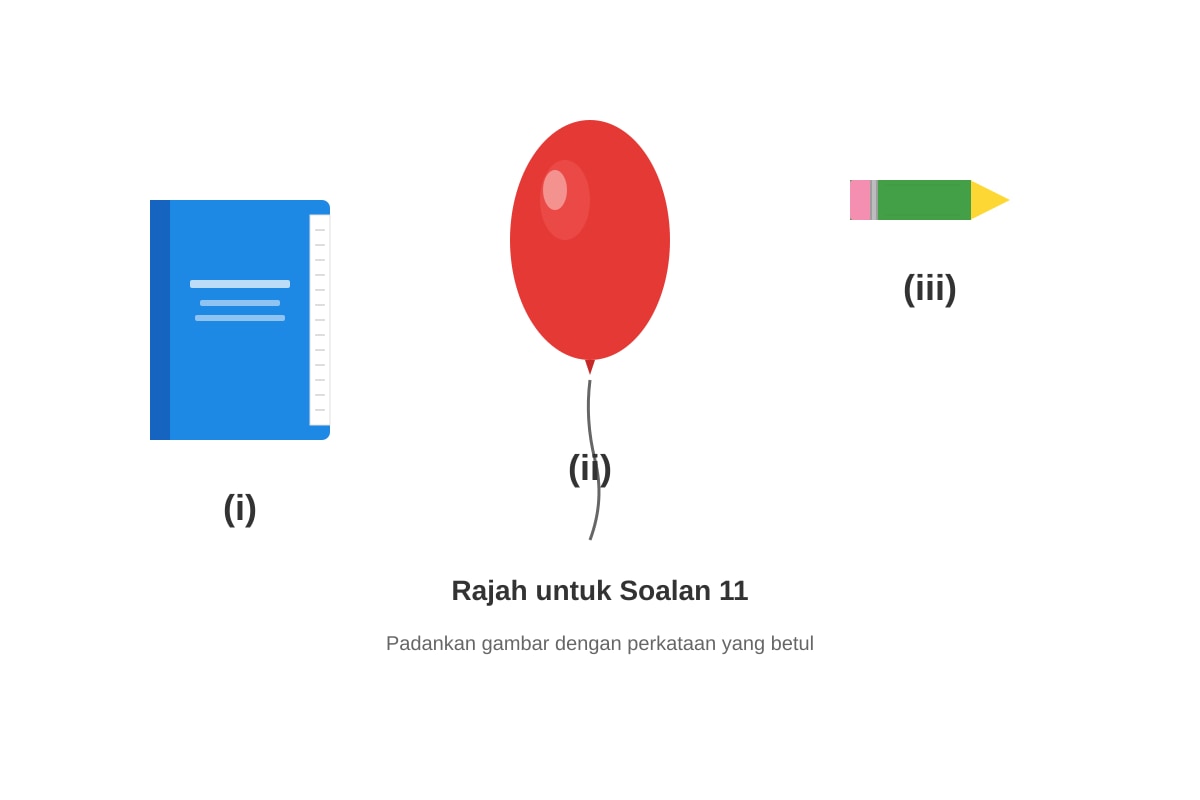
| (i) | A / buku | The left picture shows a blue book with white pages. Buku = book. Visual cues: rectangular shape, pages visible, standing upright. |
| (ii) | B / belon | The center picture shows a red round balloon with a string. Belon = balloon. Visual cues: round, floating, string hanging down. |
| (iii) | C / pensel | The right picture shows a green long pencil with a sharpened tip. Pensel = pencil. Visual cues: long thin shape, pointed tip, typical writing tool. |
Marking: 1 mark for each correct letter. Accept the word written out if legible.
Question 12 (3 marks)
| Part | Answer | Explanation |
|---|---|---|
| (i) | A / mata | The left picture shows a human eye with eyebrow and eyelashes. Mata = eye. Visual cues: oval eye shape, pupil, eyelashes, eyebrow above. |
| (ii) | B / telinga | The center picture shows a human ear. Telinga = ear. Visual cues: outer ear shape, curved, attached to side of head. |
| (iii) | C / tangan | The right picture shows a hand with five fingers spread. Tangan = hand. Visual cues: palm, five fingers, thumb visible. |
Marking: 1 mark for each correct letter. Common error: Students may confuse telinga with other body parts; emphasize "listening" function.
Question 13 (3 marks)
| Part | Answer | Explanation |
|---|---|---|
| (i) | A / gajah | The left picture shows a large animal with a trunk and big ears. Gajah = elephant. Visual cues: long trunk hanging down, large floppy ears, four thick legs, grey/brown color. |
| (ii) | B / panda | The center picture shows a black and white animal sitting on hind legs with round ears. Panda = panda. Visual cues: distinctive black eye patches, round ears, black and white body pattern. |
| (iii) | C / harimau | The right picture shows an orange and black striped animal. Harimau = tiger. Visual cues: walking posture, stripes on orange fur, fierce expression. |
Marking: 1 mark for each correct letter. Common error: Students may confuse gajah trunk with hose/pipe; emphasize it's part of the animal's face.
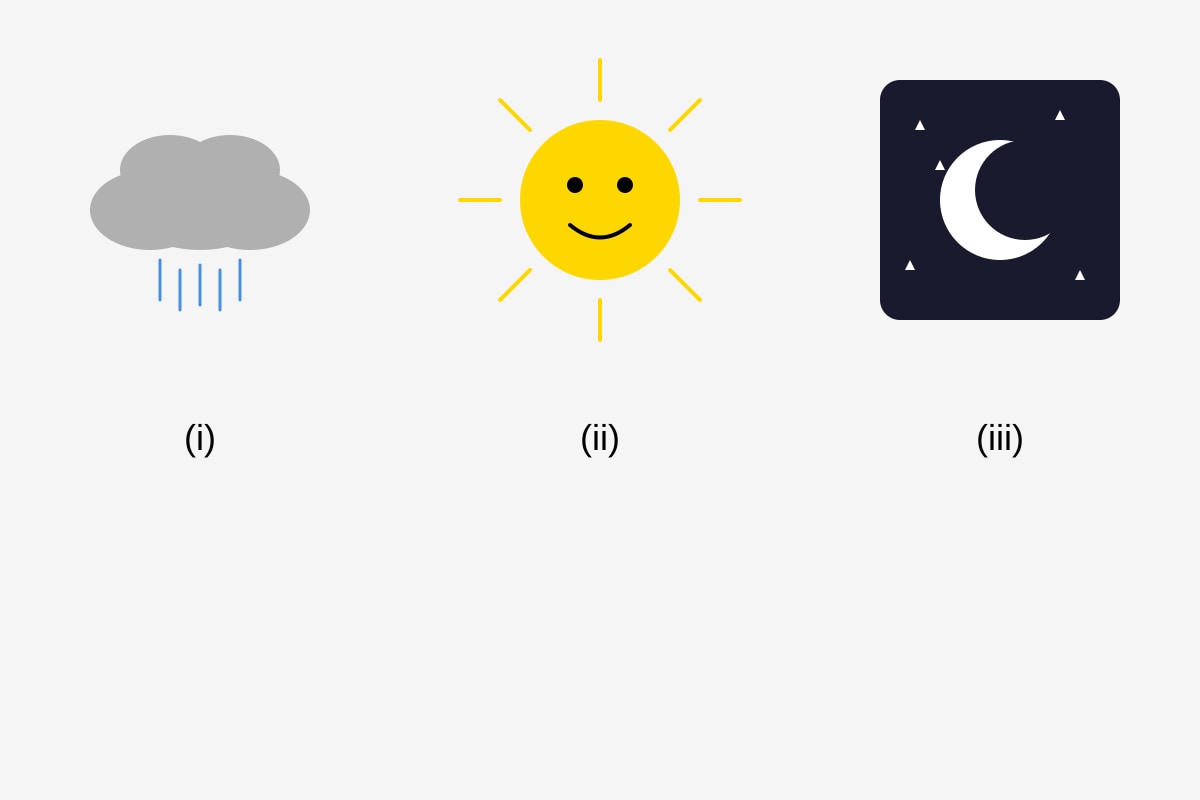
Question 14 (3 marks)
| Part | Answer | Explanation |
|---|---|---|
| (i) | A / hujan/awan | The left picture shows a grey cloud with rain drops. Awan = cloud; hujan = rain. Visual cues: fluffy grey shape, drops falling below. Note: Accept either "hujan" or "awan" as both describe the scene; the word box contains "hujan/awan" as combined option. |
| (ii) | B / matahari | The center picture shows a bright yellow sun with rays. Matahari = sun. Visual cues: radiating straight lines, smiling face, bright color. |
| (iii) | C / bulan | The right picture shows a white crescent with stars on dark background. Bulan = moon. Visual cues: crescent shape, night scene, stars nearby. |
Marking: 1 mark for each correct letter. For (i), accept "hujan" or "awan" if student writes either; the combined option tests recognition of weather phenomena.
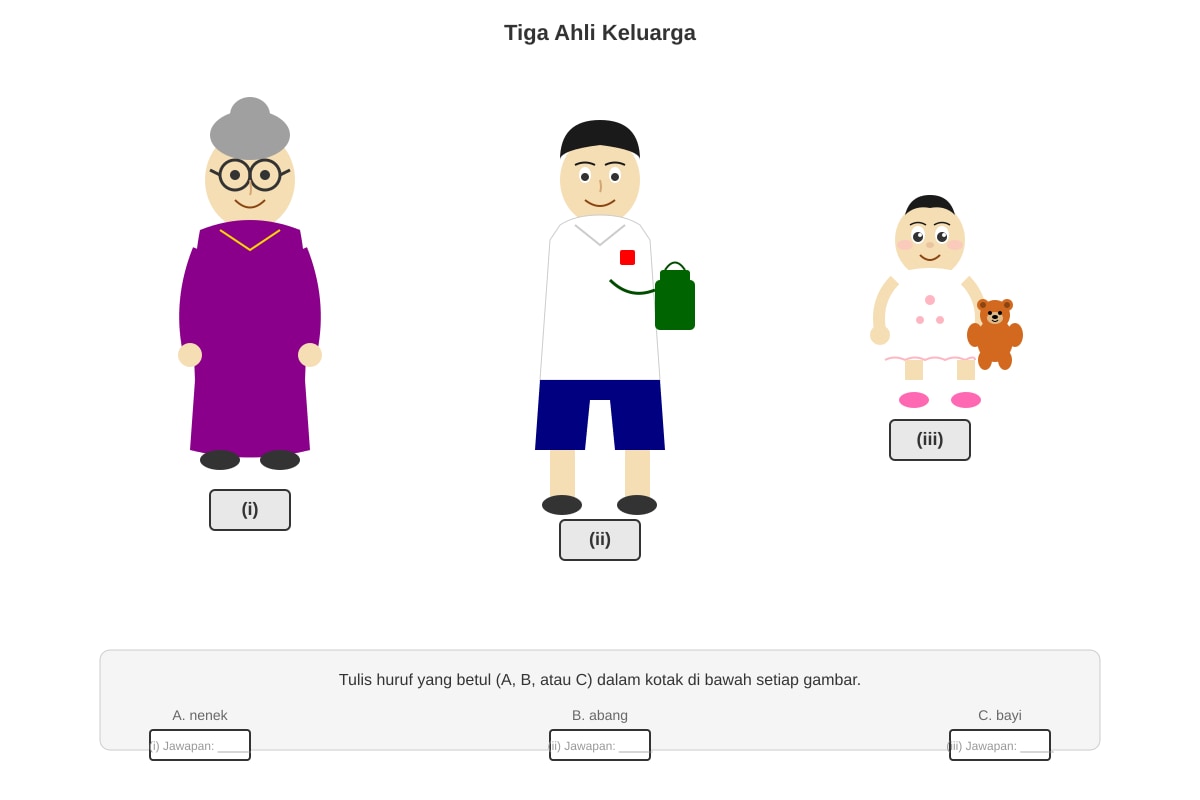
Question 15 (3 marks)
| Part | Answer | Explanation |
|---|---|---|
| (i) | A / nenek | The left picture shows an elderly woman with grey hair in a bun, wearing glasses. Nenek = grandmother. Visual cues: advanced age (wrinkles, grey hair), glasses, gentle smile, traditional dress. |
| (ii) | B / abang | The center picture shows a young boy in school uniform with a bag. Abang = older brother. Visual cues: school-age child, short hair, uniform, carrying bag, larger than baby but smaller than adult. |
| (iii) | C / bayi | The right picture shows a small baby/toddler with a teddy bear. Bayi = baby. Visual cues: smallest figure, toddler proportions, holding toy, innocent expression. |
Marking: 1 mark for each correct letter. Common error: Students may call all children "adik"; emphasize age differences: bayi (baby), adik (younger sibling, could be any age below speaker), abang (older brother).
Section B Total: 15 marks
Section C: Fill in the Blanks and Simple Writing (Isikan Tempat Kosong dan Menulis Mudah)
15 marks
Question 16 (2 marks)
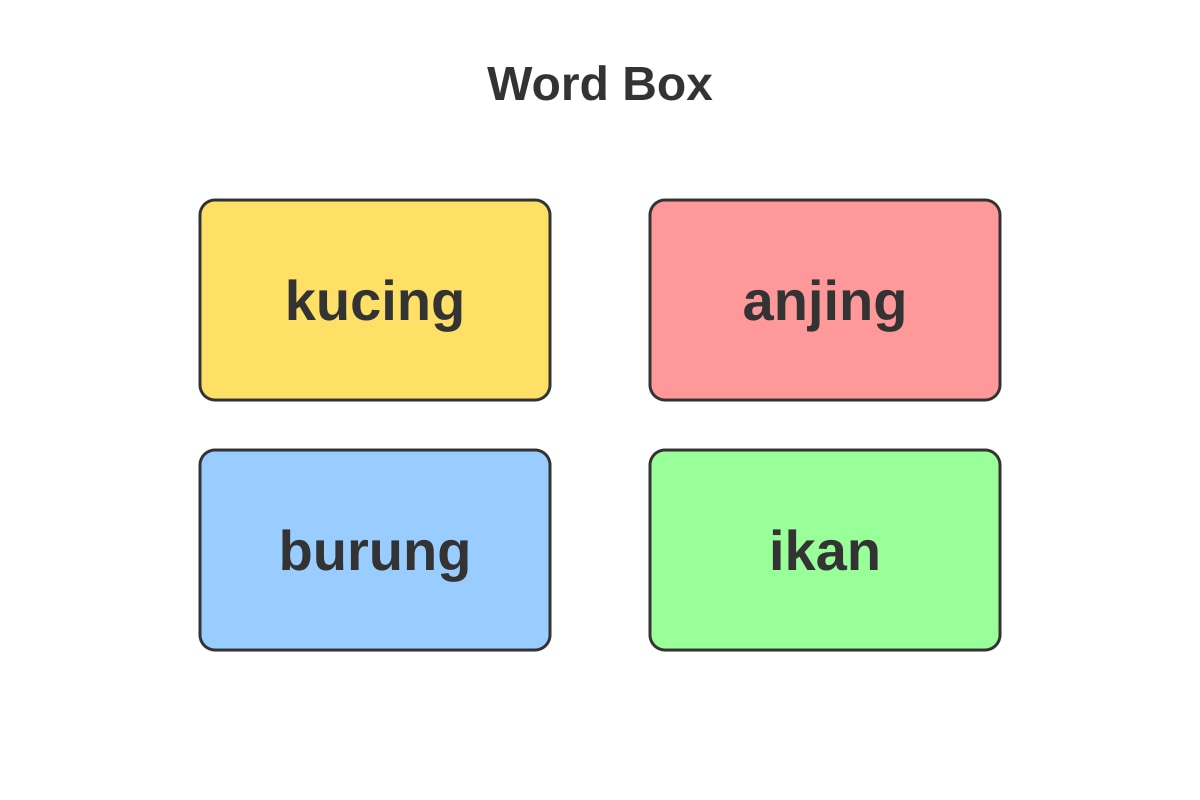
**Answer: kucing (cat)
Marking scheme:
- 2 marks: Correct word kucing written clearly
- 1 mark: Phonetically close attempt (e.g., "kuceng" — common child spelling variation) with clear understanding of the animal
- 0 marks: Irrelevant word or blank
Explanation: The sentence gives two clues: "seekor" (classifier for animals) and "mengeong" (the sound a cat makes, "meow"). The word box contains four animals:
- kucing = cat (says "meow")
- anjing = dog (says "gonggong" — woof)
- burung = bird (says "cuit cuit" — chirp)
- ikan = fish (no sound, lives in water)
Teaching note: Seekor is the counting word used for animals in Malay (similar to "a" in English but specific to animals). Mengeong is onomatopoeia — the cat's cry. Students should listen for sound clues in comprehension questions.
Common mistake: Writing anjing (dog) — dogs make "gonggong" sound, not "meow."
Question 17 (2 marks)
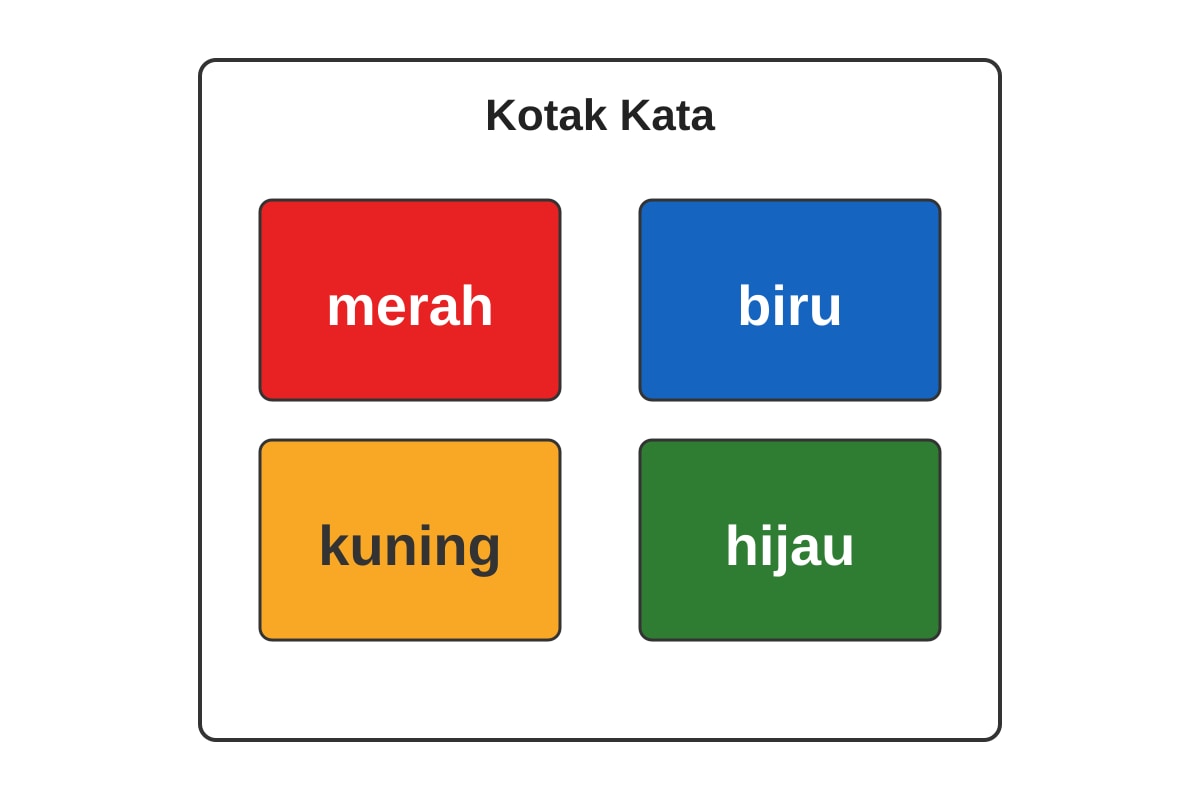
**Answer: Any one of merah, biru, kuning, or hijau — BUT must make sense contextually
Revised expected answer based on open sentence: biru (blue) — most common shirt color, OR accept any valid with reasonable justification
Note: Since the sentence "Lelaki itu memakai baju __________" is open, any color from the word box is technically acceptable if the student can describe it. However, standard marking:
Acceptable answers:
- merah (red), biru (blue), kuning (yellow), or hijau (green)
Marking scheme:
- 2 marks: Any color word from the box, written correctly and spelled accurately
- 1 mark: Color word from box with minor spelling error but recognizable
- 0 marks: Color not in box, or blank
Explanation: This question tests color vocabulary recognition and spelling. The four colors are:
- merah = red
- biru = blue
- kuning = yellow
- hijau = green
Teaching note: In Malay, colors come after the noun they describe (baju merah = red shirt, literally "shirt red"). This is different from English word order. The sentence structure here follows correct Malay grammar: noun + color descriptor.
Common mistake: Students may try to say "baju hijau" (green shirt) but spell "hijau" as "hiju" — missing the 'a'. Remind students: h-i-j-a-u, 5 letters.
Question 18 (4 marks)
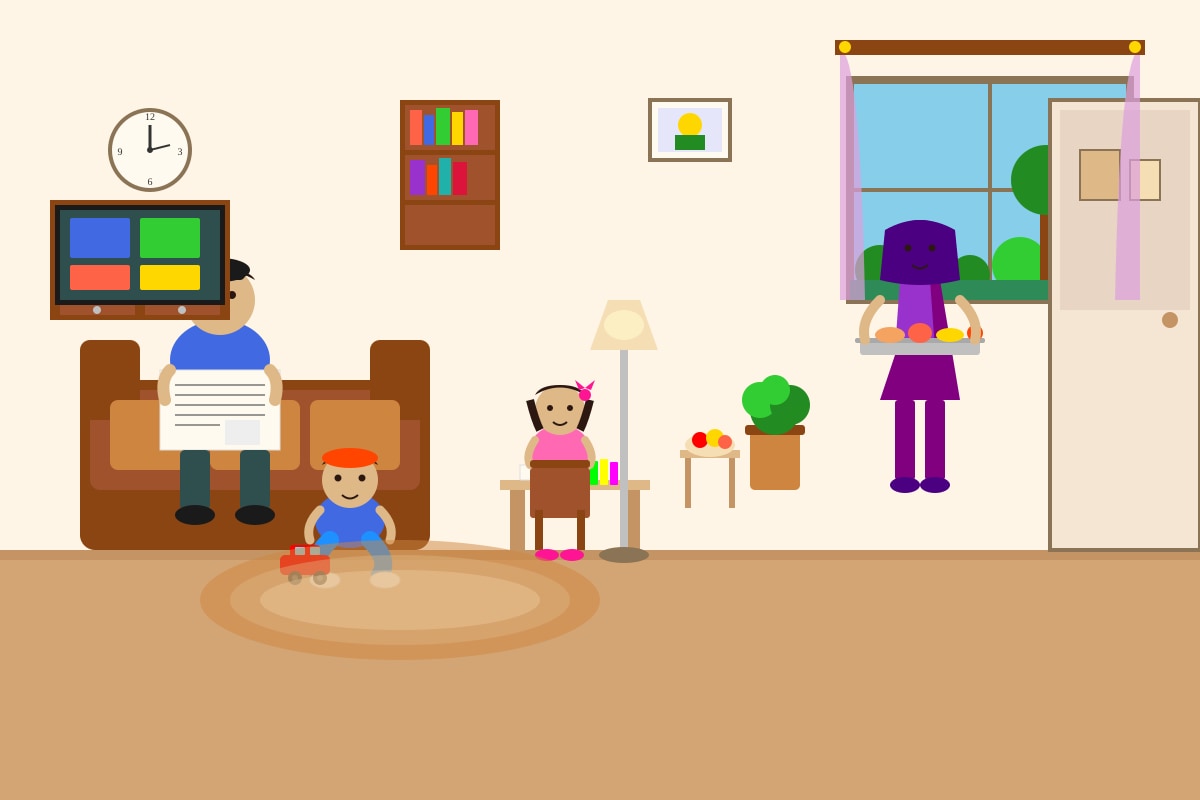
Picture description: A family in a living room — father reading newspaper, mother near kitchen with food, boy playing with toy car, girl coloring.
Expected sentences (examples of acceptable responses):
Sentence 1 (2 marks):
- "Ayah sedang membaca surat khabar." (Father is reading the newspaper.) [2 marks]
- "Ibu berdiri di pintu dapur." (Mother is standing at the kitchen door.) [2 marks]
- "Abang bermain kereta mainan." (Brother is playing with a toy car.) [2 marks]
- "Adik perempuan mewarna dengan pensel warna." (Sister is coloring with crayons.) [2 marks]
Sentence 2 (2 marks):
- Any second different sentence about another family member or activity.
Marking scheme for each sentence:
| Score | Criteria |
|---|---|
| 2 marks | Complete sentence with: correct subject (family member), correct verb/action, correct location/object. Grammar understandable with minor spelling variations. |
| 1 mark | Partial sentence: missing subject OR missing verb OR unclear who is doing what. May have significant spelling errors but meaning discernible. |
| 0 marks | Fragment, single word, or completely unrelated to picture. |
Teaching notes:
- Encourage students to use simple sentence structure: [Subject] + [verb] + [object/location]
- Acceptable family terms: ayah (father), ibu (mother), abang (older brother), kakak (older sister), adik (younger sibling), nenek (grandmother), atuk (grandfather)
- Acceptable action verbs: membaca (reading), berdiri (standing), bermain (playing), mewarna (coloring), memasak (cooking), duduk (sitting)
- The picture shows indoor domestic activities; sentences about going outside would be incorrect.
Common mistakes:
- Confusing surat khabar (newspaper) with buku (book) — the father is reading a newspaper, not a book, in the picture
- Forgetting to include who is doing the action — e.g., just writing "membaca surat khabar" without saying who
Question 19 (4 marks)
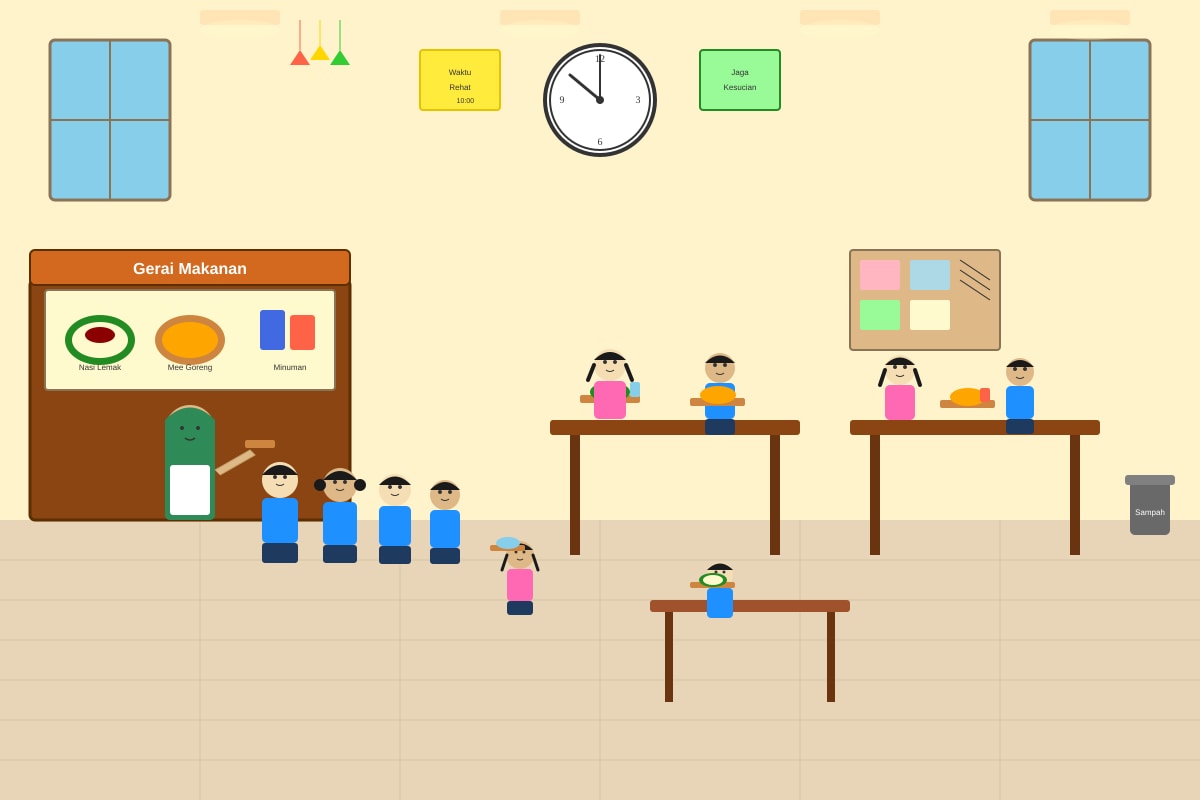
Picture description: School canteen during recess — children queuing, vendor serving, children eating, Malay food visible, clock showing 10:00.
Expected sentences (examples of acceptable responses):
Sentence 1 (2 marks):
- "Murid-murid beratur di kantin sekolah." (The students are queuing in the school canteen.) [2 marks]
- "Penjual menjual nasi lemak dan mee goreng." (The vendor is selling nasi lemak and fried noodles.) [2 marks]
- "Jam di dinding menunjukkan pukul 10:00." (The clock on the wall shows 10 o'clock.) [2 marks]
- "Kanak-kanak sedang makan di meja kantin." (The children are eating at the canteen tables.) [2 marks]
Sentence 2 (2 marks):
- Any second different sentence about another aspect of the scene.
Marking scheme for each sentence:
| Score | Criteria |
|---|---|
| 2 marks | Complete sentence with: appropriate subject, correct verb, correct location/time reference. Mentions visible activity in the canteen. Spelling understandable. |
| 1 mark | Partial sentence or mentions canteen but with unclear actors or actions. Some elements correct but incomplete. |
| 0 marks | Sentence unrelated to canteen scene, or blank. |
Teaching notes:
- Key vocabulary for this scene: kantin (canteen), sekolah (school), murid (student), beratur (queuing), makan (eating), minum (drinking), jual (sell), nasi lemak (coconut rice — traditional Malay dish), mee goreng (fried noodles), jam (clock), pukul (o'clock), rehat (recess/break)
- Time reference: pukul 10:00 or 10 pagi (10 a.m.) indicates morning recess time
- The scene shows multiple activities; encourage students to describe different things, not repeat the same sentence
Common mistakes:
- Writing about classroom activities instead of canteen — remind students to look at WHERE the scene takes place
- Confusing kantin with kelas (classroom) or tandas (toilet)
- Forgetting the food context — nasi lemak and mee goreng are specifically Malay/Singaporean foods visible in the image
Question 20 (4 marks)
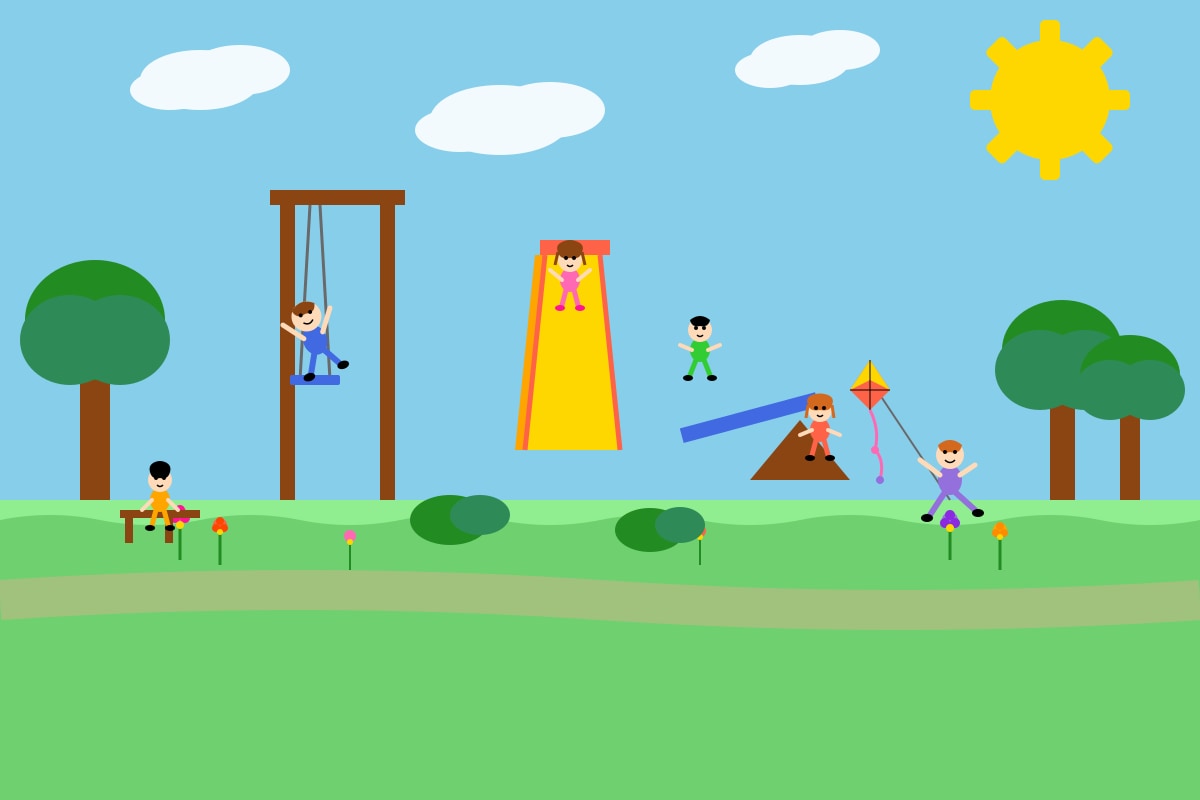
Picture description: Children in playground — boy on swing, girl on slide, two on seesaw, one running with kite, trees and flowers, sunny day.
Sentence with "suka" (2 marks):
Expected responses:
- "Saya suka bermain di taman permainan." (I like to play in the playground.) [2 marks]
- "Budak lelaki itu suka bermain buaian." (The boy likes to play on the swing.) [2 marks]
- "Kawan-kawan saya suka bermain di taman." (My friends like to play in the park.) [2 marks]
- "Adik perempuan suka meluncur." (The sister likes to slide.) [2 marks]
Marking scheme:
| Score | Criteria |
|---|---|
| 2 marks | Correct use of suka with appropriate verb/activity, grammatically correct sentence, relevant to picture. Subject + suka + verb/activity pattern. |
| 1 mark | Suka used but with incomplete sentence, wrong verb form, or slightly off-context. |
| 0 marks | Suka not used, or completely unrelated. |
Teaching note: Suka = "like/love to" — in Malay, it is followed directly by a verb (without "to" as in English): suka makan = like to eat, suka bermain = like to play, suka membaca = like to read.
Sentence with "dan" (2 marks):
Expected responses:
- "Ada buaian dan gelongsor di taman permainan." (There is a swing and a slide in the playground.) [2 marks]
- "Budak lelaki dan budak perempuan bermain bersama." (The boy and girl are playing together.) [2 marks]
- "Saya nampak bunga dan pokok di taman." (I see flowers and trees in the park.) [2 marks]
- "Murid ini dan murid itu bermain guli." (This student and that student are playing marbles.) [2 marks]
Marking scheme:
| Score | Criteria |
|---|---|
| 2 marks | Correct use of dan to join two nouns, two phrases, or two clauses. Grammatically correct. Relevant to picture. |
| 1 mark | Dan used but sentence incomplete, or joins inappropriate elements, or minor grammar issues. |
| 0 marks | Dan not used, or completely unrelated. |
Teaching note: Dan = "and" — used to connect equal elements (nouns with nouns, verbs with verbs, clauses with clauses). Common structures: [noun] dan [noun], [verb phrase] dan [verb phrase].
Common mistakes for both sentences:
- Using suka with noun instead of verb: "Saya suka buaian" (I like swings) — grammatically acceptable in Malay but less preferred than "Saya suka bermain buaian"
- Using dan to start a sentence — dan should connect within a sentence, not begin one
- Writing "dan" as "dn" or "den" — remind students: d-a-n
Section C Total: 15 marks
Grand Total Verification
| Section | Marks |
|---|---|
| Section A (Q1-Q10) | 10 marks |
| Section B (Q11-Q15) | 15 marks |
| Section C (Q16-Q20) | 15 marks |
| TOTAL | 40 marks |
Duration check: 45 minutes = approximately 1 minute per mark, with 5 minutes review time. Section A: ~10 minutes (1 min/q). Section B: ~12 minutes (2-3 min/q including looking at pictures). Section C: ~18 minutes (3-4 min/q for writing). Review: ~5 minutes.
Note to teachers: This is Version 4 of 5. Other versions should use different pictures, different word choices, and different contexts while maintaining the same skill assessment pattern and mark distribution.