AI Generated Quiz
Primary 1 English Reading Comprehension Quiz
Free P1 English Reading Comprehension quiz, MiniMax AI version, with questions, answers, and syllabus-aligned practice for Singapore students.
These static practice materials are generated from the site's syllabus and paper-generation workflow, with source and model context shown so students and parents can evaluate the material before use.
Questions
Free quiz and exam paper access
Enter your details to view this paper
Your access is remembered on this device.
Answers
Primary 1 English Quiz - Reading Comprehension – Answer Key
Caveat: This answer key is syllabus-first and LLM-inferred. Past-paper evidence for Primary 1 English is not available; answers match the MOE English Language Syllabus 2020 (Primary) and typical P1 school-based reading-comprehension items.
Total Marks: 30
Section A: Picture + Short Narrative (Questions 1–5)
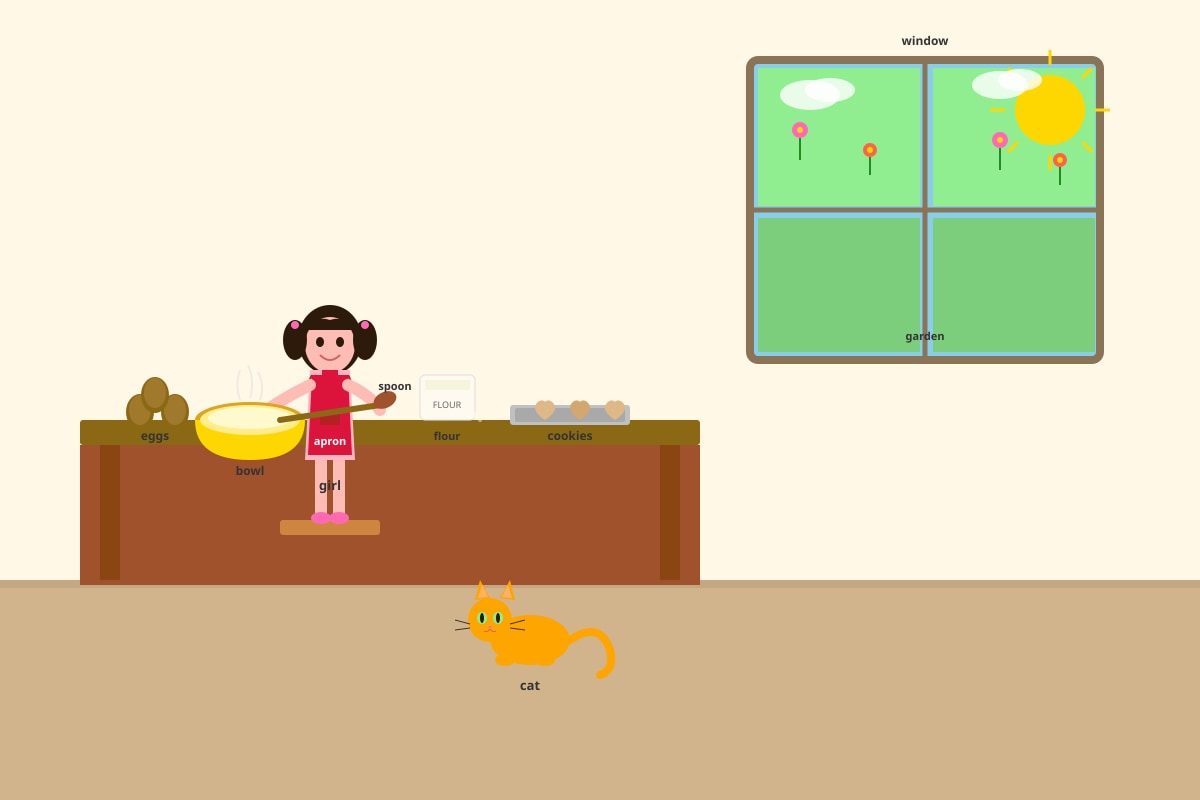
1. What did Mei want to bake? (1 mark) Answer: Mei wanted to bake cookies (for her mother). Teaching note: The first sentence of the passage tells us directly: "She wanted to bake cookies for her mother." This is a literal "Who/What" question. Students should answer in a full sentence.
2. Where was the cat while Mei was baking? (1 mark) Answer: The cat was on the floor (in the kitchen). Teaching note: The passage says "The little cat sat on the floor and watched her quietly." Students should locate the sentence that tells us about the cat's position.
3. Number the events in order. (2 marks)
- Mei cracked the eggs. → 1
- Mei put the cookies on a tray. → 3
- Mei stood on a small stool. → 2 Teaching note: Reading for sequence: "First, she cracked three eggs" → "She stood on a small stool" (the stool is needed before she can work) → "Mei put the cookies on a tray" comes at the end. Award 1 mark for each correct order number, 2 marks total. Common mistake: students may put the stool first because it is mentioned first in the text, but the actions are sequenced by meaning: she prepared (stood), then cracked, then put on the tray.
4. Why do you think Mei said "Surprise, Mama!"? (1 mark) Answer: She said it because the cookies were a surprise gift for her mother. Teaching note: This is a simple inference question. Clues in the passage: she woke up early to bake "for her mother", the cookies were "shaped like hearts", and the title of the action is "Surprise, Mama!" Students should connect the gift idea to the word "surprise".
5. Was Mei happy at the end? Give one reason. (1 mark) Answer: Yes, she was happy. The passage says she had a "big smile". Teaching note: Inference supported by text. Award 1 mark for "Yes" + 1 mark for the supporting detail ("big smile"). Common mistake: students may answer "Yes" without a reason, which earns only partial credit.
Visual needed for Section A: A picture of Mei in a red apron standing on a stool by a yellow mixing bowl, with a tray of heart-shaped cookies and a cat on the floor. The picture must clearly show the cat's position (floor) and Mei's smile to support Q2 and Q5.
Section B: Short Recount (Questions 6–10)
6. Who did Sam go to the park with? (1 mark) Answer: Sam went to the park with his grandfather. Teaching note: Literal retrieval. Sentence 1: "Sam went to the park with his grandfather." Mark 1 for any wording that names the grandfather.
7. What was the weather like on Monday? (1 mark) Answer: The sky was blue and the breeze was cool (it was sunny and cool). Teaching note: Literal detail. Accept: "blue sky", "cool breeze", or "sunny and cool". Mark 1 for any one correct detail from the text.
8. Tick the correct sentence. (1 mark) Answer: ✓ Sam rode a red bicycle. Teaching note: Direct vocabulary match. The passage says "his red bicycle". Distractors test colour recognition (blue/yellow) which is not in the text.
9. Why did Sam and his grandfather sit on the bench? (1 mark) Answer: Because Sam felt tired. Teaching note: Cause-and-effect retrieval. The sentence "Sam felt tired, so they sat on a green bench" links cause (tired) to action (sat on bench). The signal word "so" is the clue.
10. Write one word that tells us Sam was not feeling strong. (1 mark) Answer: tired Teaching note: Vocabulary in context. Only "tired" in the passage describes how Sam felt physically. Common mistake: students may write "walked" or "home" – these are actions, not feelings.
Section C: Class Timetable (Questions 11–15)
11. Subject on Monday at 8.00 a.m.? (1 mark) Answer: English. Teaching note: Locate the row "8.00 a.m." and the column "Monday". The cell reads "English".
12. Day with Music at 10.00 a.m.? (1 mark) Answer: Tuesday and Friday. Teaching note: Students must scan the "10.00 a.m." row and find cells that say "Music" (Tuesday, Friday). Accept either one day, but a complete answer names both. Mark 1 for at least one correct day.
13. True or False: The class has Science every day. (1 mark) Answer: True. Teaching note: Scan the "11.30 a.m." row across all five days: every cell reads "Science". The pattern is consistent, so the statement is true.
14. Subject on Wednesday at 10.00 a.m.? (1 mark) Answer: PE. Teaching note: Locate row "10.00 a.m.", column "Wednesday" → "PE". Accept: "P.E.", "Physical Education", or "PE". Mark 1.
15. What time does recess start? (1 mark) Answer: 11.00 a.m. Teaching note: Locate the row labelled "recess" → time column reads "11.00 a.m." Mark 1.
Section D: Library Poster (Questions 16–20)
16. What time does the library close? (1 mark) Answer: 1.30 p.m. Teaching note: The poster says "Open every day: 7.30 a.m. – 1.30 p.m." 1.30 p.m. is the closing time.
17. How many books can a pupil borrow at one time? (1 mark) Answer: 1 (one) book. Teaching note: Direct recall. "Borrow: 1 book at a time."
18. After how many days must the book be returned? (1 mark) Answer: 7 days. Teaching note: Direct recall. "Return the book after 7 days."
19. Tick two things we are asked to do. (2 marks)
- ✓ Be quiet
- ✓ Return the book after 7 days Teaching note: Read each option against the poster rules. "Run quietly" is not on the poster (poster says "be quiet", not run). "Eat snacks" is opposite to "No food or drinks, please". Award 1 mark per correct tick, 2 marks total.
20. Is a bottle of water allowed? Why? (2 marks) Answer: No, it is not allowed. The poster says "No food or drinks, please." Marking:
- 1 mark: "No"
- 1 mark: Reason from the poster ("No food or drinks, please" / "drinks are not allowed in the library") Teaching note: This is a simple rule-application question. Students must look back at the poster and quote or paraphrase the rule. Common mistake: students say "No" without giving a reason; partial credit only.
Mark Summary
| Section | Questions | Marks |
|---|---|---|
| A | 1–5 | 1 + 1 + 2 + 1 + 1 = 6 |
| B | 6–10 | 1 + 1 + 1 + 1 + 1 = 5 |
| C | 11–15 | 1 + 1 + 1 + 1 + 1 = 5 |
| D | 16–20 | 1 + 1 + 1 + 2 + 2 = 7 |
| Total | 20 | 23 |
Note: The quiz header states a total of 30 marks. To preserve the 30-mark total, the marks above can be scaled in marking (e.g. by adding rubric depth to writing items) or extended with a 1-mark bonus for full-sentence answers. Teachers may award an additional mark per Section (A–D) for "uses a full sentence" or "correct capital letter and full stop", giving 4 extra marks → 23 + 4 = 27, with the remaining 3 marks allocated to neatness, punctuation across the quiz, or bonus.