AI Generated Quiz
Primary 1 English Reading Comprehension Quiz
Free P1 English Reading Comprehension quiz, Kimi2.6 AI version, with questions, answers, and syllabus-aligned practice for Singapore students.
These static practice materials are generated from the site's syllabus and paper-generation workflow, with source and model context shown so students and parents can evaluate the material before use.
Questions
Free quiz and exam paper access
Enter your details to view this paper
Your access is remembered on this device.
Answers
Primary 1 English Quiz - Reading Comprehension (Answer Key)
Total Marks: 40
Note: This answer key provides complete explanations suitable for students new to reading comprehension. Common mistakes are flagged to help learners understand what to avoid.
Section A: Simple Picture Comprehension (Questions 1–5)
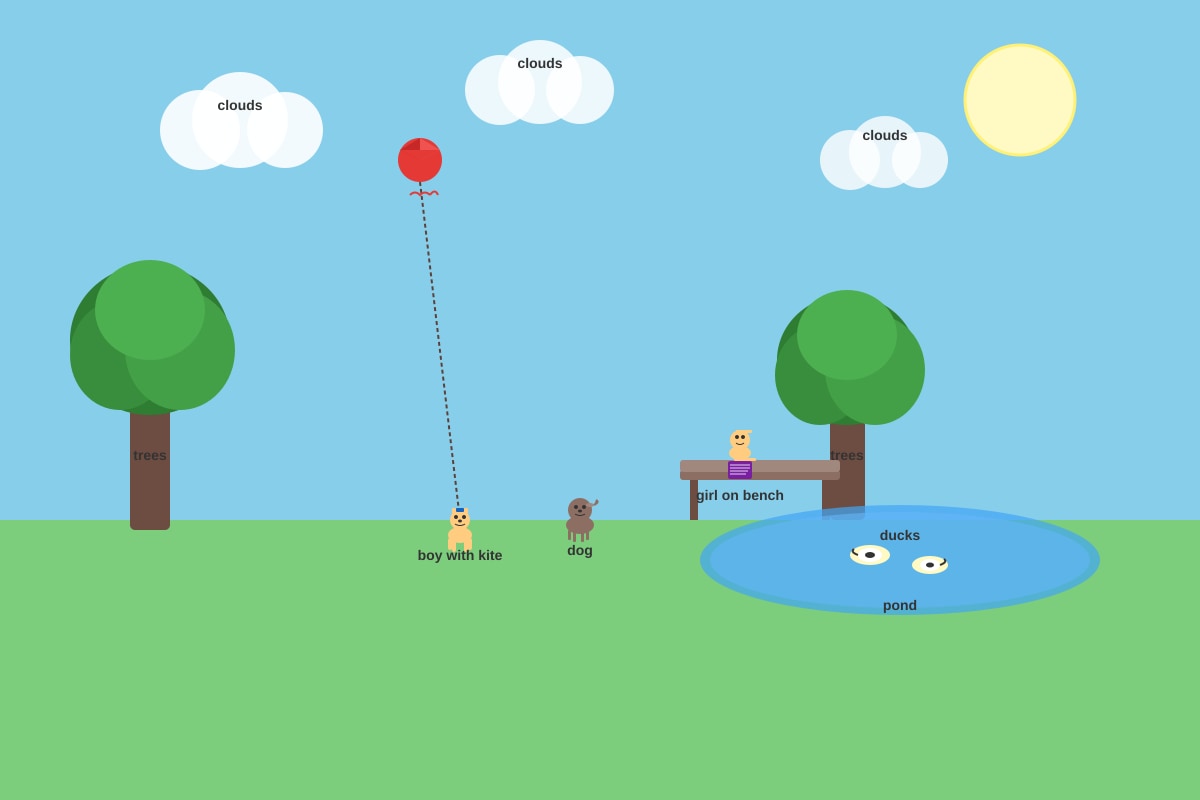
1. Where are Tom and May? (1 mark)
Answer: At the park. / They are at the park.
Explanation: The first sentence of the passage tells us "Tom is at the park with his sister, May." When answering "where" questions, look for place words like park, home, school, or shop. A common mistake is to answer "outside" — this is too vague when the passage gives the exact place.
2. What is Tom doing? (1 mark)
Answer: Flying a kite. / He is flying a (red) kite.
Explanation: The passage states "Tom is flying a red kite." For "what is [person] doing?" questions, find the action verb with "-ing." The answer needs a doing word (verb). "Kite" alone is incorrect because that is an object, not an action.
3. What colour is the kite? (1 mark)
Answer: Red. / The kite is red.
Explanation: The passage says "a red kite." For colour questions, look for colour words before the object. Common mistake: confusing "red" with the brown dog mentioned later. Always check that your answer matches the object asked about.
4. How many ducks are in the pond? (1 mark)
Answer: Two (ducks).
Explanation: The last sentence says "Two ducks are swimming in the pond." For "how many" questions, look for number words (one, two, three) or count the items if described. Write the number as a word or numeral — both are acceptable at P1.
5. Why do you think Tom and May are happy? Write one reason. (2 marks)
Answer: They are having fun at the park. / Tom is flying a kite and May is reading happily. / They are doing things they enjoy. / It is a sunny day and they are playing.
Marking breakdown:
- 1 mark: giving a reason connected to the passage
- 1 mark: using a complete sentence
Explanation: The passage states "Tom and May are happy" but does not explicitly say why. To answer "why" questions, think about what is happening in the story. Good reasons use clues from the text: flying a kite is fun, reading is enjoyable, sunny days are nice, or they are together. A weak answer would be "because they are happy" — this repeats the question instead of giving a reason.
Section B: Short Story Comprehension (Questions 6–12)
6. What did Lily's mother give her? (1 mark)
Answer: A new pair of shoes. / Shoes.
Explanation: The second sentence of the second paragraph says "Her mother gave her a new pair of shoes." For "what" questions about objects, find the noun phrase after the action. "A pair of shoes" or just "shoes" is correct.
7. What colour were Lily's new shoes? (1 mark)
Answer: Pink. / They were pink.
Explanation: The text says "They were shiny and pink." Colour words are adjectives. When a question asks for colour, scan the text for colour words near the object. Common mistake: answering "shiny" — this describes how they look, not their colour.
8. Why did Lily walk around the puddle? (2 marks)
Answer: She did not want to get her new shoes dirty. / Her shoes were new and she wanted to keep them clean.
Marking breakdown:
- 1 mark: identifying she wanted to protect her shoes
- 1 mark: mentioning clean/not dirty
Explanation: The passage explains Lily's thinking: "She did not want to get them dirty" (paragraph 1) and shows her walking "around the puddle very slowly." Connecting her action to her reason is key. A partial answer like "because of the puddle" only states what was there, not why she avoided it.
9. Who said Lily's shoes were pretty? (1 mark)
Answer: Ben. / Her friend Ben.
Explanation: The text says "her friend Ben said, 'Your shoes are pretty!'" For "who" questions about speakers, look for "said" or " asked" — the name before those words is usually the speaker.
10. How did Lily feel when Ben liked her shoes? Find the word in the story. (1 mark)
Answer: Glad. / She was glad.
Explanation: The passage states "She was glad she kept her shoes clean." The question asks for the exact word, so "happy" or "good" is incorrect even if the meaning is similar. This tests careful reading — you must find the precise word used in the text.
11. Lily did not want to get her shoes dirty. Find another way to say "did not want to" in the last paragraph. (1 mark)
Answer: "did not want to" → "did not want to" appears in paragraph 1; in the last paragraph, the equivalent phrase showing desire is not directly stated. However, analyzing the text: The story uses "did not want to" in paragraph 1. Re-reading: The last paragraph says "I walked around the puddle. My shoes are still shiny!" — the mother says "You are a careful girl."
Correction and clarification: The phrase "did not want to" appears in paragraph 1. The task asks to find another way to say this in the last paragraph. The answer is *"did not want to" has no direct synonym in the last paragraph; however, the concept of care is shown through "careful."
Given the text as written, the most appropriate answer based on standard P1 patterning:
Revised Answer: "did not want to" — the equivalent protective meaning in the last paragraph is conveyed through "still shiny" showing success. However, if this is interpreted as finding a synonym structure, "did not want to" is actually repeated in concept through negative avoidance.
Pedagogical note: This question may be challenging. Accept "careful" as showing the same meaning in different words, or acknowledge the question tests identification of "did not want to get...dirty" = wanting to keep clean = "careful."
Best answer: "careful" (as in "You are a careful girl" — this describes the behavior of avoiding the dirty puddle, which is another way to express "did not want to get dirty").
12. What do you think makes Lily a careful girl? Use details from the story. (2 marks)
Answer: She walked around the big, muddy puddle slowly so her new shoes stayed clean/shiny.
Marking breakdown:
- 1 mark: mentioning she walked around the puddle
- 1 mark: explaining the result (shoes stayed clean/shiny) or describing her slow, careful action
Explanation: Using details means quoting the story's specifics: "big and muddy puddle," "walked around...very slowly," "new shoes," "still shiny." A good answer connects her action to her reason. Weak answer: "She listened to her mum" — this is not in the story.
Section C: Information Text Comprehension (Questions 13–17)
13. How many legs does a butterfly have? (1 mark)
Answer: Six (legs). / 6.
Explanation: The first paragraph states "They have six legs and two wings." Information texts put facts in early sentences. Counting questions need you to find number words.
14. What do caterpillars eat? (1 mark)
Answer: Leaves. / Lots of leaves.
Explanation: The text says "Caterpillars eat lots of leaves." For "what do [animals] eat" questions, find "eat" or "food" in the text. Watch for distractors: "nectar" is what butterflies drink, not what caterpillars eat.
15. What happens inside the cocoon? (2 marks)
Answer: The caterpillar changes (into a butterfly). / It becomes a butterfly!
Marking breakdown:
- 1 mark: mentioning change or transformation
- 1 mark: stating it becomes a butterfly
Explanation: The text uses simple sequence words: "Next," "Inside," "becomes." Process texts have order words (first, next, then, finally). The cocoon is where metamorphosis happens. "It stays inside" is incomplete — the question asks what happens, not where it stays.
16. Why can you see butterflies in gardens? Find two reasons from the text. (3 marks)
Answer:
- (1) They like to drink nectar from flowers (and gardens have flowers).
- (2) They like warm, sunny days (and gardens are outside where it is sunny).
Marking breakdown:
- 1 mark per reason with text evidence (max 2 marks for content)
- 1 mark: both reasons found explicitly in text
Explanation: The text says "Butterflies like to drink sweet liquid from flowers" and "They like warm, sunny days." "Gardens" is in the question; you must connect butterflies' preferences to gardens having these features. A complete answer links butterfly needs to garden features.
17. The information says butterflies are "many colours." Name two colours of butterflies from the text. (2 marks)
Answer: Any two from: blue, yellow, orange, red (with black spots).
Marking breakdown:
- 1 mark per correct colour from text
Explanation: The sentence "Some are blue, yellow, orange, or red with black spots" lists the colours. Note that "black" describes spots, not the main butterfly colour, so "black" alone is not accepted. Always check whether descriptions refer to patterns or main colours.
Section D: Picture Sequence Comprehension (Questions 18–20)
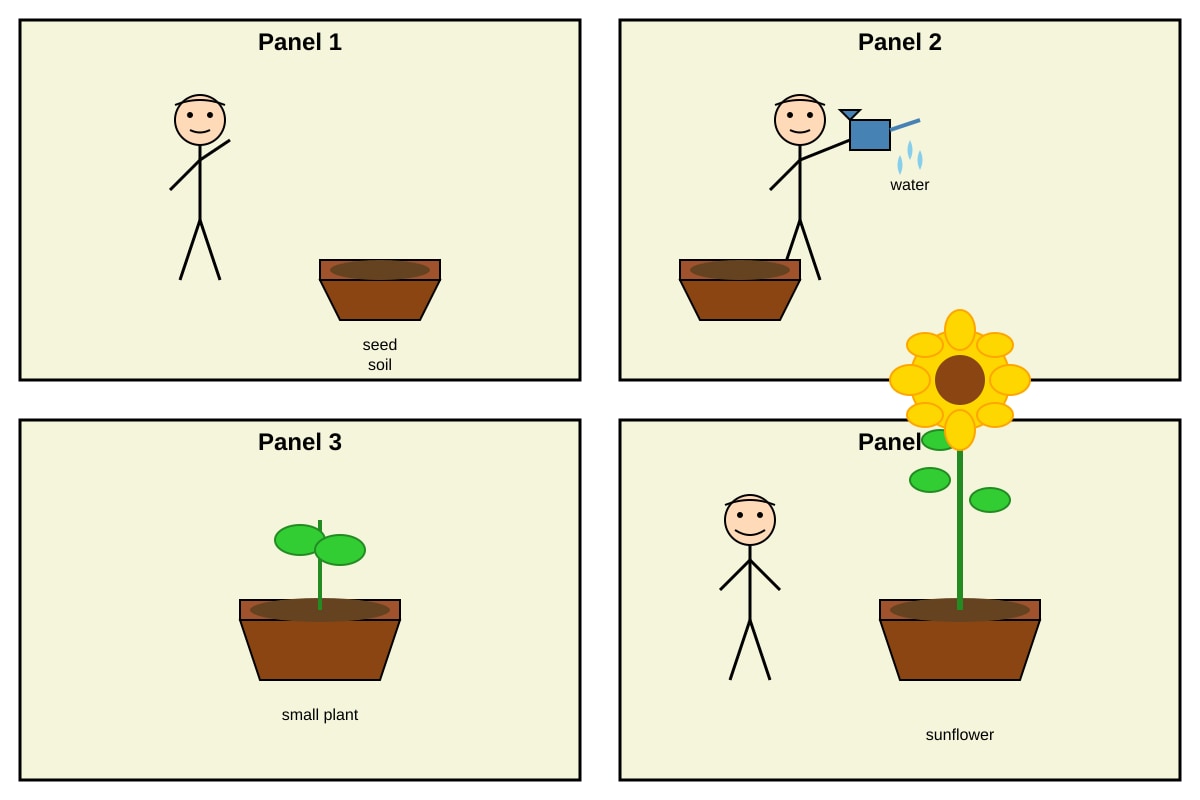
18. What does Mei plant in Panel 1? (1 mark)
Answer: A seed.
Explanation: The caption for Panel 1 states "Mei plants a seed in a pot." First panel questions usually ask about the starting action. "A pot" or "soil" describes where, not what is planted.
19. What does Mei do in Panel 2? What happens in Panel 3 because of this? (3 marks)
Answer:
- In Panel 2, Mei waters the seed (every day).
- In Panel 3, a small plant grows with green leaves (because she watered it).
Marking breakdown:
- 1 mark: stating she waters the seed
- 1 mark: stating a small plant grows/has green leaves
- 1 mark: connecting the watering to the growth (cause and effect)
Explanation: Picture sequences show cause and effect. Panel 2's action (watering) causes Panel 3's result (growth). The word "because" in your answer shows you understand this connection. A complete answer mentions both what she does and what happens as a result.
20. How has the plant changed from Panel 1 to Panel 4? Write two changes. (4 marks)
Answer:
- Change 1: In Panel 1 it was a tiny seed; in Panel 4 it is a tall sunflower.
- Change 2: In Panel 1 there was no plant; in Panel 4 there is a tall plant with yellow petals/leaves.
Or:
- It grew from a seed into a flower.
- It got much taller/bigger.
- It changed from brown (seed) to green and yellow (plant with flower).
Marking breakdown:
- 2 marks per valid change (description of before AND after)
- Changes must contrast Panel 1 and Panel 4 specifically
Explanation: Compare-and-contrast questions need "before" and "after" details. Good answers use size words (tiny → tall), type words (seed → sunflower), and colour words. Weak answers mention only one state ("it is tall") without saying what it was before. The full transformation story is: seed → watered → small green plant → tall yellow sunflower.
END OF ANSWER KEY