AI Generated Quiz
Primary 1 English Reading Comprehension Quiz
Free P1 English Reading Comprehension quiz, GLM5.3 AI version, with questions, answers, and syllabus-aligned practice for Singapore students.
These static practice materials are generated from the site's syllabus and paper-generation workflow, with source and model context shown so students and parents can evaluate the material before use.
Questions
Free quiz and exam paper access
Enter your details to view this paper
Your access is remembered on this device.
Answers
Primary 1 English Quiz - Reading Comprehension: Answer Key
TuitionGoWhere Practice Quiz (AI) - Version 1 of 5 Total Marks: 30 | Section A: 5 | Section B: 5 | Section C: 10 | Section D: 10
Teaching note for helpers: Reading comprehension means understanding what a text says. At Primary 1, answers are found directly in the story or pictures (literal comprehension), with early skills in finding clues, copying words, ordering events, and making simple predictions.
Section A: Ben and Max (Questions 1-5)
Answer 1.
C) a dog (1 mark) Teaching note: The first sentence says "Ben has a pet dog." Always look for the sentence that names the pet. Common mistake: choosing an animal not mentioned in the story.
Answer 2.
A) Max (1 mark) Teaching note: The second sentence says "The dog's name is Max." Read sentence by sentence; names usually come right after key words like "name is". Common mistake: picking "Ben" because it is a name in the story, but Ben is the owner, not the dog.
Answer 3.
B) every evening (1 mark) Teaching note: The story says "Every evening, Ben takes Max to the park." Time words such as morning, evening, and night help us find when something happens. Common mistake: guessing a time that sounds sensible instead of checking the story.
Answer 4.
D) a ball (1 mark) Teaching note: The story says "Ben throws a ball." Find the verb "throws" and read what comes after it - that is the thing thrown.
Answer 5.
Max (the dog) (1 mark) Accept "Max" or "the dog". Teaching note: The story says "Max runs fast to catch the ball," so Max catches it. Ask: who did the catching action? That person or animal is the answer.
Section B: Aisha's Pot (Questions 6-10)
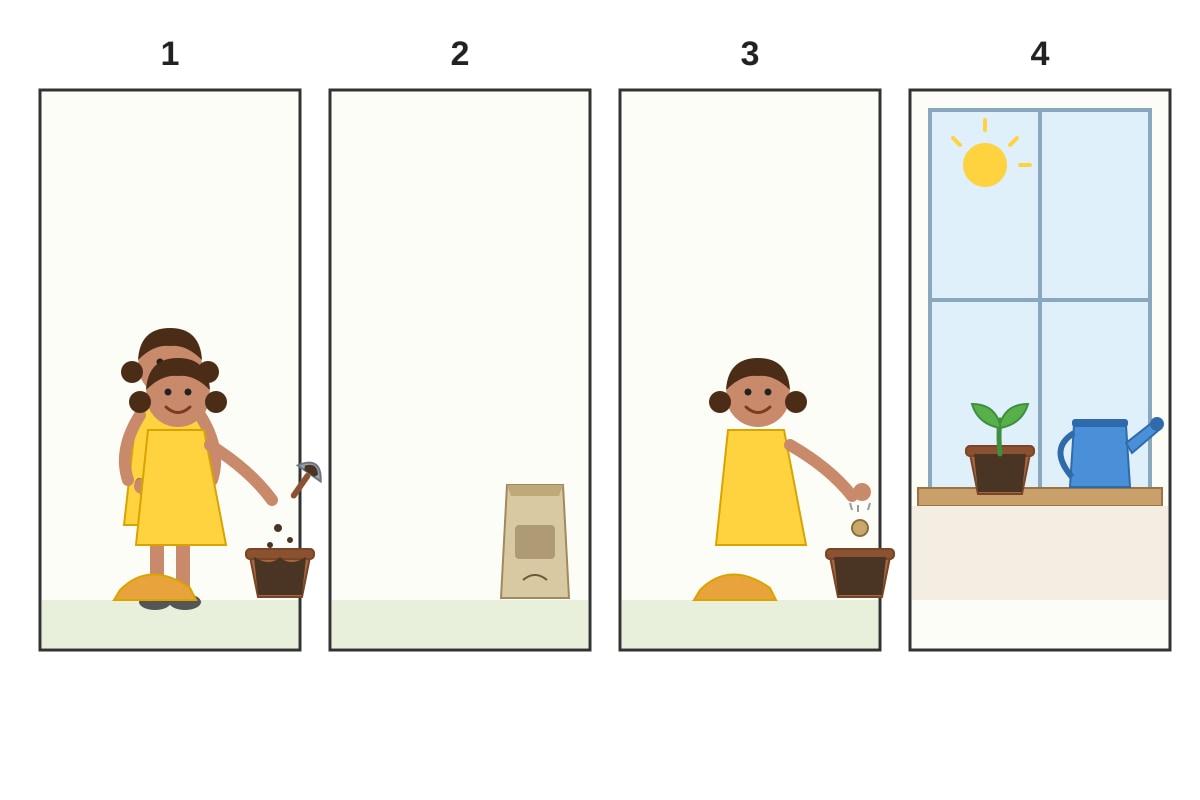
Expected visual support: the four-panel figure shows, in order - (1) Aisha holding an empty brown pot, (2) Aisha filling the pot with dark soil using a trowel, (3) Aisha dropping one seed into the soil, (4) the same pot on a sunny windowsill with a small green seedling and a blue watering can beside it.
Answer 6.
B) an empty pot (1 mark) Teaching note: Picture 1 shows Aisha holding a pot with nothing inside it yet. Look carefully at what the hands are holding before anything is added.
Answer 7.
soil (1 mark) Teaching note: Picture 2 shows dark soil being scooped into the pot. Pictures tell the story step by step, just like sentences do.
Answer 8.
a seed (1 mark) Teaching note: Picture 3 shows one small seed dropped into the soil. Seeds are what we plant to grow plants - this connects the picture story to how plants grow.
Answer 9.
a small green plant (a seedling) (1 mark) Accept "a plant", "a seedling", or "a small green plant". Teaching note: Picture 4 shows the result of planting - the seed has grown. Comparing Picture 1 (empty pot) with Picture 4 (plant in pot) shows change over time.
Answer 10.
C) A green plant grows in the pot. (1 mark) Teaching note: "Last" means at the end. Follow the panels left to right: hold pot → add soil → drop seed → plant grows. The growing plant appears only in Picture 4, so it happens last. Common mistake: choosing the first event because it is remembered best.
Section C: The Red Balloon (Questions 11-15)
Answer 11.
The balloon is red; the story happens at the fun fair. (2 marks: 1 mark for colour, 1 mark for place) Teaching note: Two details are asked, so two answers are needed. Colour: "He has a red balloon." Place: "Ravi is at the fun fair with his mother." Encourage answering both parts even when the question is long. Common mistake: writing only the colour and forgetting the place.
Answer 12.
Ravi cries because his balloon flies up into the sky (he loses his balloon). (2 marks) Marking: 2 marks - answer includes the balloon flying away/up into the sky; 1 mark - vague answer such as "because he is sad" without saying why. Teaching note: "Why" questions ask for a cause. Read the sentence before "Ravi begins to cry": the balloon flew up into the sky. Using words from the story ("flies up into the sky") makes the answer complete.
Answer 13.
strong (2 marks) Marking: 2 marks - the word "strong" copied exactly with correct spelling; 1 mark - correct word identified but spelled incorrectly (e.g., "strog"). Teaching note: Describing words tell us more about things. Test each word near "wind": "a strong wind blows" makes sense. Common mistake: copying "wind" itself, which names the thing rather than describing it.
Answer 14.
Ravi feels happy at the end. We know because he smiles again (after his mother buys him an ice cream). (2 marks: 1 mark for the feeling, 1 mark for evidence from the story) Accept "happy", "glad", or "cheerful"; evidence may be "he smiles again" or "his mother buys him an ice cream". Teaching note: Feelings are often shown, not stated. The story never says "happy", but "smiles again" is a clue for happiness. Good readers collect clues: crying before → ice cream → smiling after.
Answer 15.
Correct order: (1) Ravi holds his balloon tight. (2) A strong wind blows. (3) Ravi begins to cry. (4) Ravi smiles again. (2 marks: all four correct = 2 marks; one number wrong = 1 mark) Teaching note: Retell the story in your head first: he holds the balloon → wind blows → balloon flies away → he cries → ice cream → he smiles. Matching each event to its spot in the retelling gives the numbers 1, 2, 3, 4.
Section D: Words, Order and Ideas (Questions 16-20)
Answer 16.
B) He holds the balloon hard so it does not fly away. (2 marks) Teaching note: "Tight" means holding something firmly with no gaps. Option A is the opposite (softly); C and D do not match holding tightly. Later the balloon still flies away because of the strong wind, but at that moment Ravi grips it hard - that is what "tight" means.
Answer 17.
B) Walk out in the rain with her boots and umbrella. (2 marks) Teaching note: A good prediction uses clues in the text. Clue 1: rain is falling. Clue 2: Nurul gets boots and an umbrella - things people use in rain. Options A, C, and D do not fit these clues. Prediction means making the smartest guess the clues support.
Answer 18.
The sky is full of clouds / clouds cover the whole sky. (2 marks) Marking: 2 marks - idea that clouds fill or cover the sky (own words accepted); 1 mark - partial idea such as "there are clouds" without the sense of the sky being full. Teaching note: "Fill" means to occupy all the space, like filling a cup with water. So "dark clouds fill the sky" paints a picture of a completely cloudy sky - a sign that heavy rain is coming.
Answer 19.
Her red boots and her umbrella. (2 marks: 1 mark for each item) Both items must be given for full marks; one item only = 1 mark. Teaching note: The question asks for TWO things, so count your answers before finishing: boots (1) and umbrella (2). The word "and" in the story ("her red boots and her umbrella") signals two items.
Answer 20.
B) A Rainy Day (2 marks) Teaching note: The best title matches the main idea - what the whole text is mostly about. Almost every sentence is about rain coming and getting ready for it. Options A, C, and D name things (toy, race, beach) that never appear in the text. Choosing a title is a quick way to check you understood the big idea.
Mark summary: Section A: 5 marks | Section B: 5 marks | Section C: 10 marks | Section D: 10 marks | Total: 30 marks