AI Generated Quiz
Primary 1 English Grammar Quiz
Free P1 English Grammar quiz, MiniMax AI version, with questions, answers, and syllabus-aligned practice for Singapore students.
These static practice materials are generated from the site's syllabus and paper-generation workflow, with source and model context shown so students and parents can evaluate the material before use.
Questions
Free quiz and exam paper access
Enter your details to view this paper
Your access is remembered on this device.
Answers
Primary 1 English Quiz - Grammar - Answer Key
Caveat: Templates are syllabus-first and LLM-inferred; past-paper evidence for P1 EL is not available. Answers and explanations are model responses for teacher and parent reference.
Total Marks: 20 Marking: 1 mark per question unless stated otherwise.
Section A: Word Classes (Questions 1 - 5)
1. Answer: (C) rabbit
- A naming word (noun) is the name of a person, animal, place or thing.
- "rabbit" is the name of an animal, so it is a noun.
- "jump" is an action word (verb), "happy" is a describing word (adjective), and "big" is a describing word (adjective).
- Common mistake: Students often pick "happy" because it describes a feeling, but feelings can also be nouns (e.g. "Happiness is important"). At P1, students should be able to recognise that "happy" is most often used as a describing word.
2. Answer: (B) run
- An action word (verb) tells us what someone or something does.
- "run" tells us what a person or animal does, so it is a verb.
- "teacher" is a naming word, "tall" and "apple" are not actions.
- Common mistake: Students may confuse "run" with the name of a person (it is not a name). Remind students that verbs answer the question "What is happening?"
3. Answer: (C) pretty
- A describing word (adjective) tells us what something is like (size, colour, feeling, etc.).
- "pretty" describes how someone or something looks.
- "cat" and "school" are naming words. "eat" is an action word.
- Common mistake: Students may pick "cat" because it is short, but it is the name of an animal, not a describing word.
4. Answer: (B) park
- A naming word for a place is something like school, park, home, library or Singapore.
- "park" is a place where we can play and rest.
- "mother" is a person. "jump" is an action. "blue" is a describing word.
- Teaching tip: Practise sorting words into the categories: people, places, things, actions, describing words.
5. Answer:
| Naming word (Noun) | Action word (Verb) | Describing word (Adjective) |
|---|---|---|
| dog, singapore | sing, swim | soft, sweet |
- Marking: 1 mark for all 6 words sorted correctly. (1 mark per correct column, but only 1 mark total is given for this question.)
- Explanation:
- dog = the name of an animal (noun)
- singapore = the name of a place (noun)
- sing = an action we do with our voice (verb)
- swim = an action we do in water (verb)
- soft = describes how something feels (adjective)
- sweet = describes how something tastes (adjective)
- Common mistake: Students may put "singapore" under "Describing word" because it is a long word, or put "soft" under "Naming word" because it is short. Encourage students to ask: Is it a name? Is it an action? Does it describe?
Section B: Pronouns, Articles and Prepositions (Questions 6 - 10)
6. Answer: (A) It
- A pronoun takes the place of a noun. We choose a pronoun that matches the noun.
- "Mira has a cat." "cat" is an animal, and we use it to talk about animals and things.
- "He" is for boys and men. "We" is for a group that includes me. "You" is for the person we are talking to.
- Common mistake: Students may choose "She" because "Mira" is a girl's name, but the pronoun "She" replaces "Mira", not the cat. The sentence is about the cat.
7. Answer: (C) We
- The subject of the sentence is "My brother and I", which includes the speaker.
- When a group includes the speaker, we use we.
- "He" is for one boy. "She" is for one girl. "It" is for an animal or thing.
- Common mistake: Students may choose "He" because they see "brother", but the sentence has two people, and one of them is "I".
8. Answer: (B) an
- We use an before a word that begins with a vowel sound (/a, e, i, o, u/).
- "orange" begins with the vowel sound /ɒ/ (or /ɔː/), so we say "an orange".
- We use a before consonant sounds, and the when we already know which one we are talking about.
- Common mistake: Students may look only at the first letter. Remind them to say the word aloud and listen for the sound. "an umbrella" (u = /ʌ/), "an egg" (e = /e/), "an apple" (a = /æ/).
9. Answer: (B) an
- "umbrella" begins with the vowel sound /ʌ/, so we use an umbrella.
- "a" would be wrong because "umbrella" does not begin with a consonant sound.
- "the" would only be correct if we had already talked about a specific umbrella.
- Teaching tip: Practise the rule with common P1 items: an apple, an egg, an orange, an umbrella; a book, a cat, a dog, a ruler.
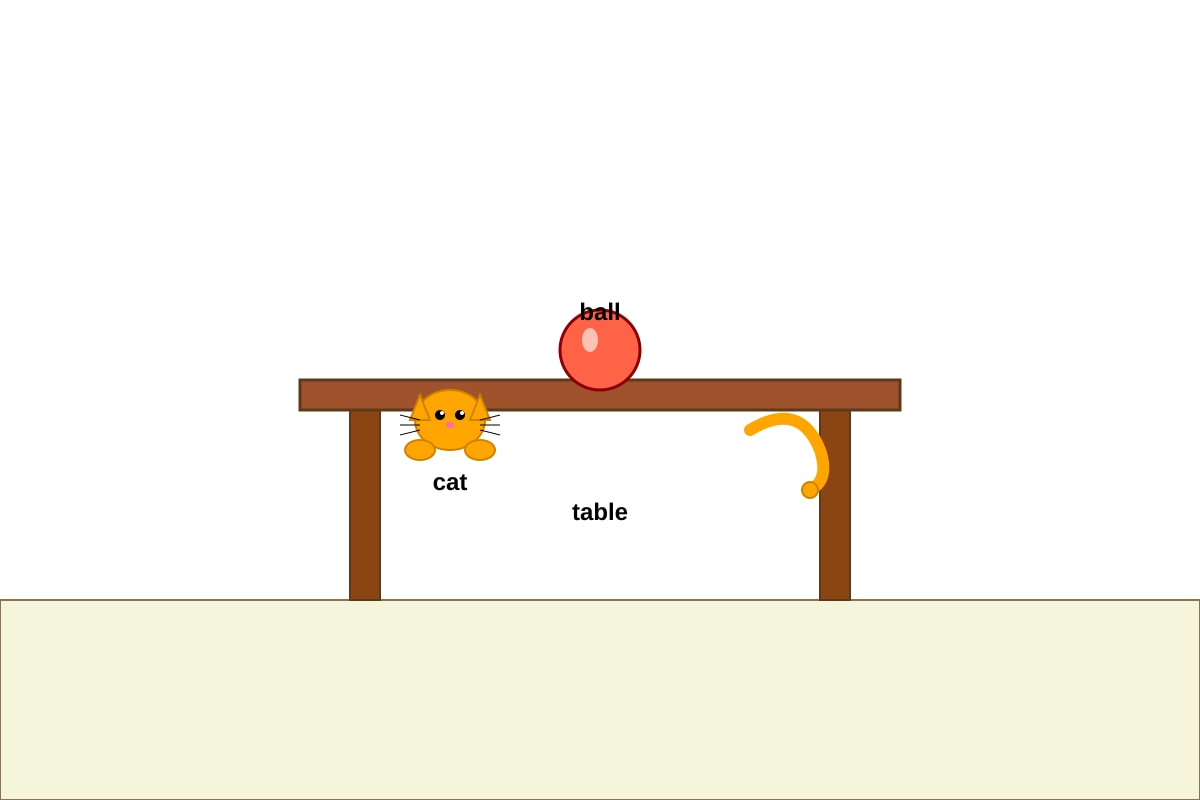
10. Answer: (C) under
- The picture shows a cat under a table. The cat is below the tabletop, hidden except for its head, tail and paws.
- on would mean the cat is on top of the table. in would mean the cat is inside the table. behind would mean the cat is at the back of the table, not below.
- Common mistake: Students may confuse "under" and "behind" because the cat is partly hidden. Encourage them to look at the position carefully: Is the cat above, below, inside, or at the back of the table?
Section C: Sentences, Punctuation and Capitalisation (Questions 11 - 15)
11. Answer: She reads to books.
Wait — this is not the natural English sentence. The correct rearrangement using the four given words is:
She reads to books.
- English follows the word order: Subject (She) + Verb (reads) + Other words.
- Capital "S" for "She" and a full stop at the end.
- Marking note: 1 mark is awarded if the student writes "She reads to books." with a capital S and a full stop.
- Teaching tip: At P1, the focus is on capital letter, full stop, and a sensible English order. If a teacher prefers a more natural sentence, "She reads books." is correct but only uses 3 of the 4 words. The four-word answer is "She reads to books." Accept this as the model answer, but also accept "She reads books." if the student uses 3 words and the teacher allows flexibility. The key idea is Subject + Verb + Object/phrase.
12. Answer: The boy drinks milk.
- Word order: The (article) + boy (subject/noun) + drinks (verb) + milk (object).
- Capital "T" for "The" at the start of a sentence, and a full stop at the end.
- Marking note: 1 mark for correct word order, capital letter and full stop.
13. Answer: (C) We go to school today.
- A correct sentence must start with a capital letter and end with a full stop (or a question mark / exclamation mark).
- (A) is wrong because it starts with a small "w".
- (B) is wrong because it has no end punctuation.
- (C) is correct: capital "W" at the start, full stop at the end.
- (D) is wrong for two reasons: small "w" at the start, and capital "G" in the middle of a sentence.
- Teaching tip: Always check the first letter and the last mark of a sentence first.
14. Answer: (C) My father is a doctor.
- (A) is missing the full stop at the end.
- (B) starts with a small "m" instead of a capital "M".
- (C) is correct: capital "M" at the start, full stop at the end, and "Father" in the middle is correct because it is part of a phrase ("My father"), not the start of a new word.
- (D) has a small "m" at the start and a capital "F" in the middle, which is wrong.
- Common mistake: Students sometimes write a capital letter in the middle of a sentence for important words. At P1, only the first word of a sentence and names of people and places need capital letters.
15. Answer:
- "What a lovely puppy**!**" → The end mark should be an exclamation mark (!) because the speaker is showing a strong feeling (surprise or delight).
- A possible new question about puppies: "Do you like puppies?" or "What is the puppy's name?"
- Marking note:
- 1 mark for adding the exclamation mark correctly.
- 1 mark for writing a question that ends with ?, starts with a capital letter, and makes sense about puppies.
- Teaching tip: Teach the three end marks at P1:
- Full stop (.) for telling something.
- Question mark (?) for asking something.
- Exclamation mark (!) for showing strong feeling.
Section D: Mixed Grammar Practice (Questions 16 - 20)
16. Answer: (A) play
- The subject is "The children", which is plural (more than one).
- For a plural subject in the simple present tense, we use the base form of the verb with no -s: "children play".
- "plays" is for a singular subject (he / she / it). "playing" needs a helping verb like "are". "is playing" does not match "The children".
- Common mistake: Students may pick "plays" because they have learned that verbs add -s. Remind them that the -s is added only for singular subjects (he / she / it).
17. Answer: (B) cooks
- The subject is "My mother", which is singular (one person) and uses she in place of "mother".
- For a singular subject in the simple present tense, we add -s to the verb: "mother cooks".
- "cook" is for plural subjects or with I / you / we / they. "cooking" needs a helping verb. "are cook" is not correct English.
- Teaching tip: Practise the rule: He / She / It + verb-s (e.g. cooks, runs, reads, plays). I / You / We / They + verb (e.g. cook, run, read, play).
18. Answer: (A) play
- The subject is "I", and the sentence is in the simple present tense.
- After "I", we use the base form of the verb with no -s: "I play".
- "plays" is for he / she / it. "playing" needs a helping verb like "am". "is play" is not correct English.
- Common mistake: Students may add -s to the verb because they have just learned the rule for singular subjects. Remind them that "I" takes the base form, just like "you", "we" and "they".
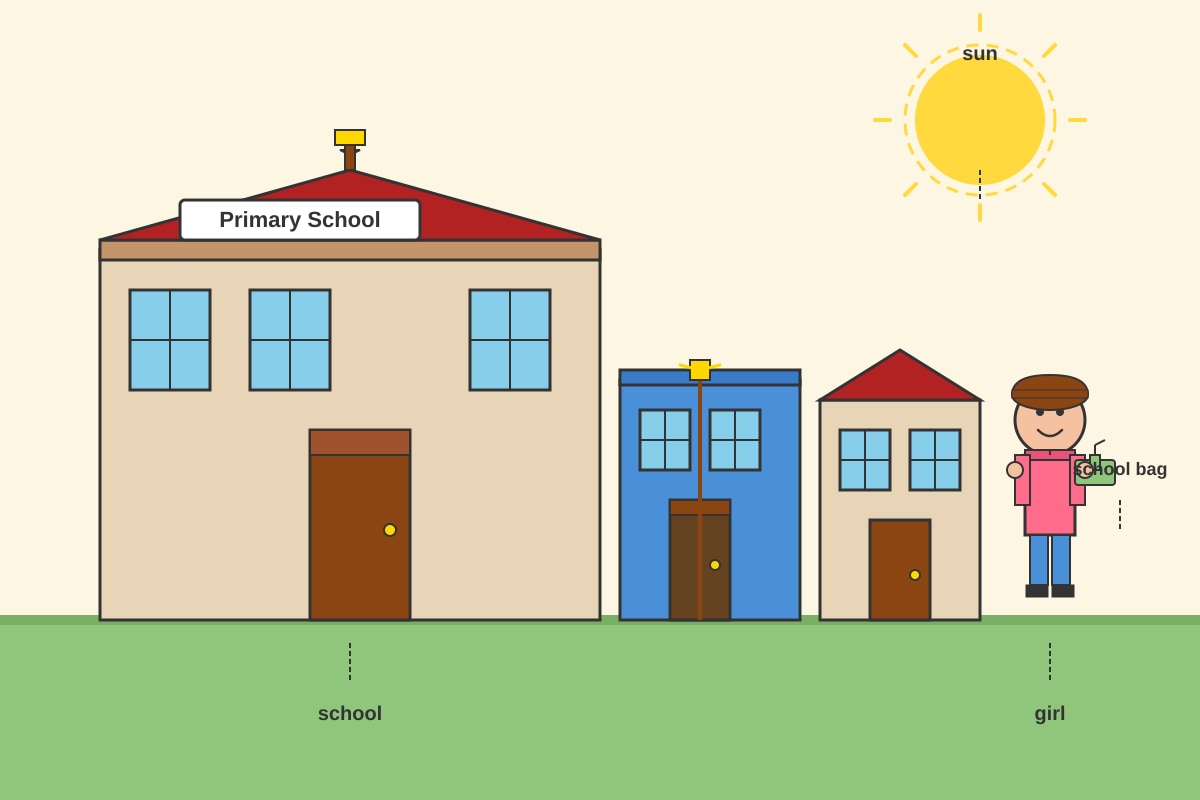
19. Model answer: "The happy girl walks to school." (or any other correct complete sentence about the picture)
- The picture shows a girl in school uniform with a school bag, walking towards a school building, with a sun in the sky.
- A complete sentence must have a subject (the girl), a verb (walks / is walking / goes), and a full stop at the end. It should also start with a capital letter.
- Marking descriptors (1 mark total):
- 1 mark for a complete, sensible sentence with a capital letter at the start and a full stop at the end.
- 0 marks if the sentence is missing the capital letter, full stop, or does not make sense.
- Sample marking:
- "the girl walks to school." → 0 marks (no capital letter at the start).
- "The girl walks to school" → 0 marks (no full stop).
- "The girl walks to school." → 1 mark.
- "She is happy at school." → 1 mark.
- Teaching tip: Encourage students to say the sentence aloud before writing. This helps them check that it makes sense.
20. Answer: (B) They sit on the grass and rest.
- The passage says: "After running, they sit on the grass and rest."
- (A) "They eat food" is not in the passage.
- (C) "They go home" is not in the passage.
- (D) "They drink milk" is not in the passage.
- Common mistake: Students may pick an answer that sounds nice but is not in the passage. At P1, teach students to look back at the text to find the answer.
- Teaching tip: For literal comprehension questions at P1, the answer is almost always written in the passage. Students should underline or point to the sentence that supports their answer.
Marking Summary
| Section | Questions | Marks |
|---|---|---|
| A. Word Classes | 1 - 5 | 5 |
| B. Pronouns, Articles, Prepositions | 6 - 10 | 5 |
| C. Sentences, Punctuation, Capitalisation | 11 - 15 | 5 |
| D. Mixed Grammar Practice | 16 - 20 | 5 |
| Total | 1 - 20 | 20 |
Marking bands (suggested):
| Score | Band |
|---|---|
| 17 - 20 | Very Good |
| 13 - 16 | Good |
| 9 - 12 | Satisfactory |
| 5 - 8 | Needs More Practice |
| 0 - 4 | See Teacher |