AI Generated Quiz
Primary 1 English Grammar Quiz
Free P1 English Grammar quiz, GLM5.3 AI version, with questions, answers, and syllabus-aligned practice for Singapore students.
These static practice materials are generated from the site's syllabus and paper-generation workflow, with source and model context shown so students and parents can evaluate the material before use.
Questions
Free quiz and exam paper access
Enter your details to view this paper
Your access is remembered on this device.
Answers
Primary 1 English Quiz - Grammar - Answer Key
Version: 1 of 5 | Total Marks: 36
Teaching note for students: Grammar is made of small rules that help us build clear sentences. Naming words (nouns) tell us people, places or things. Action words (verbs) tell us what someone does. Describing words (adjectives) tell us how things look or feel. Small words like a, an, the, in, on, under and pronouns like he, she, it, they help our sentences make sense.
Answer 1.
B) an (1 mark) We use an before a vowel sound (a, e, i, o, u): an egg. We use a before a consonant sound: a kite. Am and at are not articles. Common mistake: choosing a because the child forgets to listen to the first sound of the next word.
Answer 2.
A) in (1 mark) In means inside something. A fish swims inside its bowl. On means on top of a surface, and under means below something, so both do not fit here.
Answer 3.
C) They (1 mark) Ben and Tim means two boys, so we replace them with they. He is for one boy or man, she is for one girl or woman, and it is for one thing or animal.
Answer 4.
C) jump (1 mark) An action word shows what someone does. You can do the word "jump". You cannot "happy" or "table", so those are not action words.
Answer 5.
A) tall (1 mark) A describing word tells us more about a person or thing. Tall describes how someone looks. School and pencil name things (nouns); swim is an action word.
Answer 6.
B) garden (1 mark) A naming word names a person, place or thing. A garden is a place. Cry is an action, small describes, and quickly tells how an action is done.
Answer 7.
A) fly (1 mark) Birds means more than one bird, so the verb has no s: The birds fly. We add s only for one bird: The bird flies. Method: find the subject first, count if it is one or many, then choose the verb.
Answer 8.
B) The dog is big. (1 mark) A correct sentence starts with a capital letter, ends with a full stop, and keeps other words in small letters. Only option B does all three.
Answer 9.
(a) an ant (b) a kite (2 marks: 1 mark each) Method: say the next word aloud. If it begins with a vowel sound (ant), use an. If it begins with a consonant sound (kite), use a. Marking note: accept only the correct article in each blank.
Answer 10.
(a) on the table (b) in the box (c) under the bed (3 marks: 1 mark each) Teaching points: on = resting on top of a surface; in = inside; under = below. A cup sits on top of a table, a ball goes inside a box, and shoes kept away go under a bed. Common mistake: mixing up in and on; remind students to ask "inside or on top?"
Answer 11.
(a) She (b) It (2 marks: 1 mark each) Maya is one girl, so we use she. The lion is one animal, so we use it. Method: find who or what the sentence is about, then pick the pronoun that matches (boy → he, girl → she, thing or animal → it).
Answer 12.
(a) am (b) are (c) is (3 marks: 1 mark each) Rule: always use am with I. Use are for many people or things (the boys). Use is for one person or thing (my teacher). Method: match the subject to the verb - I → am; one → is; many → are.
Answer 13.
(a) Who (b) Where (2 marks: 1 mark each) Who asks about a person (a best friend is a person). Where asks about a place (where you live is a place). What asks about things or information, so it does not fit either blank.
Answer 14.
Naming words: doctor, bus | Action words: eat, jump | Describing words: happy, cold (3 marks: 1 mark for each column completed correctly; deduct ½ mark per misplaced word) Method: test each word - Can you see or touch it? → noun. Can you do it? → verb. Does it tell what something is like? → adjective.
Answer 15.
My mother cooks rice. (2 marks: 1 mark for capital letter at the start, 1 mark for the full stop at the end) Every sentence needs a capital letter for its first word and a full stop to show it is finished. Common mistake: forgetting the full stop after the last word.
Answer 16.
Sam plays football. (2 marks: 1 mark for correct word order, 1 mark for capital letter and full stop) Word order method: put the person first (who), then the action (does what), then the thing (to what): Sam + plays + football. The capital letter starts the sentence and the full stop ends it.
Answer 17.
She has a cat. (2 marks: 1 mark for correct word order including the article a, 1 mark for capital letter and full stop) Method: who (She) + action (has) + what (a cat). The little word a must sit before cat, not anywhere else. Common mistake: writing "She a has cat" - read the sentence aloud to check it sounds right.
Answer 18.
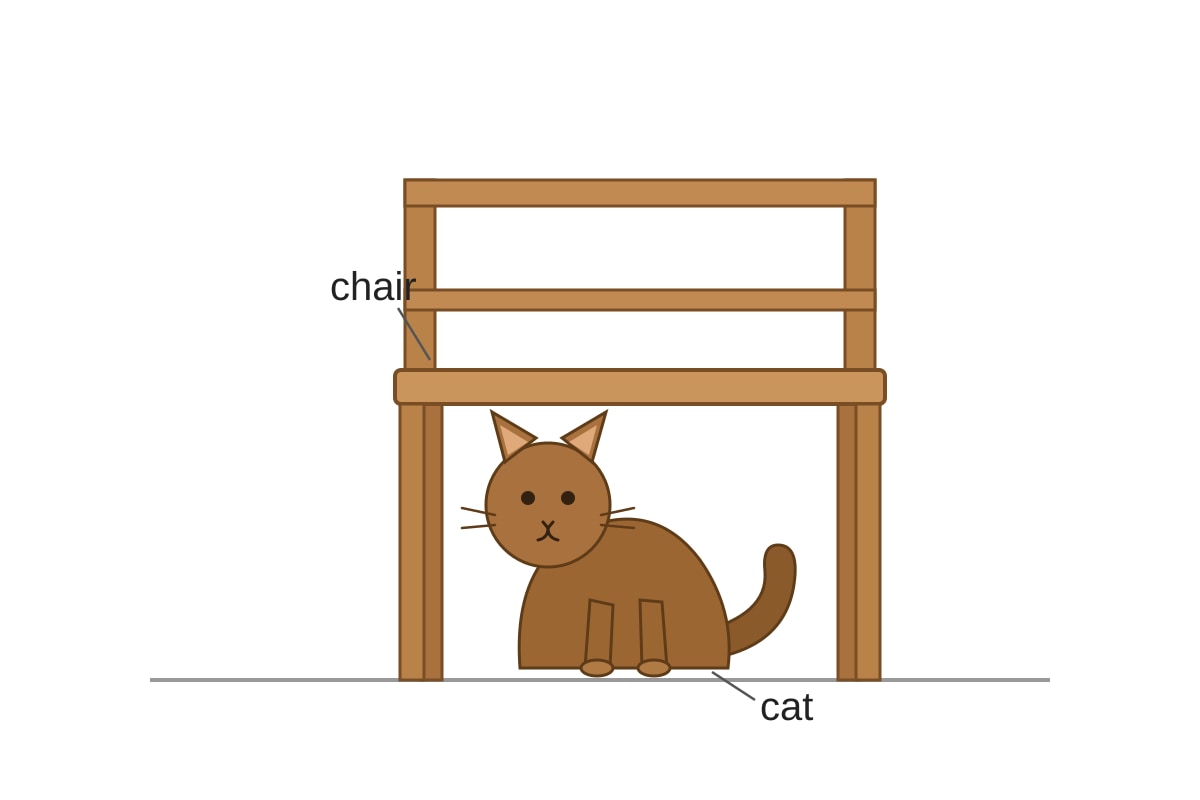
The cat is under the chair. (2 marks: 1 mark for using under correctly, 1 mark for a complete sentence with capital letter and full stop) The picture shows the cat sitting beneath the chair seat, which matches the meaning of under (below something). Accept any correct sentence using under, such as "The cat is sitting under the chair." Visual check: the cat must appear fully below the chair seat in the image.
Answer 19.
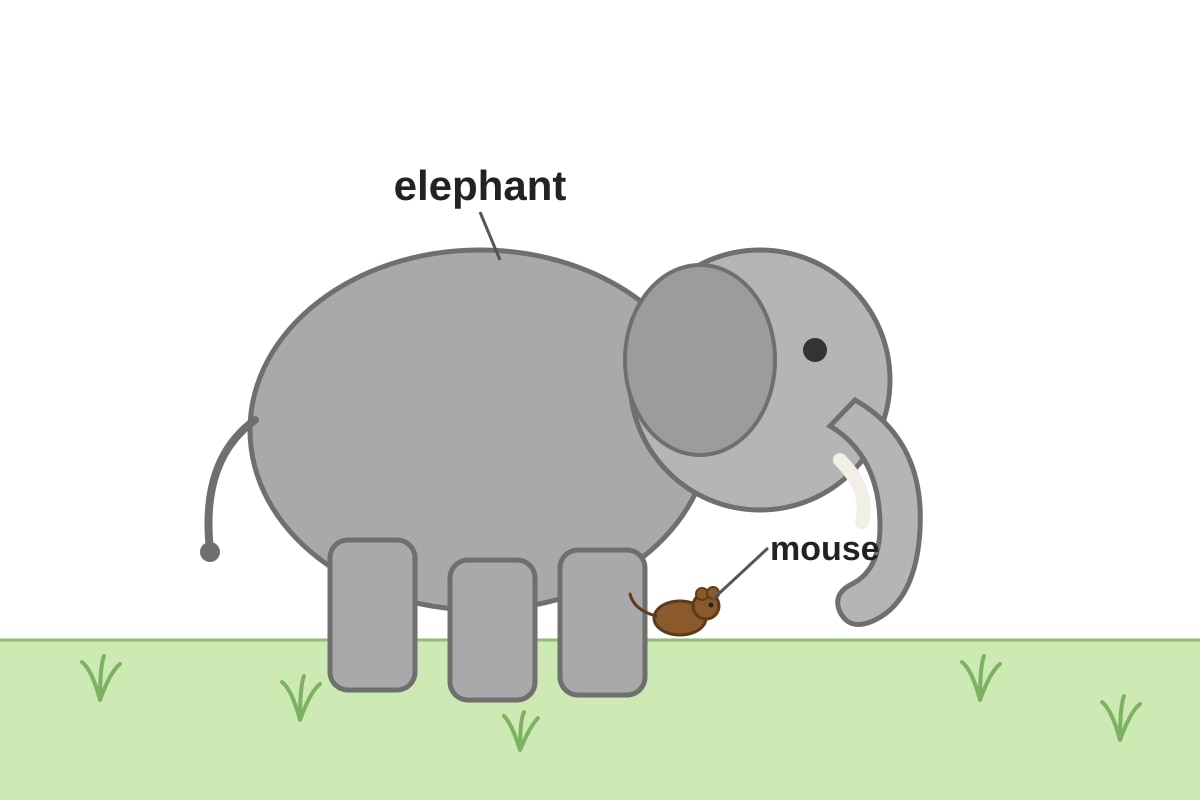
The elephant is big. (2 marks: 1 mark for using big correctly about the elephant, 1 mark for a complete sentence with capital letter and full stop) The picture shows a huge elephant beside a tiny mouse, so big correctly describes the elephant. Accept "It is a big elephant." or similar. Visual check: the elephant must be drawn much larger than the mouse. Common mistake: describing the mouse instead - remind students to point at the animal named in the question.
Answer 20.
Ali and Sita are friends. They walk to school. (3 marks: 1 mark for capital letters on the names Ali and Sita, 1 mark for capital letters starting each sentence, 1 mark for a full stop after each sentence) Step-by-step method:
- Names of people always need capital letters, even in the middle of a sentence: ali → Ali, sita → Sita.
- Start each new sentence with a capital letter: they → They.
- End each sentence with a full stop: "...friends**." and "...school.**" Marking note: award each mark only if the rewritten copy is otherwise unchanged in wording.