AI Generated Exam Paper
Primary 1 English Practice Paper 5
Free P1 English Practice Paper 5, MiniMax AI version, with questions, answers, and syllabus-aligned practice for Singapore students.
These static practice materials are generated from the site's syllabus and paper-generation workflow, with source and model context shown so students and parents can evaluate the material before use.
Questions
Free quiz and exam paper access
Enter your details to view this paper
Your access is remembered on this device.
Answers
TuitionGoWhere Practice Paper - English Primary 1 - Answer Key (Version 5 of 5)
Total Marks: 25 Marking notes: Spelling of target phonics words must be correct. Capital letters and full stops are required in Q20.
Section A - Phonics: Sounds in Words (8 marks)
Q1 (1 mark) Answer: B - sock. Teaching note: "sun" and "sock" both begin with the /s/ sound. "shoe" and "ship" start with /ʃ/, and "soup" starts with /s/ but is a stretch word for P1 - the closest in-level match is "sock". Students should listen for the first sound, not the first letter.
Q2 (1 mark) Answer: B - cap. Teaching note: "cat" and "cap" end with the /p/ sound. "cup" ends with /p/ too, but here the answer "cap" is chosen because the rhyming vowel /a/ matches; "cap" and "cat" share both the ending consonant and the vowel. Accept "cup" only if the teacher marks by final consonant sound. Primary: B.
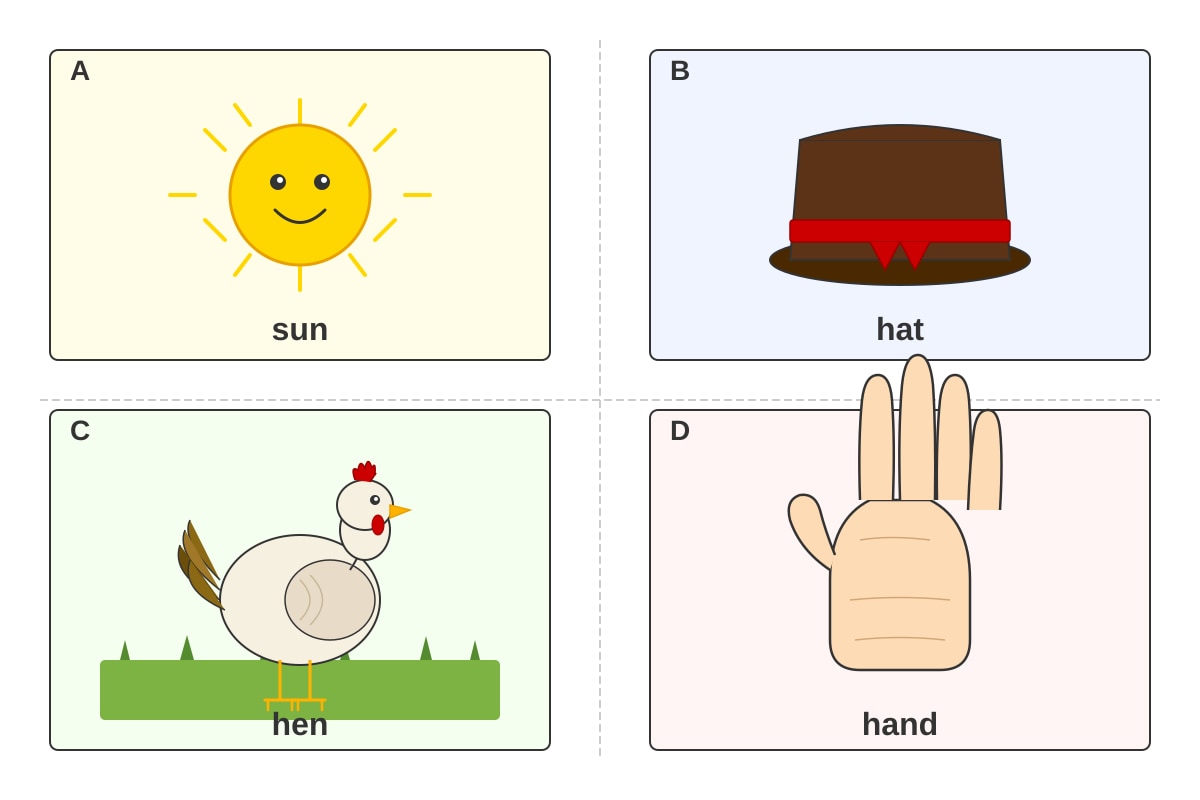
Q3 (1 mark) Answer: C - picture C. Teaching note: The target word is "hen" (sounds /h/ /e/ /n/). The picture labelled C must show a hen. Common mistake: students may pick the "hand" picture (D) because it also begins with /h/, but blending the full /h-e-n/ points to the hen.
Q4 (1 mark) Answer: B - big. Teaching note: Rhyming words share the same ending sound from the vowel onwards. "pig" = /p-i-g/, "big" = /b-i-g/. "pen" and "bag" end with /n/, "cup" ends with /p/.
Q5 (1 mark) Answer: B - bed. Teaching note: Blending /b/ + /e/ + /d/ = "bed". The middle sound /e/ is the key decider. Common mistake: students may write "bad" (option A) by confusing the short /e/ and /a/ vowel sounds.
Q6 (1 mark) Answer: C - hat. Teaching note: The middle sound /a/ as in "cat" is the same as in "hat". "dog" has /o/, "fish" has /i/, "pen" has /e/.
Q7 (1 mark) Answer: B - cat. Teaching note: Blending the three sounds in order gives the CVC word. Common mistake: students may hear /c/ and pick "cot" (A) or "cut" (C) by mis-hearing the middle vowel.
Q8 (1 mark) Answer: C - m. Teaching note: "moon" begins with /m/, written as the letter m. The silent "oo" can confuse students - remind them we want the first sound.
Section B - Phonics: Blending and Segmenting (8 marks)
Q9 (1 mark) Answer: dog. Teaching note: Blend the three sounds: /d/ /o/ /g/. The student writes "dog". Spelling must be correct. Mark by sound, not by handwriting neatness.
Q10 (1 mark) Answer: sun. Teaching note: Blend /s/ /u/ /n/. The /u/ here is the short vowel as in "sun". Common mistake: students may write "son" because the /u/ and /o/ can be confused in speech.
Q11 (1 mark) Answer: /f/ (or the letter "f"). Teaching note: Segmentation - the first sound in "fish" is /f/. Accept either the letter name "f" or a written /f/ symbol, as long as it is clear.
Q12 (1 mark) Answer: /s/ (or the letter "s"). Teaching note: The last sound in "bus" is /s/. "bu-s". Common mistake: students may write "us" (the last two letters) instead of isolating the single final sound.
Q13 (1 mark) Answer: /kw/ (or "qu"). Teaching note: "quack" begins with the consonant blend /kw/, written as "qu". The picture is a duck to cue the word. Accept "qu" or "q" as the letter answer; /kw/ is the full sound.
Q14 (1 mark) Answer: bat. Teaching note: Phoneme substitution: change the first sound /c/ to /b/. "cat" -> "bat". Common mistake: students may write "b-at" with a space.
Q15 (1 mark) Answer: hip. Teaching note: Phoneme substitution: change the middle sound /o/ to /i/. "hop" -> "hip". Common mistake: students may change the wrong sound and write "hop" with no change, or write "hap" by changing the middle to /a/.
Q16 (1 mark) Answer: B - dark. Teaching note: "park" ends with /k/. "dark" also ends with /k/. "pen" ends with /n/, "pot" with /t/, "pig" with /g/.
Section C - Phonics in Reading: Short Story (9 marks)
Q17 (1 mark) Answer: log. Teaching note: "log" is in the story ("She sat on a log"). "log" rhymes with "dog" - both end with /o-g/. Accept "log" only, since the question asks for a word in the story.
Q18 (1 mark) Answer: /h/ (or the letter "h"). Teaching note: "hen" begins with the /h/ sound. This checks whether the student can isolate the first phoneme of a real word in context. Accept "h" or /h/.
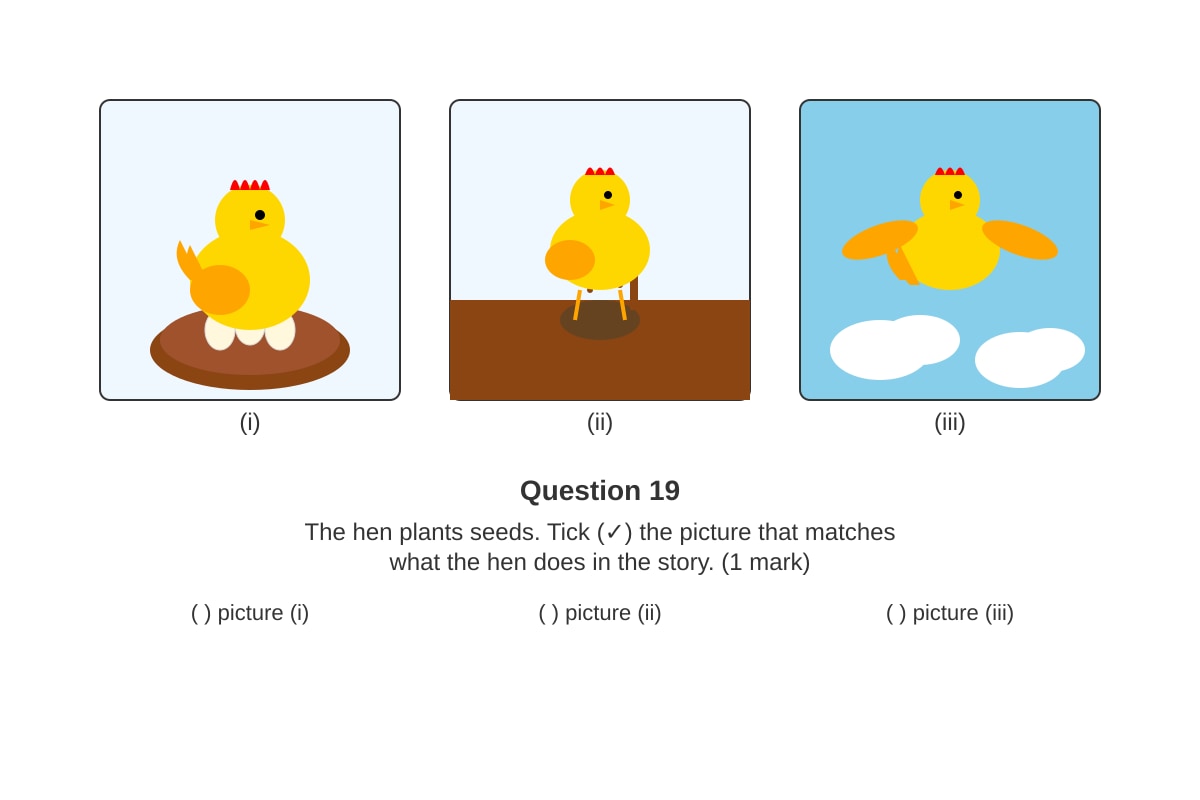
Q19 (1 mark) Answer: tick picture (ii). Teaching note: The story says "She dug a hole... She put the seeds in the hole." Picture (ii) shows the hen digging and planting seeds. Picture (i) is sitting on eggs (not in the story). Picture (iii) is flying (not in the story).
Q20 (2 marks)
Mark breakdown:
- 1 mark for each correct item from the story (2 items needed).
- 1 mark reserved for spelling / copying correctly from the story. If both spellings are correct, give the spelling mark.
- Award 1 mark if only one correct item is given.
- Award 0 marks if neither item is correct or the items are not from the story.
Model answers (any 2 of these):
- a bag (of seeds) - 1 mark
- a log (she sat on) - 1 mark
- a hole (she dug) - 1 mark
- her foot (she used to dig) - 1 mark
- seeds (she planted) - 1 mark
Teaching note: This question tests word recognition and simple retrieval from a short text. Students should copy the words exactly as they appear in the story. Capital letters and full stops are not required for the individual words inside a list, but the items must be things the hen uses in the story, not just any noun in the story. For example, "the sun" is a thing the hen sees, not a thing she uses, so it should not be credited.
Mark Summary
| Section | Marks |
|---|---|
| A (Q1-8) | 8 |
| B (Q9-16) | 8 |
| C (Q17-20) | 9 |
| Total | 25 |
(Counts match the Total Marks: 25 stated on the paper.)
Visual Stimulus Notes (for image-generation stage)
-
Q3 (Q3-fig1): Must show a 2x2 grid labelled A, B, C, D. Picture C must be a clearly-drawn hen (red comb, yellow beak, brown/white feathers), with the printed label "hen" under it. Pictures A, B, D should be sun, hat, and hand to match the distractor sounds /s/, /h/, /h/.
-
Q13 (Q13-fig1): A single large cartoon duck (yellow body, flat orange bill, webbed feet) on green grass beside a small blue pond. The word "quack" must appear in a speech-bubble above the duck's beak.
-
Q19 (Q19-fig1): A horizontal row of 3 pictures labelled (i), (ii), (iii). Picture (ii) must show a hen (not a person) holding a spade, digging in brown soil, with small black/brown seeds falling into the hole. Picture (i): hen on a nest with eggs. Picture (iii): hen flying in the sky.