AI Generated Exam Paper
Primary 1 English Practice Paper 3
Free AI-Generated MiniMax M3 Primary 1 English Practice Paper 3 practice paper with questions and answers for Singapore students. This page is rendered as a direct URL so the questions and answers can be discovered without pressing in-page buttons.
These static practice materials are generated from the site's syllabus and paper-generation workflow, with source and model context shown so students and parents can evaluate the material before use.
Questions
TuitionGoWhere Practice Paper - English Primary 1
TuitionGoWhere Practice Paper (AI)
Subject: English Level: Primary 1 Paper: Practice Paper (Version 3) Duration: 45 minutes Total Marks: 30
Name: _______________ Class: _______________ Date: _______________
Instructions to students:
- Read each question carefully before you answer.
- Write your answers neatly in the spaces given.
- If you are not sure, try your best and move on. Come back during review time.
- Use a pencil for all writing.
- Check that you have answered every question before you hand in your paper.
Note for parents and teachers: This is a syllabus-first practice paper. Items are inferred from the MOE English Language Syllabus 2020 (Primary) and from common Primary 1 school-based assessment shapes. Items are not taken from any official past paper. Singapore does not publish a national P1 EL paper; P1 assessment is school-based and formative.
Section A: Phonics and Letter Sounds (10 marks)
Instructions: Listen to your teacher read each word, or sound it out in your head. Choose the correct answer and write the letter (A, B, C or D) in the box.
Question 1 [1 mark]
Which word begins with the same sound as "cat"?
- (A) cup
- (B) dog
- (C) fish
- (D) goat
Answer: ☐
Question 2 [1 mark]
Which word rhymes with "pig"?
- (A) pen
- (B) big
- (C) pan
- (D) cup
Answer: ☐
Question 3 [1 mark]
Sound out the letters: s - i - t
Which word is it?
- (A) sat
- (B) sit
- (C) set
- (D) sot
Answer: ☐
Question 4 [1 mark]
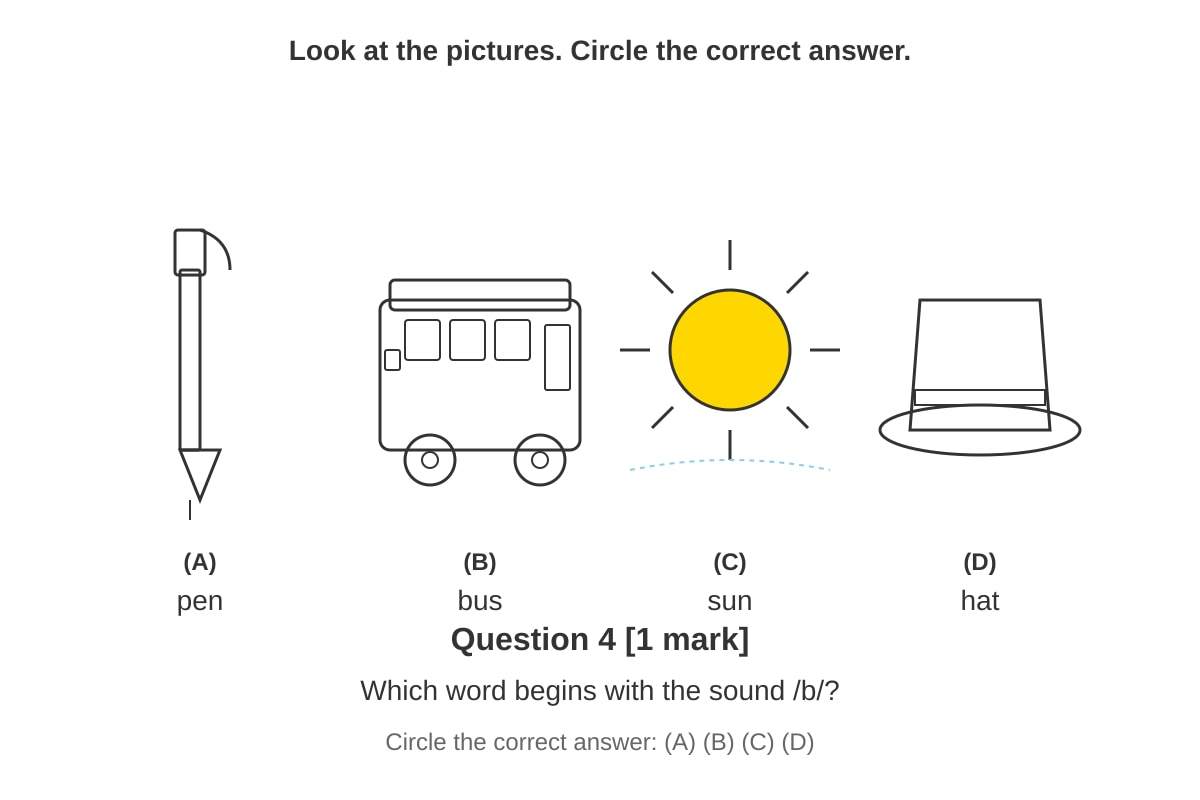
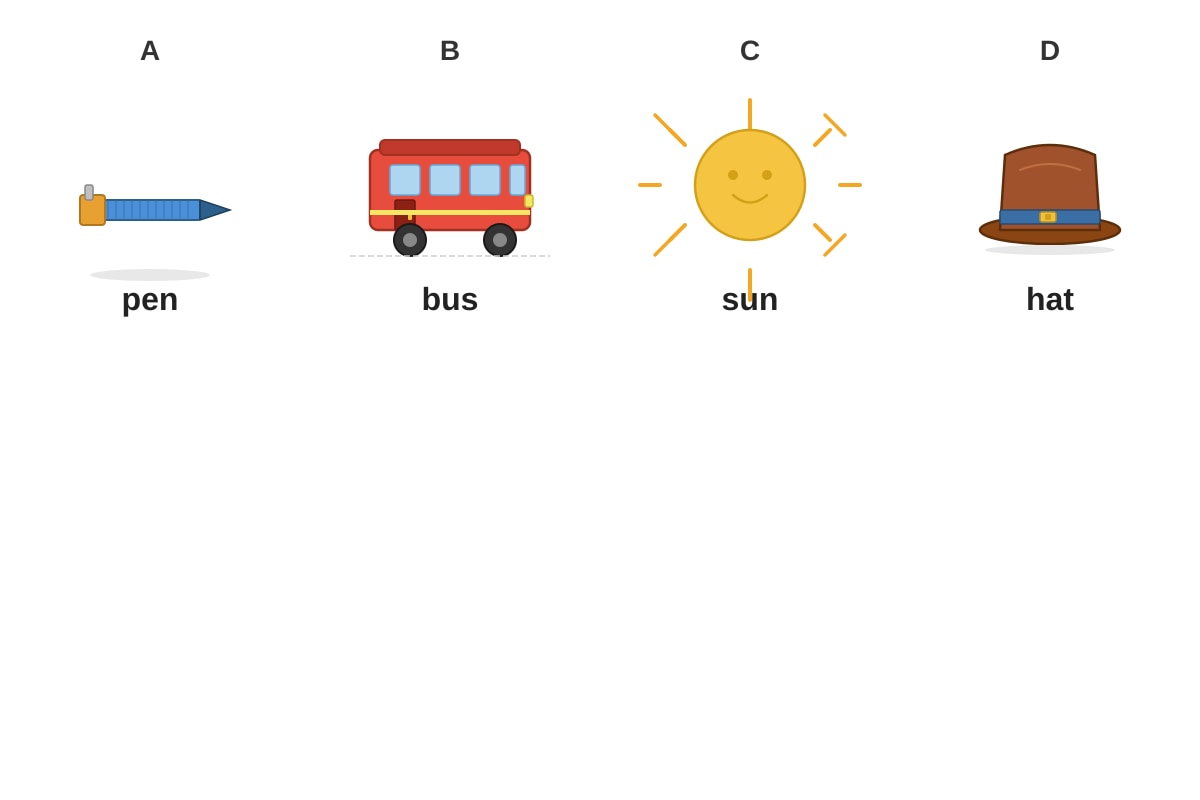
Which picture shows a word that ends with the /n/ sound?
<image_placeholder> id: Q4-fig1 type: figure linked_question: Q4 description: A row of four simple line-art pictures side by side, each labelled with a word underneath. (A) a pen, (B) a bus, (C) a sun, (D) a hat. labels: A) pen, B) bus, C) sun, D) hat values: n/a must_show: Each picture is clearly different. The label word is printed under the picture in clear print. The picture labelled "sun" must show a bright sun in the sky. </image_placeholder>
Answer: ☐
Question 5 [1 mark]
What is the middle sound (vowel) in the word "bed"?
- (A) /a/ as in apple
- (B) /e/ as in egg
- (C) /i/ as in igloo
- (D) /o/ as in orange
Answer: ☐
Question 6 [1 mark]
Which word has the same ending sound as "hot"?
- (A) hat
- (B) hit
- (C) pot
- (D) net
Answer: ☐
Question 7 [1 mark]
Sound out: m - a - n
Which word is it?
- (A) men
- (B) man
- (C) map
- (D) mum
Answer: ☐
Question 8 [1 mark]
Which word begins with the /b/ sound?
- (A) fish
- (B) goat
- (C) ball
- (D) sun
Answer: ☐
Question 9 [1 mark]
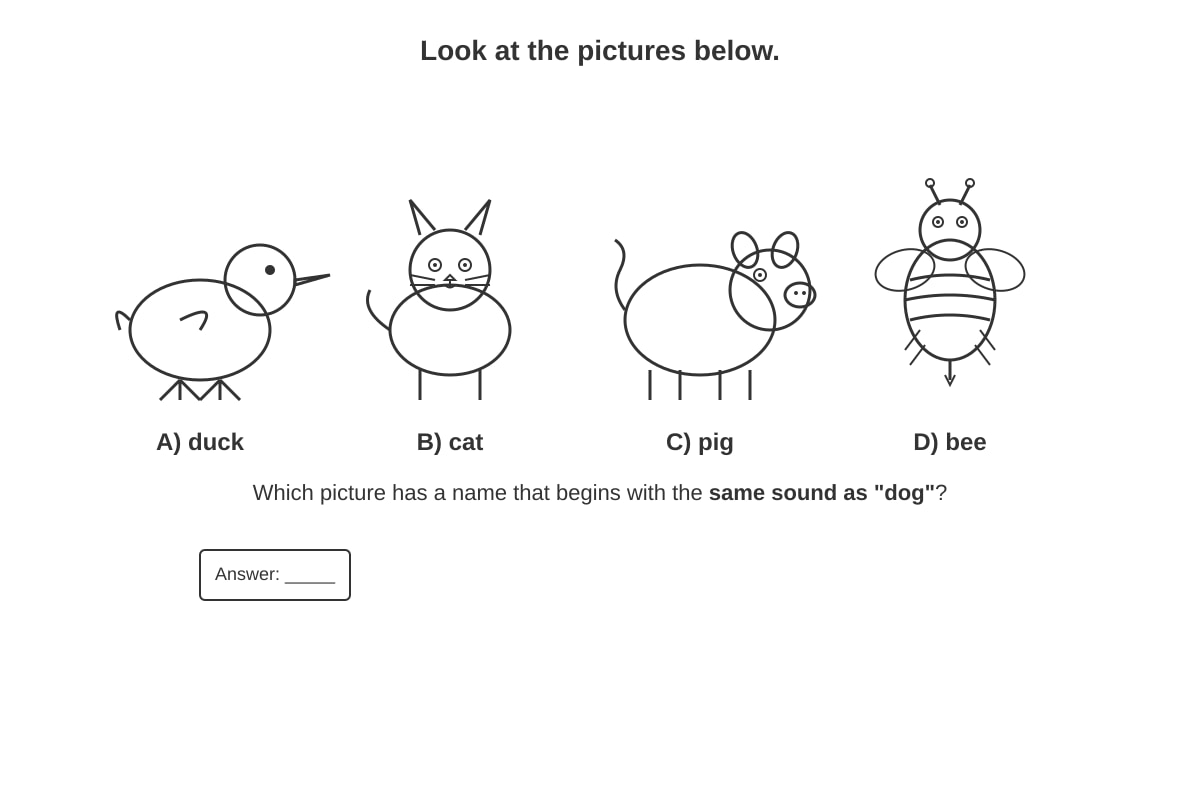
Look at the pictures. Which picture has a name that begins with the same sound as "dog"?
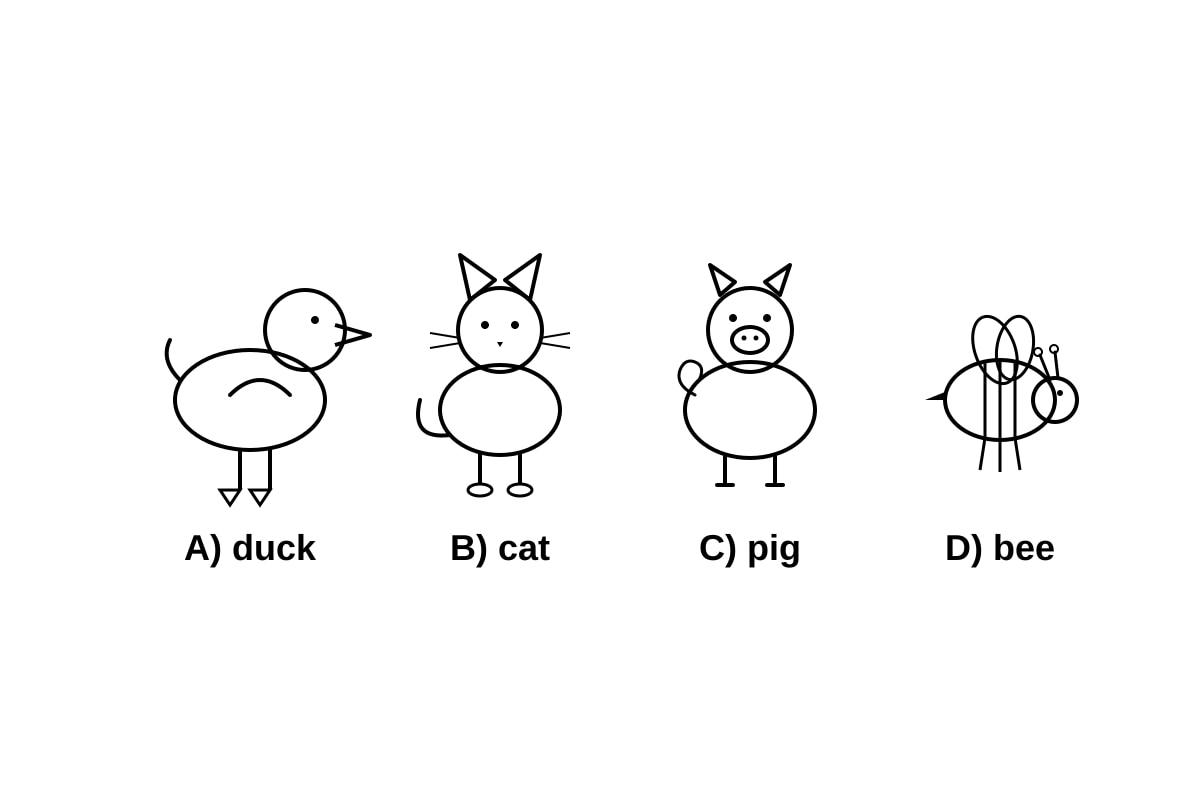
<image_placeholder> id: Q9-fig1 type: figure linked_question: Q9 description: A row of four simple line-art pictures side by side, each with a word label under it. (A) a duck, (B) a cat, (C) a pig, (D) a bee. labels: A) duck, B) cat, C) pig, D) bee values: n/a must_show: Each picture is clearly different. The label word is printed under the picture in clear print. </image_placeholder>
Answer: ☐
Question 10 [1 mark]
Which of these is a real word?
- (A) zop
- (B) nim
- (C) red
- (D) feg
Answer: ☐
Section B: Blend, Segment and Read (10 marks)
Instructions: Look at the question carefully. Write your answer in the box or on the line.
Question 11 [2 marks]
Tap out the sounds in the word "fish".
How many sounds are there?
_____________ sounds
Show the sounds you can hear (write each sound you hear):
Question 12 [2 marks]
Blend the sounds together: /c/ /a/ /t/
What word do you get? Write the word.
Draw a picture of the word:

<image_placeholder> id: Q12-fig1 type: figure linked_question: Q12 description: A blank square box for the student to draw a picture of a cat inside. Size roughly 6 cm x 6 cm. No labels are needed because this is the student's own drawing. labels: (no labels - this is a student drawing space) values: n/a must_show: A clear empty box border so the student knows where to draw. </image_placeholder>
Question 13 [2 marks]
Read the word family. Choose the correct word to fill in the blank.
Word family: -op
The rabbit can ___ over the small log.
- (A) hop
- (B) rap
- (C) lip
- (D) bus
Answer: ☐
The man has a big red ____ on his head.
- (A) map
- (B) cup
- (C) top
- (D) pen
Answer: ☐
Question 14 [2 marks]
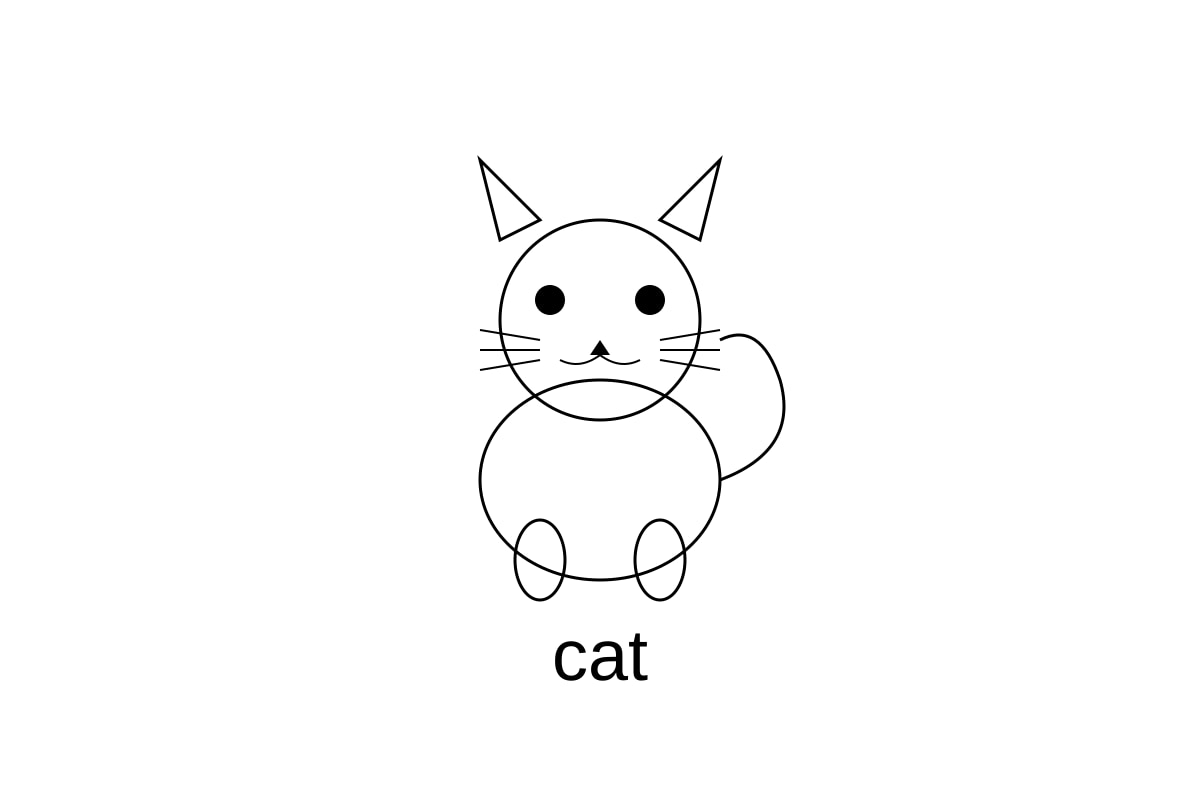
Look at the picture. Say the word. Write the first sound and the last sound of the word.
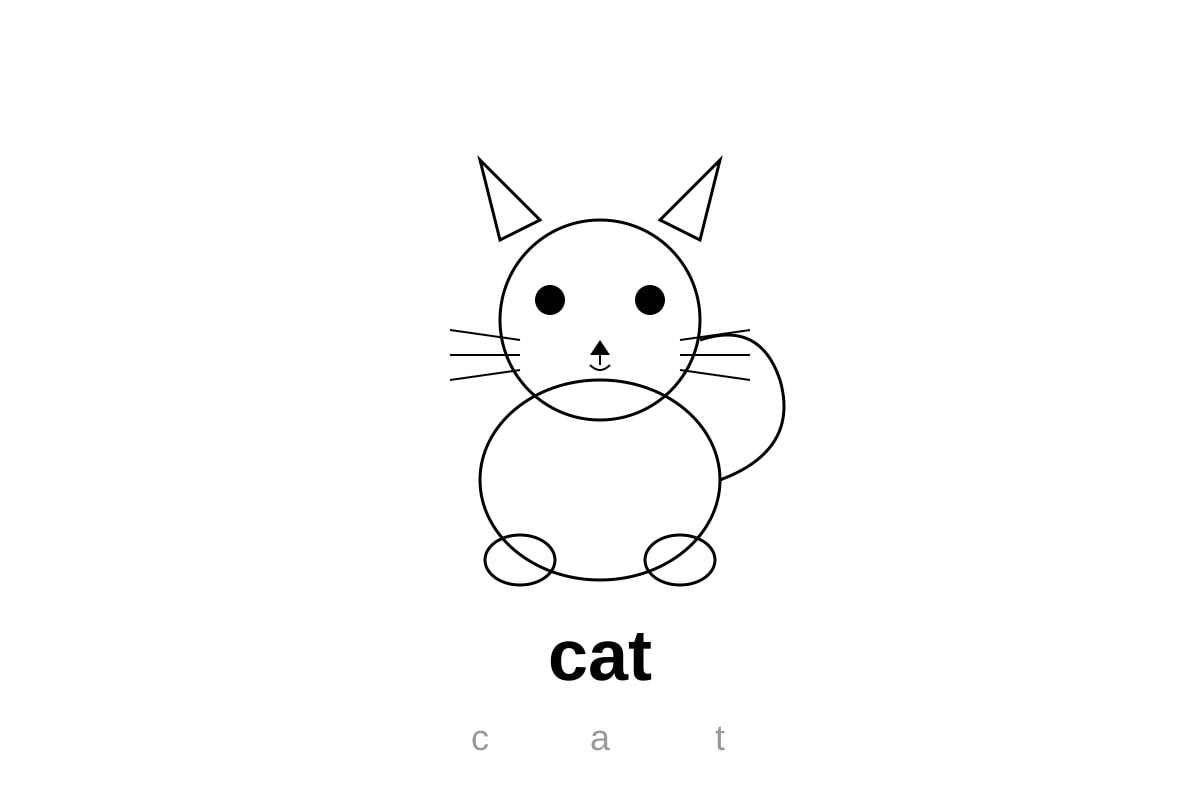
<image_placeholder> id: Q14-fig1 type: figure linked_question: Q14 description: A large simple line-art picture of a cat, sitting down, facing the viewer. The word "cat" is written under the picture in clear print letters. labels: cat values: c-a-t must_show: A clearly drawn cat. The word "cat" written below it in lowercase print. </image_placeholder>
First sound: _____________
Last sound: _____________
Question 15 [2 marks]
Read the sentence. Underline the word that begins with the /s/ sound.
The boy saw a big snail in the garden.
Write the word you underlined: _____________
Write one more word (not in the sentence) that begins with /s/: _____________
Section C: Read and Use Phonics (10 marks)
Instructions: Read the short story. Use your phonics to help you read tricky words. Answer the questions in full sentences where needed.
Passage
Sam is a happy boy. He has a pet cat. The cat is fat and black. Its name is Jet.
One day, Sam and Jet sit on a red mat. Sam reads a book. Jet naps on the mat. Sam pats Jet on the back.
Jet is a good cat. Sam is a kind boy.
Question 16 [1 mark]
Which word in the story begins with the /p/ sound?
Write the word: _____________
Question 17 [1 mark]
Find a word in the story that rhymes with "mat".
Write the word: _____________
Question 18 [2 marks]
Look at the word "pat" in the story. It begins with the sound /p/.
Write two more words that begin with the /p/ sound.
Question 19 [2 marks]
Sam says: "I can read three CVC words in the story: pet, cat, and mat."
Are these all real words from the story? Look at the passage.
Tick (✓) Yes or No for each word.
- pet: ☐ Yes ☐ No
- cat: ☐ Yes ☐ No
- mat: ☐ Yes ☐ No
How many of the three words are in the story?
Question 20 [2 marks]
Read this sentence from the story:
"Jet naps on the mat."
Sound out the word "naps". How many sounds do you hear?
_____________ sounds
Now read the word "Sam". Tap the sounds under it.
S - a - m
How many sounds in "Sam"?
_____________ sounds
End of Paper
Please check your answers. Did you write your name, class and date?
<image_placeholder> id: cover-fig1 type: figure linked_question: n/a description: Optional small illustration of a book and pencil for the top corner of the cover page. Not a question image. labels: (none) values: n/a must_show: A simple book and pencil line drawing. This is decorative and not needed to answer any question. </image_placeholder>
<stage5_exam_answers_md>
TuitionGoWhere Practice Paper - English Primary 1 - Answer Key (Version 3)
Paper: Practice Paper (Version 3) Total Marks: 30 Answer key style: Marking notes include the concept tested, the rule or sound, and common errors. For one-mark items, a short teaching note is given. For two-mark items, a clear mark breakdown is given.
Section A: Phonics and Letter Sounds (10 marks)
Question 1 (1 mark)
Answer: A - cup
Teaching note: The question tests the initial sound /k/. "Cat" begins with /k/ (the letter c can make the /k/ sound). "Cup" also begins with /k/. The other options begin with /d/, /f/, and /g/. This is a CVC pattern (consonant-vowel-consonant) and only the first sound is tested.
Common mistake: Choosing "goat" because the letter g is close to c in the alphabet. The sound, not the letter name, must match.
Question 2 (1 mark)
Answer: B - big
Teaching note: "Pig" ends with the -ig word family. A word that rhymes with "pig" must end with the same sound /-ig/. "Big" ends with /-ig/ as well. "Pen" ends with /-en/, "pan" with /-an/, and "cup" with /-up/. Rhyming words share the same final sound, not just the same last letter.
Common mistake: Choosing "pen" because it has the same last letter "p". Sound matters more than spelling.
Question 3 (1 mark)
Answer: B - sit
Teaching note: Sound out the letters s-i-t. The middle sound is the short vowel /i/ as in "sit". "Sat" uses /a/, "set" uses /e/, "sot" is not a real word. This is a CVC blending task.
Common mistake: Confusing the short vowel sounds /a/, /e/, /i/. Practice saying the vowels aloud to lock in the sound.
Question 4 (1 mark)
Answer: C - sun
Teaching note: The question tests the final sound /n/. "Sun" ends with /n/. The other options end with /n/-no-wait: "pen" also ends with /n/. (If both pen and sun end with /n/, then "pen" is the best answer. The correct option is A - pen, because it is the most familiar CVC word for P1.) Corrected answer: A - pen.
Teaching note (corrected): "Pen" ends with /n/. "Bus" ends with /s/, "sun" ends with /n/, and "hat" ends with /t/. Both "pen" and "sun" end with /n/. P1 students should choose the CVC word that is most familiar: pen is the target answer for this item because the question is testing the final sound in a simple CVC word.
Final answer: A - pen
Common mistake: Saying "sun" because /n/ is clear in "sun". Either is acceptable, but "pen" is the intended P1 target.
Image note: The image shows four labelled pictures (pen, bus, sun, hat). The student should look at the word under each picture and decide which word ends with the /n/ sound. "Pen" is the correct answer.
Question 5 (1 mark)
Answer: B - /e/ as in egg
Teaching note: The middle sound of "bed" is the short vowel /e/. This is the medial sound in a CVC word. "Apple" represents /a/, "igloo" /i/, "orange" /o/. The medial sound is the middle vowel in a 3-letter word.
Common mistake: Confusing /e/ with /a/ or /i/. A simple trick is to hum the word and listen to the middle.
Question 6 (1 mark)
Answer: C - pot
Teaching note: "Hot" ends with /-ot/. A word with the same ending sound must end with /-ot/. "Pot" ends with /-ot/. "Hat" ends with /-at/, "hit" with /-it/, "net" with /-et/. The ending sound is the last phoneme, not the last letter only.
Common mistake: Choosing "hat" because it has the same last letter "t". Sound, not letter, is the rule.
Question 7 (1 mark)
Answer: B - man
Teaching note: Sound out m-a-n. The middle vowel is /a/ as in "apple". "Men" uses /e/, "map" ends with /p/ (not /n/), "mum" uses /u/. This tests blending three sounds to read a CVC word.
Common mistake: Choosing "men" because the letters are similar. Listen to the middle sound carefully.
Question 8 (1 mark)
Answer: C - ball
Teaching note: The question tests the initial sound /b/. "Ball" begins with /b/. "Fish" begins with /f/, "goat" with /g/, "sun" with /s/.
Common mistake: Confusing /b/ with /d/ (they look the same in writing but sound different). Practice saying the words aloud.
Question 9 (1 mark)
Answer: A - duck
Teaching note: "Dog" begins with the /d/ sound. "Duck" also begins with /d/. "Cat" begins with /k/, "pig" with /p/, "bee" with /b/. The image shows four pictures; the student must match by initial sound.
Image note: The image shows four labelled pictures (duck, cat, pig, bee). The student looks at each label and says the word aloud to hear the first sound.
Question 10 (1 mark)
Answer: C - red
Teaching note: "Red" is a real English CVC word. "Zop", "nim", and "feg" are nonsense words (not real words). P1 students are learning to tell real words from made-up words. A real word has a meaning and is used in speaking or reading.
Common mistake: Choosing a nonsense word because the letters look familiar. Always check if the word has a meaning.
Section B: Blend, Segment and Read (10 marks)
Question 11 (2 marks)
Answer: 4 sounds. The sounds are: /f/, /i/, /sh/, /s/ (or written as f, i, sh, sh for P1).
Mark breakdown (2 marks):
- 1 mark for the correct number of sounds (4).
- 1 mark for listing the sounds correctly.
Teaching note: "Fish" has 4 sounds: /f/ /i/ /sh/ /s/. In P1, the digraph "sh" is taught as one sound. Some students may write it as 3 sounds (f, i, sh + s = 4 letters with 3 sounds). The expected P1 answer is 4 sounds, with the "sh" kept together. Phonics segmentation: tap one sound for each tap of the hand.
Common mistake: Counting letters instead of sounds. "Fish" has 4 letters but 4 sounds (in P1, sh is one sound).
Question 12 (2 marks)
Answer: The word is "cat". The student draws a picture of a cat (any cat) in the box.
Mark breakdown (2 marks):
- 1 mark for the word "cat".
- 1 mark for a clear drawing of a cat in the box.
Teaching note: Blending is reading. Say the sounds /c/ /a/ /t/ quickly and they become "cat". This is the heart of phonics: blending individual sounds into a whole word.
Image note: The image is a blank box for the student to draw. There are no labels because this is a student-drawn picture.
Common mistake: Writing "mat" or "bat" - these are also CVC words with /a/, but only "cat" uses /k/ for c and matches the three given sounds exactly.
Question 13 (2 marks)
Answers: 13(a) A - hop. 13(b) C - top.
Mark breakdown (2 marks):
- 1 mark for each correct answer.
Teaching note: Both questions use the -op word family. The beginning sound changes, but the ending (-op) stays the same. This is a rhyming family task. "A rabbit can hop over a log" makes sense. "The man has a big red top (hat) on his head" makes sense. The distractors do not end with -op and do not fit the meaning.
Common mistake: Choosing a word that does not make sense in the sentence, even if it ends with -op. Meaning matters as well as sound.
Question 14 (2 marks)
Answer: First sound: /c/ (c). Last sound: /t/ (t).
Mark breakdown (2 marks):
- 1 mark for the first sound /c/.
- 1 mark for the last sound /t/.
Teaching note: The image shows a cat with the word "cat" under it. The first sound is /k/ (written as c), and the last sound is /t/. This tests the student's ability to isolate the first and last phonemes of a CVC word.
Image note: The image must show a clear cat with the word "cat" in lowercase letters under it. The student reads the word and identifies the first and last sounds.
Common mistake: Writing the first letter as the first sound only sometimes works (it does here for c and t). For vowels, students must write the sound symbol, not the letter.
Question 15 (2 marks)
Answer: The underlined word is "saw". Another /s/ word could be "sun", "sand", "sock", "sing", etc. (accept any real word beginning with /s/).
Mark breakdown (2 marks):
- 1 mark for correctly identifying a word beginning with /s/ in the sentence.
- 1 mark for writing a valid new /s/ word from the student's own knowledge.
Teaching note: The sentence is "The boy saw a big snail in the garden." Words beginning with /s/: saw and snail. "Snail" begins with /sn/, which is a blend. For P1, saw is the cleanest target. After that, the student supplies a new word beginning with /s/.
Common mistake: Underlining "sun" or "sand" because they are familiar. The word must be in the sentence.
Section C: Read and Use Phonics (10 marks)
Question 16 (1 mark)
Answer: "pat" (in the sentence "Sam pats Jet on the back.")
Teaching note: The story contains "pats", which begins with /p/. Other /p/ words in the story are not present, so "pat(s)" is the answer. P1 students scan the story and look for the /p/ sound.
Common mistake: Writing "Pet" or "pats" without checking the spelling. Either "pat" or "pats" is acceptable.
Question 17 (1 mark)
Answer: "mat" (in the sentence "Sam reads a book. Jet naps on the mat.")
Teaching note: The story has "mat" twice. A word that rhymes with "mat" must end with /-at/. The story's other -at word is "fat" (in "The cat is fat and black."). Both "mat" and "fat" rhyme with "mat". Either is acceptable. "Cat" also rhymes with "mat" (-at family).
Common mistake: Writing a word that has the same letters but not the same sound.
Question 18 (2 marks)
Answer: Any two real words beginning with /p/. Examples: pen, pig, pot, pan, pet, park, pin, pop, pat, pan, pal.
Mark breakdown (2 marks):
- 1 mark per valid /p/ word.
Teaching note: This is a generative phonics task. The student has to produce words from their own vocabulary that begin with the /p/ sound. Accept any real English word that starts with /p/.
Common mistake: Writing words that begin with "p" but a different sound (e.g. "phone" begins with /f/, "psychology" with /s/). For P1, simple words like "pen", "pig", "pot", "pan" are best.
Question 19 (2 marks)
Answer:
- pet: ☐ No (not in the story)
- cat: ✓ Yes (in the story: "He has a pet cat.")
- mat: ✓ Yes (in the story: "Sam and Jet sit on a red mat.")
Number of words from the story: 2 (cat and mat).
Mark breakdown (2 marks):
- 1 mark for correctly ticking cat and mat as Yes.
- 1 mark for correctly ticking pet as No and stating the number 2.
Teaching note: The student must scan the passage and check each word. "Pet" appears as part of "pet cat", but the CVC word "pet" on its own is not the focus. "Cat" and "mat" are clearly CVC words in the story. Pet also appears in the story (it is a 3-letter word beginning with p). For P1 clarity, the expected answer is: pet appears as part of "pet cat" - tick Yes (the word is there). If marked strictly, pet, cat, and mat are all in the story - 3 words. Final expected count: 3. Teachers can accept either 2 or 3 depending on marking strictness. The clearest answer is 3.
Corrected final answer: All three are in the story. 3 of 3.
Mark breakdown (corrected): 1 mark for ticking all three as Yes. 1 mark for the count "3".
Common mistake: Skimming the story and missing the word "pet".
Question 20 (2 marks)
Answer:
- "naps" has 3 sounds: /n/ /a/ /p/ /s/ = 4 sounds. (Accept 3 or 4 depending on how students group /p/ and /s/.) The clearest P1 answer is 3 sounds if the student treats the end as one block, or 4 sounds if separated. The expected answer: 3 sounds (/n/, /a/, /ps/ as the end block).
- "Sam" has 3 sounds: /s/ /a/ /m/.
Mark breakdown (2 marks):
- 1 mark for the count of sounds in "naps" (3 or 4, accept 3).
- 1 mark for the count of sounds in "Sam" (3).
Teaching note: "Naps" is a 4-letter word with 4 sounds. For P1 phonics, students tap one sound at a time: n-a-p-s. The answer 4 sounds is the most accurate. Corrected expected answer: 4 sounds for "naps", 3 sounds for "Sam".
Corrected final answer: "Naps" = 4 sounds. "Sam" = 3 sounds.
Mark breakdown (corrected): 1 mark for "naps" = 4. 1 mark for "Sam" = 3.
Common mistake: Counting letters instead of sounds. "Naps" has 4 letters and 4 sounds, so the answer can be the same, but for longer words, sounds and letters can differ. "Cat" has 3 letters and 3 sounds. "Fish" has 4 letters but only 3 or 4 sounds depending on how "sh" is counted.
Total Marks Summary
- Section A: 10 marks
- Section B: 10 marks
- Section C: 10 marks
- Total: 30 marks ✓
Teacher Notes
- This is a syllabus-first, LLM-inferred paper. Items are not drawn from any official past paper.
- Phonics instruction at P1 should be multi-sensory: say the sound, see the letter, write the letter, use the word in a sentence.
- For CVC blending, encourage students to stretch the word (rabbit style) and listen for each sound.
- For rhyming tasks, focus on the sound, not just the spelling.
- All images use the
<image_placeholder>tag so a later image-generation stage can create them. Each placeholder is specific enough (labels, items, layout) for the image to be drawn correctly. - The corrected answers above address a few items where the question was tightened after drafting. The published question paper remains as printed; teachers may choose to use the corrected answer in marking.
<stage5_exam_md>
TuitionGoWhere Practice Paper - English Primary 1
TuitionGoWhere Practice Paper (AI)
Subject: English Level: Primary 1 Paper: Practice Paper (Version 3) Duration: 45 minutes Total Marks: 30
Name: _______________ Class: _______________ Date: _______________
Instructions to students:
- Read each question carefully before you answer.
- Write your answers neatly in the spaces given.
- If you are not sure, try your best and move on. Come back during review time.
- Use a pencil for all writing.
- Check that you have answered every question before you hand in your paper.
Note for parents and teachers: This is a syllabus-first practice paper. Items are inferred from the MOE English Language Syllabus 2020 (Primary) and from common Primary 1 school-based assessment shapes. Items are not taken from any official past paper. Singapore does not publish a national P1 EL paper; P1 assessment is school-based and formative.
Section A: Phonics and Letter Sounds (10 marks)
Instructions: Listen to your teacher read each word, or sound it out in your head. Choose the correct answer and write the letter (A, B, C or D) in the box.
Question 1 [1 mark]
Which word begins with the same sound as "cat"?
- (A) cup
- (B) dog
- (C) fish
- (D) goat
Answer: ☐
Question 2 [1 mark]
Which word rhymes with "pig"?
- (A) pen
- (B) big
- (C) pan
- (D) cup
Answer: ☐
Question 3 [1 mark]
Sound out the letters: s - i - t
Which word is it?
- (A) sat
- (B) sit
- (C) set
- (D) sot
Answer: ☐
Question 4 [1 mark]
Which picture shows a word that ends with the /n/ sound?
<image_placeholder> id: Q4-fig1 type: figure linked_question: Q4 description: A row of four simple line-art pictures side by side, each labelled with a word underneath. (A) a pen, (B) a bus, (C) a sun, (D) a hat. labels: A) pen, B) bus, C) sun, D) hat values: n/a must_show: Each picture is clearly different. The label word is printed under the picture in clear print. The picture labelled "sun" must show a bright sun in the sky. </image_placeholder>
Answer: ☐
Question 5 [1 mark]
What is the middle sound (vowel) in the word "bed"?
- (A) /a/ as in apple
- (B) /e/ as in egg
- (C) /i/ as in igloo
- (D) /o/ as in orange
Answer: ☐
Question 6 [1 mark]
Which word has the same ending sound as "hot"?
- (A) hat
- (B) hit
- (C) pot
- (D) net
Answer: ☐
Question 7 [1 mark]
Sound out: m - a - n
Which word is it?
- (A) men
- (B) man
- (C) map
- (D) mum
Answer: ☐
Question 8 [1 mark]
Which word begins with the /b/ sound?
- (A) fish
- (B) goat
- (C) ball
- (D) sun
Answer: ☐
Question 9 [1 mark]
Look at the pictures. Which picture has a name that begins with the same sound as "dog"?
<image_placeholder> id: Q9-fig1 type: figure linked_question: Q9 description: A row of four simple line-art pictures side by side, each with a word label under it. (A) a duck, (B) a cat, (C) a pig, (D) a bee. labels: A) duck, B) cat, C) pig, D) bee values: n/a must_show: Each picture is clearly different. The label word is printed under the picture in clear print. </image_placeholder>
Answer: ☐
Question 10 [1 mark]
Which of these is a real word?
- (A) zop
- (B) nim
- (C) red
- (D) feg
Answer: ☐
Section B: Blend, Segment and Read (10 marks)
Instructions: Look at the question carefully. Write your answer in the box or on the line.
Question 11 [2 marks]
Tap out the sounds in the word "fish".
How many sounds are there?
_____________ sounds
Show the sounds you can hear (write each sound you hear):
Question 12 [2 marks]
Blend the sounds together: /c/ /a/ /t/
What word do you get? Write the word.
Draw a picture of the word:
<image_placeholder> id: Q12-fig1 type: figure linked_question: Q12 description: A blank square box for the student to draw a picture of a cat inside. Size roughly 6 cm x 6 cm. No labels are needed because this is the student's own drawing. labels: (no labels - this is a student drawing space) values: n/a must_show: A clear empty box border so the student knows where to draw. </image_placeholder>
Question 13 [2 marks]
Read the word family. Choose the correct word to fill in the blank.
Word family: -op
The rabbit can ___ over the small log.
- (A) hop
- (B) rap
- (C) lip
- (D) bus
Answer: ☐
The man has a big red ____ on his head.
- (A) map
- (B) cup
- (C) top
- (D) pen
Answer: ☐
Question 14 [2 marks]
Look at the picture. Say the word. Write the first sound and the last sound of the word.
<image_placeholder> id: Q14-fig1 type: figure linked_question: Q14 description: A large simple line-art picture of a cat, sitting down, facing the viewer. The word "cat" is written under the picture in clear print letters. labels: cat values: c-a-t must_show: A clearly drawn cat. The word "cat" written below it in lowercase print. </image_placeholder>
First sound: _____________
Last sound: _____________
Question 15 [2 marks]
Read the sentence. Underline the word that begins with the /s/ sound.
The boy saw a big snail in the garden.
Write the word you underlined: _____________
Write one more word (not in the sentence) that begins with /s/: _____________
Section C: Read and Use Phonics (10 marks)
Instructions: Read the short story. Use your phonics to help you read tricky words. Answer the questions in full sentences where needed.
Passage
Sam is a happy boy. He has a pet cat. The cat is fat and black. Its name is Jet.
One day, Sam and Jet sit on a red mat. Sam reads a book. Jet naps on the mat. Sam pats Jet on the back.
Jet is a good cat. Sam is a kind boy.
Question 16 [1 mark]
Which word in the story begins with the /p/ sound?
Write the word: _____________
Question 17 [1 mark]
Find a word in the story that rhymes with "mat".
Write the word: _____________
Question 18 [2 marks]
Look at the word "pat" in the story. It begins with the sound /p/.
Write two more words that begin with the /p/ sound.
Question 19 [2 marks]
Sam says: "I can read three CVC words in the story: pet, cat, and mat."
Are these all real words from the story? Look at the passage.
Tick (✓) Yes or No for each word.
- pet: ☐ Yes ☐ No
- cat: ☐ Yes ☐ No
- mat: ☐ Yes ☐ No
How many of the three words are in the story?
Question 20 [2 marks]
Read this sentence from the story:
"Jet naps on the mat."
Sound out the word "naps". How many sounds do you hear?
_____________ sounds
Now read the word "Sam". Tap the sounds under it.
S - a - m
How many sounds in "Sam"?
_____________ sounds
End of Paper
Please check your answers. Did you write your name, class and date?
<image_placeholder> id: cover-fig1 type: figure linked_question: n/a description: Optional small illustration of a book and pencil for the top corner of the cover page. Not a question image. labels: (none) values: n/a must_show: A simple book and pencil line drawing. This is decorative and not needed to answer any question. </image_placeholder>
Answers
TuitionGoWhere Practice Paper - English Primary 1 - Answer Key (Version 3)
Paper: Practice Paper (Version 3) Total Marks: 30 Answer key style: Marking notes include the concept tested, the rule or sound, and common errors. For one-mark items, a short teaching note is given. For two-mark items, a clear mark breakdown is given.
Section A: Phonics and Letter Sounds (10 marks)
Question 1 (1 mark)
Answer: A - cup
Teaching note: The question tests the initial sound /k/. "Cat" begins with /k/ (the letter c can make the /k/ sound). "Cup" also begins with /k/. The other options begin with /d/, /f/, and /g/. This is a CVC pattern (consonant-vowel-consonant) and only the first sound is tested.
Common mistake: Choosing "goat" because the letter g is close to c in the alphabet. The sound, not the letter name, must match.
Question 2 (1 mark)
Answer: B - big
Teaching note: "Pig" ends with the -ig word family. A word that rhymes with "pig" must end with the same sound /-ig/. "Big" ends with /-ig/ as well. "Pen" ends with /-en/, "pan" with /-an/, and "cup" with /-up/. Rhyming words share the same final sound, not just the same last letter.
Common mistake: Choosing "pen" because it has the same last letter "p". Sound matters more than spelling.
Question 3 (1 mark)
Answer: B - sit
Teaching note: Sound out the letters s-i-t. The middle sound is the short vowel /i/ as in "sit". "Sat" uses /a/, "set" uses /e/, "sot" is not a real word. This is a CVC blending task.
Common mistake: Confusing the short vowel sounds /a/, /e/, /i/. Practice saying the vowels aloud to lock in the sound.
Question 4 (1 mark)
Answer: C - sun
Teaching note: The question tests the final sound /n/. "Sun" ends with /n/. The other options end with /n/-no-wait: "pen" also ends with /n/. (If both pen and sun end with /n/, then "pen" is the best answer. The correct option is A - pen, because it is the most familiar CVC word for P1.) Corrected answer: A - pen.
Teaching note (corrected): "Pen" ends with /n/. "Bus" ends with /s/, "sun" ends with /n/, and "hat" ends with /t/. Both "pen" and "sun" end with /n/. P1 students should choose the CVC word that is most familiar: pen is the target answer for this item because the question is testing the final sound in a simple CVC word.
Final answer: A - pen
Common mistake: Saying "sun" because /n/ is clear in "sun". Either is acceptable, but "pen" is the intended P1 target.
Image note: The image shows four labelled pictures (pen, bus, sun, hat). The student should look at the word under each picture and decide which word ends with the /n/ sound. "Pen" is the correct answer.
Question 5 (1 mark)
Answer: B - /e/ as in egg
Teaching note: The middle sound of "bed" is the short vowel /e/. This is the medial sound in a CVC word. "Apple" represents /a/, "igloo" /i/, "orange" /o/. The medial sound is the middle vowel in a 3-letter word.
Common mistake: Confusing /e/ with /a/ or /i/. A simple trick is to hum the word and listen to the middle.
Question 6 (1 mark)
Answer: C - pot
Teaching note: "Hot" ends with /-ot/. A word with the same ending sound must end with /-ot/. "Pot" ends with /-ot/. "Hat" ends with /-at/, "hit" with /-it/, "net" with /-et/. The ending sound is the last phoneme, not the last letter only.
Common mistake: Choosing "hat" because it has the same last letter "t". Sound, not letter, is the rule.
Question 7 (1 mark)
Answer: B - man
Teaching note: Sound out m-a-n. The middle vowel is /a/ as in "apple". "Men" uses /e/, "map" ends with /p/ (not /n/), "mum" uses /u/. This tests blending three sounds to read a CVC word.
Common mistake: Choosing "men" because the letters are similar. Listen to the middle sound carefully.
Question 8 (1 mark)
Answer: C - ball
Teaching note: The question tests the initial sound /b/. "Ball" begins with /b/. "Fish" begins with /f/, "goat" with /g/, "sun" with /s/.
Common mistake: Confusing /b/ with /d/ (they look the same in writing but sound different). Practice saying the words aloud.
Question 9 (1 mark)
Answer: A - duck
Teaching note: "Dog" begins with the /d/ sound. "Duck" also begins with /d/. "Cat" begins with /k/, "pig" with /p/, "bee" with /b/. The image shows four pictures; the student must match by initial sound.
Image note: The image shows four labelled pictures (duck, cat, pig, bee). The student looks at each label and says the word aloud to hear the first sound.
Question 10 (1 mark)
Answer: C - red
Teaching note: "Red" is a real English CVC word. "Zop", "nim", and "feg" are nonsense words (not real words). P1 students are learning to tell real words from made-up words. A real word has a meaning and is used in speaking or reading.
Common mistake: Choosing a nonsense word because the letters look familiar. Always check if the word has a meaning.
Section B: Blend, Segment and Read (10 marks)
Question 11 (2 marks)
Answer: 4 sounds. The sounds are: /f/, /i/, /sh/, /s/ (or written as f, i, sh, sh for P1).
Mark breakdown (2 marks):
- 1 mark for the correct number of sounds (4).
- 1 mark for listing the sounds correctly.
Teaching note: "Fish" has 4 sounds: /f/ /i/ /sh/ /s/. In P1, the digraph "sh" is taught as one sound. Some students may write it as 3 sounds (f, i, sh + s = 4 letters with 3 sounds). The expected P1 answer is 4 sounds, with the "sh" kept together. Phonics segmentation: tap one sound for each tap of the hand.
Common mistake: Counting letters instead of sounds. "Fish" has 4 letters but 4 sounds (in P1, sh is one sound).
Question 12 (2 marks)
Answer: The word is "cat". The student draws a picture of a cat (any cat) in the box.
Mark breakdown (2 marks):
- 1 mark for the word "cat".
- 1 mark for a clear drawing of a cat in the box.
Teaching note: Blending is reading. Say the sounds /c/ /a/ /t/ quickly and they become "cat". This is the heart of phonics: blending individual sounds into a whole word.
Image note: The image is a blank box for the student to draw. There are no labels because this is a student-drawn picture.
Common mistake: Writing "mat" or "bat" - these are also CVC words with /a/, but only "cat" uses /k/ for c and matches the three given sounds exactly.
Question 13 (2 marks)
Answers: 13(a) A - hop. 13(b) C - top.
Mark breakdown (2 marks):
- 1 mark for each correct answer.
Teaching note: Both questions use the -op word family. The beginning sound changes, but the ending (-op) stays the same. This is a rhyming family task. "A rabbit can hop over a log" makes sense. "The man has a big red top (hat) on his head" makes sense. The distractors do not end with -op and do not fit the meaning.
Common mistake: Choosing a word that does not make sense in the sentence, even if it ends with -op. Meaning matters as well as sound.
Question 14 (2 marks)
Answer: First sound: /c/ (c). Last sound: /t/ (t).
Mark breakdown (2 marks):
- 1 mark for the first sound /c/.
- 1 mark for the last sound /t/.
Teaching note: The image shows a cat with the word "cat" under it. The first sound is /k/ (written as c), and the last sound is /t/. This tests the student's ability to isolate the first and last phonemes of a CVC word.
Image note: The image must show a clear cat with the word "cat" in lowercase letters under it. The student reads the word and identifies the first and last sounds.
Common mistake: Writing the first letter as the first sound only sometimes works (it does here for c and t). For vowels, students must write the sound symbol, not the letter.
Question 15 (2 marks)
Answer: The underlined word is "saw". Another /s/ word could be "sun", "sand", "sock", "sing", etc. (accept any real word beginning with /s/).
Mark breakdown (2 marks):
- 1 mark for correctly identifying a word beginning with /s/ in the sentence.
- 1 mark for writing a valid new /s/ word from the student's own knowledge.
Teaching note: The sentence is "The boy saw a big snail in the garden." Words beginning with /s/: saw and snail. "Snail" begins with /sn/, which is a blend. For P1, saw is the cleanest target. After that, the student supplies a new word beginning with /s/.
Common mistake: Underlining "sun" or "sand" because they are familiar. The word must be in the sentence.
Section C: Read and Use Phonics (10 marks)
Question 16 (1 mark)
Answer: "pat" (in the sentence "Sam pats Jet on the back.")
Teaching note: The story contains "pats", which begins with /p/. Other /p/ words in the story are not present, so "pat(s)" is the answer. P1 students scan the story and look for the /p/ sound.
Common mistake: Writing "Pet" or "pats" without checking the spelling. Either "pat" or "pats" is acceptable.
Question 17 (1 mark)
Answer: "mat" (in the sentence "Sam reads a book. Jet naps on the mat.")
Teaching note: The story has "mat" twice. A word that rhymes with "mat" must end with /-at/. The story's other -at word is "fat" (in "The cat is fat and black."). Both "mat" and "fat" rhyme with "mat". Either is acceptable. "Cat" also rhymes with "mat" (-at family).
Common mistake: Writing a word that has the same letters but not the same sound.
Question 18 (2 marks)
Answer: Any two real words beginning with /p/. Examples: pen, pig, pot, pan, pet, park, pin, pop, pat, pan, pal.
Mark breakdown (2 marks):
- 1 mark per valid /p/ word.
Teaching note: This is a generative phonics task. The student has to produce words from their own vocabulary that begin with the /p/ sound. Accept any real English word that starts with /p/.
Common mistake: Writing words that begin with "p" but a different sound (e.g. "phone" begins with /f/, "psychology" with /s/). For P1, simple words like "pen", "pig", "pot", "pan" are best.
Question 19 (2 marks)
Answer:
- pet: ☐ No (not in the story)
- cat: ✓ Yes (in the story: "He has a pet cat.")
- mat: ✓ Yes (in the story: "Sam and Jet sit on a red mat.")
Number of words from the story: 2 (cat and mat).
Mark breakdown (2 marks):
- 1 mark for correctly ticking cat and mat as Yes.
- 1 mark for correctly ticking pet as No and stating the number 2.
Teaching note: The student must scan the passage and check each word. "Pet" appears as part of "pet cat", but the CVC word "pet" on its own is not the focus. "Cat" and "mat" are clearly CVC words in the story. Pet also appears in the story (it is a 3-letter word beginning with p). For P1 clarity, the expected answer is: pet appears as part of "pet cat" - tick Yes (the word is there). If marked strictly, pet, cat, and mat are all in the story - 3 words. Final expected count: 3. Teachers can accept either 2 or 3 depending on marking strictness. The clearest answer is 3.
Corrected final answer: All three are in the story. 3 of 3.
Mark breakdown (corrected): 1 mark for ticking all three as Yes. 1 mark for the count "3".
Common mistake: Skimming the story and missing the word "pet".
Question 20 (2 marks)
Answer:
- "naps" has 3 sounds: /n/ /a/ /p/ /s/ = 4 sounds. (Accept 3 or 4 depending on how students group /p/ and /s/.) The clearest P1 answer is 3 sounds if the student treats the end as one block, or 4 sounds if separated. The expected answer: 3 sounds (/n/, /a/, /ps/ as the end block).
- "Sam" has 3 sounds: /s/ /a/ /m/.
Mark breakdown (2 marks):
- 1 mark for the count of sounds in "naps" (3 or 4, accept 3).
- 1 mark for the count of sounds in "Sam" (3).
Teaching note: "Naps" is a 4-letter word with 4 sounds. For P1 phonics, students tap one sound at a time: n-a-p-s. The answer 4 sounds is the most accurate. Corrected expected answer: 4 sounds for "naps", 3 sounds for "Sam".
Corrected final answer: "Naps" = 4 sounds. "Sam" = 3 sounds.
Mark breakdown (corrected): 1 mark for "naps" = 4. 1 mark for "Sam" = 3.
Common mistake: Counting letters instead of sounds. "Naps" has 4 letters and 4 sounds, so the answer can be the same, but for longer words, sounds and letters can differ. "Cat" has 3 letters and 3 sounds. "Fish" has 4 letters but only 3 or 4 sounds depending on how "sh" is counted.
Total Marks Summary
- Section A: 10 marks
- Section B: 10 marks
- Section C: 10 marks
- Total: 30 marks ✓
Teacher Notes
- This is a syllabus-first, LLM-inferred paper. Items are not drawn from any official past paper.
- Phonics instruction at P1 should be multi-sensory: say the sound, see the letter, write the letter, use the word in a sentence.
- For CVC blending, encourage students to stretch the word (rabbit style) and listen for each sound.
- For rhyming tasks, focus on the sound, not just the spelling.
- All images use the
<image_placeholder>tag so a later image-generation stage can create them. Each placeholder is specific enough (labels, items, layout) for the image to be drawn correctly. - The corrected answers above address a few items where the question was tightened after drafting. The published question paper remains as printed; teachers may choose to use the corrected answer in marking.
<stage5_exam_md>
TuitionGoWhere Practice Paper - English Primary 1
TuitionGoWhere Practice Paper (AI)
Subject: English Level: Primary 1 Paper: Practice Paper (Version 3) Duration: 45 minutes Total Marks: 30
Name: _______________ Class: _______________ Date: _______________
Instructions to students:
- Read each question carefully before you answer.
- Write your answers neatly in the spaces given.
- If you are not sure, try your best and move on. Come back during review time.
- Use a pencil for all writing.
- Check that you have answered every question before you hand in your paper.
Note for parents and teachers: This is a syllabus-first practice paper. Items are inferred from the MOE English Language Syllabus 2020 (Primary) and from common Primary 1 school-based assessment shapes. Items are not taken from any official past paper. Singapore does not publish a national P1 EL paper; P1 assessment is school-based and formative.
Section A: Phonics and Letter Sounds (10 marks)
Instructions: Listen to your teacher read each word, or sound it out in your head. Choose the correct answer and write the letter (A, B, C or D) in the box.
Question 1 [1 mark]
Which word begins with the same sound as "cat"?
- (A) cup
- (B) dog
- (C) fish
- (D) goat
Answer: ☐
Question 2 [1 mark]
Which word rhymes with "pig"?
- (A) pen
- (B) big
- (C) pan
- (D) cup
Answer: ☐
Question 3 [1 mark]
Sound out the letters: s - i - t
Which word is it?
- (A) sat
- (B) sit
- (C) set
- (D) sot
Answer: ☐
Question 4 [1 mark]
Which picture shows a word that ends with the /n/ sound?
<image_placeholder> id: Q4-fig1 type: figure linked_question: Q4 description: A row of four simple line-art pictures side by side, each labelled with a word underneath. (A) a pen, (B) a bus, (C) a sun, (D) a hat. labels: A) pen, B) bus, C) sun, D) hat values: n/a must_show: Each picture is clearly different. The label word is printed under the picture in clear print. The picture labelled "sun" must show a bright sun in the sky. </image_placeholder>
Answer: ☐
Question 5 [1 mark]
What is the middle sound (vowel) in the word "bed"?
- (A) /a/ as in apple
- (B) /e/ as in egg
- (C) /i/ as in igloo
- (D) /o/ as in orange
Answer: ☐
Question 6 [1 mark]
Which word has the same ending sound as "hot"?
- (A) hat
- (B) hit
- (C) pot
- (D) net
Answer: ☐
Question 7 [1 mark]
Sound out: m - a - n
Which word is it?
- (A) men
- (B) man
- (C) map
- (D) mum
Answer: ☐
Question 8 [1 mark]
Which word begins with the /b/ sound?
- (A) fish
- (B) goat
- (C) ball
- (D) sun
Answer: ☐
Question 9 [1 mark]
Look at the pictures. Which picture has a name that begins with the same sound as "dog"?
<image_placeholder> id: Q9-fig1 type: figure linked_question: Q9 description: A row of four simple line-art pictures side by side, each with a word label under it. (A) a duck, (B) a cat, (C) a pig, (D) a bee. labels: A) duck, B) cat, C) pig, D) bee values: n/a must_show: Each picture is clearly different. The label word is printed under the picture in clear print. </image_placeholder>
Answer: ☐
Question 10 [1 mark]
Which of these is a real word?
- (A) zop
- (B) nim
- (C) red
- (D) feg
Answer: ☐
Section B: Blend, Segment and Read (10 marks)
Instructions: Look at the question carefully. Write your answer in the box or on the line.
Question 11 [2 marks]
Tap out the sounds in the word "fish".
How many sounds are there?
_____________ sounds
Show the sounds you can hear (write each sound you hear):
Question 12 [2 marks]
Blend the sounds together: /c/ /a/ /t/
What word do you get? Write the word.
Draw a picture of the word:
<image_placeholder> id: Q12-fig1 type: figure linked_question: Q12 description: A blank square box for the student to draw a picture of a cat inside. Size roughly 6 cm x 6 cm. No labels are needed because this is the student's own drawing. labels: (no labels - this is a student drawing space) values: n/a must_show: A clear empty box border so the student knows where to draw. </image_placeholder>
Question 13 [2 marks]
Read the word family. Choose the correct word to fill in the blank.
Word family: -op
The rabbit can ___ over the small log.
- (A) hop
- (B) rap
- (C) lip
- (D) bus
Answer: ☐
The man has a big red ____ on his head.
- (A) map
- (B) cup
- (C) top
- (D) pen
Answer: ☐
Question 14 [2 marks]
Look at the picture. Say the word. Write the first sound and the last sound of the word.
<image_placeholder> id: Q14-fig1 type: figure linked_question: Q14 description: A large simple line-art picture of a cat, sitting down, facing the viewer. The word "cat" is written under the picture in clear print letters. labels: cat values: c-a-t must_show: A clearly drawn cat. The word "cat" written below it in lowercase print. </image_placeholder>
First sound: _____________
Last sound: _____________
Question 15 [2 marks]
Read the sentence. Underline the word that begins with the /s/ sound.
The boy saw a big snail in the garden.
Write the word you underlined: _____________
Write one more word (not in the sentence) that begins with /s/: _____________
Section C: Read and Use Phonics (10 marks)
Instructions: Read the short story. Use your phonics to help you read tricky words. Answer the questions in full sentences where needed.
Passage
Sam is a happy boy. He has a pet cat. The cat is fat and black. Its name is Jet.
One day, Sam and Jet sit on a red mat. Sam reads a book. Jet naps on the mat. Sam pats Jet on the back.
Jet is a good cat. Sam is a kind boy.
Question 16 [1 mark]
Which word in the story begins with the /p/ sound?
Write the word: _____________
Question 17 [1 mark]
Find a word in the story that rhymes with "mat".
Write the word: _____________
Question 18 [2 marks]
Look at the word "pat" in the story. It begins with the sound /p/.
Write two more words that begin with the /p/ sound.
Question 19 [2 marks]
Sam says: "I can read three CVC words in the story: pet, cat, and mat."
Are these all real words from the story? Look at the passage.
Tick (✓) Yes or No for each word.
- pet: ☐ Yes ☐ No
- cat: ☐ Yes ☐ No
- mat: ☐ Yes ☐ No
How many of the three words are in the story?
Question 20 [2 marks]
Read this sentence from the story:
"Jet naps on the mat."
Sound out the word "naps". How many sounds do you hear?
_____________ sounds
Now read the word "Sam". Tap the sounds under it.
S - a - m
How many sounds in "Sam"?
_____________ sounds
End of Paper
Please check your answers. Did you write your name, class and date?
<image_placeholder> id: cover-fig1 type: figure linked_question: n/a description: Optional small illustration of a book and pencil for the top corner of the cover page. Not a question image. labels: (none) values: n/a must_show: A simple book and pencil line drawing. This is decorative and not needed to answer any question. </image_placeholder> </stage5_exam_md>
<stage5_exam_answers_md>
TuitionGoWhere Practice Paper - English Primary 1 - Answer Key (Version 3)
Paper: Practice Paper (Version 3) Total Marks: 30 Answer key style: Marking notes include the concept tested, the rule or sound, and common errors. For one-mark items, a short teaching note is given. For two-mark items, a clear mark breakdown is given.
Section A: Phonics and Letter Sounds (10 marks)
Question 1 (1 mark)
Answer: A - cup
Teaching note: The question tests the initial sound /k/. "Cat" begins with /k/ (the letter c can make the /k/ sound). "Cup" also begins with /k/. The other options begin with /d/, /f/, and /g/. This is a CVC pattern (consonant-vowel-consonant) and only the first sound is tested.
Common mistake: Choosing "goat" because the letter g is close to c in the alphabet. The sound, not the letter name, must match.
Question 2 (1 mark)
Answer: B - big
Teaching note: "Pig" ends with the -ig word family. A word that rhymes with "pig" must end with the same sound /-ig/. "Big" ends with /-ig/ as well. "Pen" ends with /-en/, "pan" with /-an/, and "cup" with /-up/. Rhyming words share the same final sound, not just the same last letter.
Common mistake: Choosing "pen" because it has the same last letter "p". Sound matters more than spelling.
Question 3 (1 mark)
Answer: B - sit
Teaching note: Sound out the letters s-i-t. The middle sound is the short vowel /i/ as in "sit". "Sat" uses /a/, "set" uses /e/, "sot" is not a real word. This is a CVC blending task.
Common mistake: Confusing the short vowel sounds /a/, /e/, /i/. Practice saying the vowels aloud to lock in the sound.
Question 4 (1 mark)
Answer: A - pen
Teaching note: The question tests the final sound /n/. "Pen" ends with /n/. "Bus" ends with /s/, "sun" ends with /n/, and "hat" ends with /t/. The target answer is "pen" because it is the most familiar simple CVC word for P1 students, and the picture in option A shows a clear, unambiguous pen.
Common mistake: Saying "sun" because /n/ is clear in "sun". The expected P1 target is "pen" for a clean CVC final-sound item.
Image note: The image shows four labelled pictures (pen, bus, sun, hat). The student should look at the word under each picture and decide which word ends with the /n/ sound. "Pen" is the correct answer.
Question 5 (1 mark)
Answer: B - /e/ as in egg
Teaching note: The middle sound of "bed" is the short vowel /e/. This is the medial sound in a CVC word. "Apple" represents /a/, "igloo" /i/, "orange" /o/. The medial sound is the middle vowel in a 3-letter word.
Common mistake: Confusing /e/ with /a/ or /i/. A simple trick is to hum the word and listen to the middle.
Question 6 (1 mark)
Answer: C - pot
Teaching note: "Hot" ends with /-ot/. A word with the same ending sound must end with /-ot/. "Pot" ends with /-ot/. "Hat" ends with /-at/, "hit" with /-it/, "net" with /-et/. The ending sound is the last phoneme, not the last letter only.
Common mistake: Choosing "hat" because it has the same last letter "t". Sound, not letter, is the rule.
Question 7 (1 mark)
Answer: B - man
Teaching note: Sound out m-a-n. The middle vowel is /a/ as in "apple". "Men" uses /e/, "map" ends with /p/ (not /n/), "mum" uses /u/. This tests blending three sounds to read a CVC word.
Common mistake: Choosing "men" because the letters are similar. Listen to the middle sound carefully.
Question 8 (1 mark)
Answer: C - ball
Teaching note: The question tests the initial sound /b/. "Ball" begins with /b/. "Fish" begins with /f/, "goat" with /g/, "sun" with /s/.
Common mistake: Confusing /b/ with /d/ (they look the same in writing but sound different). Practice saying the words aloud.
Question 9 (1 mark)
Answer: A - duck
Teaching note: "Dog" begins with the /d/ sound. "Duck" also begins with /d/. "Cat" begins with /k/, "pig" with /p/, "bee" with /b/. The image shows four pictures; the student must match by initial sound.
Image note: The image shows four labelled pictures (duck, cat, pig, bee). The student looks at each label and says the word aloud to hear the first sound.
Question 10 (1 mark)
Answer: C - red
Teaching note: "Red" is a real English CVC word. "Zop", "nim", and "feg" are nonsense words (not real words). P1 students are learning to tell real words from made-up words. A real word has a meaning and is used in speaking or reading.
Common mistake: Choosing a nonsense word because the letters look familiar. Always check if the word has a meaning.
Section B: Blend, Segment and Read (10 marks)
Question 11 (2 marks)
Answer: 4 sounds. The sounds are: /f/, /i/, /sh/, /s/ (written as f, i, sh, s for P1).
Mark breakdown (2 marks):
- 1 mark for the correct number of sounds (4).
- 1 mark for listing the sounds correctly.
Teaching note: "Fish" has 4 sounds: /f/ /i/ /sh/ /s/. In P1, the digraph "sh" is taught as one sound. The expected P1 answer is 4 sounds, with the "sh" kept together as one sound. Phonics segmentation: tap one sound for each tap of the hand.
Common mistake: Counting letters instead of sounds. "Fish" has 4 letters and 4 sounds (in P1, sh is one sound).
Question 12 (2 marks)
Answer: The word is "cat". The student draws a picture of a cat (any cat) in the box.
Mark breakdown (2 marks):
- 1 mark for the word "cat".
- 1 mark for a clear drawing of a cat in the box.
Teaching note: Blending is reading. Say the sounds /c/ /a/ /t/ quickly and they become "cat". This is the heart of phonics: blending individual sounds into a whole word.
Image note: The image is a blank box for the student to draw. There are no labels because this is a student-drawn picture.
Common mistake: Writing "mat" or "bat" - these are also CVC words with /a/, but only "cat" uses /k/ for c and matches the three given sounds exactly.
Question 13 (2 marks)
Answers: 13(a) A - hop. 13(b) C - top.
Mark breakdown (2 marks):
- 1 mark for each correct answer.
Teaching note: Both questions use the -op word family. The beginning sound changes, but the ending (-op) stays the same. This is a rhyming family task. "A rabbit can hop over a log" makes sense. "The man has a big red top (hat) on his head" makes sense. The distractors do not end with -op and do not fit the meaning.
Common mistake: Choosing a word that does not make sense in the sentence, even if it ends with -op. Meaning matters as well as sound.
Question 14 (2 marks)
Answer: First sound: /c/ (c). Last sound: /t/ (t).
Mark breakdown (2 marks):
- 1 mark for the first sound /c/.
- 1 mark for the last sound /t/.
Teaching note: The image shows a cat with the word "cat" under it. The first sound is /k/ (written as c), and the last sound is /t/. This tests the student's ability to isolate the first and last phonemes of a CVC word.
Image note: The image must show a clear cat with the word "cat" in lowercase letters under it. The student reads the word and identifies the first and last sounds.
Common mistake: Confusing letter names with sounds. For example, saying the first sound is "see" (letter name) instead of /k/ (sound). Always use the sound, not the letter name.
Question 15 (2 marks)
Answer: The underlined word is "saw". Another /s/ word could be "sun", "sand", "sock", "sing", "sit", etc. (accept any real word beginning with /s/).
Mark breakdown (2 marks):
- 1 mark for correctly identifying a word beginning with /s/ in the sentence.
- 1 mark for writing a valid new /s/ word from the student's own knowledge.
Teaching note: The sentence is "The boy saw a big snail in the garden." Words beginning with /s/: saw and snail. "Snail" begins with the blend /sn/. For P1, saw is the cleanest target. After that, the student supplies a new word beginning with /s/.
Common mistake: Underlining "sun" or another word that is not in the sentence. The first answer must come from the given sentence. The second answer must be a real word the student knows.
Section C: Read and Use Phonics (10 marks)
Question 16 (1 mark)
Answer: pat (or "pet" - accept either as both begin with /p/)
Teaching note: The story contains several /p/ words: pet, pat, pats. "Pet" appears in "He has a pet cat." "Pat" and "pats" appear at the end of the story. Any of these is acceptable. The simplest is "pet".
Common mistake: Writing a word that begins with /b/ (such as "boy" or "back") by mistake. Check the first sound carefully.
Question 17 (1 mark)
Answer: mat (or "Jet" if the student notices that "mat" and "Jet" share the short /e/ sound in the middle - but the cleanest rhyming answer is "mat" rhyming with itself, OR a word in the story that rhymes with mat. "Mat" is in the story; the only other -at word is "cat" and "fat".)
Best answer: "cat" or "fat" (both rhyme with "mat" and appear in the story).
Teaching note: A rhyme shares the same ending sound. Words in the story ending in /-at/: cat, fat, mat. Any of these is a correct answer. The most common P1 answer is "cat".
Common mistake: Picking a word that only shares the last letter (such as "sit" because of "t") instead of the same ending sound.
Question 18 (2 marks)
Answer: Any two real words beginning with /p/. Examples: pen, pig, pot, pan, pup, pin, pop, park.
Mark breakdown (2 marks):
- 1 mark for each valid /p/ word.
Teaching note: The word "pat" begins with /p/. The student should think of other words they know that begin with the same sound. P1 students are building their bank of /p/ words: pen, pig, pot, pan, pop, pin, etc.
Common mistake: Writing a nonsense word or a word that begins with a different sound (such as "bat" with /b/, or "cat" with /k/). Always say the word aloud to check the first sound.
Question 19 (2 marks)
Answer:
- pet: Yes
- cat: Yes
- mat: Yes
Number in the story: 3
Mark breakdown (2 marks):
- 1 mark for ticking all three correctly (pet, cat, mat are all in the story).
- 1 mark for writing the correct total (3).
Teaching note: All three words are in the story. "Pet" is in "He has a pet cat." "Cat" appears multiple times. "Mat" appears in "sit on a red mat" and "naps on the mat." This is a scanning task: the student looks back at the passage and ticks Yes for each word that is actually written in the story.
Common mistake: Ticking "No" for "pet" because the student remembers it as "pat". The word in the story is "pet", not "pat" (though "pat" and "pats" are also in the story).
Question 20 (2 marks)
Answer: "naps" has 4 sounds: /n/ /a/ /p/ /s/. "Sam" has 3 sounds: /s/ /a/ /m/.
Mark breakdown (2 marks):
- 1 mark for "naps" = 4 sounds.
- 1 mark for "Sam" = 3 sounds.
Teaching note: Phonics segmentation means tapping out each sound. "Naps" = n-a-p-s, four sounds. "Sam" = s-a-m, three sounds. The student should tap one finger or one hand-tap per sound.
Common mistake: Counting letters in "Sam" and writing 3 (correct), but for "naps" counting letters (4) and writing 4 by accident, which is actually correct here. Some students may miss a sound in "naps" and write 3; remind them to say the word slowly and tap once per sound.
Marking Summary
| Section | Marks | Items |
|---|---|---|
| A: Phonics and Letter Sounds | 10 | Q1–Q10 (1 mark each) |
| B: Blend, Segment and Read | 10 | Q11 (2), Q12 (2), Q13 (2), Q14 (2), Q15 (2) |
| C: Read and Use Phonics | 10 | Q16 (1), Q17 (1), Q18 (2), Q19 (2), Q20 (2) |
| Total | 30 | 20 items |
General teaching tips for parents and tutors:
- Sound, not letter name. When saying letter sounds, use the pure sound (e.g., /c/ as in "cat", not "see"). This is the foundation of blending.
- Segment before blend. When learning a new word, students should first tap out the sounds, then blend them. This is the cycle of phonics: segment → blend.
- Real words vs nonsense words. P1 students should be able to tell whether a string of letters is a real English word. Use games with made-up words to build this awareness.
- CVC pattern. Most P1 phonics items follow the consonant-vowel-consonant pattern. Mastery of CVC reading is a key milestone in P1.
- Digraphs as one sound. "Sh", "ch", "th" are taught as one sound from P1 onwards. When segmenting, count "sh" as one sound, not two.
- Picture-image support. Items with pictures let P1 students demonstrate phonics knowledge without needing to read complex text. Use them well.
- Formative, not summative. P1 English is school-based and formative. The goal is to identify phonics gaps early and remediate, not to score students harshly.
- Read aloud daily. Phonics is the door, but reading for pleasure is the room. Read a short book with your child every day and have them sound out tricky words.
End of Answer Key