AI Generated Exam Paper
Primary 1 English Practice Paper 2
Free P1 English Practice Paper 2, Kimi2.6 AI version, with questions, answers, and syllabus-aligned practice for Singapore students.
These static practice materials are generated from the site's syllabus and paper-generation workflow, with source and model context shown so students and parents can evaluate the material before use.
Questions
Free quiz and exam paper access
Enter your details to view this paper
Your access is remembered on this device.
Answers
TuitionGoWhere Practice Paper - English Primary 1
Answer Key and Marking Scheme
Paper: Practice Paper - Phonics & Early Literacy (Version 2 of 5)
Total Marks: 40 marks
Duration: 45 minutes
Section A: Letter Sounds and Matching (12 marks)
Question 1 (2 marks)
Answer: Circle S (or s)
Marking: 1 mark for correct letter shape; 1 mark for correct case (uppercase S as shown). Accept either if student circles clearly.
Teaching Note: The letter 's' makes the /s/ sound as in "sun," "sit," "snake." Students often confuse /s/ with /z/ (as in "zoo"). Remind them: /s/ is a quiet hissing sound, like air escaping. The letter name is "ess" but the sound is /s/.
Question 2 (2 marks)
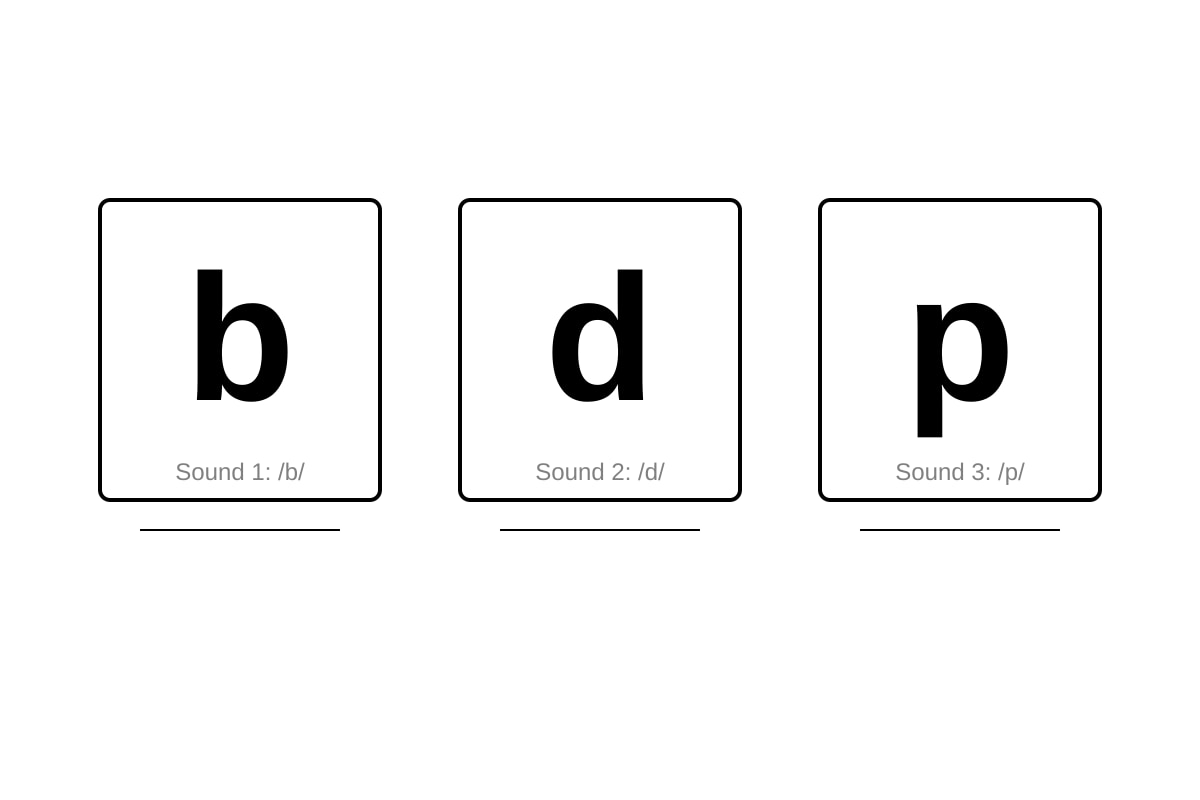
| Sound | /b/ | /d/ | /p/ |
|---|---|---|---|
| Letter | b | d | p |
Marking: 1 mark for any two correct; 2 marks for all three correct. Deduct 1 mark for each reversal error (b/d confusion) — this is a common P1 developmental pattern.
Teaching Note: These letters are visual mirror images. Key mnemonic: b has the "belly" on the right (think "b for belly"); d has the "diaper" or round part first when writing; p drops below the line. Say the sound aloud: /b/ is voiced (vibrating vocal cords), /p/ is unvoiced (quiet pop of air).
Question 3 (1 mark)
Answer: B) a
Marking: 1 mark for B.
Teaching Note: The short /æ/ sound is the "ah" sound in "apple," "ant," "ax." Not to be confused with the letter name /eɪ/ ("ay"). At P1, focus on the sound, not the letter name. The other options: e = /e/ (egg), i = /ɪ/ (igloo), o = /ɒ/ (octopus).
Question 4 (1 mark)
Answer: C) mop
Marking: 1 mark for C.
Teaching Note: /m/ is a nasal sound — air flows through the nose, lips pressed together. "Mop" begins /m/. The other options: net /n/, pen /p/, sun /s/. Students may confuse /m/ and /n/ — both are nasals, but /m/ uses both lips, /n/ uses tongue behind teeth.
Question 5 (2 marks)
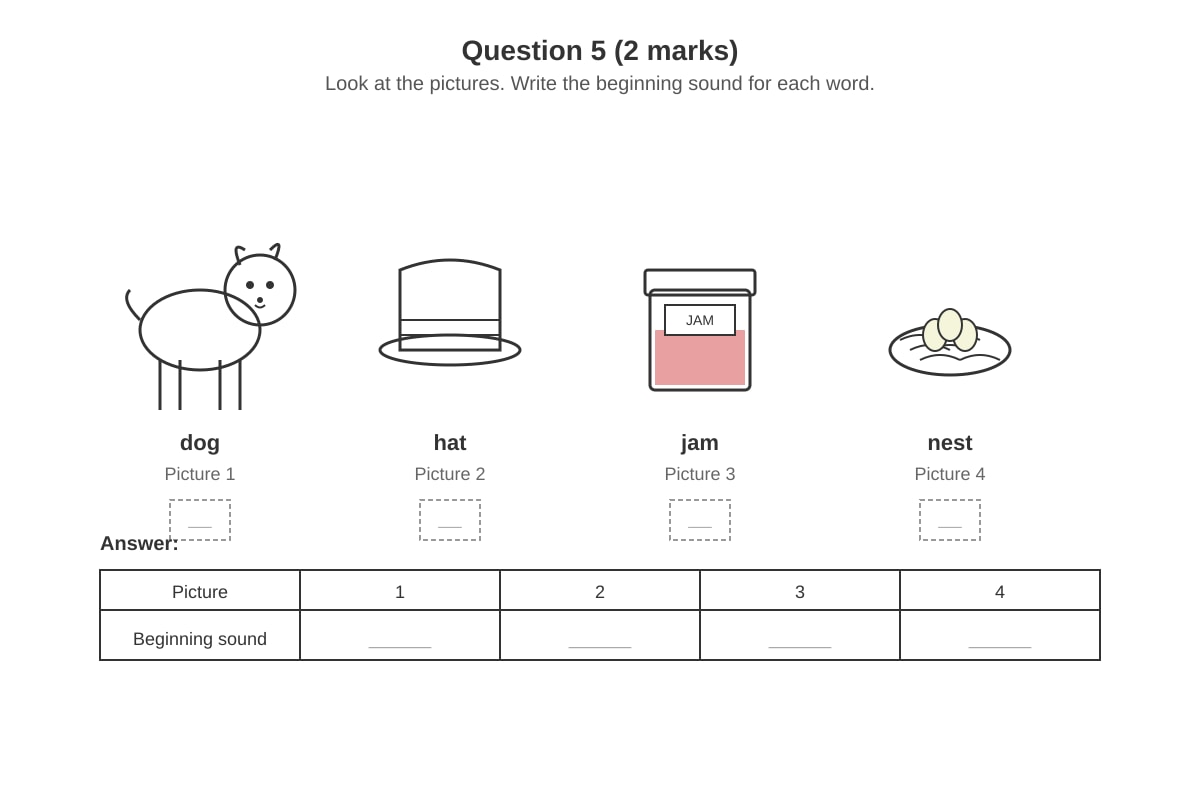
| Picture | 1 (dog) | 2 (hat) | 3 (jam) | 4 (nest) | |:---|:---|:---|:---| | Beginning sound | /d/ | /h/ | /dʒ/ | /n/ |
Marking: 0.5 mark each. Accept letter or phonetic symbol. Accept "j" for /dʒ/ as this is how P1 students typically learn it.
Teaching Note: Emphasize listening for the FIRST sound only. Common error: writing the whole word or last sound. For "jam," note that the written letter is 'j' but the sound is /dʒ/ — P1 students need not master the IPA symbol, but teachers should model the correct affricate sound (like a quick "d" + "zh").
Question 6 (1 mark)
Answer: A) /f/
Marking: 1 mark for A.
Teaching Note: "Fish" = /f/ + /ɪ/ + /ʃ/. The beginning sound is /f/ — a quiet, breathy sound with top teeth on bottom lip. Common confusion: some students hear "sh" at the end and select B. Reinforce: listen for the BEGINNING sound only.
Question 7 (1 mark)
Answer: Circle c and k (both make /k/)
Marking: 1 mark only if BOTH c and k are circled. 0 marks for any single letter or wrong pair.
Teaching Note: This tests the hard c/k correspondence — a key P1 phonics objective. The letter 'c' makes /k/ before a, o, u ("cat," "cot," "cut") and /s/ before e, i, y ("cent," "city"). The letter 'k' always makes /k/. Students should learn that "cat" and "kite" share a beginning sound despite different letters.
Question 8 (2 marks)
| Letter | Word | |
|---|---|---|
| r | ——→ | rabbit |
| v | ——→ | van |
| t | ——→ | tent |
| n | ——→ | net |
Marking: 0.5 mark each correct line. Must show clear one-to-one matching. Crossing lines acceptable if clear.
Teaching Note: This tests initial sound-letter correspondence with decoding practice. Students should sound out the beginning of each word: r-r-rabbit, v-v-van, etc. Common error: matching by visual similarity (r-van because both have a "v-like" shape) — remind students to use sound, not shape.
Section B: Blending and Word Building (14 marks)
Question 9 (2 marks)
Answer: at
Marking: 2 marks for correct word. 1 mark if letters are correct but reversed (ta) — note as common developmental error but give partial credit.
Teaching Note: Blending is the core P1 phonics skill: merging individual sounds smoothly. Model: /æ/ → slide to /t/ without a break: "aaaat," not "ah-tuh." The schwa (/ə/) on consonants is a common teaching error — avoid adding "uh" to consonant sounds.
Question 10 (2 marks)
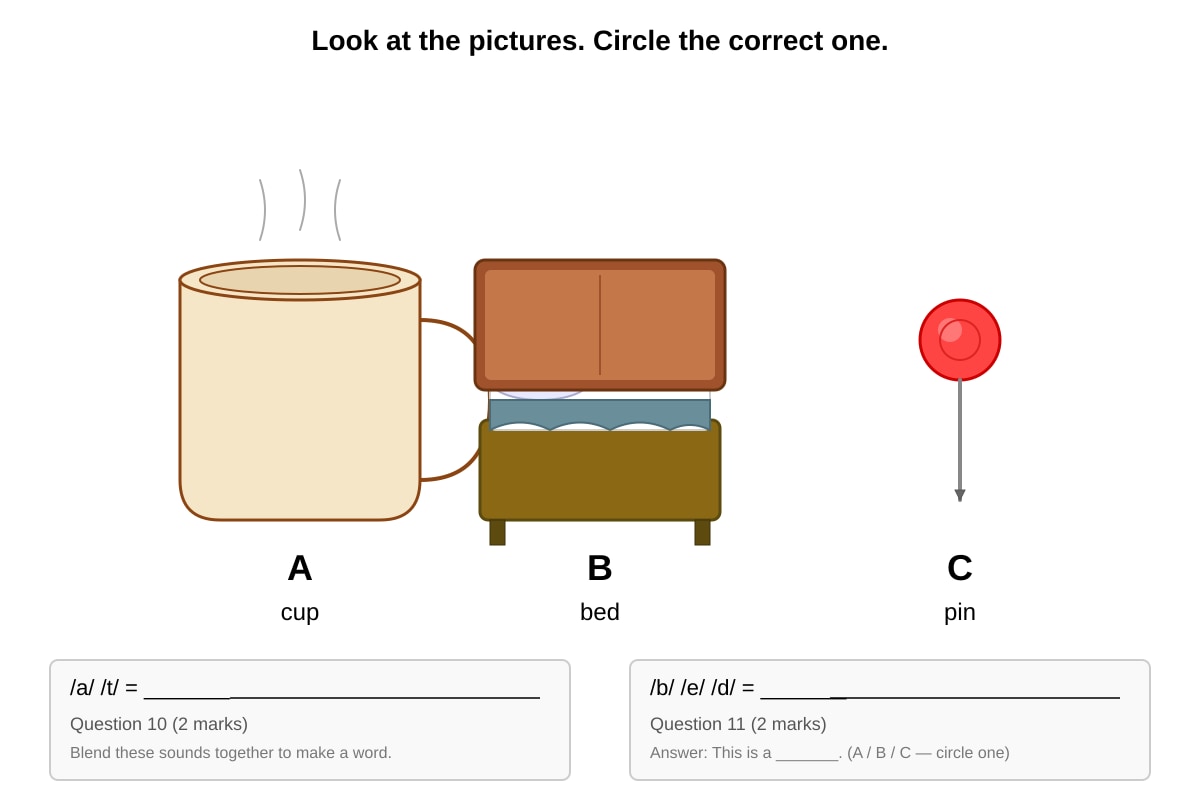
Answer: bed; Circle B (bed/picture of bed)
Marking: 1 mark for word; 1 mark for correct picture.
Teaching Note: Segmented sounds: /b/ + /e/ + /d/. Three phonemes, three letters — this is the CVC (consonant-vowel-consonant) pattern that forms the foundation of P1 reading. The medial vowel /e/ ("eh" as in "egg") is often confused with /æ/ ("ah").
Question 11 (2 marks)
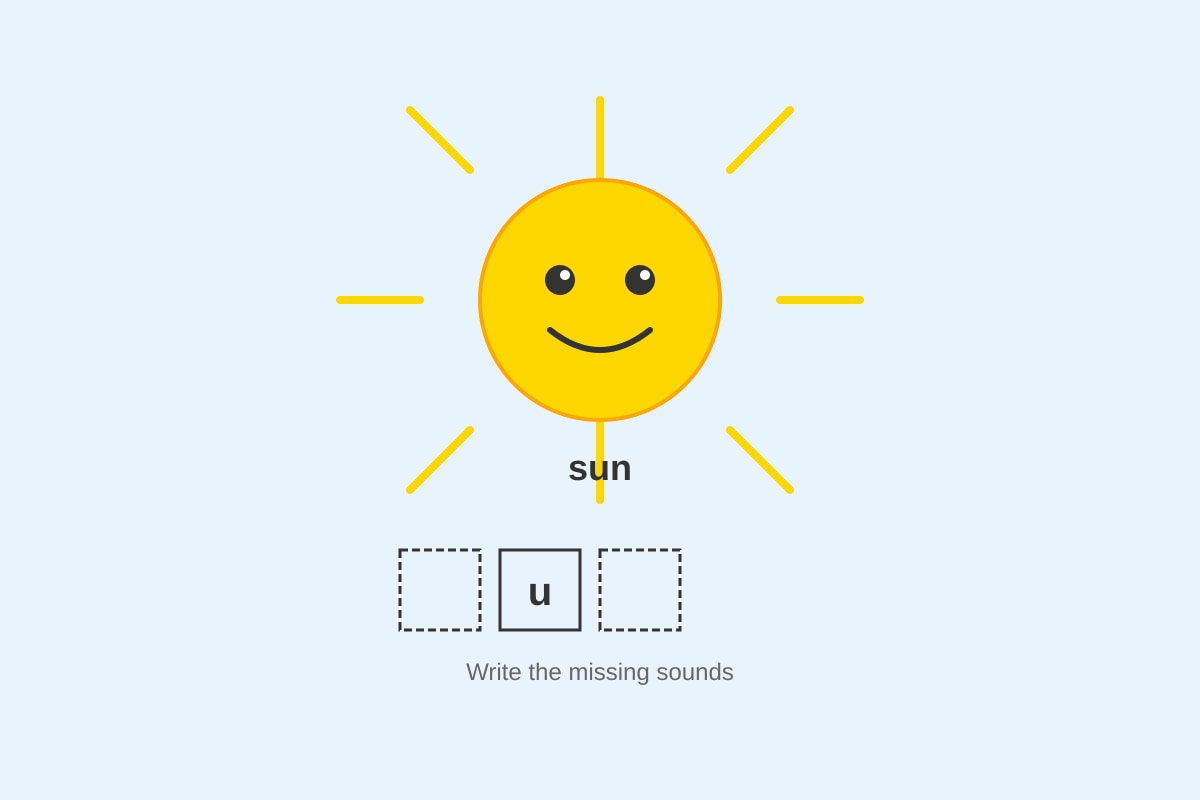
Answer: s /u/ n → sun
Marking: 1 mark for each correct consonant. Both required for full marks.
Teaching Note: The word "sun" has the same CVC structure but with a nasal /n/ at the end. Students may write 'c' instead of 's' due to similar shape. Remind: /s/ is the hissing sound; /k/ (as in "cat") is a stop sound. The vowel /ʌ/ is the short "u" sound — lips are relaxed, not rounded as in "oo."
Question 12 (3 marks)
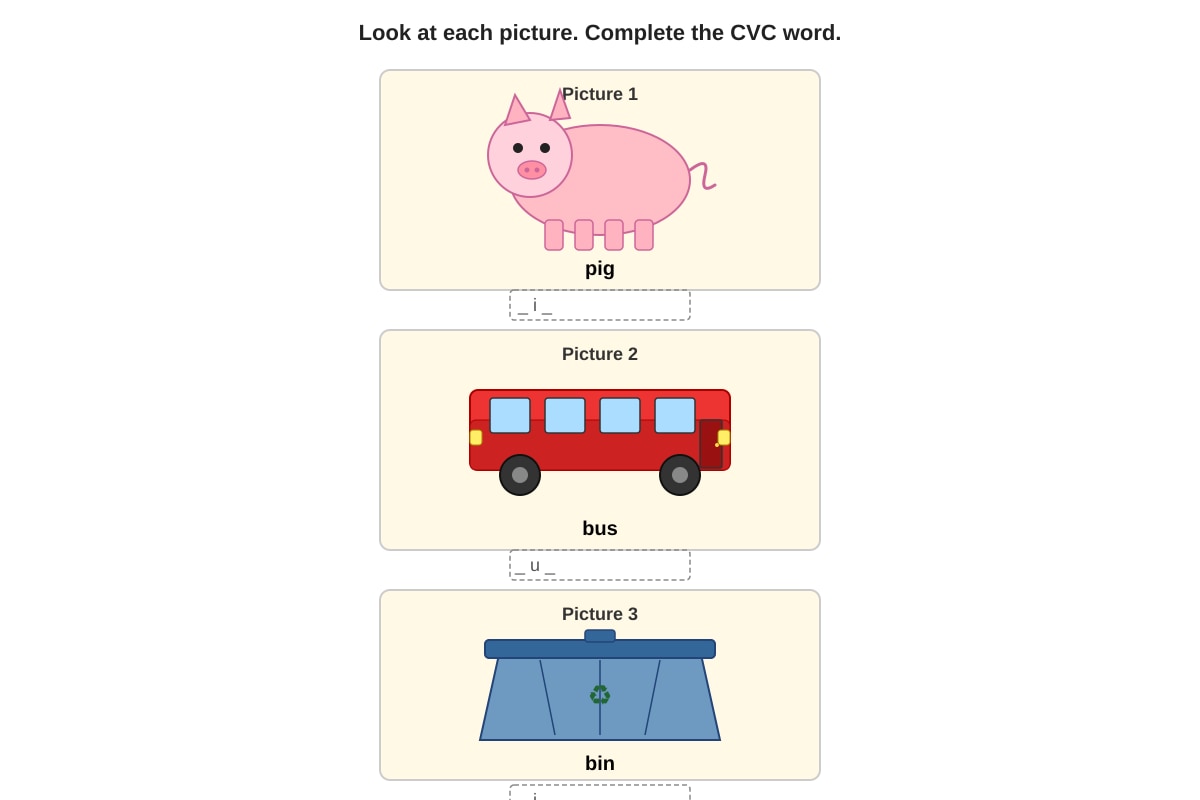
(a) p /i/ g → pig (1 mark)
(b) /b/ u /s/ → bus (1 mark)
(c) b /i/ /n/ → bin (1 mark)
Marking: 1 mark each. Letter reversals (d/b, p/q) — deduct 0.5 per error if intended letter is clear from context.
Teaching Note: All three are CVC words with short vowels. Note the pattern: all have different initial consonants but share the medial vowel + final consonant structure. For "bus," students may write 'o' for /ʌ/ due to regional accent influence — emphasize the "uh" sound is the same in "cup," "mud," "hut."
Question 13 (3 marks)
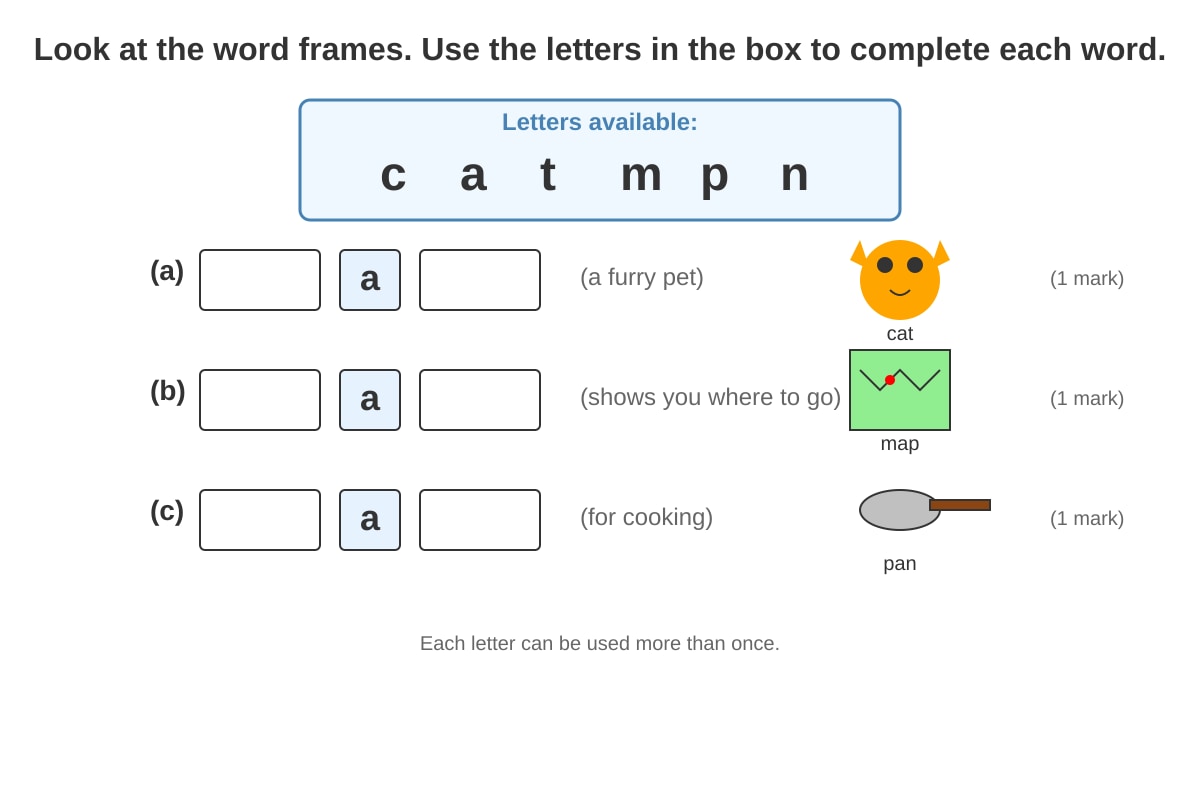
(a) c a t → cat (1 mark)
(b) m a p → map (1 mark)
(c) p a n → pan (1 mark)
Marking: 1 mark each. Must use correct letters from available set. Penalty: if student uses letter not in box, 0 marks for that item.
Teaching Note: This tests medial vowel /æ/ consistency — the "a" in all three words sounds the same. This is the short 'a' family: -at, -ap, -an. Students should begin to recognize word families/patterns. The definitions help confirm meaning: cat (furry pet), map (directions), pan (cooking). If students write "cap" for (b), accept if creative but note — "map" matches the definition best.
Question 14 (2 marks)
Number of sounds: 4
Sounds: /s/ / /t/ / /ɒ/ / /p/ (or /s/ /t/ /o/ /p/ using letter approximations)
Marking: 1 mark for correct number; 0.5 mark each for first two sounds correct, 0.5 mark for recognizing /ɒ/ or /oʊ/ (students may write 'o'). Accept letter representations at P1 level.
Teaching Note: "Stop" is a CCVC word — two consonants at the beginning. This stretches P1 students beyond simple CVC. The blend /st/ contains two distinct sounds: /s/ + /t/. Students often hear this as one "chunk" initially. Stretch the word: "ssss-ttt-aaa-ppp" to separate the sounds. The vowel is /ɒ/ (British English) or /ɑː/ in some Singapore accents.
Section C: Reading and Application (14 marks)
Question 15 (2 marks)
(a) 1 (or one) — The /p/ sound appears once at the beginning of "Pat." (1 mark)
(b) Circle cat (1 mark)
Marking: (a) Accept "1" or "one" or "once." (b) Must clearly circle "cat."
Teaching Note: (a) Distinguish letter 'p' appearing twice from sound /p/ appearing once. The capital 'P' and lowercase 'p' are the same letter but the sound /p/ is heard once. (b) Rhyme recognition: "cat" shares the /æt/ rime with "hat." Focus students on the ending sounds: -at, not just the beginning.
Question 16 (3 marks)
(a) run (1 mark)
(b) hop (1 mark)
(c) sit (1 mark)
Marking: 1 mark each. Context-appropriate word required.
Teaching Note: All words follow the CVC pattern with short vowels. This tests reading-for-meaning plus phonics. Students decode each option then match to context: dogs run fast (not hop on one leg); hopping is one-legged; sitting is on chairs. Common error: "mop" for (c) — mops are for floors, not chairs. Semantic cueing plus phonics decoding is the goal.
Question 17 (2 marks)
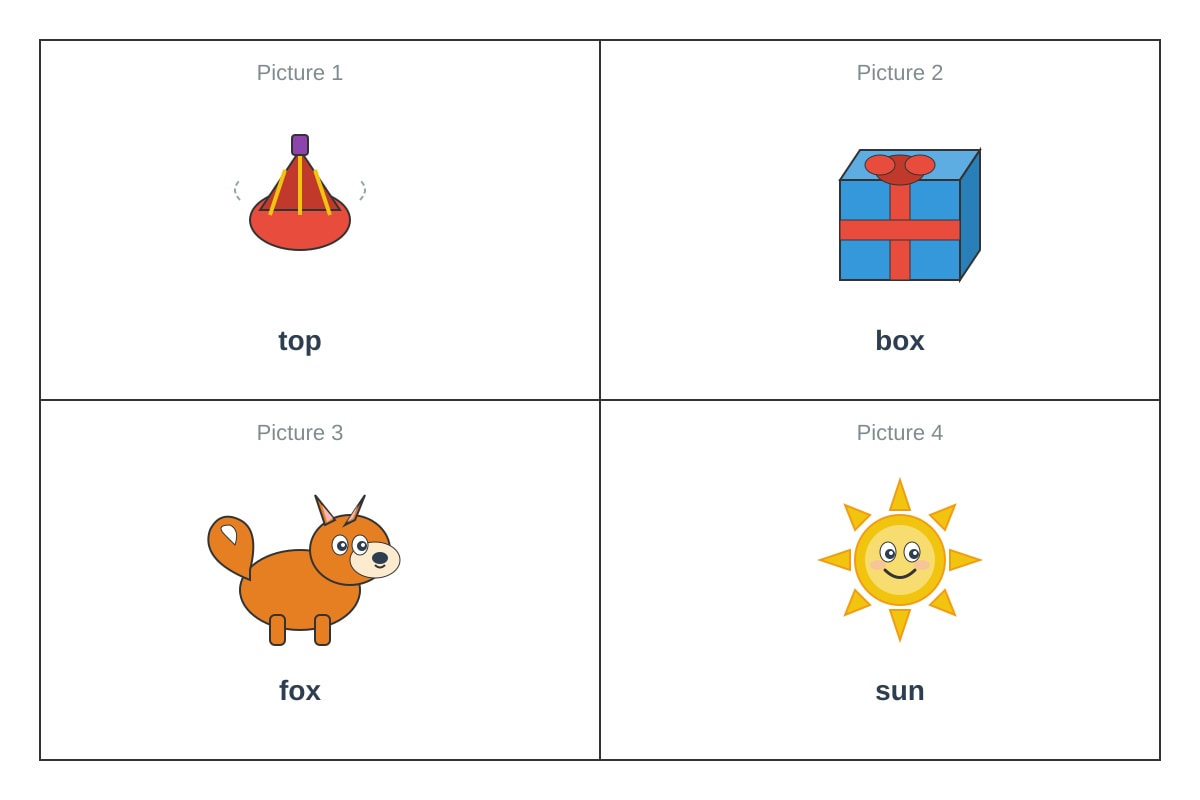
Circle: The sun (Picture 4)
Why? Because "sun" does not rhyme with the others / does not have the /ɒ/ sound / does not end in -op or -ox. (Accept any clear explanation: "sun has short u," "the others end in -op or -ox," "sun is in the sky, the others are objects.")
Marking: 1 mark for correct circling; 1 mark for explanation showing awareness of sound or meaning difference.
Teaching Note: Multiple valid answers. Sound-based: "top," "box," "fox" all contain /ɒ/; "sun" has /ʌ/. Pattern-based: three end with consonant clusters or specific rimes. Meaning-based: sun is natural/sky; others are household/toy items. Accept any reasonable justification — this tests flexible phonological awareness.
Question 18 (3 marks)
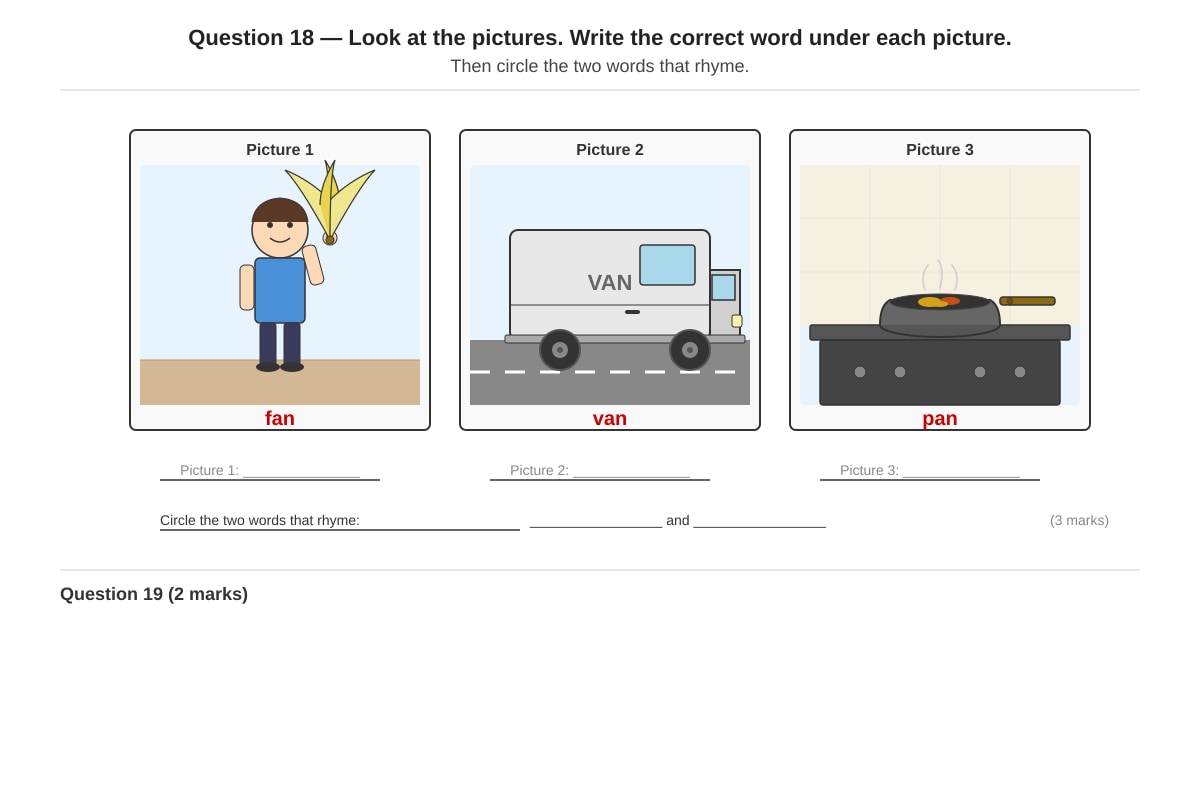
Picture 1: fan
Picture 2: van
Picture 3: pan
Circle: fan and pan (or any correct rhyming pair)
Marking: 1 mark each correct word; 1 mark for correct rhyming pair.
Teaching Note: This family is the /æn/ rime: fan, van, pan, can, man, tan. Note "fan" and "van" do NOT rhyme with each other — they share onset consonants but different vowels? No: /fæn/ and /væn/ and /pæn/ — all rhyme! All three rhyme together. Any pair is correct. Students may circle all three — accept. The -an family is one of the first word families taught in P1.
Question 19 (2 marks)
Corrected answer: I tick (✓) none / all are correct OR identify that this is a trick question where all five words begin with /p/.
Expected student insight: "Wait! All of them begin with /p/!" or "There is no mistake."
Acceptable answers:
- "I tick none because they all begin with /p/."
- "There is no wrong answer — all start with /p/."
- "The table is wrong to say one is different."
Marking: 2 marks for recognizing all words begin with /p/. 1 mark for correct identification but incomplete explanation. 0 marks for following the false premise without critical checking.
Teaching Note: This tests critical reading plus phonics. All five words (pen, pan, pig, pin, pet) begin with /p/. The table contains a deliberate error to encourage checking. Students who mindlessly follow instructions fail; those who sound out each word succeed. This builds "discerning reader" competency from the syllabus.
Question 20 (2 marks)
sit = 3 sounds (/s/ /ɪ/ /t/)
stop = 4 sounds (/s/ /t/ /ɒ/ /p/) — but table says 4 sounds; this is correct
dog = 3 sounds (/d/ /ɒ/ /ɡ/)
Correct match from table (if followed):
- sit → 3 sounds (table says 3 — but sit has 3, so this matches!)
- stop → 4 sounds (table says 4 — matches!)
- dog → 3 sounds (table says 2 — this is the mismatch!)
Wait — re-examining the table in the question: the arbitrary match shown is sit→2, stop→3, dog→4. Students must IGNORE this and write correct counts.
Correct answers independent of table labels:
sit = 3 sounds
stop = 4 sounds (or note: 3 if counting blend /st/ as one, but phonemic awareness requires 4)
dog = 3 sounds
Marking: 0.5 mark for each correct number; 0.5 mark for showing awareness that blends contain multiple sounds. Accept "3 or 4" for stop with explanation.
Teaching Note: This reveals a common instructional debate. Strict phonemic awareness: /s/ /t/ /ɒ/ /p/ = 4 phonemes. Practical early reading: /st/ may be taught as a blend unit. At P1, accept either if reasoned. "Dog" = /d/ /ɒ/ /ɡ/ = 3 clear sounds. The table's labels are intentionally scrambled to test independent analysis.
Marking Summary
| Section | Marks |
|---|---|
| Section A | 12 |
| Section B | 14 |
| Section C | 14 |
| Total | 40 |
Common Error Patterns to Note
| Error | Likely Cause | Intervention |
|---|---|---|
| b/d/p/q reversals | Visual-motor development | Multisensory practice: sky-writing, sand-tracing |
| Letter name vs. sound confusion | Overemphasis on ABC song | Isolate sounds: "The letter is B, the sound is /b/" |
| Adding schwa to consonants (/buh/ for /b/) | Teacher model | Exaggerate pure sounds, use mirrors |
| Hearing blends as one sound (/st/ = 1) | Normal developmental stage | Stretch words: "ssss-ttt-aaa-ppp" |
| Rhyme vs. onset confusion | Working memory load | Focus on ending sounds first, then whole word |
Answer Key Version 2 of 5. Generated for TuitionGoWhere syllabus-aligned practice.