AI Generated Exam Paper
Primary 1 English Practice Paper 1
Free P1 English Practice Paper 1, Kimi2.6 AI version, with questions, answers, and syllabus-aligned practice for Singapore students.
These static practice materials are generated from the site's syllabus and paper-generation workflow, with source and model context shown so students and parents can evaluate the material before use.
Questions


Free quiz and exam paper access
Enter your details to view this paper
Your access is remembered on this device.
Answers
TuitionGoWhere Practice Paper Answer Key - English Primary 1
TuitionGoWhere Practice Paper (AI) – Version 1 of 5
| Subject: | English |
| Level: | Primary 1 |
| Topic: | Phonics |
| Total Marks: | 40 |
Section A: Phonemic Awareness and Sound Recognition
Section Total: 16 marks
1. Answer: B) s
[1 mark]
Explanation: The letter 's' makes the /s/ sound, as in "sun," "sit," and "snake."
- Teaching note: The letter name is "ess," but the sound it makes is /s/. Many P1 students confuse letter names with letter sounds. Practice by saying "The snake goes /s/ /s/ /s/."
- Common error: Choosing 'c' (option C) — while 'c' can sometimes make a /s/ sound (as in "city"), at P1 level students should recognise /s/ primarily with the letter 's.'
2. Answer: A) /d/
[1 mark]
Explanation: The word "dog" begins with the /d/ sound.
- Break it down: /d/ – /o/ – /g/
- The first sound you hear when you say "dog" is /d/.
- Teaching note: Encourage students to say the word slowly, stretching out the first sound: "d-d-d-og." This helps them isolate the initial phoneme.
- Common error: Choosing /t/ (option D) — students may confuse /d/ and /t/ as both are made with the tongue behind the teeth. Explain that /d/ uses voice (vocal cords vibrate) while /t/ is quieter.
3. Answer: C) b
[1 mark]
Explanation: The letter 'b' makes the /b/ sound, as in "bat," "ball," and "baby."
- Teaching note: The letter 'b' and 'd' (option B) are commonly confused by P1 students because they look similar. Teach this mnemonic: "First the bat (b), then the ball" — the stick comes first in 'b.' For 'd,' "First the drum (d), then the drumstick" — the circle comes first.
- Common error: Choosing 'p' (option A) — both /b/ and /p/ are made with the lips, but /b/ uses voice while /p/ does not. You can feel your throat vibrate when saying /b/ but not /p/.
4. Answer: C) /sh/
[1 mark]
Explanation: The word "fish" ends with the /sh/ sound (spelled 'sh').
- Break it down: /f/ – /i/ – /sh/
- The final two letters 's' and 'h' together make one sound: /sh/.
- Teaching note: This is a digraph — two letters that make one sound. Other common digraphs at P1 include 'ch,' 'th,' and 'wh.' Explain that 's' and 'h' are "sound buddies" that work together.
- Common error: Choosing /s/ (option D) — students may try to sound out each letter separately. Emphasise that 'sh' is one team, one sound.
5. Answer: B) bat
[2 marks]
Explanation: "Bat" rhymes with "cat" because they share the same ending sound: /at/.
- Cat = /c/ – /at/
- Bat = /b/ – /at/
- Teaching note: Rhyming words have the same ending sounds from the vowel onwards. This is called the "rime." The beginning consonant (the "onset") changes. Practice with word families: -at, -an, -ad, -ap, -et, -en.
- Why other answers are wrong:
- "car" ends in /ar/ — different vowel sound
- "cut" ends in /ut/ — different vowel sound
- "cot" ends in /ot/ — different vowel sound
- [2 marks] — 1 mark for recognising the concept of rhyme, 1 mark for correct identification.
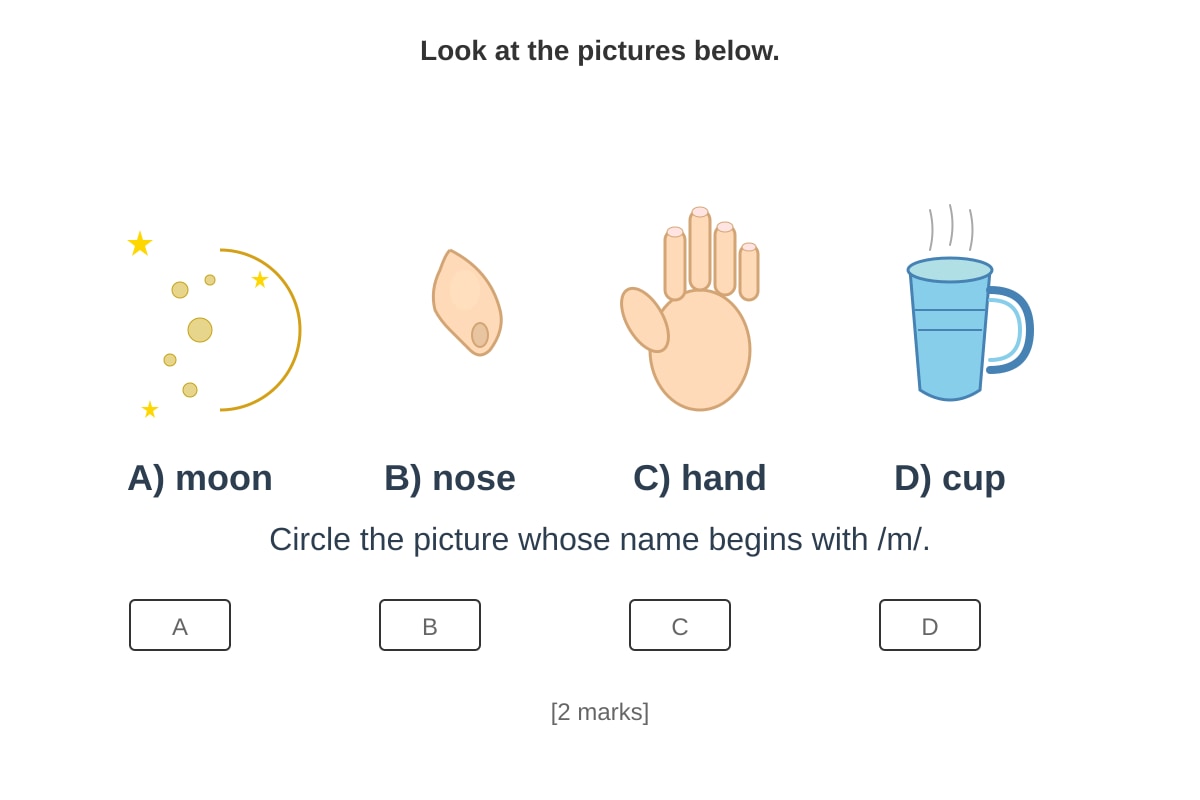
6. Answer: A) moon
[2 marks]
Image expected features for answer verification: The correct picture is the moon (option A), which begins with /m/.
- Moon = /m/ – /oo/ – /n/
- Teaching note: Students need to identify the picture AND know its initial sound. Some P1 students may know "moon" but think it begins with 'm' (letter name) rather than /m/ (sound). Reinforce: "The letter name is 'em,' but the sound is /m/."
- Why other answers are wrong:
- "nose" begins with /n/
- "hand" begins with /h/
- "cup" begins with /k/
- [2 marks] — 1 mark for correct picture identification, 1 mark for sound-letter connection.
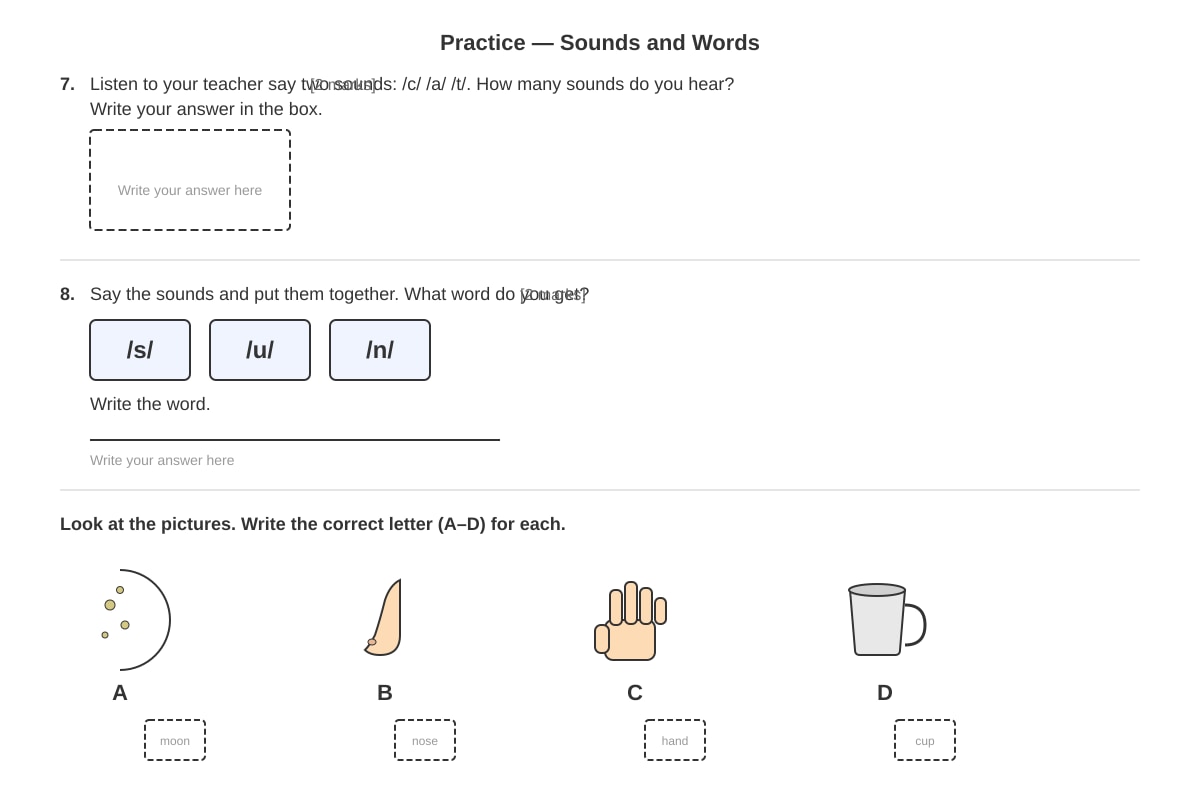
7. Answer: 3 (three)
[2 marks]
Image expected features: The student writes the number 3 or the word "three" in the provided box.
- The sounds are: /c/ – /a/ – /t/ (3 sounds)
- Teaching note: This tests phonemic segmentation — breaking a word into its individual sounds (phonemes). This is a crucial early reading skill.
- Counting method: Hold up one finger for each sound: /c/ (1), /a/ (2), /t/ (3).
- Common error: Counting letters instead of sounds, or including the word "cat" as a fourth item. Remind students: "We count the sounds we HEAR, not the letters we see."
- [2 marks] — 2 marks for correct answer; 1 mark if student counts 2 or 4 (shows segmentation attempt but miscounted).
8. Answer: sun
[2 marks]
Explanation: /s/ – /u/ – /n/ = sun
- Step-by-step blending:
- Say the first sound: /s/
- Add the second sound: /su/
- Add the third sound: /sun/
- Teaching note: This is phonemic blending — putting sounds together to make a word. Some students blend gradually: /s/ → /su/ → /sun/. Others need to say all sounds quickly before the word "pops out." Both methods are valid at P1.
- Common error: Writing "son" — students may know the word but use wrong phonics mapping. Clarify that /u/ in "sun" makes the /u/ sound (as in "up"), not the name 'u.'
- [2 marks] — 2 marks for correct spelling; 1 mark for phonetically plausible alternative (e.g., "son," "sunn").
Section B: Phonics – Blending and Segmenting
Section Total: 12 marks
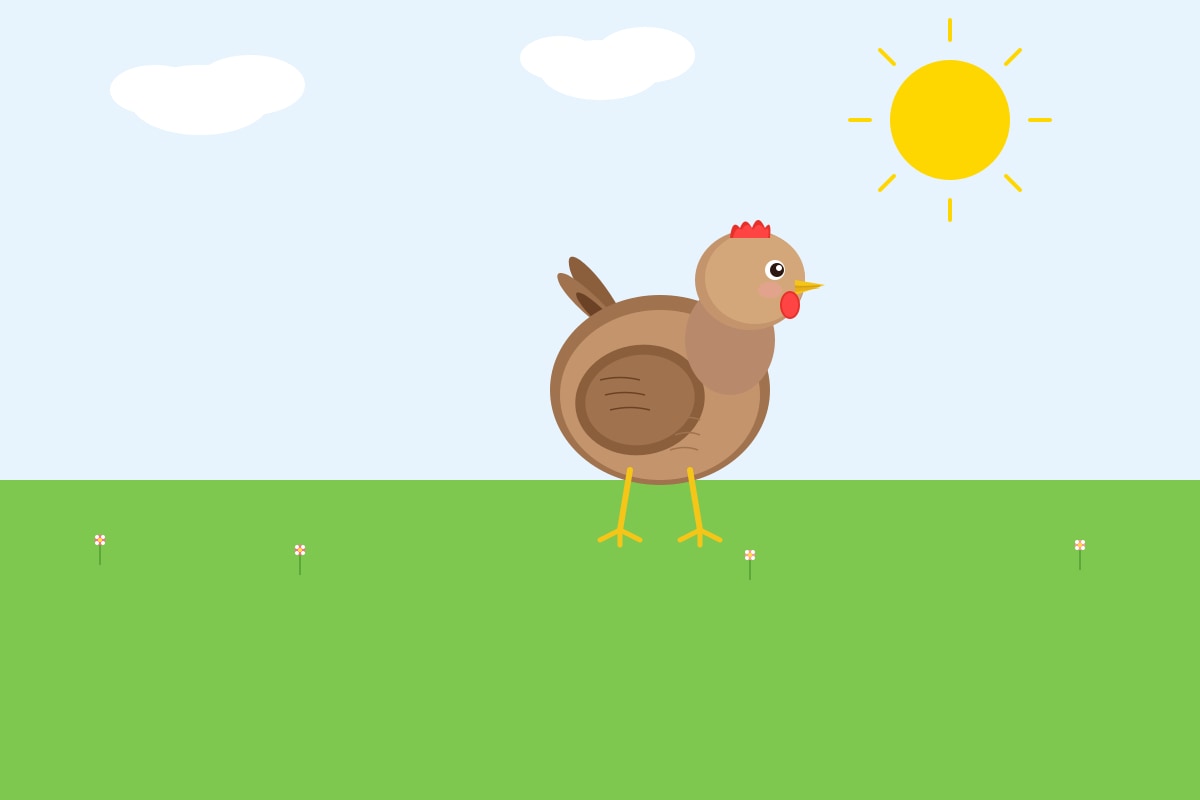
9. Answer: h – e – n (hen)
[2 marks]
Image expected features: A hen (female chicken). Word structure to complete: _ e _
- Step-by-step solution:
- Identify the picture: hen
- Say the sounds: /h/ – /e/ – /n/
- The middle sound is /e/, already given
- Write 'h' at the beginning and 'n' at the end
- Teaching note: This is a CVC (consonant-vowel-consonant) word pattern. The middle letter 'e' makes its short sound /e/ (as in "bed," "red," "pen"). Students need to recognise that some vowels in words are "short" and some are "long" (say their name).
- Common error: Writing 'c' instead of 'h' ("cen" — not a word). Remind students to check: "Does it look right? Does it sound right? Does it make sense?"
- [2 marks] — 1 mark for each correct letter (h and n).
10. Answer: b – u – s (bus)
[2 marks]
Image expected features: A yellow school bus. Word structure to complete: _ u _
- Step-by-step solution:
- Identify the picture: bus
- Say the sounds: /b/ – /u/ – /s/
- The middle sound is /u/, already given
- Write 'b' at the beginning and 's' at the end
- Teaching note: The short /u/ sound is in "bus," "cup," "sun," and "run." Many P1 students find /u/ harder to distinguish from /o/. Practice with minimal pairs: bus/boss, cup/cop.
- Common error: Writing 'p' instead of 'b' ("pus" — not a common word). The /b/ and /p/ confusion is common; /b/ uses voice (feel throat vibrate).
- [2 marks] — 1 mark for each correct letter (b and s).
11. Answer:
- t – a – p → tap
- p – e – n → pen
- h – a – t → hat
[2 marks]
Marking scheme:
-
Each correct match: 0.5 marks (3 matches = 1.5, rounded to 2 marks for all correct)
-
Alternative: 1 mark for first two correct, 1 mark for third correct (total 2 marks)
-
Teaching note: This tests both blending skills (putting scrambled letters together) and word-meaning recognition. Students must:
- Blend the scrambled letters to form candidate words
- Match to meaningful words in the right column
- Verify all matches make sense (no duplicates)
-
Strategy: Start with the easiest — "h-a-t" clearly makes "hat." Then "p-e-n" makes "pen." By elimination, "t-a-p" matches "tap."
-
Common error: Matching "t-a-p" to "pen" because first letter 't' is ignored. Teach students to blend ALL letters, not just look at first and last.
12. Answer: gift / present
[2 marks]
Image expected features: A gift box with ribbon — a present.
- Acceptable answers: "gift" or "present" (both are correct; "gift" is the simpler phonics match)
- Teaching note for "gift":
- Sounds: /g/ – /i/ – /f/ – /t/
- This is a CCVC word (consonant-consonant-vowel-consonant), slightly more complex than CVC
- The 'ft' ending blend is a common P1 pattern
- Teaching note for "present":
- More complex word; acceptable if student knows it
- Not expected as written answer unless student is more advanced
- Phonics focus: If student writes "gift," check: /g/ (hard g as in goat), /i/ (short i as in "sit"), /f/ (as in "fish"), /t/ (as in "tap")
- [2 marks] — 2 marks for correct word spelling; 1 mark for phonetically plausible attempt ("gif," "gft"); 0 for unrelated word.
13. Answer: rug
[2 marks]
Step-by-step solution:
- Say each letter sound: /r/ – /u/ – /g/
- Blend gradually: /ru/ → /rug/
- Write the word: r – u – g
- Teaching note: This tests pure blending without picture support — a harder skill. Students must trust their phonics knowledge and create a real word.
- Vocabulary check: "Rug" is a small carpet. Ensure P1 students know this word; if unfamiliar, describe as "something soft on the floor."
- Common error: Writing "rag" — confusing /u/ and /a/ sounds. Practice minimal pairs: rug/rag, mug/mag, hug/hag.
- [2 marks] — 2 marks for correct spelling; 1 mark for phonetically plausible alternative that shows blending attempt ("rugg," "ruhg").
14. Answer: sock
[2 marks]
Step-by-step solution:
- Read the clue: "something you wear on your feet"
- Try blending the letters in order: /s/ – /o/ – /c/ – /k/ = sock
- Verify: socks go on feet ✓
-
Teaching note: This combines phonics blending with vocabulary context — a higher-order skill. The clue provides semantic support. Other possible arrangements:
- s-o-c-k = sock ✓
- s-o-k-c = "sokc" ✗ (not a word)
- c-o-s-k, k-o-c-s, etc. = no real words
-
Common error: Writing "shock" — adding an 'h' that isn't there. Remind students to use ONLY the given letters.
-
[2 marks] — 2 marks for correct answer with plausible reasoning; 1 mark for correct word without using clue context; 0 for non-word arrangements.
Section C: Phonics in Context – Reading and Application
Section Total: 12 marks
15. Answer: cat
[2 marks]
Complete sentence: The cat sits on the mat.
-
Step-by-step solution:
- Read the sentence context: "The ______ sits on the mat."
- Consider each option:
- "cat" = an animal that sits ✓
- "dog" = an animal that sits, but let's check more...
- "car" = does not sit ✗
- Try "cat" in the sentence: makes sense grammatically and semantically
- Bonus: "cat" and "mat" rhyme — common in early reading texts
-
Teaching note: This tests reading for meaning using phonics. Students should:
- Decode each option using phonics
- Use context clues ("sits," "mat" — an animal, not an object)
- Check if the sentence makes sense
-
[2 marks] — 2 marks for correct answer; 1 mark if student chooses "dog" (plausible but less common collocation with "sits on the mat" in traditional rhymes).
16. Answer: pen and hen
[2 marks]
Explanation: "Pen" and "hen" share the same middle sound /e/.
-
Break down all words:
- pen = /p/ – /e/ – /n/
- pin = /p/ – /i/ – /n/
- hen = /h/ – /e/ – /n/
- pan = /p/ – /a/ – /n/
- hat = /h/ – /a/ – /t/
-
Middle sounds: /e/, /i/, /e/, /a/, /a/
-
Teaching note: Students must identify the vowel sound in the middle. This is harder than initial sound identification because medial sounds are less salient (prominent). Strategy: say each word and listen for the "singing" part — the vowel.
-
Common error: Choosing "pen and pin" — same beginning and ending, different middle. Students focus on shape similarity rather than sound.
-
[2 marks] — 2 marks for both correct; 1 mark for one correct; 0 for incorrect pair.
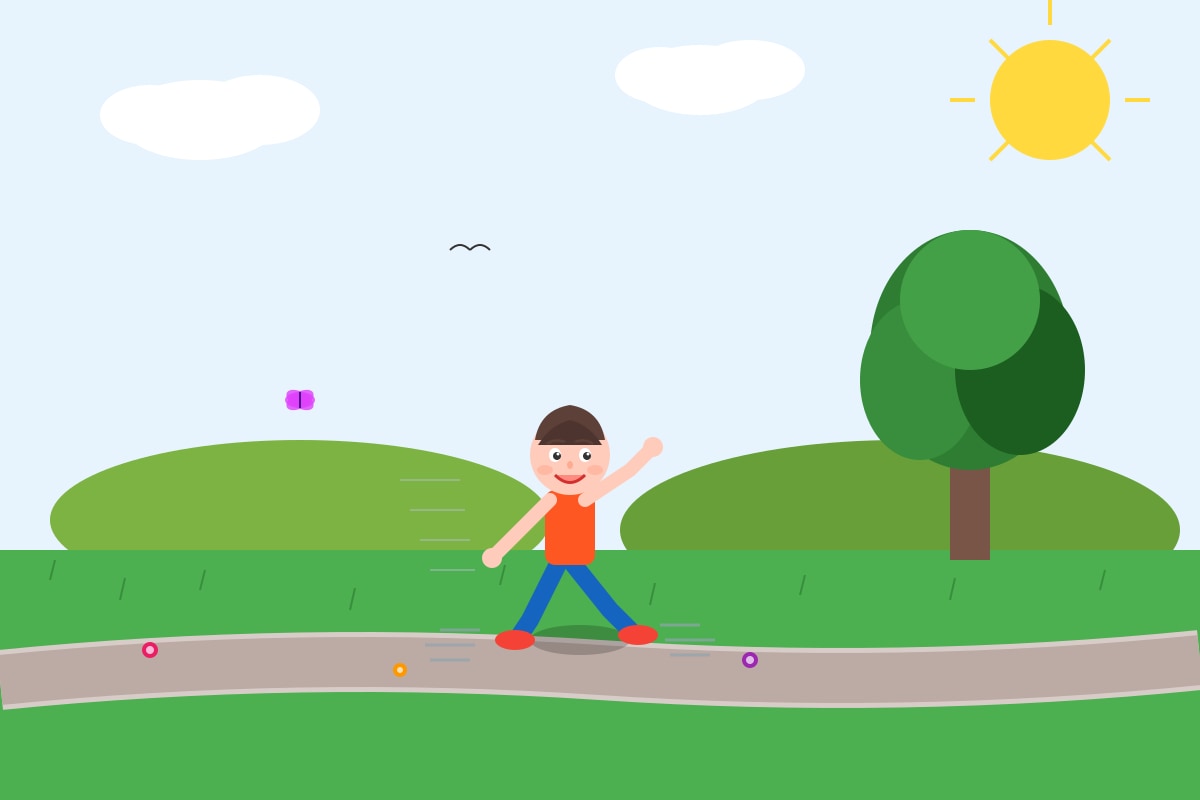
17. Answer: Any sentence containing "run" that describes the picture acceptably, e.g.:
- "The boy can run."
- "He likes to run."
- "I can run fast like him."
[2 marks]
Image expected features: A boy running in a park.
-
Marking descriptors:
- 2 marks: Complete, grammatically acceptable sentence using "run" correctly; relates to picture
- 1 mark: Attempt at sentence with "run" but incomplete or grammatically flawed; OR sentence without "run" but describes picture accurately
- 0 marks: Unrelated or blank
-
Teaching note: This is the most open-ended question, testing application of phonics to writing. The word "run" uses known phonics: /r/ – /u/ – /n/. Students must:
- Recall how to spell "run" from sound knowledge
- Construct a simple sentence (SVO or SV pattern)
- Connect to visual stimulus
-
Common errors:
- "The boy is run" — confusion of verb forms. Guide: "run" is the action word; "running" needs "is."
- "The boy is runing" — invented spelling acceptable at early P1 but teach correct form.
-
Sample acceptable answers with issues:
- "run" — just the word (1 mark, shows phonics knowledge but not sentence construction)
- "I run" — fragment, not full sentence (1 mark)
18. Answer: The word "fish" should be underlined (or "dish" if students interpret the space between words differently — accept either with explanation).
[2 marks]
Explanation: The /sh/ sound appears in "fish" (/f/ – /i/ – /sh/) and "dish" (/d/ – /i/ – /sh/).
-
Teaching note: The instruction asks for "the word" (singular), but there are two correct answers. This tests:
- Recognition of the digraph 'sh' = /sh/
- Ability to scan a sentence for target sounds
- Understanding that 'sh' can appear at the end of words too
-
Clarification for marking: Accept either "fish" or "dish" if student underlines one; bonus praise if both identified. The question as stated has one answer expected — "fish" comes first in left-to-right reading.
-
Common error: Underlining "the" or "in" — students look for any word rather than listening for the sound. Teach: "Touch each word, say it slowly, listen for /sh/."
-
[2 marks] — 2 marks for correct identification; 1 mark for underlining "dish" or showing /sh/ awareness but wrong word; 0 for no /sh/ sound identified.
19. Answer: /s/
[2 marks]
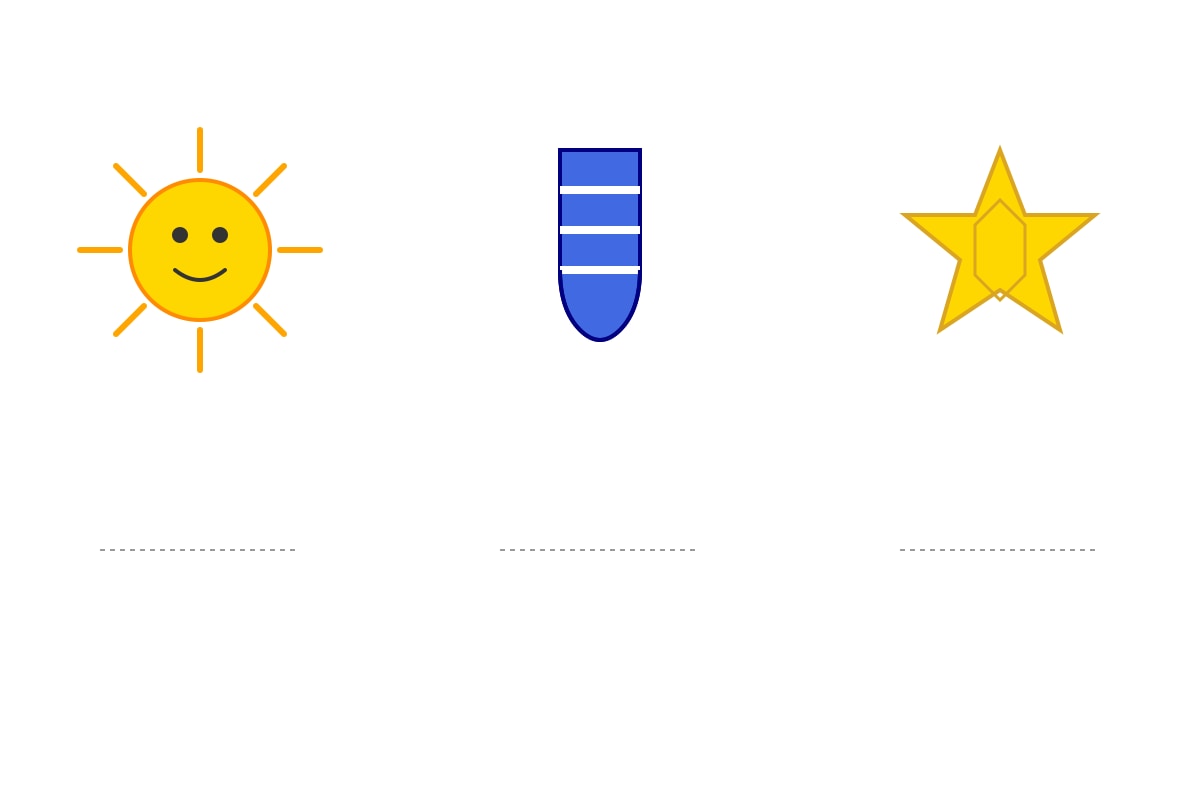
Image expected features: Sun, sock, and star — all beginning with /s/.
-
Step-by-step identification:
- Picture 1: sun = /s/ – /u/ – /n/
- Picture 2: sock = /s/ – /o/ – /k/
- Picture 3: star = /s/ – /t/ – /ar/
- Common beginning sound: /s/
-
Teaching note: This tests common initial sound across different words — a phonemic awareness skill that supports alliteration recognition and alphabet organisation. Students should:
- Name each picture confidently
- Isolate the first sound of each
- Identify the shared sound
-
Extension: These words all begin with the letter 's' — but note that "star" has 'st' blend, and "sun" has 's' alone. The common phoneme is /s/.
-
Common error: Writing "sun" instead of /s/ — the question asks for the sound, not a word. Or writing "s" (letter name) instead of /s/ (sound symbol).
-
[2 marks] — 2 marks for /s/ or 's'; 1 mark for identifying concept but wrong notation; 0 for unrelated answer.
20. Answer:
- dog
- run
- mat
[2 marks]
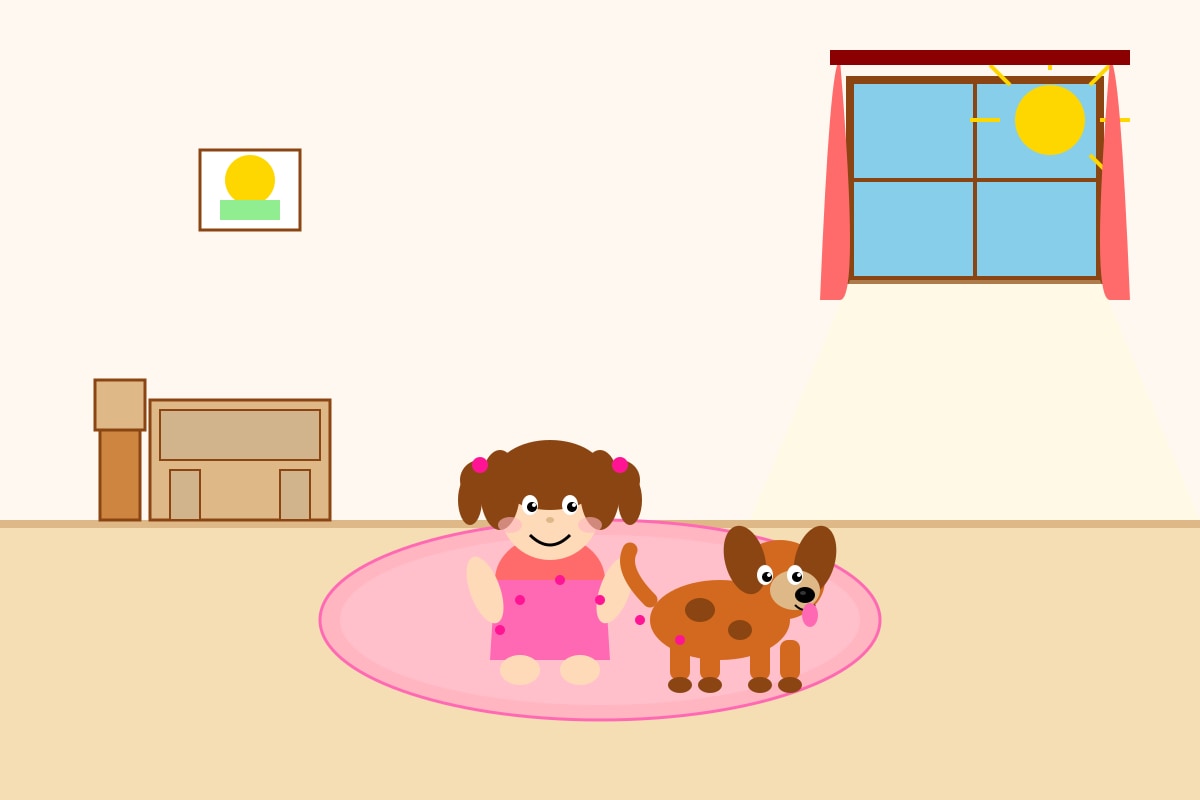
Complete story: Pam has a pet. It is a dog. The pet can run. Pam and her pet sit on the mat.
Image expected features: Girl with pet dog, sitting on a mat.
-
Step-by-step solution:
- Read context: "Pam has a pet" → needs an animal → choose "dog" from box
- "The pet can ______" → needs an action verb → "run" fits (dogs run; "mat" doesn't work)
- "Pam and her pet sit on the ______" → needs a place/noun → "mat" fits
-
Teaching note: This cloze procedure tests:
- Phonics decoding (reading the word options)
- Grammatical awareness (noun vs. verb slots)
- Semantic coherence (what makes sense in a story)
- Picture support (confirming the scene)
-
Story coherence check: The completed text reads as a mini-narrative with logical flow. This is early comprehension integrated with phonics.
-
Common error: "The pet can mat" — choosing by position without reading for meaning. Teach students to re-read their completed sentence to check it makes sense.
-
[2 marks] — 1 mark for first two correct; 1 mark for third correct; OR 2 marks for all correct. Deduct 0.5 per error if partial credit system used.
Total Marks Summary
| Section | Marks |
|---|---|
| Section A (Q1-8) | 16 |
| Section B (Q9-14) | 12 |
| Section C (Q15-20) | 12 |
| TOTAL | 40 |
Note to teachers/parents: This answer key includes teaching notes and common errors to support intervention. For students who score below 24/40 (60%), focus on phonemic segmentation and blending skills before moving to context application. For students scoring 32+/40, introduce CCVC words and consonant blends.
This practice paper is syllabus-aligned for Singapore Primary 1 English (Phonics focus) but is not derived from official past-year examination materials.