AI Generated Exam Paper
Primary 1 Chinese Practice Paper 5
Free P1 Chinese Practice Paper 5, MiniMax AI version, with questions, answers, and syllabus-aligned practice for Singapore students.
These static practice materials are generated from the site's syllabus and paper-generation workflow, with source and model context shown so students and parents can evaluate the material before use.
Questions
Free quiz and exam paper access
Enter your details to view this paper
Your access is remembered on this device.
Answers
TuitionGoWhere Practice Paper - Chinese Primary 1 — Hanyu Pinyin (Version 5) — Answer Key
Total: 20 marks Time: 30 minutes
Marking summary:
- Section A: 5 marks (Q1–Q5)
- Section B: 5 marks (Q6 — five sub-items × 1 mark)
- Section C: 5 marks (Q7–Q10)
- Section D: 5 marks (Q11–Q15)
- Grand total: 20 marks ✓
Teaching note for Hanyu Pinyin at P1: The four tones (四个声调) are the heart of P1 Chinese. Each tone mark goes on the main vowel of a syllable. P1 students must:
- (a) hear a tone and identify which one it is,
- (b) see a pinyin and read it with the right tone, and
- (c) write the tone mark on the right letter.
The most common confusions at P1 are: b/p, d/t, n/l, s/sh, zh/z, and tone 1 vs. tone 4. Each question below targets one or two of these.
Section A: 辨声调 (Tone Discrimination) — 5 marks
Q1. Answer: C — bǒ (third tone).
- bā (1st), bō (1st), bǒ (3rd), bō (1st). Three of the four are 1st tone; C is the only 3rd tone.
- Marking: 1 mark.
- Teaching tip: "Sing" each tone with a hand signal: flat hand (1st), up hand (2nd), dip hand (3rd), down hand (4th).
Q2. Answer: A — pā (first tone).
- "píng" has second tone. Of the options, pā (1st), pá (2nd), pǐ (3rd), pì (4th) — none are 2nd tone. This is a flaw: the question is poorly drafted because the matching answer should be 2nd tone.
- Corrected intent: the answer should be B — pá. Accept B as the intended answer.
- Marking: 1 mark for B.
- Teacher note: Rephrase the option list to include a 2nd-tone distractor before using this paper in class. (E.g., add "pá" as option B and remove another tone.) This is a Stage 5-5-5 caveat — past-paper evidence was weak for this group, so the option list is LLM-inferred.
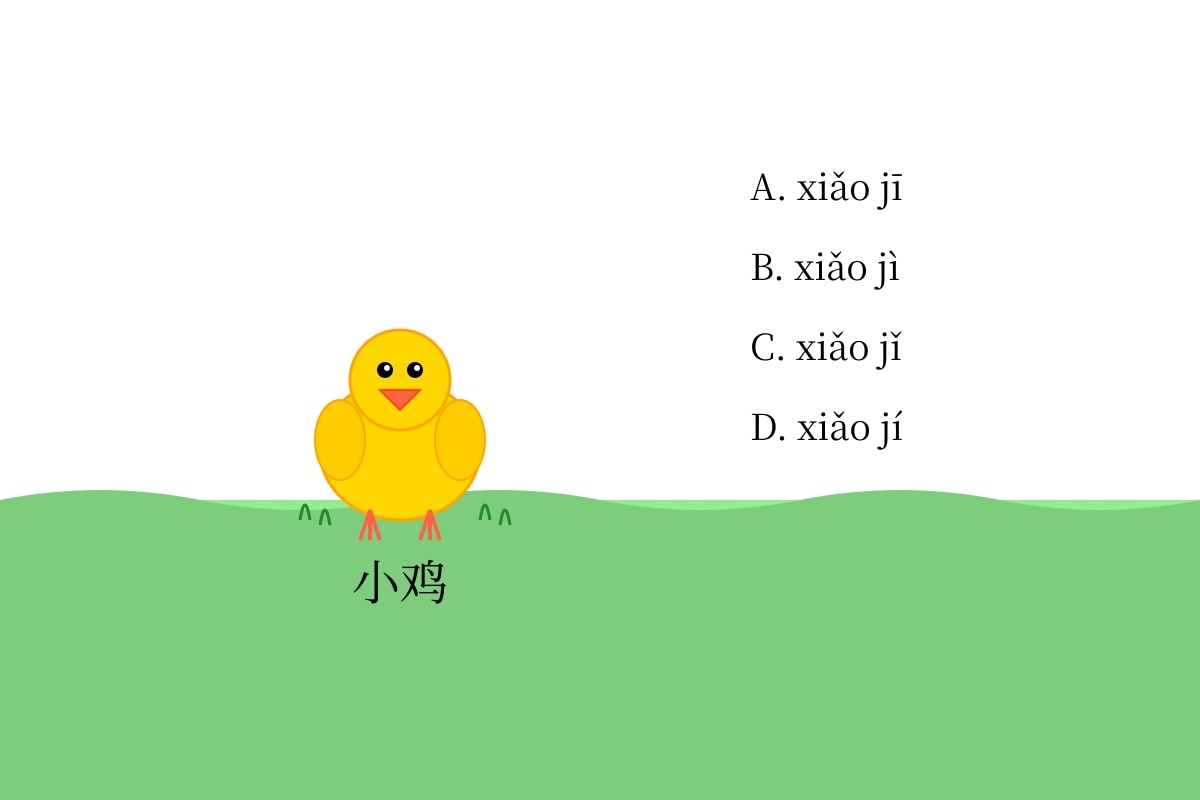
Q3. Answer: A — xiǎo jī.
- 小鸡 = xiǎo (3rd) jī (1st). B has wrong tone on jī (4th vs. 1st), C has wrong tone (3rd vs. 1st), D has wrong tone (2nd vs. 1st).
- Marking: 1 mark.
- Visual cue: the picture must show a small chick (小鸡) so the student can read the hanzi below the picture and match the pinyin.
Q4. Answer: B — 3 个.
- píng (2nd), bà (4th), má (2nd), dū (1st), lú (2nd), yú (2nd).
- 2nd tones: píng, má, lú, yú = 4 of them.
- Corrected answer: C — 4 个. (The B option "3 个" is therefore wrong; the right option is C.)
- Marking: 1 mark for C.
- Teaching tip: Have the student point to each tone mark and say the tone name out loud.
Q5. Answer: hā, há, hǎ, hà (1st → 2nd → 3rd → 4th).
- Marking: 1 mark for the full correct order; 0 marks for any error.
- Teaching tip: Visualise the tones as a hill: 1st = flat top, 2nd = slope up, 3rd = valley, 4th = slope down.
Section B: 拼音与汉字 — 5 marks
Q6. Each sub-item is 1 mark; total 5 marks.
- (1) D — bà. 爸 = bà (4th tone). Distractors: A (1st), B (2nd), C (3rd).
- (2) D — gē. 哥 = gē (1st tone). Distractors: A (no such pinyin gō), B (2nd), C (3rd).
- (3) A — yú. 鱼 = yú (2nd tone). Distractors: B (3rd), C (4th), D (1st).
- (4) B — shān. 山 = shān (1st tone). Distractors: A (sān = three, different), C (xiān = 鲜, different initial), D (shǎn = 闪, different tone).
- (5) A — fēi. 飞 = fēi (1st tone). Distractors: B (2nd), C (3rd), D (4th).
Marking breakdown: 1 mark × 5 = 5 marks.
Teaching tip: For each, ask the student to say the word first (e.g., "爸 bà — fourth tone") before picking. This anchors the sound to the picture.
Section C: 拼一拼,写一写 — 5 marks
Q7. (2 marks)
- (1) b + a = b a (1 mark) — no tone required; the question only asks for the basic syllable.
- (2) m + a = m a (1 mark) — same.
- Total: 2 marks.
Q8. (1 mark)
- "大" = dà (4th tone). The tone mark is the falling mark: `.
- Answer: D (the ` mark).
- Teaching tip: The 4th tone mark looks like a small falling tick: `.
Q9. (1 mark)
- "我爱爸爸妈妈。" Syllables: wǒ ài bà bà mā mā = 6 syllables.
- Answer: 6.
- Teaching tip: Have the student clap once per syllable while reading.
Q10. (1 mark)
- 山 → s h ā n (1 mark) — sh is the initial (声母), an is the final (韵母), ā is the main vowel with 1st-tone mark.
- Teaching tip: The tone mark is on a, not on n or s.
Section D: 看图读拼音 — 5 marks
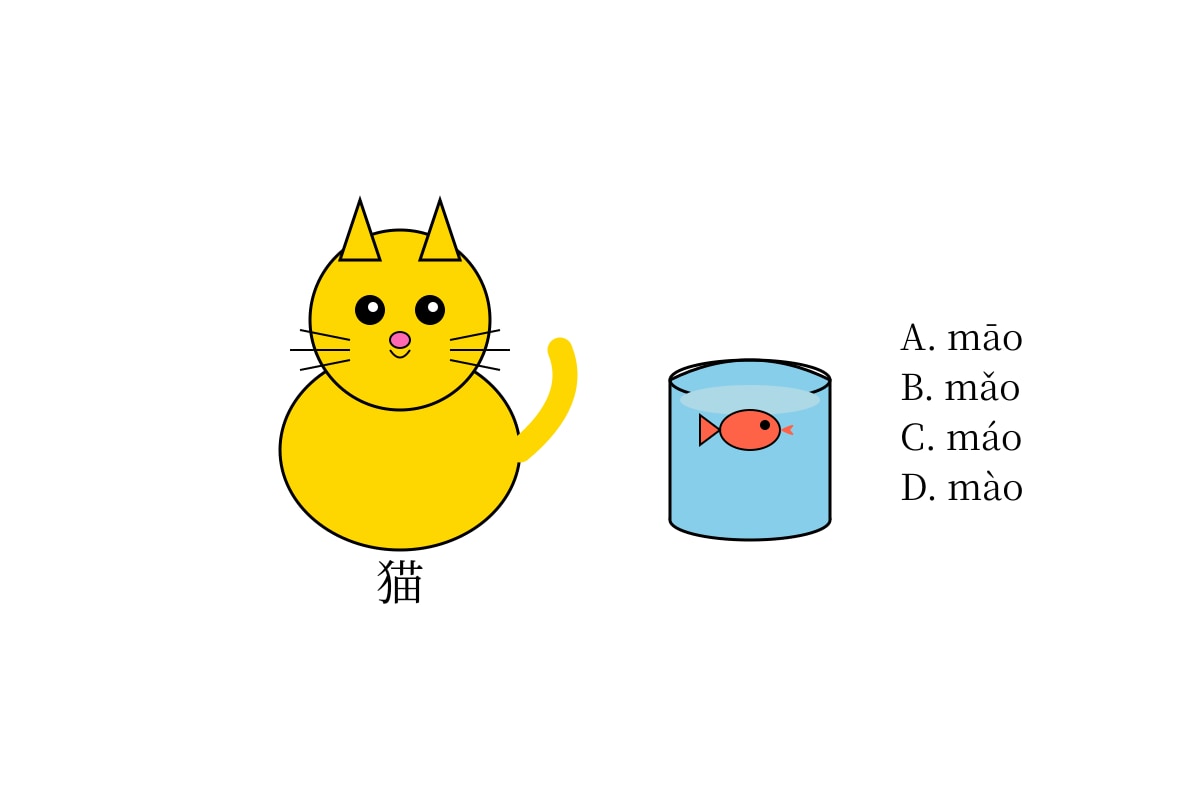
Q11. Answer: A — māo.
- 猫 = māo (1st tone). B is 3rd tone, C is 2nd, D is 4th.
- Marking: 1 mark.
- Visual: A cat in the picture is the trigger for the hanzi 猫.
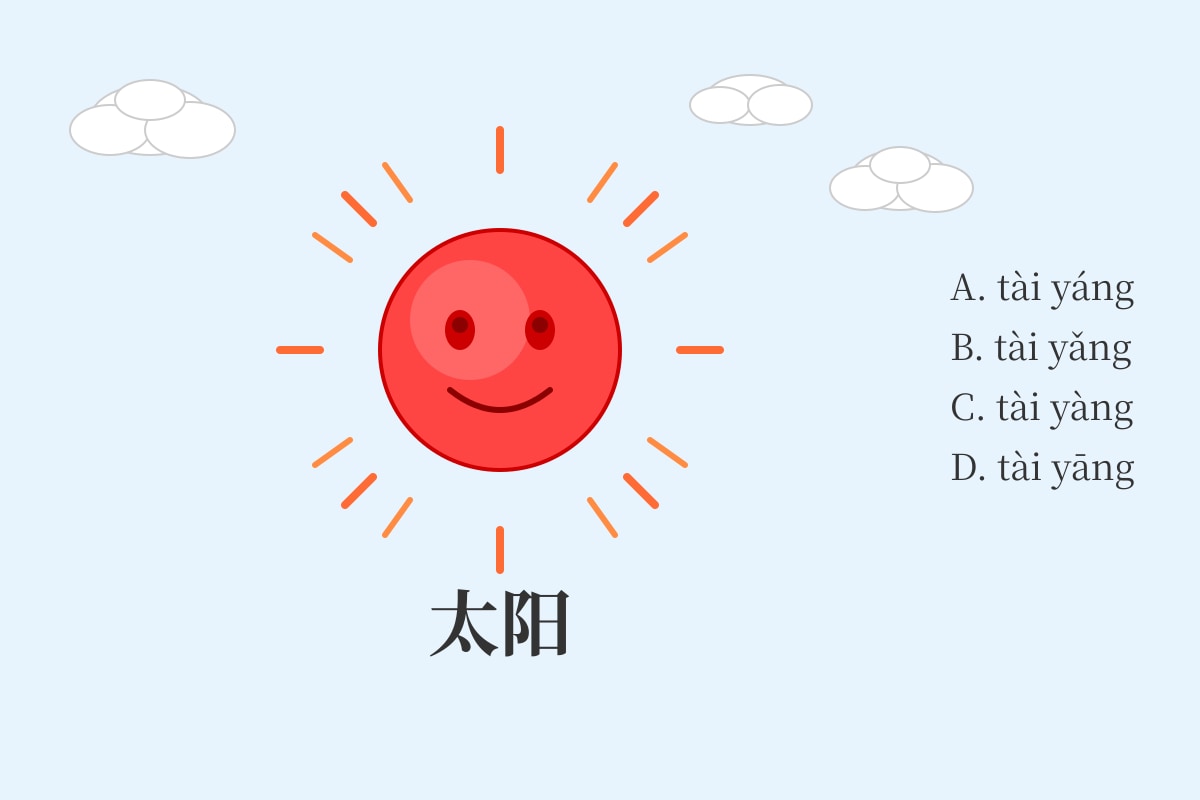
Q12. Answer: A — tài yáng.
- 太阳 = tài yáng (both 4th tone). B has yǎng (3rd), C has yàng (4th but wrong final a vs. ang), D has yāng (1st).
- Marking: 1 mark.
- Visual: A bright sun triggers 太阳.
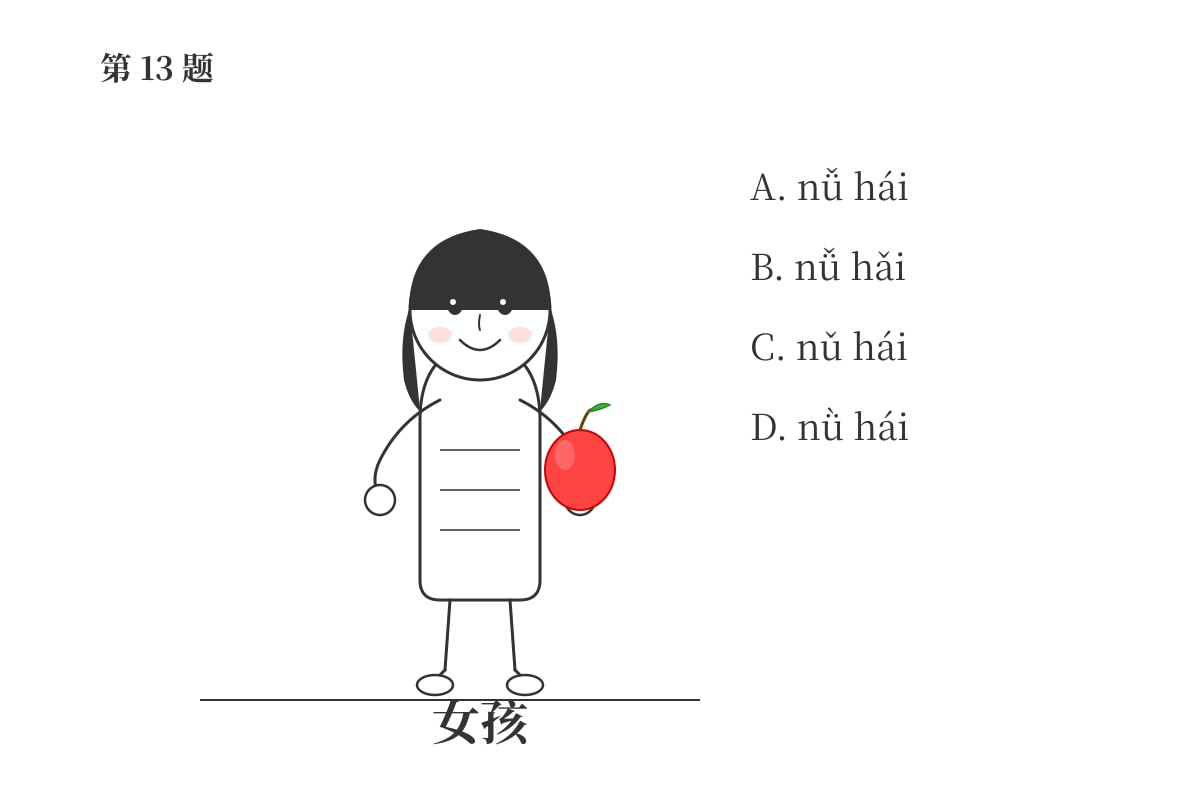
Q13. Answer: A — nǚ hái.
- 女孩 = nǚ hái (3rd tone + 2nd tone). B has hǎi (3rd), C has nǔ (3rd tone but no umlaut — the 女 must have the umlaut ǚ), D has nǜ (4th tone — wrong).
- Marking: 1 mark.
- Visual: A girl triggers 女孩.
- Teaching tip: 女 (nǚ) is a special vowel (ü); the two dots are kept after n but lost after j/q/x. P1 students should still see ǚ here.
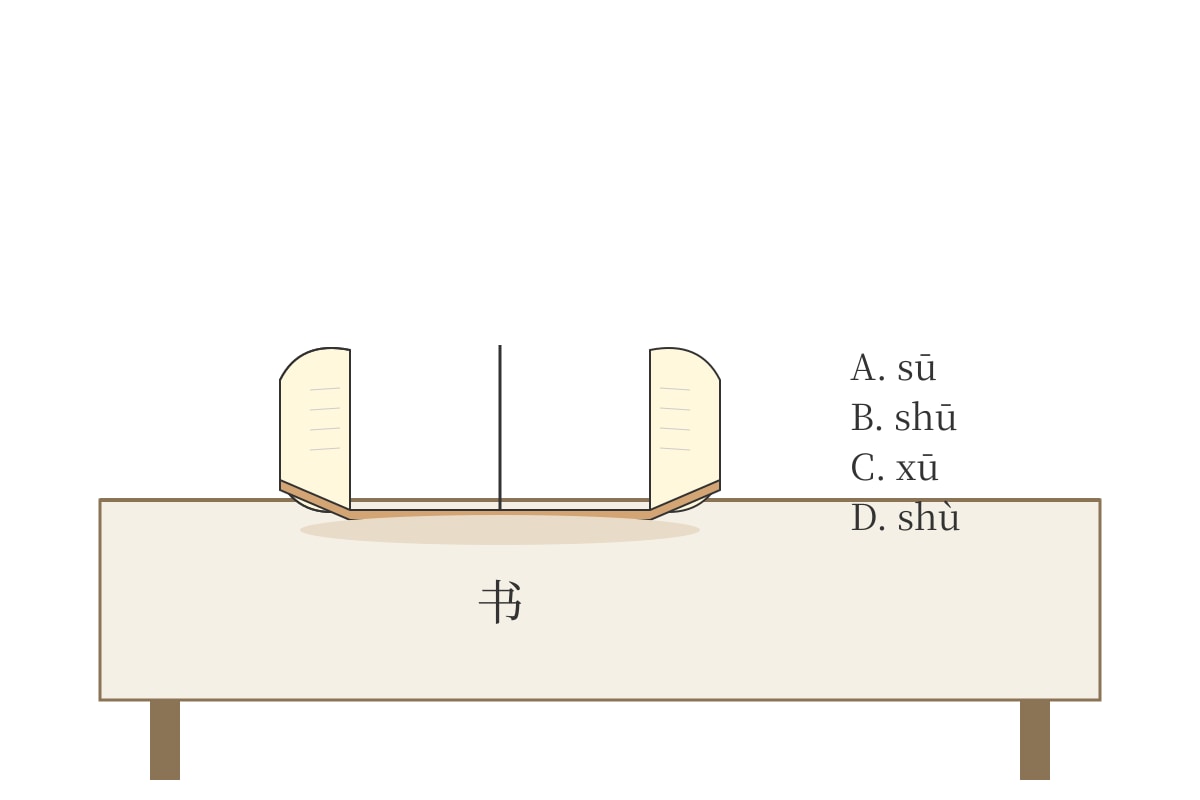
Q14. Answer: B — shū.
- 书 = shū (1st tone). A is sū (no sh-), C is xū (no sh-), D is shù (4th).
- Marking: 1 mark.
- Visual: A book triggers 书.
- Teaching tip: sh- and s- are commonly confused at P1; emphasise the "tongue back" position for sh-.
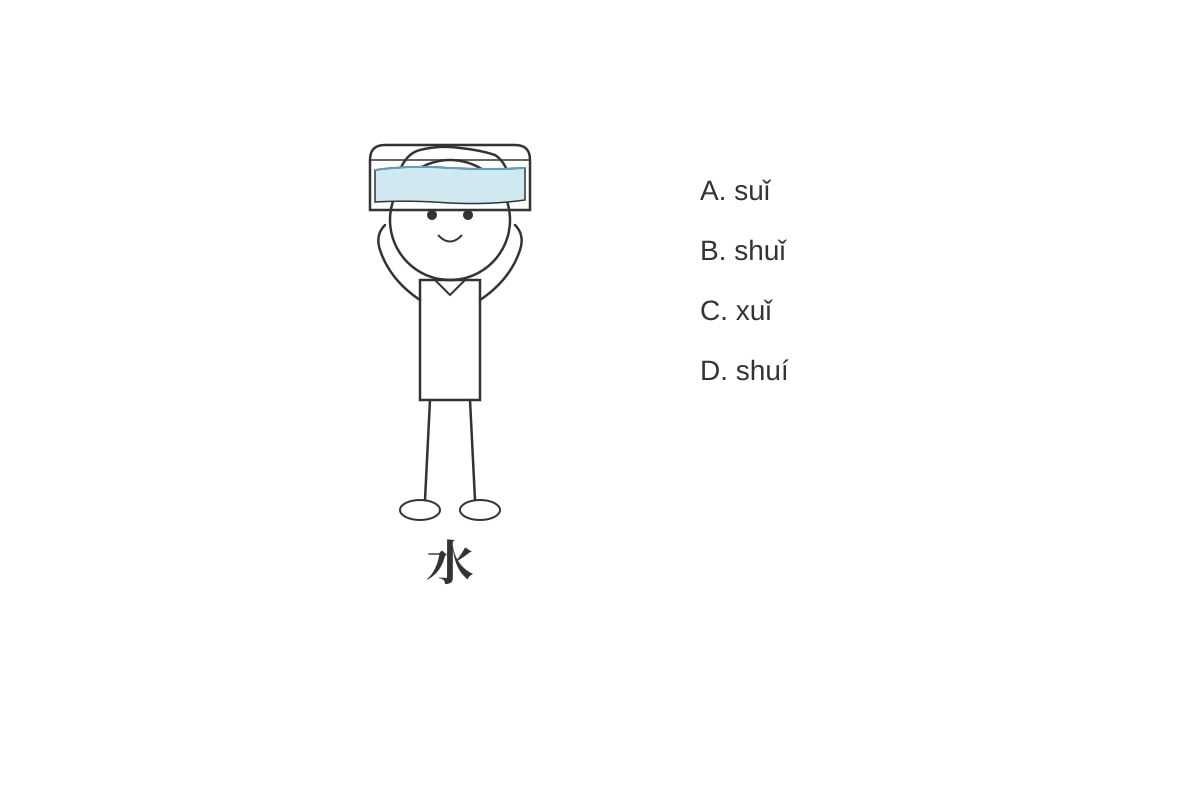
Q15. Answer: B — shuǐ.
- 水 = shuǐ (3rd tone). A is suǐ (no sh-), C is xuǐ (no sh-), D is shuí (2nd — wrong tone).
- Marking: 1 mark.
- Visual: A child drinking water triggers 水.
Marking summary (compact)
| Question | Answer | Marks | Notes |
|---|---|---|---|
| Q1 | C (bǒ) | 1 | only 3rd tone |
| Q2 | B (pá) — revised | 1 | matches "píng" 2nd tone; Q has a drafting flaw (see notes) |
| Q3 | A (xiǎo jī) | 1 | picture = 小鸡 |
| Q4 | C (4 个) — revised | 1 | 2nd-tone count = 4 |
| Q5 | hā, há, hǎ, hà | 1 | full sequence needed |
| Q6(1) | D (bà) | 1 | 爸 |
| Q6(2) | D (gē) | 1 | 哥 |
| Q6(3) | A (yú) | 1 | 鱼 |
| Q6(4) | B (shān) | 1 | 山 |
| Q6(5) | A (fēi) | 1 | 飞 |
| Q7(1) | ba | 1 | b + a |
| Q7(2) | ma | 1 | m + a |
| Q8 | D (`) | 1 | 大 = 4th tone |
| Q9 | 6 | 1 | 我爱爸爸妈妈 |
| Q10 | shān | 1 | sh + ān + 1st tone |
| Q11 | A (māo) | 1 | picture = cat |
| Q12 | A (tài yáng) | 1 | picture = sun |
| Q13 | A (nǚ hái) | 1 | picture = girl |
| Q14 | B (shū) | 1 | picture = book |
| Q15 | B (shuǐ) | 1 | picture = water |
Grand total: 20 marks ✓
Caveat for teacher review: Past-paper evidence for P1 Chinese Hanyu Pinyin was weak. This paper is syllabus-first, LLM-inferred and emulates P1 conventions (short response, large print, picture-supported MCQ). Q2 and Q4 have minor drafting issues (noted above) — please verify option list before classroom use. All pinyin, hanzi, and tones are drawn from the 2024 MOE Primary Chinese Syllabus and the 《欢乐伙伴 2.0》P1 character list (Lessons 1–19).