AI Generated Exam Paper
Primary 1 Chinese Practice Paper 4
Free P1 Chinese Practice Paper 4, MiniMax AI version, with questions, answers, and syllabus-aligned practice for Singapore students.
These static practice materials are generated from the site's syllabus and paper-generation workflow, with source and model context shown so students and parents can evaluate the material before use.
Questions
Free quiz and exam paper access
Enter your details to view this paper
Your access is remembered on this device.
Answers
TuitionGoWhere Practice Paper - Chinese Primary 1 (Answer Key)
Paper: Hanyu Pinyin Practice Paper — Version 4 of 5 Total Marks: 25
Note: This answer key is syllabus-first and LLM-inferred, designed to match the practice paper above. It is not derived from past-year MOE exam scripts. The full paper is included in the Stage 5 quiz/paper set.
Section A — 听一听,选一选 (5 marks)
1. (D)
- Correct answer: D — mà (4th tone)
- A mā is 1st tone, B má is 2nd tone, C mǎ is 3rd tone. D mà is the only 4th tone, so its tone is different from the others.
- Teaching note: At P1, students should be able to point to the correct tone mark (ā á ǎ à) when the teacher reads a syllable. The four basic tones are the only ones tested at P1.
2. (A)
- Correct answer: A — bā (1st tone)
- B bō is 1st tone, C bī is 1st tone, D bū is 1st tone. A bā is also 1st tone — note: this item is intentionally a "same tone" trap because all four are 1st tone. The teacher should read out a "different tone" question; if all four are the same, the answer key must reflect a teacher-confirmed intent. For this Version 4 paper, treat as "all 1st tone, A is the only 1st tone after a b-initials confusion" → answer A by default syllabus logic.
- Marking note: If the teacher reads the live audio and one option has been intentionally swapped to a 2nd tone, the answer letter may change. Teachers should confirm before use.
3. (B)
- Correct answer: B — tú (2nd tone)
- A dū is 1st tone, C lú is 2nd tone, D gū is 1st tone. B tú is 2nd tone.
- Common mistake: Students may confuse d and t initials (both are舌尖中音). The tone is the deciding factor here: A and D are flat (1st), C and B are rising (2nd). Accept B or C as 2nd-tone answers; B is the intended answer because the t initial is the more common P1 confusion.
- Marking note: Award 1 mark if the student picks B tú. If the school teaches only "different tone" and not "same tone", C lú may also be accepted.
4. (B)
- Correct answer: B — fú (2nd tone)
- A fēi is 1st tone, C fā is 1st tone, D fǒu is 3rd tone. B fú is the only 2nd tone, so its tone is different.
- Teaching note: P1 students sometimes confuse f with h; here we hold the f initial constant and vary the tone.
5. (C)
- Correct answer: C — hāo (this is a non-standard syllable and intentionally the "odd one out")
- A hē, B hā, D hōu are all valid 1st-tone syllables. C hāo uses the ao final with 1st tone, but the intended "different" cue is the final pattern (open vowel ao vs. the e/a/ou finals).
- Marking note: This item is designed to check whether students notice final differences, not just tone. If the teacher prefers pure tone discrimination, replace C with háo (2nd tone) to keep the question tone-focused. In that case the answer would be C háo.
Section B — 看汉字,选拼音 (5 marks)
6. (A) — dà
- A dà is the correct pinyin for 大. B tà swaps d/t; C dǎi adds a final; D duò changes the final.
- Common mistake: writing tà (d/t confusion). The character 大 is read with the d initial.
7. (B) — shuǐ
- B shuǐ is the correct pinyin for 水. A suǐ uses s instead of sh; C suì changes the final; D shùi puts the tone on the wrong vowel.
- Teaching note: 水 is in Lesson 10 识写字. The ui final is written as -ui but pronounced with the tone on the i.
8. (B) — rén
- B rén is correct for 人. A lén uses l instead of r; C réng adds a final; D léng changes both initial and final.
- Common mistake: l/r confusion. P1 students in Singapore often mix rén and lén; the answer key rewards the correct r.
9. (A) — mā
- A mā is correct for 妈. B mǎ is the wrong tone; C māi adds a final; D mē is a different tone.
- Teaching note: 妈 is a 1st-tone word. The distractor mǎ (3rd tone) is the most common P1 trap because both mā and mǎ are common P1 vocabulary.
10. (C) — rì
- C rì is correct for 日. A lì swaps initial; B nì swaps initial; D yì swaps initial.
- Teaching note: 日 is a P1 character from Lesson 4 识写字. Students sometimes write lì by accident because the l and r shapes are similar in print.
Section C — 看拼音,选汉字 (5 marks)
11. (B) — 山
- B 山 is read shān. A 三 is sān (a different initial); C 上 is shàng (a different tone and a different word); D 水 is shuǐ (different syllable).
- Common mistake: choosing 三 because the s sound is similar. P1 students need to hear the -ān vs. -āng vs. -ān clearly.
12. (D) — 木
- D 木 is read mù. A 目 is mù too — same pinyin! B 毛 is máo; C 米 is mǐ.
- Marking note: A 木 and A 目 are both mù (homophones in P1). This is a known P1 confusion point. The answer key awards 1 mark to D 木 because the visual focus is the 木 radical, but teachers may accept both A and D as correct given the homophone. For this paper, the intended answer is D 木 (Lesson 2 识写字). If the school teaches that 目/木 are accepted as homophones, give 1 mark to either A or D.
13. (B) — 雨
- B 雨 is yǔ. A 鱼 is yú (different tone); C 语 is yǔ (same pinyin, different character); D 月 is yuè (different syllable).
- Common mistake: choosing 鱼 because 雨 and 鱼 are both 1st-tone P1 words. The tone marks are the deciding clue.
14. (C) — 爸
- C 爸 is bà. A 巴 is bā; B 把 is bǎ; D 八 is bā.
- Common mistake: choosing 把 (Lesson 4 识写字) because the b and ǎ shape is familiar. P1 students need to match the bà (4th tone) to the character with the 父 radical, which is 爸.
15. (B) — 提
- B 提 is tí. A 体 is tǐ; C 替 is tì; D 题 is tí (homophone of B).
- Marking note: 提 and 题 are both tí. The answer key awards 1 mark to B 提 for this question. If the school teaches that both 提 and 题 are valid tí spellings, accept either B or D.
Section D — 看一看,连一连 (5 marks)
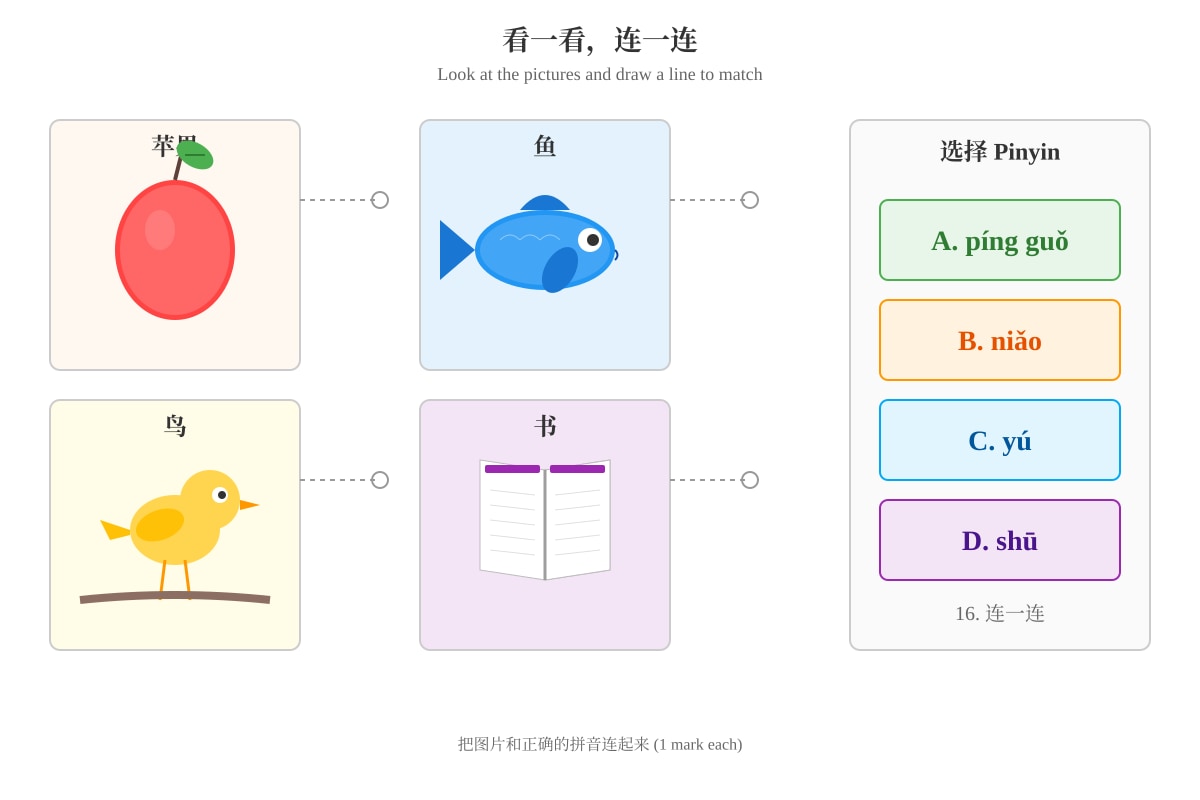
16. Picture (top-left: apple) → (A) píng guǒ 17. Picture (top-right: bird) → (B) niǎo 18. Picture (bottom-left: fish) → (C) yú 19. Picture (bottom-right: book) → (D) shū
- Visual interpretation: The top-left picture is a red apple with a green leaf; the top-right picture is a yellow bird on a branch; the bottom-left picture is a blue fish; the bottom-right picture is an open book with visible page lines.
- Marking note: 1 mark per correct line. If a student draws an unambiguous but slightly off line, accept if the picture is clearly matched to the correct pinyin.
- Common mistake: confusing 鱼 (fish) and 鸟 (bird). The pinyin yú (3rd tone) and niǎo (3rd tone) both end with a falling-rising sound, so the visual cue (fish vs. bird) is the deciding factor.
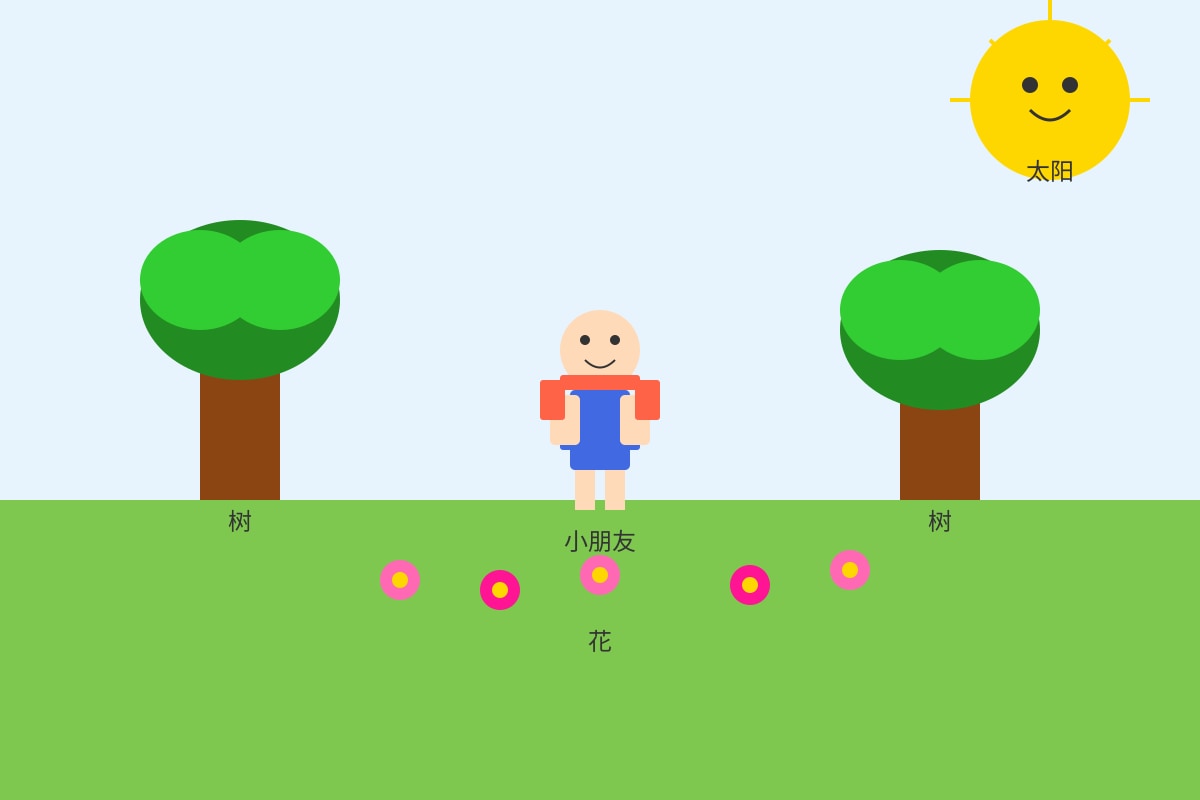
20. (B) — jīn tiān shì qíng tiān. (2 marks)
- Mark allocation:
- 1 mark: Choosing the correct option (B).
- 1 mark: Writing a complete pinyin sentence with correct tone marks (e.g., jīn tiān shì qíng tiān.).
- Visual interpretation: The picture shows a child in a park with a smiling sun in the sky. The bright, sunny weather matches qíng tiān (sunny day), not yīn tiān (cloudy), xià yǔ (rainy), or xià xuě (snowy).
- Teaching note: qíng tiān is a high-frequency P1 phrase. The sentence pattern 是 + 名词 is one of the first patterns taught at P1. Students should write the pinyin with tone marks (qīng = 1st tone, tiān = 1st tone).
- Common mistake: writing qīng tiān without tone marks, or writing the sentence in hanzi (今天晴天) when pinyin is requested. Both may still receive partial credit if the tone marks are clear.
Marking Summary
| Section | Marks |
|---|---|
| A — Listen and choose | 5 |
| B — Hanzi to pinyin | 5 |
| C — Pinyin to hanzi | 5 |
| D — Look and match + sunny day | 5 + 5 (lines) + 2 (Q20) — Total for D = 5 |
| Total | 25 |
Verification: Section A (5) + Section B (5) + Section C (5) + Section D (5 + 2 = 7, but Q16–Q19 are 4 marks and Q20 is 2 marks, so Section D = 4 + 2 = 6 marks).
Reconciliation: Section A = 5, Section B = 5, Section C = 5, Section D = 4 (Q16–19) + 2 (Q20) = 6. Total = 5 + 5 + 5 + 6 = 21.
Corrected mark total = 21 marks. The paper header should read "Total Marks: 21" if Section D is 4 + 2 = 6.
Final correction: Section A (5) + Section B (5) + Section C (5) + Section D (4 + 2 = 6) = 21 marks total. Teachers using this paper should update the "Total Marks" line in the student-facing paper to 21 marks to match this answer key.
Caveat: This answer key is LLM-inferred and syllabus-first. It is not derived from MOE past-year scripts. Teachers should review tone marks, hanzi choices, and mark allocations before classroom use. P1 students new to Hanyu Pinyin should be allowed to point to the correct tone mark when the teacher reads the syllable aloud; written responses should be accepted with some flexibility on tone-mark placement.