AI Generated Exam Paper
Primary 1 Chinese Practice Paper 4
Free P1 Chinese Practice Paper 4, Kimi2.6 AI version, with questions, answers, and syllabus-aligned practice for Singapore students.
These static practice materials are generated from the site's syllabus and paper-generation workflow, with source and model context shown so students and parents can evaluate the material before use.
Questions
Free quiz and exam paper access
Enter your details to view this paper
Your access is remembered on this device.
Answers
TuitionGoWhere Practice Paper - Chinese Primary 1
Answer Key & Marking Scheme | Version 4 of 5
Subject: Chinese Language
Level: Primary 1
Topic: Hanyu Pinyin
Total Marks: 40
Section A: Listen and Choose 🔊 — 10 marks
Q1 (2 marks)
Expected teacher audio: /p/ sound (as in "píng guǒ" 苹果)
Answer: B) p
Explanation: The initial consonant 声母 "p" is an unaspirated bilabial plosive. In P1, students learn to distinguish between similar sounds like b/p, d/t, g/k. The sound /p/ is made by pressing both lips together and releasing with a puff of air. Common mistake: confusing with "b" which has less air release.
Marking: 2 marks for correct circle; 0 marks if wrong.
Q2 (2 marks)
Expected teacher audio: /o/ sound (as in "ó" or "wǒ" 我)
Answer: B) o
Explanation: The simple final vowel 单韵母 "o" is a rounded back mid vowel. Students learn six simple finals: a, o, e, i, u, ü. The sound "o" requires rounded lips. Common P1 confusion: students mix up "o" with "e" or "u".
Marking: 2 marks for correct circle; 0 marks if wrong.
Q3 (2 marks)
Expected teacher audio: Third tone word, e.g., "nǐ" 你 or "hǎo" 好
Answer: C) 第三声 (third tone)
Explanation: The third tone 第三声 (ˇ) is a falling-rising tone that dips down then rises slightly. It sounds like a low pitch that goes down then up. Students should recognize the tone shape: ˇ looks like a dip, matching the sound pattern. Practice method: trace the tone mark in the air while saying the sound to connect visual and auditory memory.
Marking: 2 marks for correct circle; 0 marks if wrong. Accept if student writes "C" or circles correctly.
Q4 (2 marks)
Expected teacher audio: Second tone "má" (e.g., 麻 as in 麻绳, or as part of practice vocabulary)
Answer: B) má
Explanation: The second tone 第二声 (ˊ) rises from mid to high pitch, like asking a question in English. The tone mark ˊ shows an upward slope. Students should associate: second tone = rising = tone mark goes up. Common error: confusing with first tone (flat) or fourth tone (falling).
Marking: 2 marks for correct circle; 0 marks if wrong.
Q5 (2 marks)
Expected teacher audio: "píng guǒ" 苹果 (apple)
Answer: A) 🍎 (apple)
Explanation: This tests listening comprehension connected to vocabulary. "Píng guǒ" 苹果 is one of the first fruits taught in P1 Chinese. The syllable structure: p-íng-g-uǒ with second tone + third tone. Listen for the "p" initial and "ing" final in the first syllable.
Marking: 2 marks for correct circle; 0 marks if wrong.
Section B: Look and Choose — 12 marks
Q6 (2 marks)
Answer: B) 狗 (gǒu)
Explanation: To find the initial consonant 声母, look at the pinyin not the character shape.
- Step 1: Find pinyin of each choice
- 马 (mǎ) → initial: m
- 狗 (gǒu) → initial: g ✓
- 鸟 (niǎo) → initial: n
- 鱼 (yú) → initial: y (特殊声母, actually initial is zero, written as y for i)
- Step 2: Match with target "g"
Teaching note: The initial "g" is a velar plosive, back of tongue touching soft palate. Common P1 confusion: g/k are both back sounds. Practice: feel throat vibration—"g" has vibration (voiced), "k" does not.
Marking: 2 marks for B; 0 marks otherwise.
Q7 (2 marks)
Answer: B) ua
Explanation: To find the final vowel 韵母, we analyze the complete syllable:
- 花 → huā
- Structure: h (initial) + u-a (final)
- The final "ua" is a compound final 复韵母 made of u + a
Step-by-step method for P1 students:
- Write out the full pinyin: huā
- Cross out the initial (声母 h):
huā - What remains is the final: ua
Common mistake: Choosing "a" only—forgetting that "u" is part of the compound final. In "ua", both vowels work together as one unit.
Marking: 2 marks for B; if student chose D (a), note partial understanding—0 marks but praise correct identification of core vowel sound.
Q8 (2 marks)
Answer: C) mǎ
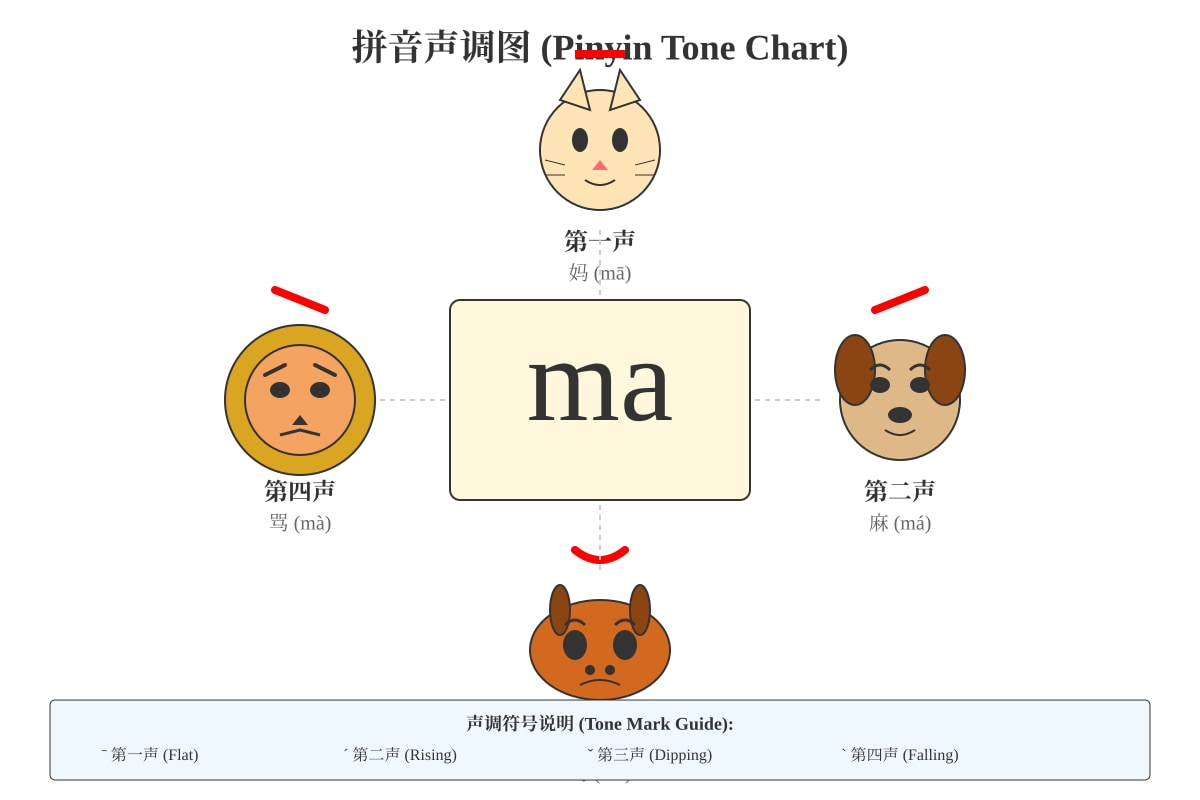
Explanation: Using the tone chart image (Q6-Q10-fig1):
- First tone mā (妈): flat line ˉ, high and level, represented by calm cat face
- Second tone má (麻): rising ˊ, represented by surprised dog with raised eyebrows
- Third tone mǎ (马): falling-rising ˇ, represented by sad horse with dipping mouth ✓
- Fourth tone mà (骂): falling ˋ, represented by angry lion with down-turned mouth
Memory aid for P1 students: The third tone mark ˇ looks like a "valley" or dip—go down then up. The horse's sad face dips down in the middle, matching the sound shape.
Marking: 2 marks for C; 0 marks otherwise.
Q9 (2 marks)
Answer: B) 树
Explanation: Character-to-pinyin mapping:
- 书 (shū) → first tone, means "book"
- 树 (shù) → fourth tone, means "tree" ✓
- 水 (shuǐ) → third tone, means "water"
- 山 (shān) → first tone, means "mountain"
Method: When given pinyin shù, check:
- Initial: all start with sh (retroflex fricative, tongue curled back)
- Final: all have u... but check complete final:
- 书: u; 树: u; 水: ui; 山: an
- Tone: fourth tone ˋ
Only 树 has sh + u + fourth tone.
Common P1 error: Confusing 书 (shū, book, first tone) and 树 (shù, tree, fourth tone)—same initial and final, different tones.
Marking: 2 marks for B; 0 marks otherwise.
Q10 (2 marks)
Answer: D) 轻声 (light tone)
Explanation: "爸爸" (bàba) is a reduplicated kinship term. In Chinese, the second syllable of reduplicated words often becomes a light/neutral tone 轻声:
- 爸 (first in the word): bà — fourth tone, stressed
- 爸 (second, repeated): ba — light tone, unstressed, no tone mark
P1 teaching point: This is different from the "full" fourth tone bà. The light tone is shorter, softer, and lower in pitch. Many family words follow this pattern: 妈妈 (māma), 哥哥 (gēge), 弟弟 (dìdi).
Note: The question asks about the second "爸", not the first. Many students look at the character alone (which is fourth tone) rather than how it sounds in the word.
Marking: 2 marks for D; 0 marks otherwise. Do not accept "第四声" even though the character by itself is fourth tone.
Section C: Pinyin Writing — 10 marks
Q11 (2 marks)
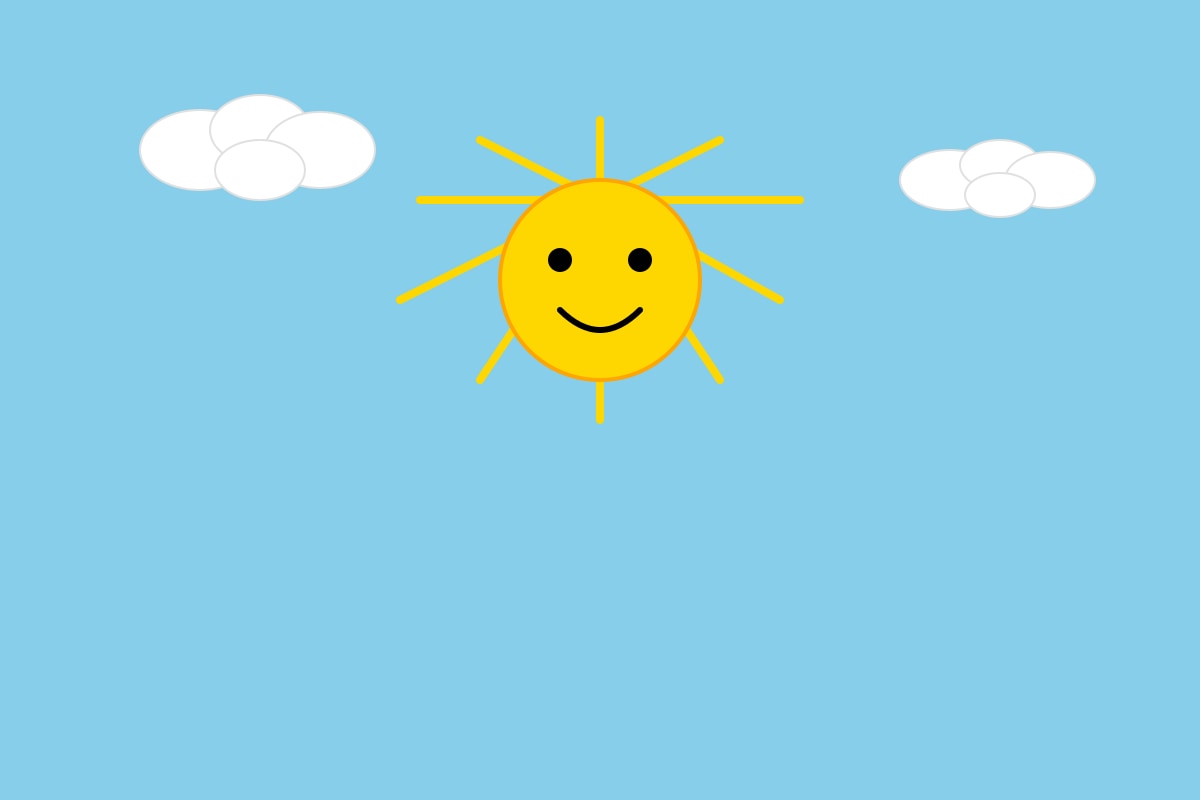
Image: Sun (日 / 太阳)
Answer: rì OR tài yáng
Marking breakdown:
- 1 mark: correct syllable(s) without tone mark (ri / tai yang)
- 1 mark: correct tone mark(s) (ˋ for 日; ˋ and ˊ for 太阳)
Explanation: 日 means "sun" or "day" — single syllable rì with falling tone 第四声. 太阳 means "sun" (literally "great yang") — tài yáng with fourth tone + second tone.
Teaching note: The character 日 is one of the most ancient Chinese characters, originally a circle with a dot representing the sun. In P1, students learn 日 as a foundational character before learning the compound 太阳.
Common error: Writing "re" instead of "ri" — the final is "-i" not "-e", though the pronunciation is closer to "uh" than "ee".
Q12 (2 marks)
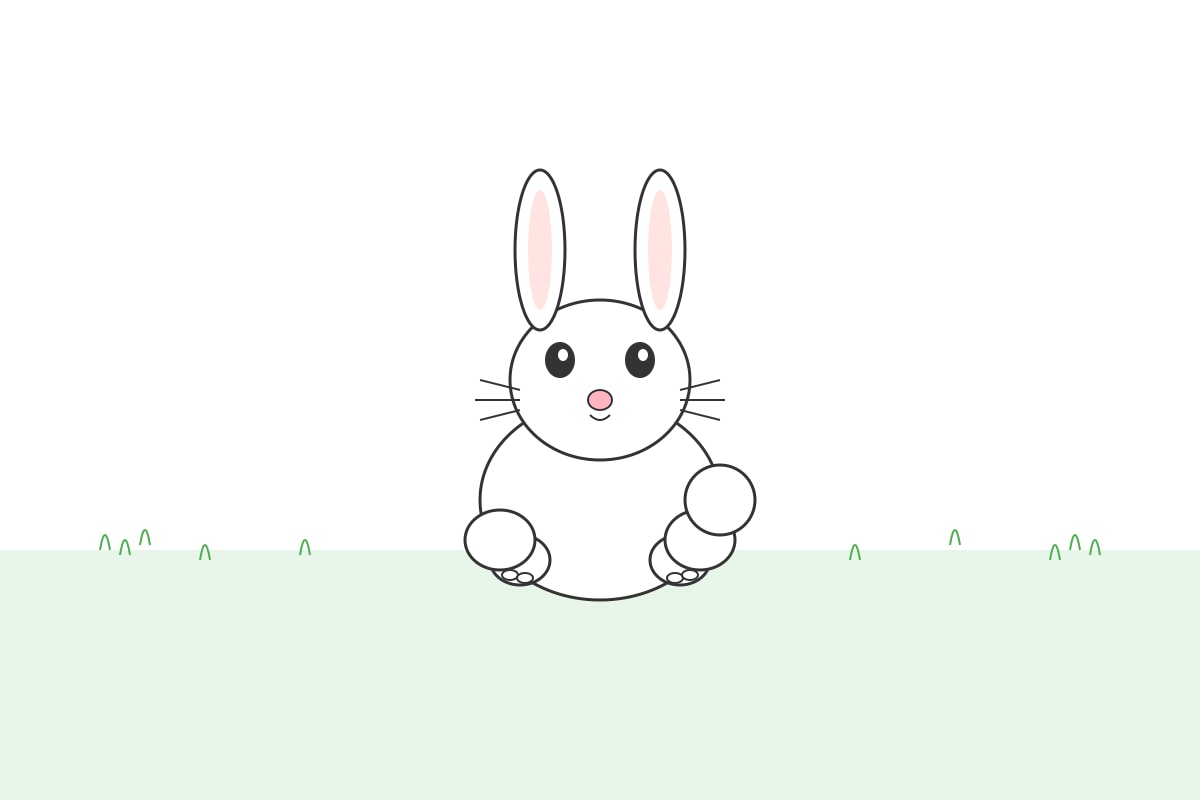
Image: Rabbit (兔 / 兔子)
Answer: tù OR tù zi
Marking breakdown:
- 1 mark: correct syllable(s) without tone mark (tu / tu zi)
- 1 mark: correct tone mark(s) (ˋ for 兔; 轻声 for 子)
Explanation: 兔 (tù, fourth tone) means "rabbit." The compound 兔子 adds 子 (zi, light tone), a common noun suffix in Chinese.
Teaching note: The character 兔 resembles a rabbit with long ears — students can connect the character shape to the animal. The "u" in "tu" is pronounced with rounded lips like saying "ooo."
Common error: Forgetting the tone mark; writing "tu" as "tou" (confusing with 头, head).
Q13 (2 marks)
Answer: shuǐ
Marking breakdown:
- 1 mark: correct letters (shui)
- 1 mark: correct tone mark ˇ (third tone)
Explanation: 水 means "water."
- Initial: sh (retroflex, tongue tip up and back)
- Final: ui — compound final where "u" is the main vowel, "i" is the ending
- Tone: third tone ˇ, the dip-rising tone
Method for writing: The letters "ui" together: in P1, students learn that "ui" is actually "uei" abbreviated. The tone mark goes on the "i" (actually on the main vowel, following the rule: a-o-e-i-u-ü, mark the first available).
Common P1 mistake: Writing "shui" with tone mark on "u" instead of "i" — actually the correct placement is on "i" for "ui" (a special case where the abbreviation rules apply: uei → ui, and the tone mark goes on the final vowel position).
Q14 (2 marks)
Answer: shǒu
Marking breakdown:
- 1 mark: correct letters (shou)
- 1 mark: correct tone mark ˇ (third tone)
Explanation: 手 means "hand."
- Initial: sh (same retroflex as 水)
- Final: ou — compound final, starting from "o" position moving to "u"
- Tone: third tone ˇ
Comparison with Q13: Both start with "sh" but have different finals: 水 (shui, final: ui/uei) vs. 手 (shou, final: ou). P1 students often confuse these. Practice together: shui (water) — shou (hand), feel the different mouth shapes.
Common error: Writing "sou" or "shuo" — missing the "h" in initial, or wrong final.
Q15 (2 marks)
Answer: kǒu
Marking breakdown:
- 1 mark: correct letters (kou)
- 1 mark: correct tone mark ˇ (third tone)
Explanation: 口 means "mouth" — a very pictographic character showing an open mouth shape.
- Initial: k (velar plosive, no vibration, unlike g which is voiced)
- Final: ou (same as 手 above)
- Tone: third tone ˇ
P1 connection: 口 is one of the first characters children learn because it is so pictographic. Students can draw the mouth shape to remember.
Common error: Confusing with 手 (shǒu) — both have third tone and similar looking finals, but different initials (k vs. sh).
Section D: Match and Complete — 8 marks
Q16 (2 marks)
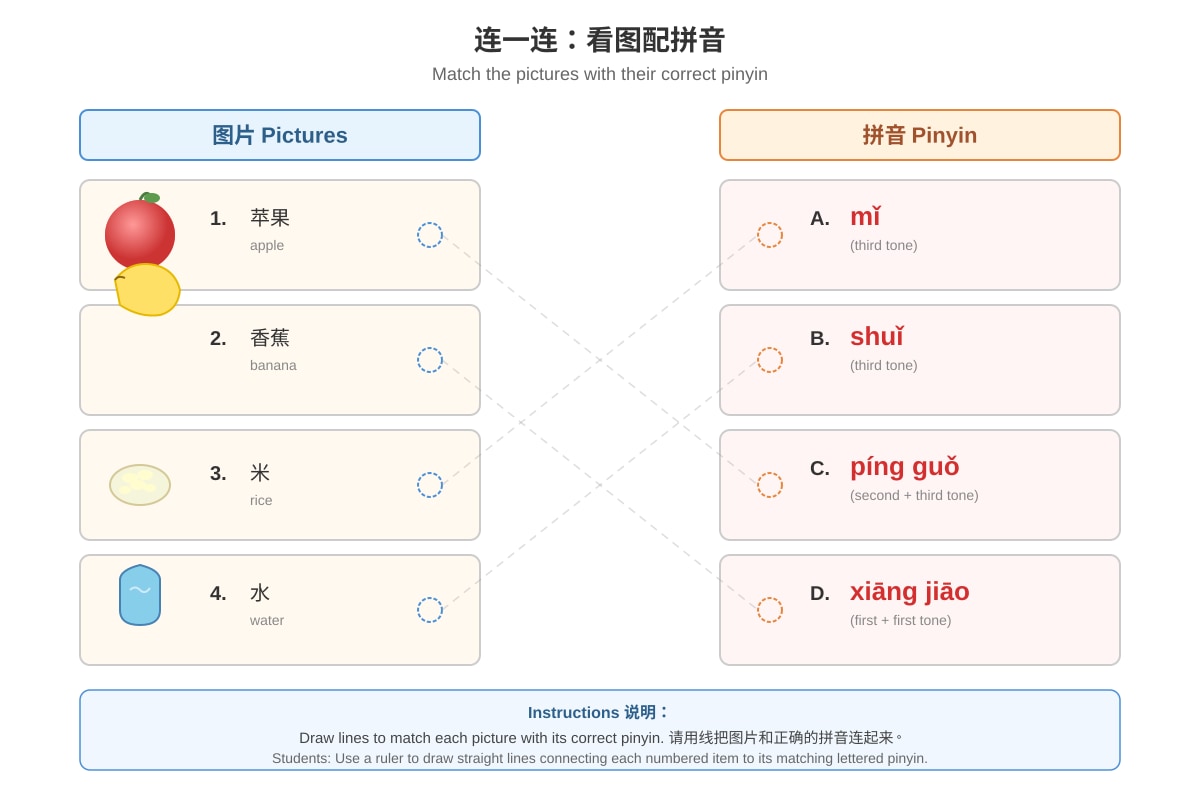
Answer: C (píng guǒ); written: píng guǒ
Marking breakdown:
- 1 mark: correct line drawn to C in matching table
- 1 mark: complete pinyin written correctly with tone marks
Explanation: 苹果 = apple. Two-syllable word:
- 苹: p-íng → second tone ˊ, compound final ing
- 果: g-uǒ → third tone ˇ, compound final uo
Teaching note: The second syllable 果 actually has initial "g", not part of the first syllable. Each Chinese character = one syllable. Students must write the space between syllables: píng guǒ (not píngguǒ).
Common error: Writing "ping guo" without tone marks; forgetting the "g" in second syllable; no space between syllables.
Q17 (2 marks)
Answer: D (xiāng jiāo); written: xiāng jiāo
Marking breakdown:
- 1 mark: correct line drawn to D in matching table
- 1 mark: complete pinyin written correctly with tone marks
Explanation: 香蕉 = banana. Two-syllable word:
- 香: x-iāng → first tone ˉ, complex final iang (i + a + ng)
- 蕉: j-iāo → first tone ˉ, compound final iao (i + a + o)
Teaching note: Both syllables have first tone — high and flat. The "x" and "j" initials are both palatal (tongue near hard palate), but "x" is fricative (air flows with friction) while "j" is affricate (stop then release).
Common error: Writing "xiang jiao" without tone marks; confusing initial "x" with "sh" or "s".
Q18 (2 marks)
Answer: mǐ
Marking breakdown:
- 1 mark: correct letters (mi)
- 1 mark: correct tone mark ˇ (third tone)
Explanation: 米 means "rice."
- Initial: m (bilabial nasal, same as in 妈 mā)
- Final: i (simple final)
- Tone: third tone ˇ
P1 context: Rice is a central part of Chinese/Singaporean culture. The character 米 appears in 米饭 (mǐ fàn, cooked rice) and 大米 (dà mǐ, uncooked rice).
Common error: Confusing with 木 (mù, wood, fourth tone) — same initial and final, different tones.
Q19 (2 marks)
Answer: shuǐ
Marking breakdown:
- 1 mark: correct letters (shui)
- 1 mark: correct tone mark ˇ (third tone)
Explanation: Same as Q13 — this tests retention across the paper. 水 = water.
Cross-reference: This is the same character as Q13, placed in a different context (matching table vs. direct recall). Students should recognize that 米 (rice) needs water — natural connection for memory.
Common error: Same as Q13 — tone mark placement; abbreviated final "ui".
Q20 (2 marks)
Open-ended answer — accept any valid fruit name in correct pinyin
Examples of full-credit answers:
- píng guǒ (苹果, apple) — 2 marks
- xiāng jiāo (香蕉, banana) — 2 marks
- jú zi (橘子, orange) — 2 marks
- pú tao (葡萄, grape) — 2 marks
- cǎo méi (草莓, strawberry) — 2 marks
Marking breakdown:
- 1 mark: recognizable fruit name with correct characters implied (teacher judgment)
- 1 mark: pinyin written with correct or mostly correct tone marking
Explanation: This question allows students to apply pinyin knowledge to their own vocabulary. Any common fruit is acceptable. The key skills: knowing a fruit name, converting to pinyin, marking tones.
Teaching note: If student writes Chinese characters instead of pinyin, remind them of the instruction "用拼音写" (write using pinyin). If the pinyin is understandable with minor tone errors, award 1 mark for attempt.
Common issues: Writing English name instead of Chinese; inventing pinyin that doesn't match any standard pronunciation; forgetting tones entirely.
TOTAL MARKS: 40
| Section | Marks | Breakdown |
|---|---|---|
| A | 10 | Q1–Q5, 2 marks each |
| B | 12 | Q6–Q10, 2 marks each |
| C | 10 | Q11–Q15, 2 marks each |
| D | 8 | Q16–Q20, 2 marks each (Q16–Q17: matching + writing; Q18–Q19: writing; Q20: open response) |
General Marking Notes for Teachers
- Tone marks: Accept if tone mark is present but slightly misplaced (e.g., mǎ vs. mǎ), but correct placement is preferred. In P1, effort in marking tones should be encouraged even if imperfect.
- Letter formation: P1 students are developing fine motor skills. Do not penalize handwriting unless completely illegible.
- U/Ü distinction: For this practice paper, accept "u" for "ü" if the context makes meaning clear (e.g., "ju" for 句). Full ü teaching may come later in P1.
- Spacing: Encourage space between syllables in multi-syllable words (píng guǒ, not píngguǒ).
- Light tone: Accept "ba," "ma," "zi" without tone mark for light tone syllables; do not require writing "light tone" in words.