AI Generated Exam Paper
Primary 1 Chinese Practice Paper 3
Free P1 Chinese Practice Paper 3, Nemo3 AI version, with questions, answers, and syllabus-aligned practice for Singapore students.
These static practice materials are generated from the site's syllabus and paper-generation workflow, with source and model context shown so students and parents can evaluate the material before use.
Questions
Free quiz and exam paper access
Enter your details to view this paper
Your access is remembered on this device.
Answers
TuitionGoWhere Practice Paper - Chinese Primary 1 (Answer Key)
Subject: Chinese
Level: Primary 1
Paper: Practice Paper 3 (Hanyu Pinyin Focus)
Total Marks: 40
Section A: Initials (声母) Recognition [10 marks]
1. [2 marks]
Answer: A) b
Explanation: The word "爸爸" (bà ba) starts with the initial b. The initial b is a bilabial unaspirated stop. It is different from p (aspirated), m (nasal), and f (labiodental fricative).
Teaching Note: When you say "b", your lips close and then open with a small puff of air (unaspirated). For "p", the puff of air is stronger (aspirated).
2. [2 marks]
Answer: A) m
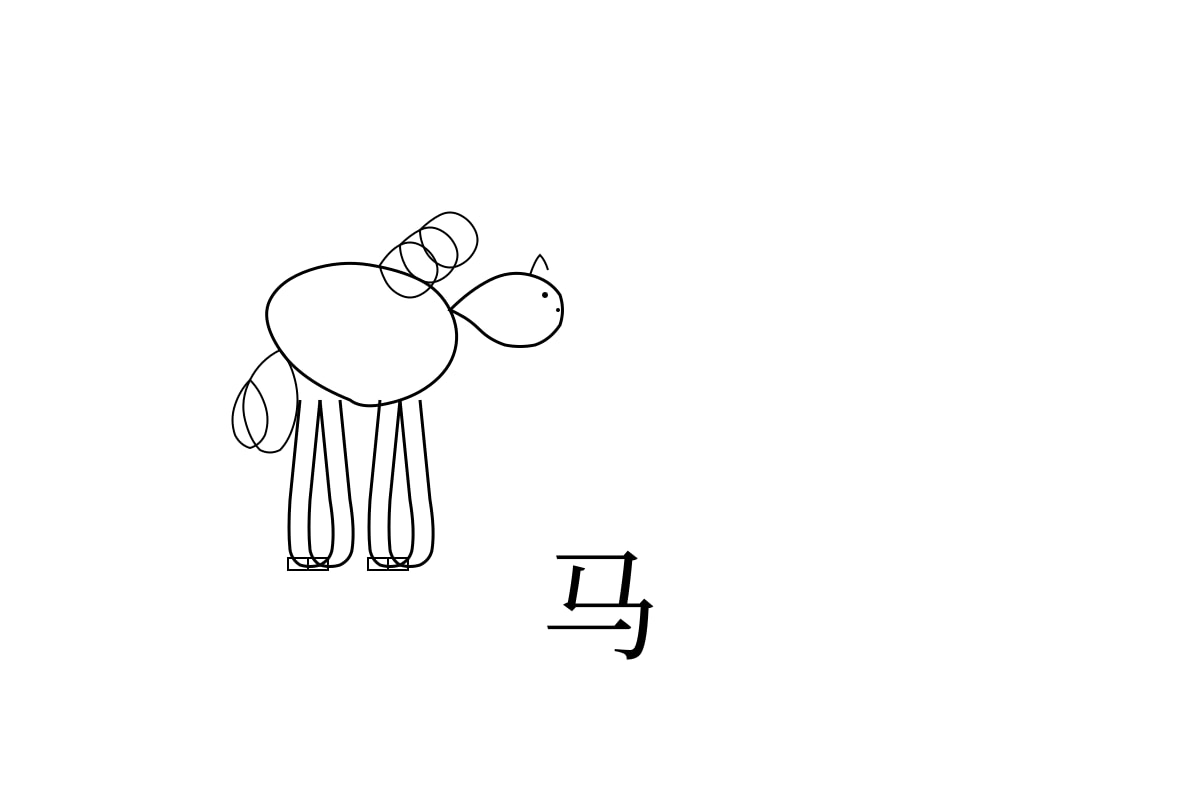
Explanation: The picture shows a horse. The Chinese word is 马 (mǎ). The initial is m, a bilabial nasal sound. Air flows through the nose.
Common Mistake: Confusing m with n (alveolar nasal). For m, lips are closed; for n, tongue touches the alveolar ridge behind the upper teeth.
3. [2 marks]
Answer: A) 狗 (gǒu)
Explanation:
- A) 狗 (gǒu) → initial g ✓
- B) 苹果 (píng guǒ) → initial p
- C) 书包 (shū bāo) → initial sh
- D) 老师 (lǎo shī) → initial l
Teaching Note: g is a velar unaspirated stop. The back of the tongue touches the soft palate.
4. [2 marks]
Answer: B) 草 (cǎo)
Explanation: The "齐齿音" (flat tongue sounds) are z, c, s.
- A) 早 (zǎo) → initial z
- B) 草 (cǎo) → initial c ✓
- C) 手 (shǒu) → initial sh (curled tongue sound)
- D) 书 (shū) → initial sh
Teaching Note: For c, the tongue is flat, and there is a strong puff of air (aspirated). For z, the puff is weak (unaspirated).
5. [2 marks]
Answer: A) x
Explanation: The syllable "xiong" (熊 xióng) starts with the initial x. x is a palatal fricative. The tongue blade is raised towards the hard palate. It is different from sh (retroflex), s (alveolar), and zh (retroflex stop).
Section B: Finals (韵母) Recognition [10 marks]
6. [2 marks]
Answer: A) 山 (shān)
Explanation:
- A) 山 (shān) → final an (front nasal final) ✓
- B) 手 (shǒu) → final ou (compound final)
- C) 心 (xīn) → final in (front nasal final)
- D) 云 (yún) → final un (front nasal final)
Teaching Note: an is an open mouth sound. The tongue is low, then moves to touch the alveolar ridge for the nasal ending.
7. [2 marks]
Answer: B) ü
Explanation: The word 雨 (yǔ) has the final ü (a high front rounded vowel). The two dots on ü are omitted when written after j, q, x, y (e.g., yu for yǔ), but the sound is still ü.
Teaching Note: To make the ü sound, say i (ee) and then round your lips tightly.
8. [2 marks]
Answer: C) 猫 (māo)
Explanation:
- A) 马 (mǎ) → final a (simple final)
- B) 米 (mǐ) → final i (simple final)
- C) 猫 (māo) → final ao (compound final / 复韵母) ✓
- D) 木 (mù) → final u (simple final)
Teaching Note: Compound finals (复韵母) are made of two vowel sounds gliding together: ai, ei, ao, ou, ia, ie, ua, uo, üe.
9. [2 marks]
Answer: ü (or yu when written as a whole syllable)
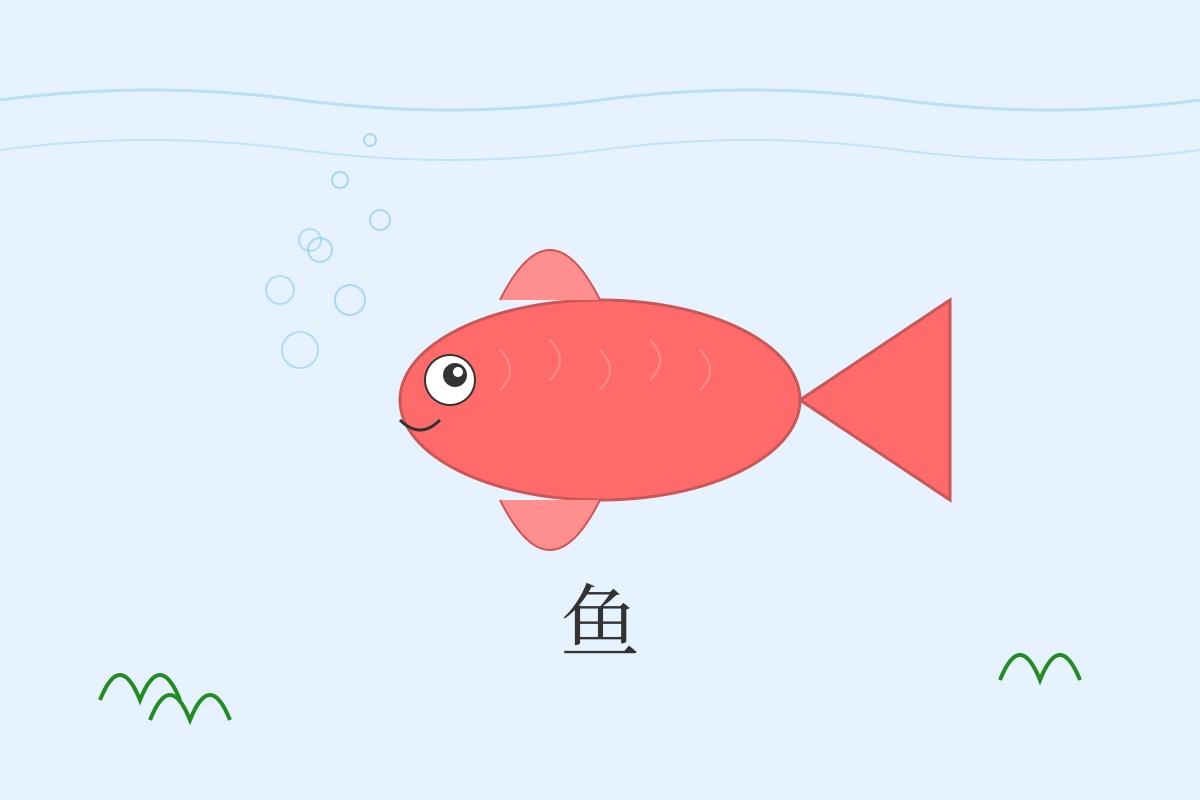
Explanation: The picture shows a fish. The word is 鱼 (yú). As a whole syllable, it is written yu (the dots on ü are omitted after y). The final sound is ü.
Marking: Accept ü or yu. If student writes u, deduct 1 mark (confusion with u sound).
10. [2 marks]
Answer: B) ang, eng, ing, ong
Explanation: These are the back nasal finals (后鼻韵母). The tongue root rises to touch the soft palate (velum) for the ng ending.
- A) an, en, in, un, ün → front nasal finals (前鼻韵母)
- C) ai, ei, ao, ou → compound finals
- D) a, o, e, i, u → simple finals
Section C: Tones (声调) [8 marks]
11. [2 marks]
Answer: C) Third tone (上声)
Explanation: 我 (wǒ) is pronounced with the third tone: the pitch dips down then goes up (ˇ). Tone marks: 1st (ˉ), 2nd (ˊ), 3rd (ˇ), 4th (ˋ).
12. [2 marks]
Answer: B) Fourth tone + Light tone (轻声)
Explanation: 弟弟 (dì di) — The first 弟 is 4th tone (dì, falling pitch). The second 弟 is a light tone (轻声) — short, light, no tone mark. Many kinship terms and particles use light tone for the second syllable.
13. [2 marks]
Answer: mà (m with tone mark ˋ over a)
Explanation: 骂 (mà) is 4th tone (去声) — sharp falling pitch. The tone mark goes over the main vowel a. Rule: If there is a, mark a; else if o, e, mark them; else mark i/u/ü (dot on i removed if marked).
14. [2 marks]
Answer: D) All of the above
Explanation:
- A) 妈妈 (mā ma) — 2nd ma is light tone
- B) 马马虎虎 (mǎ ma hū hu) — 2nd ma, 2nd hu are light tones
- C) 爸爸 (bà ba) — 2nd ba is light tone
Teaching Note: Light tone (轻声) has no tone mark. It is short and unstressed.
Section D: Blending (拼读) & Syllable Structure [12 marks]
15. [2 marks]
Answer: A) jiao
Explanation: j + i + ao = jiao. The initial j (palatal affricate) combines with the compound final iao.
Teaching Note: j, q, x are palatals. They are followed by i or ü (written as u without dots). jiao, qiao, xiao are common syllables.
16. [2 marks]
Answer: A) h + u + ang
Explanation: The syllable huang (黄) is analysed as:
- Initial: h
- Medial: u
- Final: ang (back nasal final)
In Pinyin structure: Initial + Medial + Final. uang = u + ang.
17. [2 marks]
Answer: B) xia yu (with correct tone marks: xià yǔ)
Explanation:
- 下 (xià) → 4th tone
- 雨 (yǔ) → 3rd tone
Option B is the only one with correct spelling and correct tone marks.
Marking: 1 mark for correct spelling (xia yu), 1 mark for correct tone marks (xià yǔ).
18. [2 marks]
Answer: tài yáng
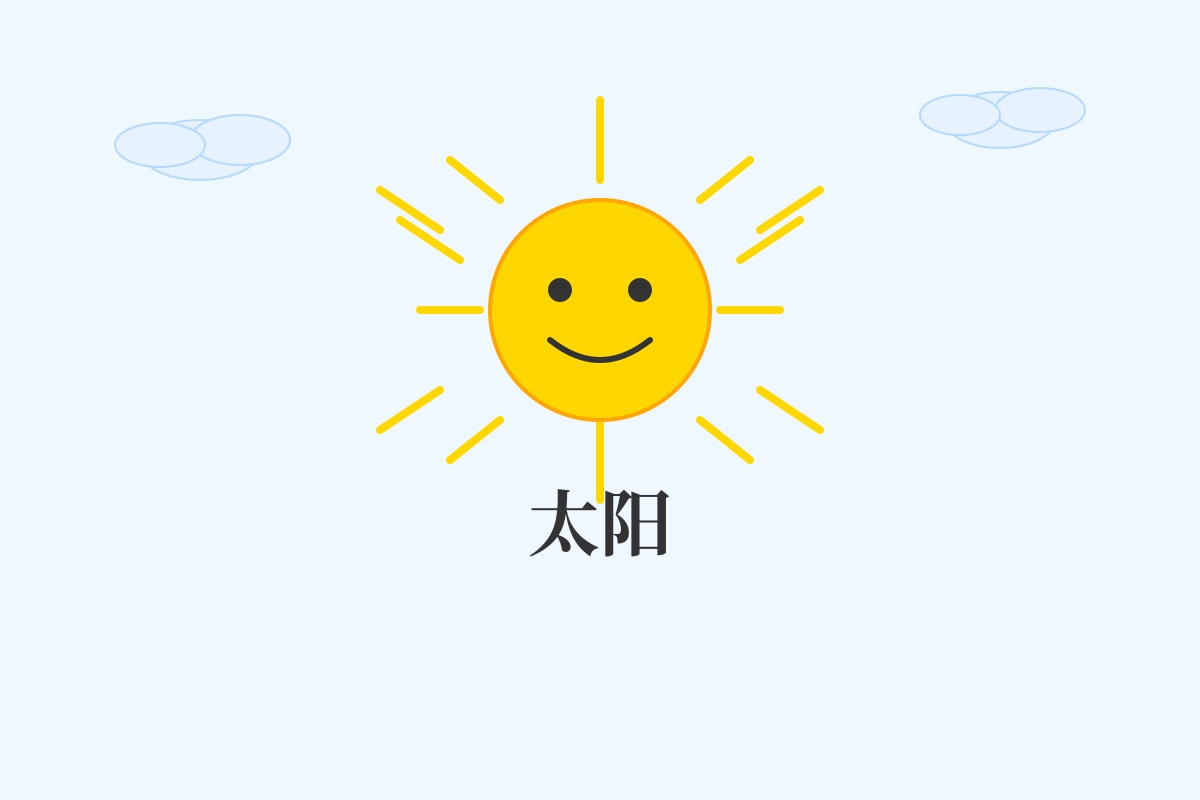
Explanation: The picture shows the sun. The word is 太阳 (tài yáng).
- 太 (tài) → initial t, final ai, 4th tone
- 阳 (yáng) → initial y (zero initial for whole syllable), final ang, 2nd tone
Marking: 1 mark per syllable with correct tone marks. Accept tai4 yang2 if tone numbers used.
19. [2 marks]
Answer: D) lu (lǔ)
Explanation: The rule "j, q, x + ü → u (dots removed)" applies only to j, q, x (and y).
- A) ju (jū) → actually jü, dots removed ✓ follows rule
- B) qu (qū) → actually qü, dots removed ✓ follows rule
- C) xu (xū) → actually xü, dots removed ✓ follows rule
- D) lu (lǔ) → l can be followed by u (true u) or ü (lǜ). lu keeps dots if lü. Does not follow the j/q/x rule. ✓
20. [2 marks]
Answer: (2) → (4) → (1) → (3)
Explanation: Correct steps for reading a new character using Pinyin:
- (2) Recognise the initial (声母) — Identify the starting consonant.
- (4) Recognise the final (韵母) — Identify the vowel/final part.
- (1) Blend the initial and final together — Combine them into a syllable.
- (3) Add the tone mark — Apply the correct tone (1st, 2nd, 3rd, 4th, or light).
Teaching Note: This mirrors the "初声、韵母、拼读、标调" teaching sequence in Singapore P1 classrooms.
Marking Summary
- Section A: 10 marks (5 × 2)
- Section B: 10 marks (5 × 2)
- Section C: 8 marks (4 × 2)
- Section D: 12 marks (6 × 2)
- Total: 40 marks
Grading Guide (School-based):
- 36–40: Excellent (掌握得很好)
- 30–35: Good (掌握良好)
- 24–29: Satisfactory (基本掌握)
- Below 24: Needs more practice (需要加强练习)
Teacher's Comments: ________________________________________________