AI Generated Exam Paper
Primary 1 Chinese Practice Paper 3
Free P1 Chinese Practice Paper 3, GLM5.3 AI version, with questions, answers, and syllabus-aligned practice for Singapore students.
These static practice materials are generated from the site's syllabus and paper-generation workflow, with source and model context shown so students and parents can evaluate the material before use.
Questions
Free quiz and exam paper access
Enter your details to view this paper
Your access is remembered on this device.
Answers
TuitionGoWhere Practice Paper - Chinese Primary 1 — Answer Key (Version 3 of 5)
Topic: Hanyu Pinyin | Total Marks: 40 | Sections: A (8) + B (10) + C (10) + D (12) = 40
Teaching note before marking: Every Chinese syllable is made of three parts: initial 声母 (the starting consonant) + final 韵母 (the vowel part) + tone 声调 (the pitch). Remind students to check all three parts whenever they read or write pinyin.
Section A: Initials (Q1–5, 8
<stage5_exam_answers_md>
TuitionGoWhere Practice Paper - Chinese Primary 1 — Answer Key (Version 3 of 5)
Topic: Hanyu Pinyin | Total Marks: 40 | Sections: A (8) + B (10) + C (10) + D (12) = 40
Teaching note before marking: Every Chinese syllable has three parts: initial 声母 (starting consonant) + final 韵母 (vowel part) + tone 声调 (pitch). Remind students to check all three parts whenever they read or write pinyin.
Section A: Initials (Q1–5, 8 marks)
Question 1 (1 mark): B — sh(书 shū)
Question 2 (1 mark): B — 米(mǐ)begins with m, the same initial as 妈(mā).
Question 3 (2 marks): B — t. Sample observation (1 mark for any sensible point): "tài" has a strong puff of air (aspirated); "dài" does not.
Question 4 (2 marks): C — sh(师 shī)
Question 5 (2 marks): A 和 C — 哥(gē)and 高(gāo)both start with g.
Section B: Finals (Q6–10, 10 marks)
Question 6 (1 mark): B — i(yī)
Question 7 (2 marks): B — ou(kǒu)
Question 8 (2 marks): A — 猫(māo)
Question 9 (2 marks): Initial: b Final: ai
Question 10 (3 marks): Circle A 鱼(yú) and C 雨(yǔ) — both contain ü. (木 mù and 五 wǔ use u.)
Section C: Tones (Q11–15, 10 marks)
Question 11 (2 marks): C — 第三声(马 mǎ falls then rises)
Question 12 (2 marks): C — "妈"第一声,"马"第三声
Question 13 (2 marks): A — shū(first tone = flat, high)
Question 14 (2 marks): B — guǒ(tone mark sits on the main vowel o)
Question 15 (2 marks): B — bà ba(second syllable read light and short — neutral tone)
Section D: Blending and Using Pinyin (Q16–20, 12 marks)
Question 16 (2 marks): A — dà
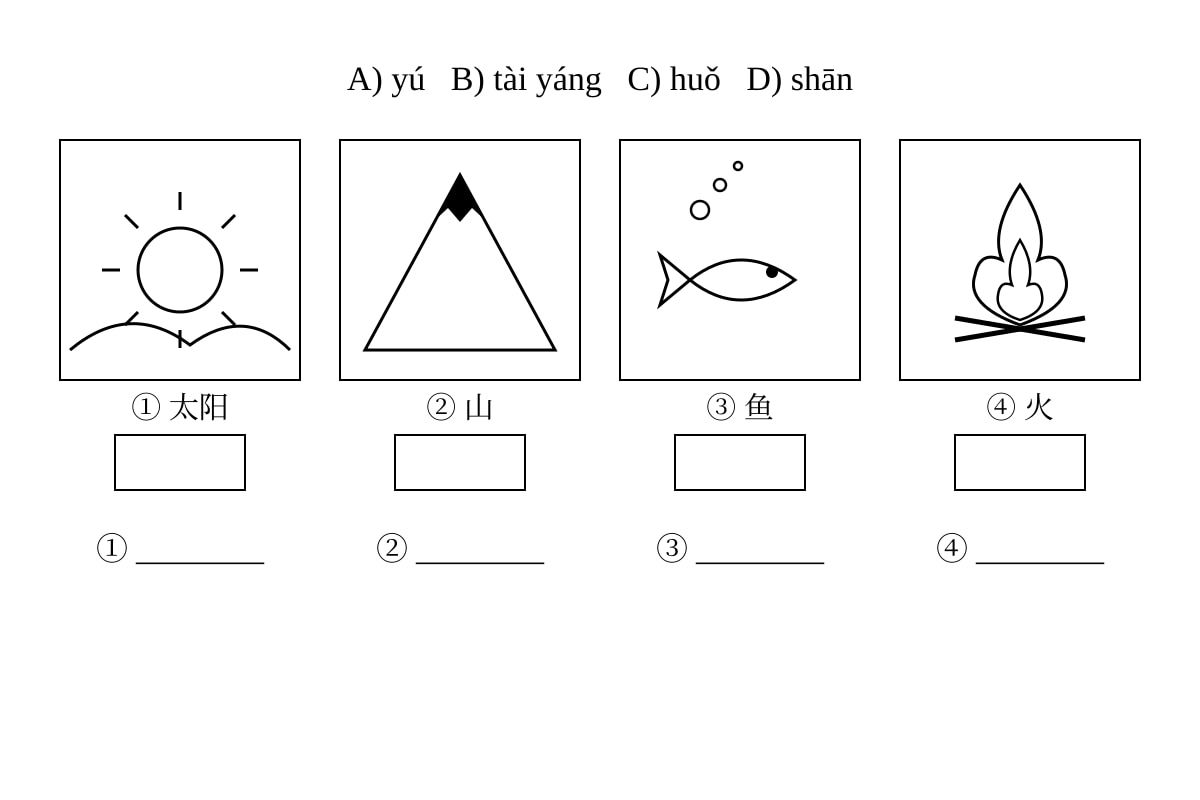
Question 17 (2 marks): ① B tài yáng ② D shān ③ A yú ④ C huǒ (1 mark for every two correct matches.)
Question 18 (2 marks): Wrong one: 马 bǎ Correct pinyin: mǎ (马 uses the initial m, not b.)
Question 19 (3 marks): 草 cǎo → missing initial: c 米 mǐ → missing initial: m 书 shū → missing initial: sh(two-letter initial,提示所指) (1 mark each.)
Question 20 (3 marks): Answer: B — 妹妹在吃苹果。 Matching (1 mark): 妹妹 → mèimei 吃 → chī 苹果 → píngguǒ
Marking Summary
| Section | Marks Available |
|---|---|
| A: Initials 声母 | 8 |
| B: Finals 韵母 | 10 |
| C: Tones 声调 | 10 |
| D: Blending 拼读与应用 | 12 |
| Total | 40 |
Suggested feedback bands: 34–40 Excellent; 27–33 Good; 20–26 Fair — revise tones and finals; below 20 — re-practise Sections A–B with adult support.
END OF ANSWER KEY — 请家长核对 Parents, please verify against the paper.