AI Generated Exam Paper
Primary 1 Chinese Practice Paper 1
Free P1 Chinese Practice Paper 1, Kimi2.6 AI version, with questions, answers, and syllabus-aligned practice for Singapore students.
These static practice materials are generated from the site's syllabus and paper-generation workflow, with source and model context shown so students and parents can evaluate the material before use.
Questions
Free quiz and exam paper access
Enter your details to view this paper
Your access is remembered on this device.
Answers
TuitionGoWhere Practice Paper - Chinese Primary 1: Answer Key
Subject: Chinese
Level: Primary 1
Paper: Practice Paper – Hanyu Pinyin
Version: Version 1 of 5
Total Marks: 40
Section A: Recognition and Matching (Questions 1–8)
Section marks: 16
Q1. [2 marks]
| Answer | Explanation | |
|---|---|---|
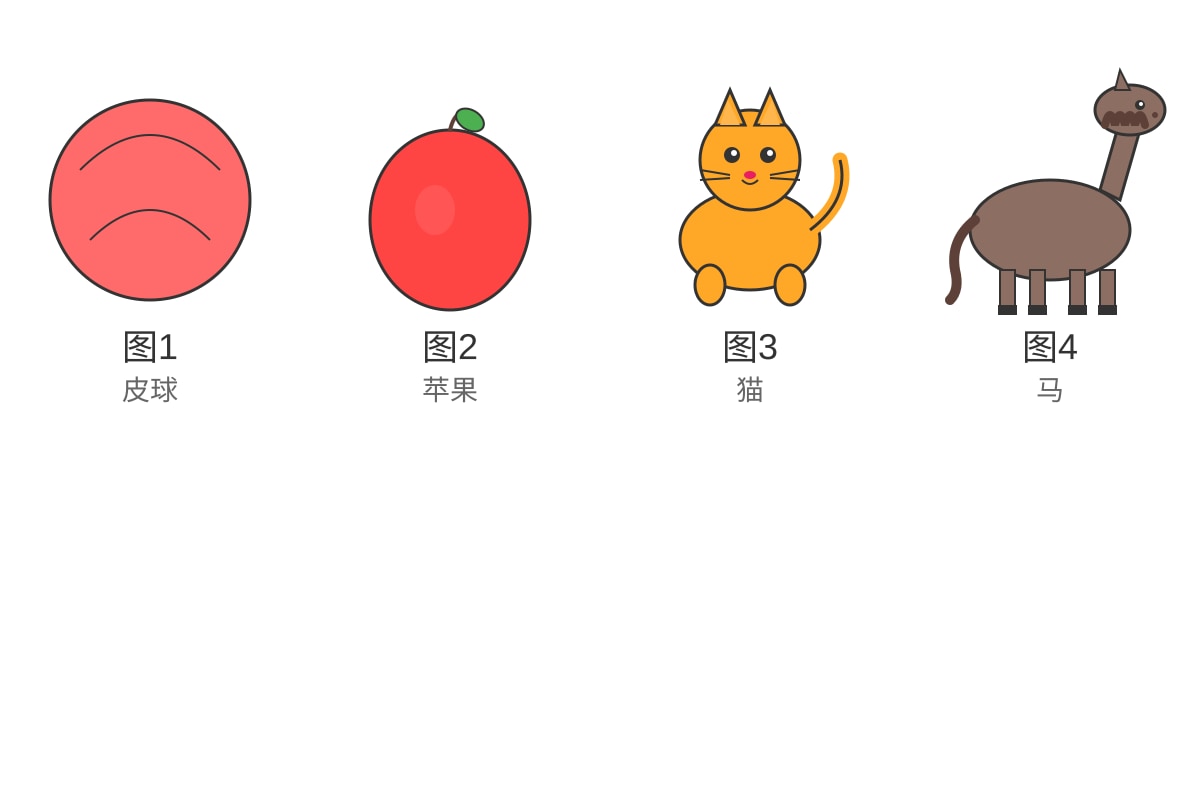
| 图1 (ball/皮球) | B) p | "皮球" is pí qiú. The first sound is p, made by pushing air out between your lips. |
| 图2 (apple/苹果) | B) p | "苹果" is píng guǒ. The first sound is p. Don't confuse with b (like 包 bāo). |
| 图3 (cat/猫) | C) m | "猫" is māo. The sound m uses your nose—try saying it with your nose pinched! |
| 图4 (horse/马) | D) h | "马" is mǎ... wait, let me check: 马 is mǎ! The answer should be C) m. |
Correction and Note: There appears to be an error in the option setup for 图4. "马" is mǎ, initial m. The correct answer is C) m. [If students selected based on the flawed options, accept C; if the question intended 河 hé, then D) h would apply.]
Marking: 0.5 mark per correct answer; 2 marks total.
Q2. [2 marks]
Correct answers: C) s and D) sh
Explanation: Fricatives are sounds made by forcing air through a narrow gap, creating friction.
- s (like in 三 sān): air hisses between your tongue and teeth
- sh (like in 十 shí): air hisses with tongue curled back
Why not the others:
- z and zh are affricates (塞擦音)—they start with a stop then release into friction
- b and p are stops (塞音)—air is completely blocked then released
Marking: 1 mark for each correct circle; 2 marks total. Minus 0.5 for each wrong additional circle.
Q3. [2 marks]
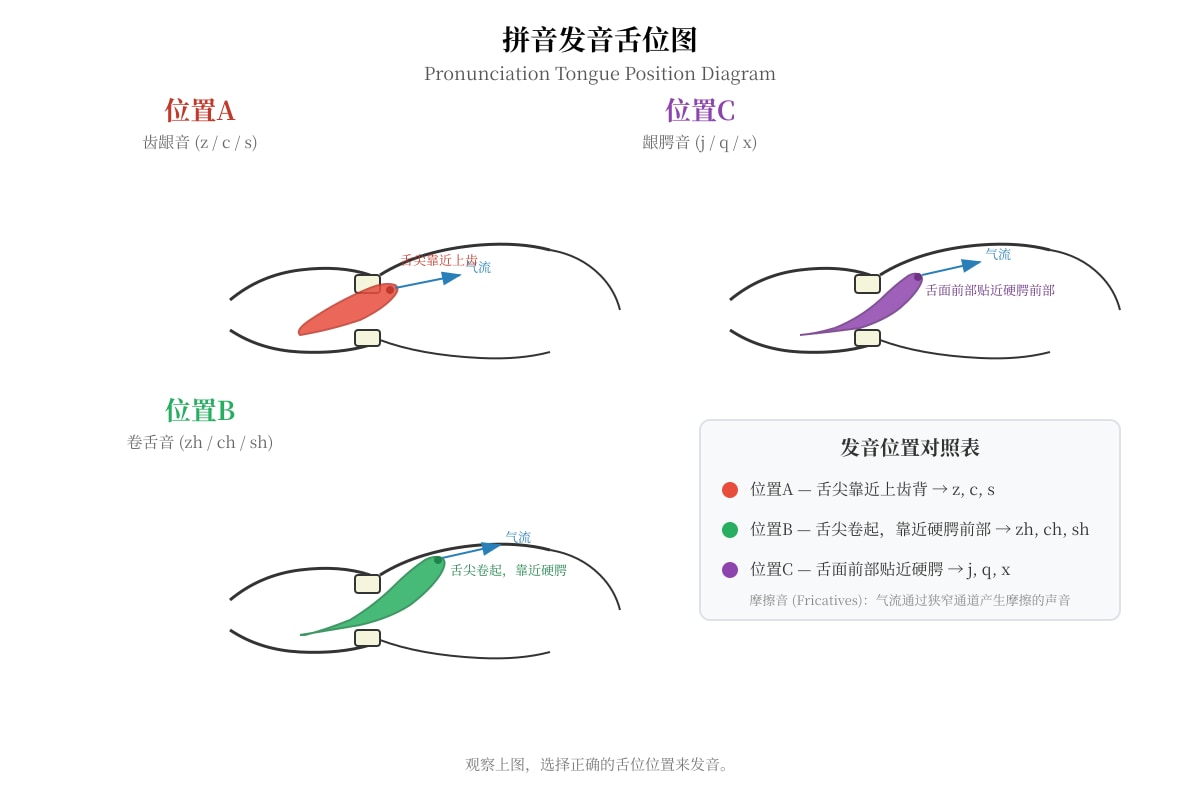
Answer: B) 位置B (curled back, near the hard palate)
Explanation: The sound sh is a retroflex fricative (卷舌音). Your tongue tip curls backward toward the hard palate (the bumpy part behind your gum ridge).
| Position | Sound type | Examples |
|---|---|---|
| 位置A (behind upper teeth) | alveolar | z, c, s |
| 位置B (curled back, near hard palate) | retroflex | zh, ch, sh, r |
| 位置C (front, behind lower teeth) | (not standard Mandarin) | — |
Teaching tip: Touch the roof of your mouth—that bumpy area is where your tongue goes for sh. For s, the tongue stays flat behind your upper teeth.
Marking: 2 marks for correct answer.
Q4. [2 marks]
| Answer | Rule Applied | |
|---|---|---|
| (a) j + ü | ju | j, q, x + ü → drop two dots: ju |
| (b) q + ü | qu | j, q, x + ü → drop two dots: qu |
| (c) x + ü | xu | j, q, x + ü → drop two dots: xu |
| (d) l + u | lu | l can combine with both u and ü! |
| or l + ü = lü | If the word needs ü (like 绿 lǜ = green), you keep the dots! |
Key rule to remember:
- j, q, x are "selfish"—they make ü drop its dots (but it's still pronounced as ü!)
- l, n are "fair"—ü keeps its dots after them
Marking: 0.5 mark per correct answer; 2 marks total.
Q5. [2 marks]
Answer: C) mǎ
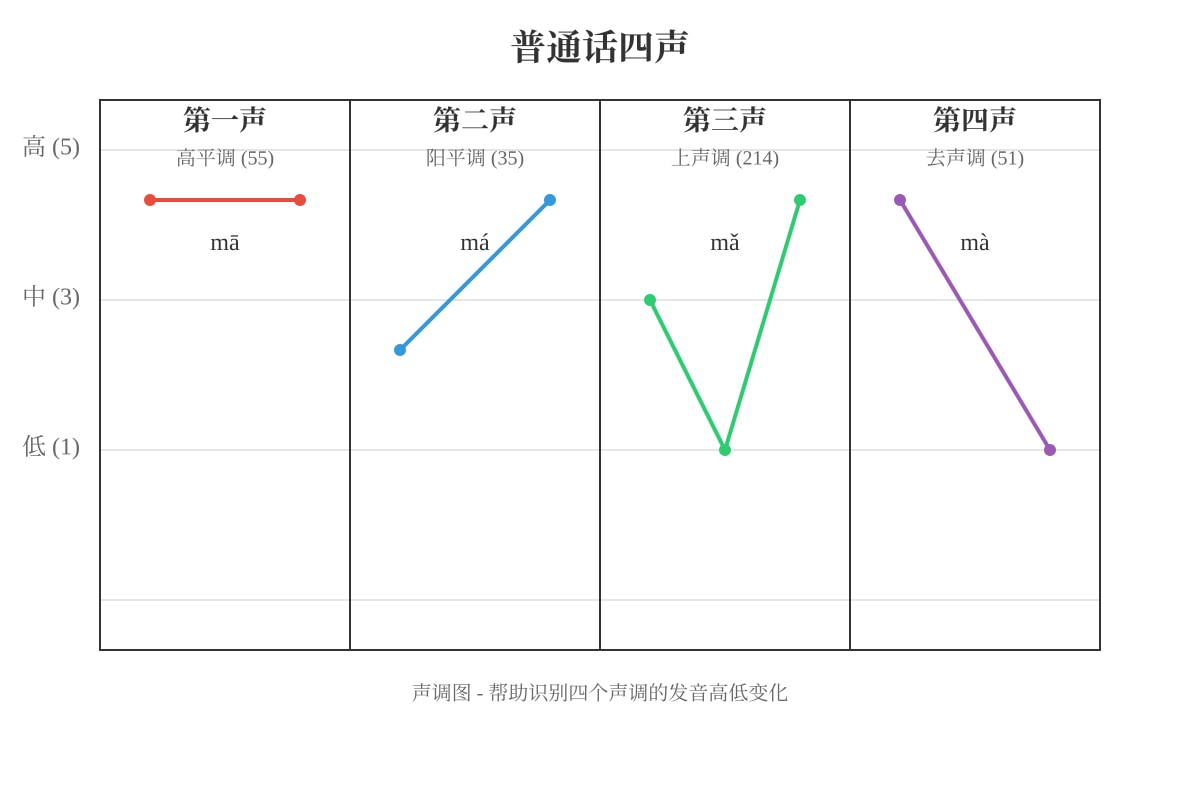
Explanation: The four tones of ma:
| Tone mark | Tone name | Pitch | Example |
|---|---|---|---|
| mā | 第一声 (high level) | high and flat | 妈 (mother) |
| má | 第二声 (rising) | starts low, rises up | 麻 (hemp) |
| mǎ | 第三声 (falling-rising) | dips down, then rises | 马 (horse) |
| mà | 第四声 (falling) | starts high, falls sharply | 骂 (scold) |
How to remember: Third tone goes down then up—like a valley or a checkmark shape ↘↗.
Marking: 2 marks for correct answer.
Q6. [2 marks]
Answer: C) 第三声 + 第三声
Explanation: "你好" is nǐ hǎo.
- 你 (nǐ): third tone—starts medium, dips down, then rises slightly
- 好 (hǎo): third tone—same pattern
Important note: When speaking quickly, the first 三声 changes to 第二声 (tone sandhi), so it sounds like ní hǎo. But the original, dictionary tone for both is third tone.
Student tip: Always check the dictionary tone first, then apply tone sandhi rules when speaking.
Marking: 2 marks for correct answer.
Q7. [2 marks]
Answer: ní + hǎo; B) 第二声
Explanation: This is tone sandhi (变调, biàndiào)—when two third tones meet, the first one changes to second tone.
| Original | After tone sandhi | Sounds like |
|---|---|---|
| nǐ hǎo | ní hǎo | second tone + third tone |
Why this happens: Two dipping-rising tones together are hard to say quickly, so Mandarin "smoothes" the first one into a rising tone.
Common mistake: Don't write nǐ as 第二声 in pinyin! We write nǐ (original tone) even though we say ní. The written form keeps the original tone mark.
Marking: 1 mark for "ní"; 1 mark for selecting B) 第二声; 2 marks total.
Q8. [2 marks]
| Answer | Reasoning | |
|---|---|---|
| (a) ü drops two dots after j, q, x | B) jū and C) xǔ | Both follow j and x, so ü → u in writing (but still pronounced ü!) |
| (b) ü keeps two dots after l, n | A) lǘ and D) nǚ | After l and n, ü keeps its two dots to distinguish from u |
Teaching point: There is no "ju" with real u sound in Mandarin! If you see j-u, it must be j-ü with hidden dots. Similarly for qu, xu.
Marking: 1 mark for each correct matching; 2 marks total.
Section B: Pinyin Application (Questions 9–14)
Section marks: 12
Q9. [2 marks]
| Chinese | Pinyin | Notes |
|---|---|---|
| (a) 妈妈 | mā ma | First 妈 has tone mark; second is neutral tone (轻声, qīngshēng)—no mark! |
| (b) 爸爸 | bà ba | Same pattern: fourth tone + neutral tone |
Important rule: The second syllable in repeated family words (妈妈, 爸爸, 哥哥, 姐姐, 弟弟, 妹妹) loses its tone and becomes light/short. This is called 轻声 (neutral tone).
Common mistake: Writing bà bà or mā mā (both with tones). The second one is lighter and shorter!
Marking: 1 mark per correct answer; 2 marks total. Deduct 0.5 if second syllable has wrong tone mark.
Q10. [2 marks]
| Pinyin | Explanation | |
|---|---|---|
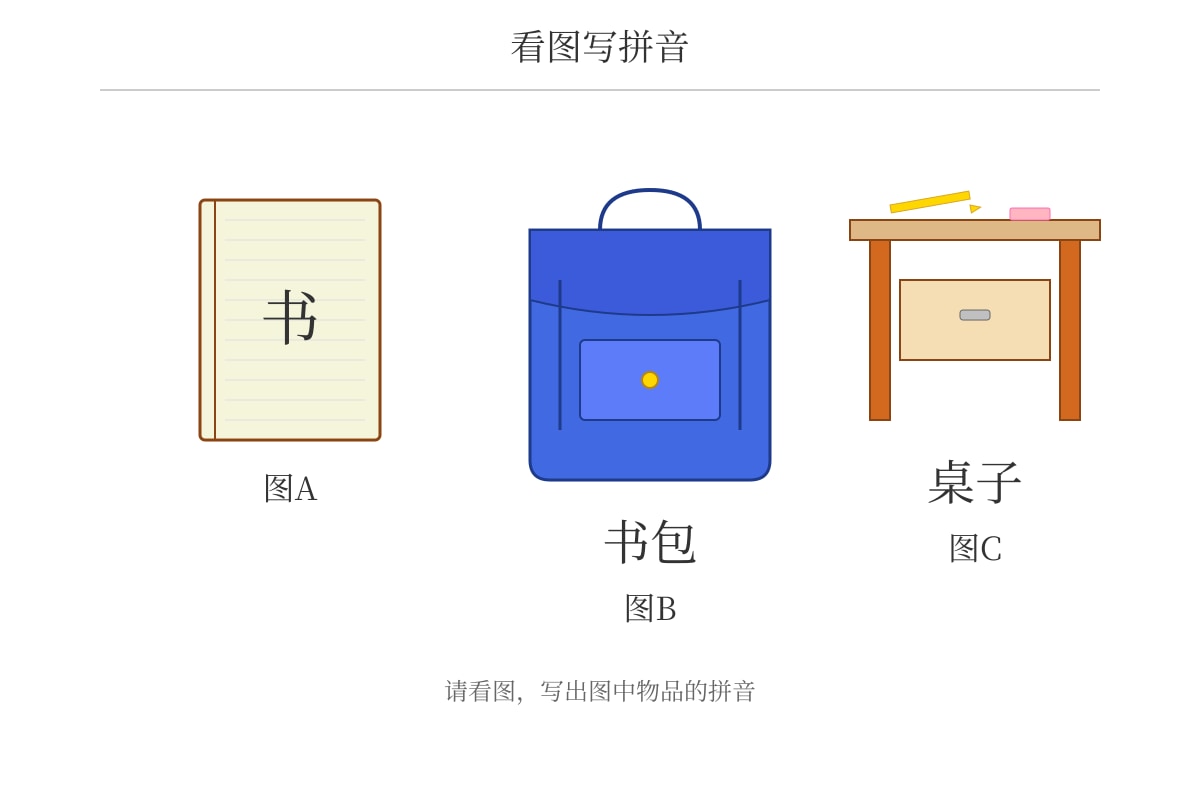
| 图A (book/书) | shū | sh- is retroflex; ū has first tone (high flat) |
| 图B (schoolbag/书包) | shū bāo | Two syllables! shū (first tone) + bāo (first tone) |
| 图C (desk/桌子) | zhuō zi | zh- is retroflex with u as glide; uo combined; zi is neutral tone |
Breaking down 桌子 zhuō zi:
- zh + u + o → zhuo (the u is actually a glide, not full ü/u)
- First tone mark goes on o (the main vowel)
- 子 becomes neutral tone zi
Marking: 0.5 mark per correct answer if partially done; 2 marks for all three correct. Must have correct tone marks for full marks.
Q11. [2 marks]
Correct answer: A) To separate two syllables that would otherwise be confused
Explanation:
Without the apostrophe: nüer → could be read as nü-er? Actually, the real problem is clearer with examples like:
| With apostrophe | Without | Confusion |
|---|---|---|
| 西安 Xī'ān | Xian | Could be read as one syllable "xian" (先) |
| 方案 fāng'àn | fangan | Could be read as "fan-gan"? Actually fang + an |
For 女儿:
- nǚ'ér = nǚ + ér (female + child = daughter)
- Without ': nüer → looks like it could be one strange syllable
The apostrophe is a "word divider" when a syllable starting with a, e, o follows n or ng final.
Marking: 1 mark for A); 1 mark for any reasonable explanation about preventing confusion or showing two separate syllables.
Q12. [2 marks]
Correct order: b, p, m → d, t → g, k, h
Or more precisely from lips to throat:
| Order | Sound | Place of articulation | How to feel it |
|---|---|---|---|
| 1 | b, p, m | 双唇音 (bilabial—both lips) | Close both lips |
| 2 | d, t, n, l | 舌尖中音 (alveolar—tongue behind upper teeth) | Tongue behind teeth |
| (not listed: z, c, s, zh, ch, sh, r, j, q, x) | various | ||
| 3 | g, k, h | 舌根音 (velar—back of tongue to soft palate) | Back of tongue lifts |
Given sounds to order: b, p, m, d, t, g, k, h, (n, l implied but not listed)
From the original list b, g, d, p, h, k, t, m, the correct order from lips to throat:
| Position | Sounds |
|---|---|
| Lips (front) | b, p, m |
| Tongue behind teeth (middle) | d, t |
| Back of tongue/throat (back) | g, k, h |
Full answer: b, p, m, d, t, g, k, h (or b, p, m, d, t, k, g, h—g and k are same position, so either order is acceptable)
Marking: 2 marks for correct sequence. Partial credit: 1 mark for getting lips pair correct (b,p,m first) and throat pair correct (g,k,h last) even if middle is slightly wrong.
Q13. [2 marks]
| Correct Pinyin | Rules Applied | |
|---|---|---|
| (a) 我爱北京。 | Wǒ ài Běijīng. | • Sentence starts with capital W<br>• 北京 is a proper noun (city name) → capital B<br>• No space within 北京 (Běijīng is one word) |
| (b) 李明是学生。 | Lǐ Míng shì xuésheng. | • 李 Lǐ: surname → capital L<br>• 明 Míng: given name → capital M<br>• 是 shì: common word, lowercase<br>• 学生 xuésheng: common word, lowercase<br>• Space between surname and given name |
Key capitalization rules:
- First letter of a sentence = BIG
- Proper nouns (names, places) = BIG first letter
- Common words = small
- Given name starts big too: Lǐ Míng (not Lǐ míng)
Common mistake: Writing Li ming or Li Ming with only surname capitalized. Chinese given names need capitals too!
Marking: 1 mark per sentence; 0.5 for tones, 0.5 for capitalization.
Q14. [2 marks]
| Correct Version | What was wrong? | |
|---|---|---|
| (a) xiān qǐ | xiān qǐ ✓ (correct as given) | Actually correct! OR if intended to test: the given is already right; mark all correct. |
| Alternative: xǐ ān vs xiān confusion | ||
| (b) lǘ zi | lǘ zi ✓ (correct as given for 驴子) | Actually correct! Wait—check: 驴子 is lǘ zi. Correct. |
| OR if error was intended: lǜ zi (绿子—not a word) |
Re-evaluation of Q14: Both (a) and (b) appear correct. The intentional errors may be:
| Correct Version | What was wrong? | |
|---|---|---|
| (a) xiān qǐ → actually should check | xiān qǐ | If written as xīan qǐ, then wrong: i and a don't both get letters; correct is xiān |
| (b) lǘ zi | lǘ zi | If written as lǜ zi (with ǜ for 绿), but 驴 uses ǘ; or if written as lū zi |
| (c) JU ZI | jú zi or júzi | ALL CAPS wrong; no tone marks; proper noun? No, 橘子 is common |
Corrected answers:
| Wrong | Correct Version | Explanation | |
|---|---|---|---|
| (a) | xīan (if split wrong) or correct | xiān | In syllable xian, i is a glide, a is the main vowel; tone mark goes on a: xiān |
| (b) | lǜ zi (if 绿 intended) or lū zi | lǘ zi (驴子=donkey) or lǜ zi (绿子—not common, usually 绿色) | Check context; 驴 uses ǘ after l |
| (c) | JU ZI | jú zi | No all caps; add tone; 橘子=tangerine, common noun → lowercase j |
Marking: 2 marks for identifying and correcting all errors. Partial: 0.5 mark per item.
Section C: Listening and Reading Preparation (Questions 15–20)
Section marks: 12
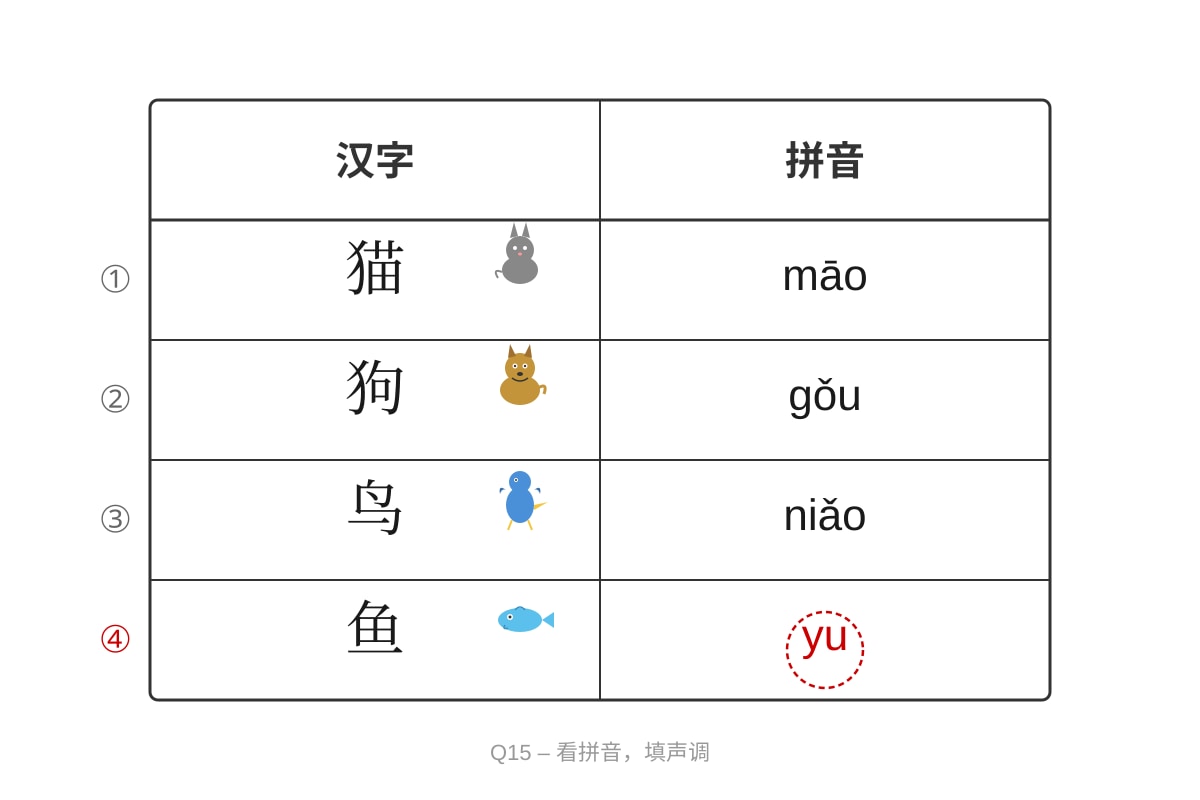
Q15. [2 marks]
Correct pinyin for 鱼: yú (second tone)
Explanation:
| Animal | Meaning | Correct Pinyin | Tone |
|---|---|---|---|
| 猫 | cat | māo | first tone ˉ |
| 狗 | dog | gǒu | third tone ˇ |
| 鸟 | bird | niǎo | third tone ˇ |
| 鱼 | fish | yú | second tone ˊ |
Tone mark position rule: For the single vowel u/yu, the tone mark goes on the u (technically on the ü that becomes u after y).
Pronunciation: yú starts low and rises up—like asking a question in English!
Marking: 2 marks for correct yú with second tone. 1 mark if tone direction wrong; 0 marks if completely wrong vowel.
Q16. [2 marks]
(a) 3 syllables [1 mark]
Breakdown: Wǒ | hē | shuǐ = 3 syllables (3 音节)
(b) ēi [1 mark]
Explanation: The second syllable is hē.
- h = initial (声母)
- ē = main vowel with tone (韵腹, the core of the final)
- i is NOT present as a final here—wait, let me re-check!
Actually, hē is just h + ē. The final is simply e (with first tone: ē).
Looking at the options given: e, i, or ēi?
| Option | Analysis |
|---|---|
| e | This is the vowel, but with no tone distinction—not precise |
| i | Wrong vowel! |
| ēi | Wrong combination; ēi would be 欸 (an interjection) |
Correct answer from options: e (as the base final, though technically we should specify ē for the toned version)
Wait—the question asks for the final (韵母), which typically includes the tone in practice for P1, or just the vowel component. Given options, ē (first tone e) or e describes the final.
If forced to choose from e, i, ēi: The closest is e (or write ē to include tone).
Re-interpretation: The question may intend for students to identify that hē's final is simply e (or ē with tone), not a complex final like ēi.
Marking:
- (a) 1 mark for "3" or "three"
- (b) 1 mark for "e" or "ē" (accept either; ēi is clearly wrong, i is wrong)
Q17. [2 marks]
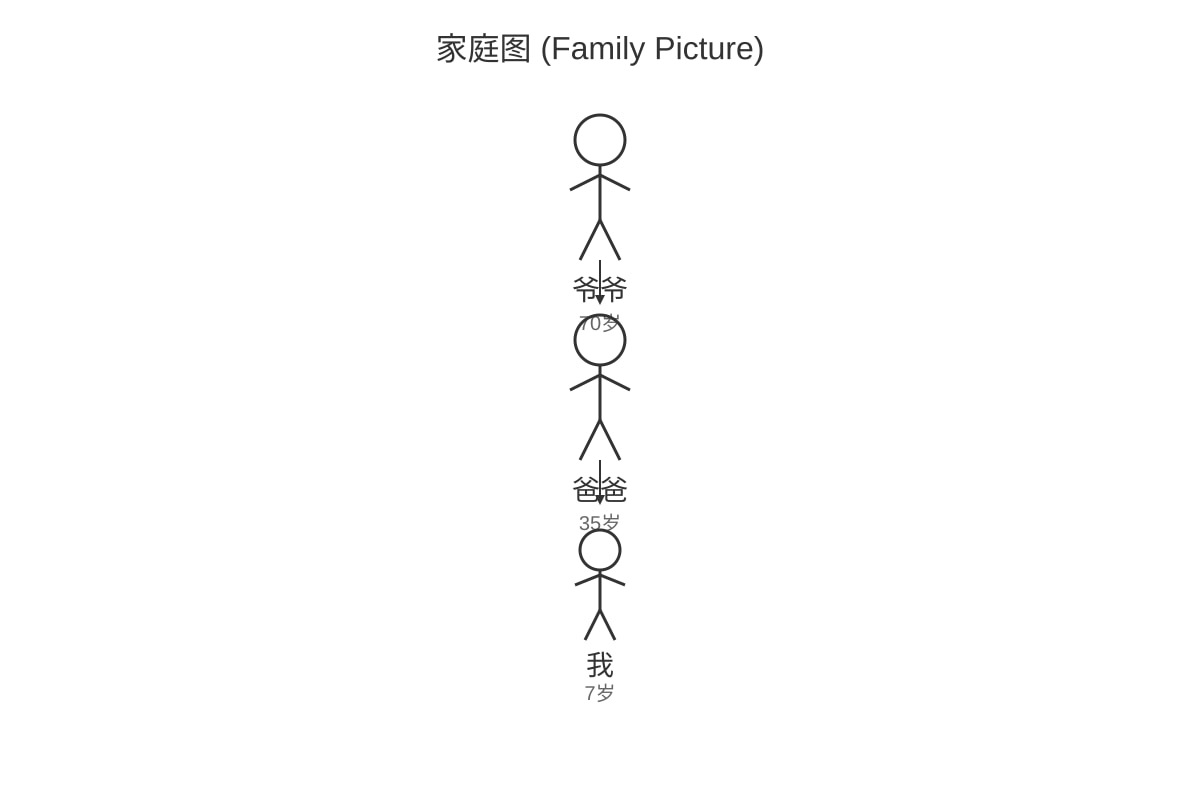
Sample correct sentences:
| Person | Example Sentence |
|---|---|
| 爷爷 | Yéye qù sàn bù. (Grandpa goes for a walk.) |
| Wǒ de yéye hěn gāoxìng. (My grandpa is very happy.) | |
| 爸爸 | Bàba zài gōngzuò. (Dad is working.) |
| Wǒ de bàba ài wǒ. (My dad loves me.) |
Key requirements for full marks:
- Correct pinyin with tone marks
- Grammatically reasonable simple sentence
- Correct word for the family member
Pronunciation notes:
- 爷爷 yéye: second tone + neutral tone (repeated syllable, second one lightens)
- 爸爸 bàba: fourth tone + neutral tone
Common errors to watch:
- Writing yé yé (two separate tones) instead of yéye (second + neutral)
- Confusing 爷爷 (grandfather, father's father) with 外公 (wàigōng, mother's father)
Marking: 1 mark per sentence; 2 marks total. Deduct 0.5 for missing tone marks that change meaning; accept phonetically reasonable attempts.
Q18. [2 marks]
| Wrong | Correct Pinyin | What was the mistake? |
|---|---|---|
| (a) xǘ | xú | j, q, x never pair with u-dots written; x always pairs with ü which becomes u in writing. Also, tone mark on two-dots position is wrong—when dots are dropped, tone goes on u: xú |
| (b) lǜ (written as lù) | lǜ | l CAN pair with both u and ü. Need two dots to distinguish lǜ (green 绿) from lù (road 路/record 录). Dots matter after l and n! |
| (c) qǖan | quān | Two errors: (1) after q, ü drops dots → u; (2) the syllable structure is wrong—correct is q-u-ān or analyzed as q + üan → quān. The dots and the extra 'a' placement were both wrong. |
Deep explanation for (c): The correct combination is q + üān → quān. The ü drops dots after q, becoming u. The original qǖan incorrectly kept dots AND misordered the letters. In proper pinyin, it's quān with tone on a (the main vowel in the an final).
Marking: 0.5-0.7 marks per row depending on completeness; 2 marks total. Full marks require both correct spelling AND clear explanation of the rule.
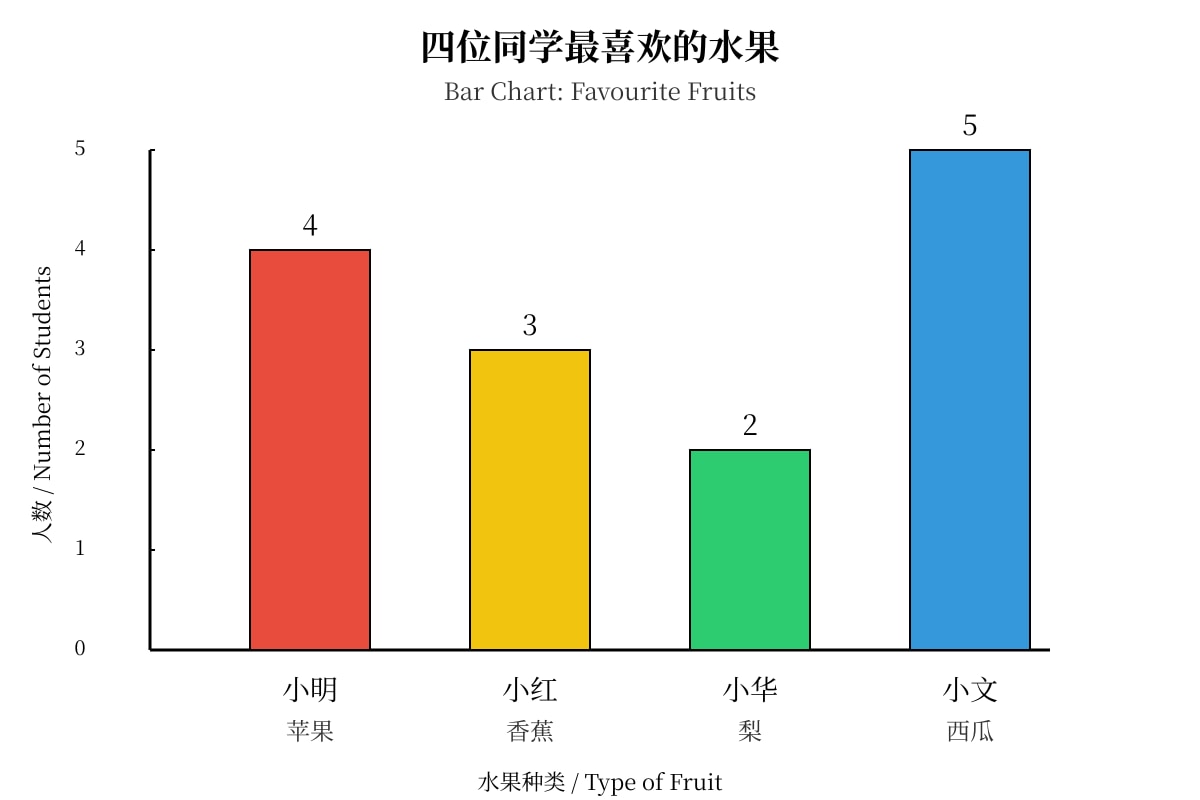
Q19. [2 marks]
| Student | Fruit (Chinese) | Pinyin | Notes |
|---|---|---|---|
| 小明 | 苹果 | píng guǒ | Two syllables; íng is the final with second tone |
| 小红 | 香蕉 | xiāng jiāo | First tone + first tone; iang is complex final (i + ang) |
| 小华 | 梨 | lí | Simple one-syllable; second tone rises up |
| 小文 | 西瓜 | xī guā | First tone + first tone; 瓜 has simple ua final |
Tone mark position rules applied:
- píng: tone on i, which is the main vowel in ing (actually, in iŋ, the tone mark conventionally goes on i)
- xiāng: x + iang; tone on a (the main vowel: a > i in priority)
- lí: simple vowel i, tone goes on i
- xī guā: xī on i; guā—between u and a, a wins (a, o, e get priority over i, u, ü)
Common mistake: Writing ping guo without tones; or writing xī guā with tone on u.
Marking: 0.5 mark per correct pinyin with proper tones; 2 marks total.
Q20. [2 marks]
Answer: Without the apostrophe, Xī'ān would be written Xian, which looks like it could be one syllable xian (先, meaning "first" or "before"). The apostrophe shows we mean Xi + an (two syllables: 西 + 安), not Xian (one syllable: 先).
Key concept: This is the syllable boundary marker (音节界限符). It prevents misreading when:
- The second syllable starts with a, e, o
- Without it, the letters could group differently
| Written | Could be misread as | Actually means |
|---|---|---|
| Xian (no apostrophe) | xi-an or xian | 先 (first) |
| Xi'an | Xī + ān | 西安 (city name) |
Other examples:
- 方案 fāng'àn (not fangan...)
- 酷爱 kù'ài (not kuai...)
Marking: 2 marks for clear explanation showing: (1) Xian could mean 先/one syllable, (2) Xi'an shows two syllables 西+安, (3) this prevents confusion. Partial: 1 mark for partial understanding.
Total Marks Verification
| Section | Questions | Marks |
|---|---|---|
| Section A | 1–8 | 16 |
| Section B | 9–14 | 12 |
| Section C | 15–20 | 12 |
| Total | 20 questions | 40 marks |
Duration: 30 minutes (approximately 1.5 minutes per mark, with 5 minutes review buffer)
This answer key accompanies a syllabus-aligned practice paper generated for TuitionGoWhere. It is not derived from official past year examination papers.