AI Generated Quiz
O Level Tamil Composition Quiz
Free O Level Tamil Composition quiz, AI version, with questions, answers, and O Level-style practice for Singapore students.
These static practice materials are generated from the site's syllabus and paper-generation workflow, with source and model context shown so students and parents can evaluate the material before use.
Questions
Free quiz and exam paper access
Enter your details to view this paper
Your access is remembered on this device.
Answers
O-Level Tamil Quiz - Composition: Answer Key
Total Marks: 40
Section A: Essay Planning and Structure (Questions 1–5)
1. What is the main purpose of writing a narrative essay? Explain briefly. [2]
Answer: The main purpose of writing a narrative essay is to tell a story or recount an event. It aims to engage the reader by presenting a sequence of events, often with a clear beginning, middle, and end, and may include characters, a setting, and a plot.
Marking Notes:
- 1 mark for identifying the purpose (to tell a story/recount an event).
- 1 mark for a brief explanation (e.g., engaging the reader, having a plot).
Common Mistake: Students may confuse narrative with descriptive. A narrative focuses on events; a descriptive focuses on sensory details.
2. List any two key elements that should be included in the introduction paragraph of a descriptive essay. [2]
Answer: Any two of the following:
- A hook or engaging opening sentence to capture the reader's attention.
- A clear statement of the subject being described (e.g., a place, person, or object).
- An overview of the overall impression or mood the description will convey.
Marking Notes:
- 1 mark for each correctly identified element (max 2).
- Accept reasonable alternatives like "setting the scene" or "introducing the topic."
Common Mistake: Listing elements of a narrative essay (e.g., characters, plot) instead of descriptive.
3. What is the difference between a narrative essay and a descriptive essay? Provide one sentence for each. [2]
Answer:
- Narrative essay: A narrative essay tells a story or recounts a sequence of events.
- Descriptive essay: A descriptive essay creates a vivid picture of a person, place, object, or experience using sensory details.
Marking Notes:
- 1 mark for a correct definition of a narrative essay.
- 1 mark for a correct definition of a descriptive essay.
Common Mistake: Giving similar definitions for both. The key difference is story vs. sensory description.
4. Why is it important to use a variety of sentence structures in a composition? Give one reason. [2]
Answer: Using a variety of sentence structures makes the writing more engaging and less monotonous for the reader. It also helps to emphasize different ideas and create a better rhythm in the text.
Marking Notes:
- 2 marks for a clear and relevant reason.
- 1 mark for a partially correct or vague answer (e.g., "it makes it better").
Common Mistake: Saying "it makes the essay longer" – this is not the primary reason.
5. In the context of essay writing, what does the term "conclusion" refer to? Explain in one sentence. [2]
Answer: The conclusion is the final paragraph of an essay that summarizes the main points, restates the thesis or main idea in a new way, and provides a sense of closure for the reader.
Marking Notes:
- 2 marks for a complete and accurate explanation.
- 1 mark for a partial answer (e.g., "it's the ending").
Common Mistake: Confusing conclusion with a summary that simply repeats the introduction.
Section B: Vocabulary and Language Use (Questions 6–10)
6. Choose the most appropriate word to complete the sentence: [2]
The old man walked ______________ along the dusty road.
a) quickly
b) slowly
c) loudly
d) angrily
Answer: b) slowly
Explanation: The context of "old man" and "dusty road" suggests a slow, perhaps tired or leisurely pace. "Slowly" is the most logical and descriptive choice.
Marking Notes:
- 2 marks for correct answer.
- 0 marks for incorrect answer.
Common Mistake: Choosing "angrily" or "loudly" without considering the context.
7. Rewrite the following sentence using a more descriptive verb: [2]
"The girl went to the shop."
Answer: (Accept any reasonable answer that uses a more specific verb than "went". Examples:)
- The girl hurried to the shop.
- The girl skipped to the shop.
- The girl strolled to the shop.
- The girl rushed to the shop.
Explanation: "Went" is a generic verb. Using a more descriptive verb (e.g., hurried, skipped, strolled, rushed) adds detail about the manner of movement and creates a clearer image.
Marking Notes:
- 2 marks for a sentence with a clearly more descriptive verb.
- 1 mark for a sentence that is slightly improved but still uses a weak verb.
Common Mistake: Adding an adverb (e.g., "went quickly") instead of changing the verb itself.
8. Identify the idiom in the following sentence and explain its meaning: [2]
"He was pulling my leg the whole time."
Answer:
- Idiom: pulling my leg
- Meaning: To tease or joke with someone, often by telling them something that is not true.
Marking Notes:
- 1 mark for correctly identifying the idiom.
- 1 mark for a correct explanation of its meaning.
Common Mistake: Interpreting the idiom literally (e.g., "he was physically pulling my leg").
9. Fill in the blank with the correct compound word from the list: [2]
(அடக்கவொடுக்கம், ஆற அமர, இல்லாததும் பொல்லாததும்)
The children sat ______________ and listened to the story.
Answer: ஆற அமர
Explanation: "ஆற அமர" (aara amara) is a compound word meaning "calmly and patiently" or "settled down." It fits the context of children sitting and listening attentively.
Marking Notes:
- 2 marks for correct answer.
- 0 marks for incorrect answer.
Common Mistake: Choosing "இல்லாததும் பொல்லாததும்" (meaning "all sorts of things") which doesn't fit the context.
10. Write a short sentence (2-3 lines) that uses both a simile and a metaphor to describe a stormy sea. [2]
Answer: (Accept any reasonable answer that correctly uses both. Example:) "The waves were like angry giants (simile), and the sea was a roaring beast (metaphor) that threatened to swallow the shore."
Explanation:
- Simile: A comparison using "like" or "as" (e.g., "like angry giants").
- Metaphor: A direct comparison stating one thing is another (e.g., "the sea was a roaring beast").
Marking Notes:
- 1 mark for correctly using a simile.
- 1 mark for correctly using a metaphor.
- 0 marks if only one is used or if they are used incorrectly.
Common Mistake: Using two similes or two metaphors instead of one of each.
Section C: Composition Writing (Questions 11–20)
11. Write a short paragraph (4-5 sentences) describing your favourite place. Use at least three sensory details (sight, sound, smell, touch, taste). [4]
Answer: (Model answer – accept any reasonable paragraph that meets the criteria.) "My favourite place is the library. I can see rows and rows of colourful books neatly arranged on tall shelves (sight). I can hear the gentle rustling of pages as people read (sound). I can smell the faint, pleasant scent of old paper and ink (smell). It is a peaceful haven where I can escape into different worlds."
Marking Notes:
- 1 mark for a clear description of a place.
- 3 marks for including at least three distinct sensory details (1 mark each).
- Deduct marks for not meeting the sentence count or for unclear writing.
Common Mistake: Listing sensory details without integrating them into a coherent paragraph.
12. You are asked to write a story that begins with the sentence: "It was a dark and stormy night." Write the next three sentences of the story. [4]
Answer: (Model answer – accept any creative and coherent continuation.) "It was a dark and stormy night. The wind howled like a pack of wolves, rattling the windows of the old house. Rain lashed against the glass, blurring the world outside. A sudden flash of lightning illuminated a shadowy figure standing by the gate."
Marking Notes:
- 1 mark for maintaining the mood/tone set by the opening sentence.
- 1 mark for each coherent and engaging sentence (max 3 marks).
- 0 marks for sentences that are unrelated or break the narrative flow.
Common Mistake: Changing the tense or introducing a completely unrelated event.
13. Write a short dialogue (4-6 lines) between two friends who are planning a surprise party for a third friend. [4]
Answer: (Model answer – accept any reasonable dialogue.) A: "I think we should have the party at the park." B: "That's a great idea! What about the cake?" A: "I'll ask my mom to bake a chocolate cake. It's Ravi's favourite." B: "Perfect! Should we invite the whole class?" A: "No, let's keep it small. Just his closest friends." B: "Okay. I'll make the invitations tonight."
Marking Notes:
- 1 mark for correct dialogue format (new line for each speaker).
- 1 mark for staying on topic (planning a surprise party).
- 2 marks for natural and engaging conversation.
- Deduct marks if the dialogue is too short or lacks coherence.
Common Mistake: Writing a narrative instead of a dialogue, or forgetting to indicate who is speaking.
14. Describe the image below in 3-4 sentences. Use vivid language. [4]
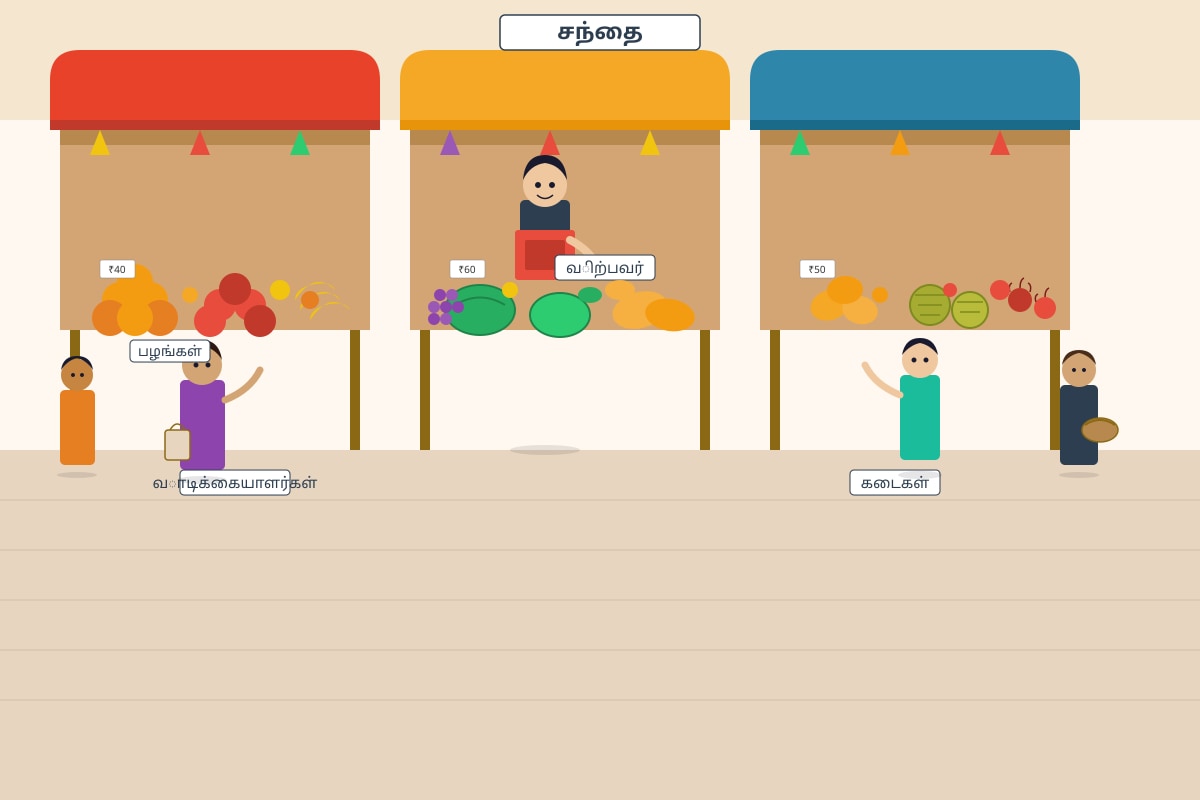
Generated image for Q14.
Answer: (Model answer – accept any reasonable description based on the image.) "The market was a vibrant explosion of colours and sounds. A cheerful vendor was arranging a pyramid of bright red apples and sunny yellow oranges. Customers jostled gently as they examined the fresh produce, their voices blending into a lively hum. The air was filled with the sweet fragrance of ripe mangoes and the earthy scent of vegetables."
Marking Notes:
- 1 mark for describing the setting (market).
- 1 mark for describing the vendor and/or customers.
- 2 marks for using vivid, sensory language (e.g., colours, sounds, smells).
- Deduct marks for vague or generic descriptions.
Common Mistake: Simply listing what is in the image without creating a vivid picture.
15. Write a short paragraph (4-5 sentences) explaining the importance of saving money. Use at least two examples. [4]
Answer: (Model answer – accept any reasonable explanation with examples.) "Saving money is important because it provides financial security for the future. For example, having savings can help you pay for unexpected expenses, like a medical emergency or a car repair. It also allows you to achieve long-term goals, such as buying a house or funding your education. By saving regularly, you can build a safety net and avoid debt."
Marking Notes:
- 1 mark for a clear explanation of the importance of saving.
- 1 mark for each relevant example (max 2 marks).
- 1 mark for a coherent and well-structured paragraph.
- Deduct marks for not meeting the sentence count.
Common Mistake: Giving only one example or providing examples that are not directly related to saving money.
16. You are writing a story about a lost puppy. Write the climax of the story (the most exciting part) in 3-4 sentences. [4]
Answer: (Model answer – accept any creative and exciting climax.) "The puppy, shivering and alone, found itself at the edge of a busy road. Cars whizzed by, their horns blaring. Just as it was about to step onto the road, a little girl's voice called out, 'Buddy!' The puppy's ears perked up, and it turned to see its owner running towards it, tears of joy streaming down her face."
Marking Notes:
- 1 mark for creating a moment of high tension or excitement.
- 1 mark for staying on topic (lost puppy).
- 2 marks for engaging and descriptive writing.
- Deduct marks for a climax that is not exciting or is resolved too quickly.
Common Mistake: Writing the resolution (finding the owner) instead of the climax (the most tense moment).
17. Rewrite the following paragraph to make it more engaging. Use more descriptive language and vary the sentence structure. [4]
"The boy went to the park. He saw a dog. The dog was big. The boy was scared."
Answer: (Model answer – accept any reasonable improvement.) "As the boy stepped into the sunlit park, his eyes fell upon a massive dog. The creature's fur was as dark as coal, and its deep bark echoed through the air. A shiver of fear ran down the boy's spine, and he froze in his tracks."
Explanation: The original paragraph uses short, simple sentences. The improved version uses more descriptive language (e.g., "sunlit park," "massive dog," "fur as dark as coal") and varies sentence structure (e.g., starting with a dependent clause, using a compound sentence).
Marking Notes:
- 2 marks for using more descriptive language.
- 2 marks for varying sentence structure.
- Deduct marks for only minor changes or for making the paragraph longer without improving quality.
Common Mistake: Simply adding adjectives without changing the sentence structure.
18. Write a short essay (5-7 sentences) on the topic: "The Importance of Reading Books." Include an introduction, two body points, and a conclusion. [4]
Answer: (Model answer – accept any reasonable essay that follows the structure.) "Reading books is a valuable habit that offers numerous benefits. (Introduction) Firstly, it expands our knowledge and vocabulary, helping us learn about different cultures, ideas, and subjects. (Body Point 1) Secondly, reading improves our concentration and critical thinking skills, as we follow complex plots and analyse characters. (Body Point 2) In conclusion, making reading a regular part of our lives can enrich our minds and broaden our perspectives. (Conclusion) "
Marking Notes:
- 1 mark for a clear introduction.
- 1 mark for each relevant body point (max 2 marks).
- 1 mark for a clear conclusion.
- Deduct marks for not meeting the sentence count or for lacking structure.
Common Mistake: Writing a single paragraph without clear introduction, body, and conclusion.
19. Imagine you are a journalist. Write the first paragraph of a news report about a school event (e.g., a sports day or a cultural festival). Use a formal tone. [4]
Answer: (Model answer – accept any reasonable news report lead.) "Singapore, 15 October 2024 – The annual Sports Day at Raffles Institution concluded yesterday with record-breaking performances and enthusiastic participation from students across all levels. The event, held at the school's main field, featured a variety of track and field events, including the 100-metre sprint, relay races, and the long jump. Principal Mrs. Tan Wei Ling praised the students for their sportsmanship and dedication."
Marking Notes:
- 1 mark for using a formal, journalistic tone.
- 1 mark for including key details (what, when, where).
- 1 mark for a clear and engaging lead sentence.
- 1 mark for overall coherence.
- Deduct marks for using an informal tone or for missing key details.
Common Mistake: Writing in a narrative or personal style instead of a formal news report style.
20. Write a short story (8-10 sentences) based on the following proverb: "Slow and steady wins the race." [4]
Answer: (Model answer – accept any story that clearly illustrates the proverb.) "Once, a speedy hare mocked a slow tortoise for his pace. The tortoise challenged the hare to a race. The hare sprinted ahead and, confident of winning, decided to take a nap under a tree. Meanwhile, the tortoise plodded along, never stopping. He moved slowly but steadily, one step at a time. When the hare woke up, he was shocked to see the tortoise near the finish line. He ran as fast as he could, but it was too late. The tortoise had crossed the finish line first. The hare learned that consistency and perseverance are more important than speed."
Marking Notes:
- 1 mark for a clear story structure (beginning, middle, end).
- 1 mark for staying on topic (illustrating the proverb).
- 2 marks for engaging and coherent writing.
- Deduct marks for a story that is too short or does not clearly relate to the proverb.
Common Mistake: Simply explaining the proverb instead of telling a story.
END OF ANSWER KEY