AI Generated Quiz
O Level Social Studies Source Based Skills Quiz
Free O Level Social Studies Source Based Skills quiz, AI version, with questions, answers, and O Level-style practice for Singapore students.
These static practice materials are generated from the site's syllabus and paper-generation workflow, with source and model context shown so students and parents can evaluate the material before use.
Questions
Free quiz and exam paper access
Enter your details to view this paper
Your access is remembered on this device.
Answers
Answer Key: O-Level Social Studies Quiz - Source Based Skills
Total Marks: 50
Section A: Inference and Comparison (Questions 1–5)
Question 1 [2 marks]
- Answer: The source suggests a partnership or collaborative relationship between the government and citizens. Evidence: The minister states that the nation's strength is in "the trust between our people and our government" and describes the relationship as a "partnership" for navigating challenges.
- Marking Notes:
- 1 mark for a valid inference (e.g., partnership, collaborative, trusting).
- 1 mark for supporting evidence from the source.
- Teaching Note: Inference means reading between the lines. The source doesn't explicitly say "the government and citizens are partners," but the use of words like "trust," "together," and "partnership" strongly implies this. Students should avoid simply repeating the source and should state the conclusion they draw from it.
Question 2 [1 mark]
- Answer: The government views citizen participation as essential/important for navigating a complex and uncertain world and building a resilient and inclusive society.
- Marking Notes:
- 1 mark for a clear statement of the government's positive view.
- Teaching Note: This is a direct recall question. The answer is explicitly stated in the source: "This partnership is essential for navigating a complex and uncertain world."
Question 3 [1 mark]
- Answer: The key message is that active citizen participation and trust are the foundations of a strong nation.
- Marking Notes:
- 1 mark for a concise statement of the main idea.
- Teaching Note: The main message is the central idea the speaker wants the audience to remember. It's the "takeaway" point. In this case, it's about the importance of the government-citizen partnership.
Question 4 [3 marks]
- Answer: Source A presents a positive view of citizen participation, where the government values and partners with citizens. Source B presents a negative/sceptical view, where the citizen feels their participation is ineffective ("just for show") and that the government does not genuinely listen. The difference is between an ideal of partnership and a perception of tokenism.
- Marking Notes:
- 1 mark for identifying the view in Source A (positive/partnership).
- 1 mark for identifying the contrasting view in Source B (negative/tokenism).
- 1 mark for explaining the difference clearly.
- Teaching Note: Comparison requires identifying similarities and differences. Here, the key difference is in the perceived effectiveness of participation. Students must reference both sources to show the contrast.
Question 5 [2 marks]
- Answer: The citizen may have had a personal experience where their feedback was not implemented, leading to disillusionment. Alternatively, the minister, as a government representative, is presenting the official, idealised vision, while the citizen is sharing a ground-level, personal experience.
- Marking Notes:
- 1 mark for a plausible reason related to personal experience or perspective.
- 1 mark for a brief explanation.
- Teaching Note: This question asks students to think about why perspectives differ. Possible reasons include different roles (government official vs. ordinary citizen), different experiences (positive vs. negative), or different goals (promoting policy vs. expressing frustration).
Section B: Reliability and Utility (Questions 6–10)
Question 6 [3 marks]
- Answer: Source C is less reliable because it is a blog post by a freelance journalist with a known critical bias against MNCs. It is published on a personal website, not an official or peer-reviewed platform. Source D is an official government report from MTI, which is a credible authority on the Singapore economy. The purpose of Source C is to argue a point, while Source D's purpose is to inform based on official data.
- Marking Notes:
- 1 mark for identifying the author's bias/purpose in Source C.
- 1 mark for identifying the official/professional nature of Source D.
- 1 mark for explaining why this makes Source C less reliable.
- Teaching Note: Reliability is assessed by considering the author, purpose, and context of a source. A source with a clear bias or a non-expert author is generally less reliable for factual information than an official, expert source.
Question 7 [2 marks]
- Answer: Source C is useful for understanding a critical perspective on globalisation that exists in public discourse. It shows the arguments and concerns of those who oppose the current model of globalisation. A student studying different viewpoints would find this valuable, even if the source is not factually balanced.
- Marking Notes:
- 1 mark for identifying the perspective it provides (critical/opposition).
- 1 mark for explaining its utility for studying different viewpoints.
- Teaching Note: Utility is about how useful a source is for a specific purpose. A biased source can be very useful for understanding a particular viewpoint, even if it's not reliable for facts.
Question 8 [3 marks]
- Answer: Source D is reliable as it comes from an official government ministry with access to comprehensive data. However, its reliability is limited because it is a government source with a vested interest in presenting a positive picture of its own policies. It may downplay the negative impacts of globalisation, such as job displacement for lower-skilled workers. Therefore, it is reliable for the government's official position but not for a fully objective account.
- Marking Notes:
- 1 mark for identifying why it is reliable (official source, expert).
- 1 mark for identifying a limitation (potential bias, vested interest).
- 1 mark for a balanced conclusion.
- Teaching Note: Students should avoid giving a simple "yes" or "no" answer. A good answer acknowledges both the strengths and weaknesses of a source's reliability.
Question 9 [3 marks]
- Answer: Source D is highly useful for a historian studying the government's response. It provides the official policy, the government's stated rationale, and specific examples of programmes (e.g., SkillsFuture). It is a primary source document from the time period. However, its utility is limited because it only shows the government's perspective and does not include independent evaluations of the effectiveness of these policies.
- Marking Notes:
- 1 mark for stating it is useful and why (official policy, primary source).
- 1 mark for providing a specific example from the source (SkillsFuture).
- 1 mark for identifying a limitation (only one perspective).
- Teaching Note: For utility, students must always link their answer to the specific purpose mentioned in the question (e.g., "for a historian studying...").
Question 10 [4 marks]
- Answer: Source D is more trustworthy for factual information. It is an official government report from a ministry with expertise and access to data, published on an official website. Its purpose is to inform the public. Source C is a blog post from a journalist with a known critical bias, published on a personal website. Its purpose is to persuade and criticise. Therefore, Source D is more reliable for objective facts about the economic effects of globalisation.
- Marking Notes:
- 1 mark for a clear choice (Source D).
- 1 mark for explaining why Source D is reliable (official, expert, purpose).
- 1 mark for explaining why Source C is less reliable (bias, non-expert, purpose).
- 1 mark for a well-structured comparison.
- Teaching Note: This is a comparative reliability question. Students must directly compare the two sources on the same criteria (author, purpose, context) to justify their choice.
Section C: Surprise and Evaluation (Questions 11–15)
Question 11 [3 marks]
- Answer: Yes, the information in Source E would be surprising. Source F presents a harmonious picture where the government welcomes youth activism and provides support. Source E, however, suggests a more confrontational relationship, with youth asking "tough questions" and government reps feeling "uncomfortable." This contrast between cooperation and tension would be unexpected for someone who only read Source F.
- Marking Notes:
- 1 mark for stating "yes, it would be surprising."
- 1 mark for explaining the expectation from Source F (harmonious).
- 1 mark for explaining the surprise from Source E (confrontational).
- Teaching Note: "Surprise" is a specific skill. It asks whether the content of one source is expected or unexpected given the content of another source. The key is to establish the "expectation" first.
Question 12 [2 marks]
- Answer: The government's response is positive because it "welcomed this trend" and provided "grants and mentorship" to support youth initiatives. The Minister is quoted as being "encouraged" by their energy, showing official approval.
- Marking Notes:
- 1 mark for identifying the welcoming/supportive response.
- 1 mark for providing evidence from the source.
- Teaching Note: This is a source-based question. Students must use only the information in Source F to support their answer.
Question 13 [2 marks]
- Answer: The activist might be critical because the government reps "seemed uncomfortable" when asked about structural changes like minimum wage. This suggests the government is resistant to deeper, systemic changes that the activist believes are necessary.
- Marking Notes:
- 1 mark for identifying the criticism (government discomfort/resistance).
- 1 mark for providing evidence from the source.
- Teaching Note: This is a source-based question. Students must use only the information in Source E to support their answer.
Question 14 [4 marks]
- Answer: To a limited extent. Source F provides the government's positive perspective on youth participation. Source E provides a more critical, activist perspective. Together, they show two sides of the same coin. However, they do not provide a fully balanced view because they are only two specific voices. Source F is a general news article, while Source E is one individual's tweet. A balanced view would require more sources representing a wider range of youth and government voices.
- Marking Notes:
- 1 mark for stating "to a limited extent" or similar.
- 1 mark for explaining the balance they do provide (two perspectives).
- 1 mark for explaining the limitation (only two voices, not representative).
- 1 mark for a clear, evaluative conclusion.
- Teaching Note: This is an evaluation question. Students must make a judgement and support it with reasoning. A good answer acknowledges both the strengths and weaknesses of the sources in providing a balanced view.
Question 15 [3 marks]
- Answer: Source E is more valuable for understanding the tensions in the relationship. It provides a raw, unfiltered perspective from a participant, showing that the relationship is not always smooth. Source F is more valuable for understanding the official relationship and the government's supportive framework. However, for a critical understanding, Source E is more valuable as it reveals challenges that the official source (F) might downplay.
- Marking Notes:
- 1 mark for a clear choice.
- 1 mark for justifying the choice with reference to the source's content.
- 1 mark for explaining what the other source lacks.
- Teaching Note: This question asks for a personal judgement based on a specific purpose (understanding the relationship). Students should explain why their chosen source is more helpful for that purpose.
Section D: Synthesis and Evaluation (Questions 16–20)
Question 16 [2 marks]
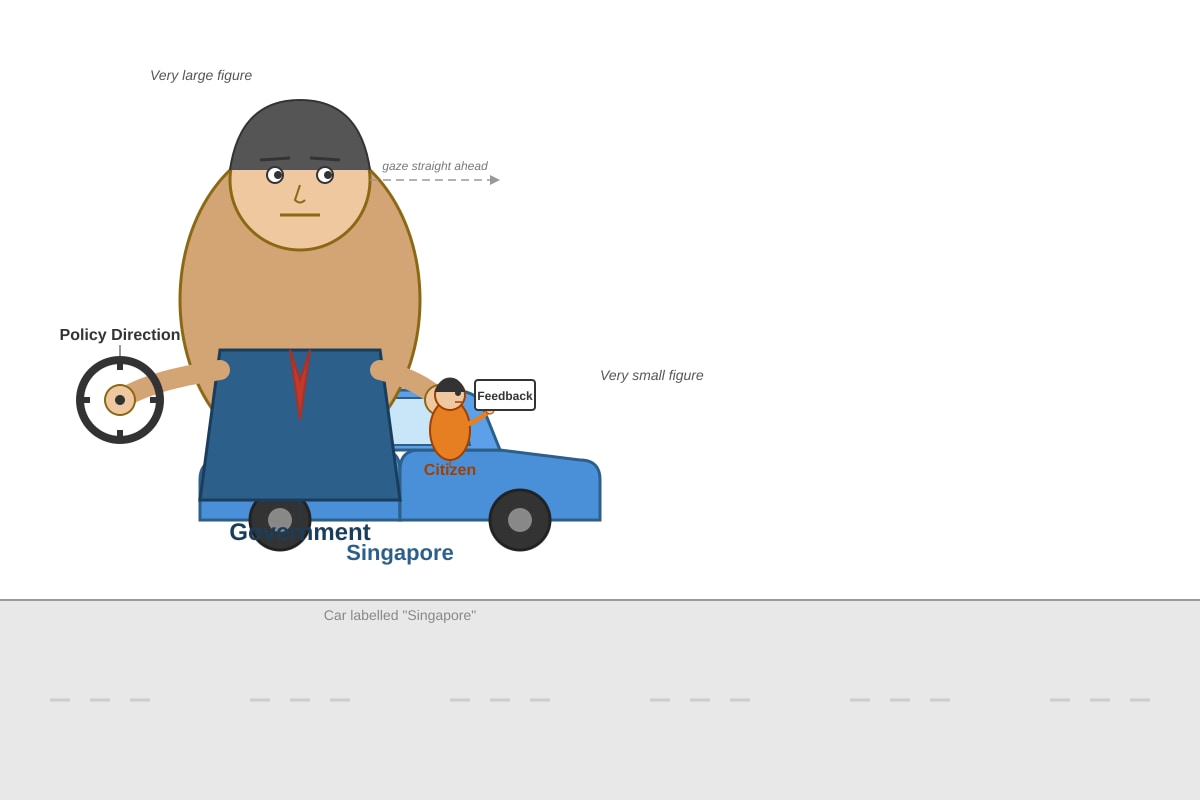
- Answer: The main message is that the government has all the power and control ("steering wheel"), while citizens have very little influence. The citizen's feedback is small and ignored, suggesting that participation is superficial and does not affect real decision-making.
- Marking Notes:
- 1 mark for identifying the power imbalance.
- 1 mark for explaining the message about citizen participation being ineffective.
- Teaching Note: Students must interpret the visual elements of the cartoon (size, position, objects) to infer the message.
Question 17 [3 marks]
- Answer: Source G presents a vision of equal partnership where both government and citizens work together. Source H challenges this by showing a clear power imbalance, with the government in control and the citizen having no real say. The cartoon suggests the partnership is unequal, contradicting the MP's claim of a "partnership."
- Marking Notes:
- 1 mark for stating the message of Source G (partnership).
- 1 mark for stating the contrasting message of Source H (power imbalance).
- 1 mark for explaining how Source H challenges Source G.
- Teaching Note: This is a comparison question that asks how one source challenges another. Students must show the direct contradiction between the two messages.
Question 18 [4 marks]
- Answer: Source H is arguably more accurate. While the government promotes a vision of partnership (Source G), in reality, the government holds the ultimate decision-making power. Citizens can give feedback, but there is no guarantee it will be implemented. For example, the government may conduct engagement sessions on a policy but proceed with its original plan after considering (but not necessarily adopting) the feedback. Source H's depiction of a powerful government with a less powerful citizen reflects this reality more accurately than the idealistic vision in Source G.
- Marking Notes:
- 1 mark for a clear choice.
- 1 mark for explaining the reality of the power dynamic.
- 1 mark for providing a relevant example from own knowledge.
- 1 mark for a well-reasoned conclusion.
- Teaching Note: This question requires students to use their own knowledge of Singapore's governance to evaluate the sources. A good answer will go beyond the sources and apply real-world understanding.
Question 19 [3 marks]
- Answer: The difference exists because the government's stated vision (Source G) is an ideal, while citizens' perception (Source H) is based on their lived experience. The government may genuinely believe in partnership, but citizens may feel their feedback is not acted upon. This gap between the ideal and the reality can lead to cynicism, as shown in Source H.
- Marking Notes:
- 1 mark for identifying the ideal vs. reality gap.
- 1 mark for explaining the government's perspective.
- 1 mark for explaining the citizen's perspective.
- Teaching Note: This question asks students to synthesise information from both sources to explain a phenomenon. The key is to connect the two sources to show why the difference exists.
Question 20 [5 marks]
- Answer:
- Agree (to a limited extent): Source G and Source F show that the government has created many platforms for engagement (e.g., Singapore Together, Youth Action Challenge) and claims to value feedback. This suggests a willingness to listen.
- Disagree: Source E and Source H suggest that listening does not always lead to action. The cartoon (H) implies feedback is ignored, and the activist (E) felt the government was uncomfortable with tough questions. This suggests the government is willing to listen only to feedback that fits its existing plans.
- Own Knowledge: The government has a track record of adjusting policies after feedback (e.g., fine-tuning the GST voucher scheme). However, on major policy directions, the government has often proceeded despite public opposition (e.g., the decision to increase immigration).
- Conclusion: The government is willing to listen to citizens, but its willingness to be influenced is limited. It prioritises long-term national interests and is more open to feedback on implementation than on fundamental policy direction. Therefore, I agree to a limited extent.
- Marking Notes (Level Descriptors):
- Level 1 (1-2 marks): Simple agreement or disagreement with little or no source use.
- Level 2 (3 marks): Uses one source to support a point. Some own knowledge.
- Level 3 (4-5 marks): Uses multiple sources to build a balanced argument. Provides relevant own knowledge. Reaches a clear, well-supported conclusion.
- Teaching Note: This is a high-level evaluation question. Students must take a position, use evidence from the sources, support it with their own knowledge, and arrive at a nuanced conclusion. The best answers will not be purely one-sided but will acknowledge the complexity of the issue.
End of Answer Key