AI Generated Quiz
O Level Social Studies Singapore Society Quiz
Free O Level Social Studies Singapore Society quiz, HY3 AI version, with questions, answers, and O Level-style practice for Singapore students.
These static practice materials are generated from the site's syllabus and paper-generation workflow, with source and model context shown so students and parents can evaluate the material before use.
Questions
Free quiz and exam paper access
Enter your details to view this paper
Your access is remembered on this device.
Answers
O-Level Social Studies Quiz - Singapore Society (Answer Key)
Total Marks: 40
Topic: Singapore Society
Teaching notes are provided for each question to help students new to the topic.
Section A: Knowledge and Understanding
1. [1 mark]
Answer: Any one right, e.g., the right to vote in elections.
Teaching note: Citizenship includes legal status with rights (e.g., voting) and obligations (e.g., obeying laws). A citizen enjoys protected rights by law.
2. [1 mark]
Answer: Any one function, e.g., makes and passes laws.
Teaching note: The government’s roles include law-making, enforcement, and maintaining order. Choose one from syllabus: makes/passes laws, implements/enforces, interprets, maintains law and order, ensures well-being, protects interests.
3. [1 mark]
Answer: Race, religion, socioeconomic status, or nationality.
Teaching note: Identity is shaped by multiple factors; any one from the syllabus list is acceptable.
4. [1 mark]
Answer: Active citizenship means participating in civic life and shared values, not just holding legal status.
Teaching note: Beyond legal status, active citizens engage in public affairs and uphold shared values.
5. [1 mark]
Answer: Differing needs, competing demands, or unequal sharing of costs.
Teaching note: Deciding “good of society” is hard because groups have different needs; trade-offs are needed.
Section B: Source-Based Questions
6. [2 marks]
Answer: Some residents (e.g., elderly) prefer staying within their own ethnic group, showing not all embrace mixing; younger/others appreciate cultural exchange.
Marking: 1 mark for inference of mixed response, 1 mark for referencing elderly preference.
Teaching note: Inference goes beyond text—Source A shows both appreciation and reluctance, implying diverse personal responses to diversity.
7. [1 mark]
Answer: To ensure balanced ethnic mix and prevent ethnic enclaves / promote daily interaction.
Teaching note: Source B explicitly states EIP purpose; direct extraction.
8. [2 marks]
Answer: Similarity: both show efforts/value in inter-ethnic interaction. Difference: Source A is ground-up community experience with some resistance; Source B is government policy enforcing mix.
Marking: 1 mark similarity, 1 mark difference.
Teaching note: Comparison needs both contrast and compare using evidence from both.
9. [2 marks]
Answer: Useful because it is a government brief stating clear policy aim and mechanism; limitation: no citizen feedback.
Marking: 1 mark usefulness, 1 mark explanation/limitation.
Teaching note: Utility = usefulness for purpose; here purpose is understanding govt effort, so official source is useful but one-sided.
10. [2 marks]
Answer: Not surprising because elderly may keep to own group due to habit; OR surprising if expecting full harmony. Reason required.
Marking: 1 mark stance, 1 mark reason.
Teaching note: “Surprise” asks if info is expected; based on known diversity challenges, partial separation is expected.
11. [2 marks]
Answer: Source B more reliable for govt policy as it is official brief with clear purpose; Source A is anecdotal.
Marking: 1 mark source, 1 mark reason (provenance).
Teaching note: Reliability depends on origin/purpose; official policy doc beats newsletter for policy facts.
12. [2 marks]
Answer: Citizens join events (Source A) while govt sets EIP (Source B); together they build daily interaction and respect.
Marking: 1 mark citizen role, 1 mark govt role linked.
Teaching note: Syllabus says citizens and govt play complementary roles; combine both sources.
Section C: Structured Response
13. [2 marks]
Answer: E.g., joining RC events, giving feedback to MPs, volunteering.
Marking: 2 valid examples or 1 explained.
Teaching note: Participation includes informal and formal public affairs engagement.
14. [2 marks]
Answer: Government-financed (e.g., subsidies) or shared responsibility (e.g., co-funding schemes).
Marking: name approach 1 mark, brief describe 1 mark.
Teaching note: Socio-economic diversity addressed via financial support or partnerships.
15. [2 marks]
Answer: Assimilation expects minorities to adopt majority culture (tension: loss of identity); integration keeps identity but shares values (tension: slow cohesion).
Marking: 1 mark each policy tension.
Teaching note: Both policies aim harmony but create different frictions.
16. [1 mark]
Answer: Anticipating change / meritocracy / stake for everyone.
Teaching note: Principles of governance keep system relevant.
17. [2 marks]
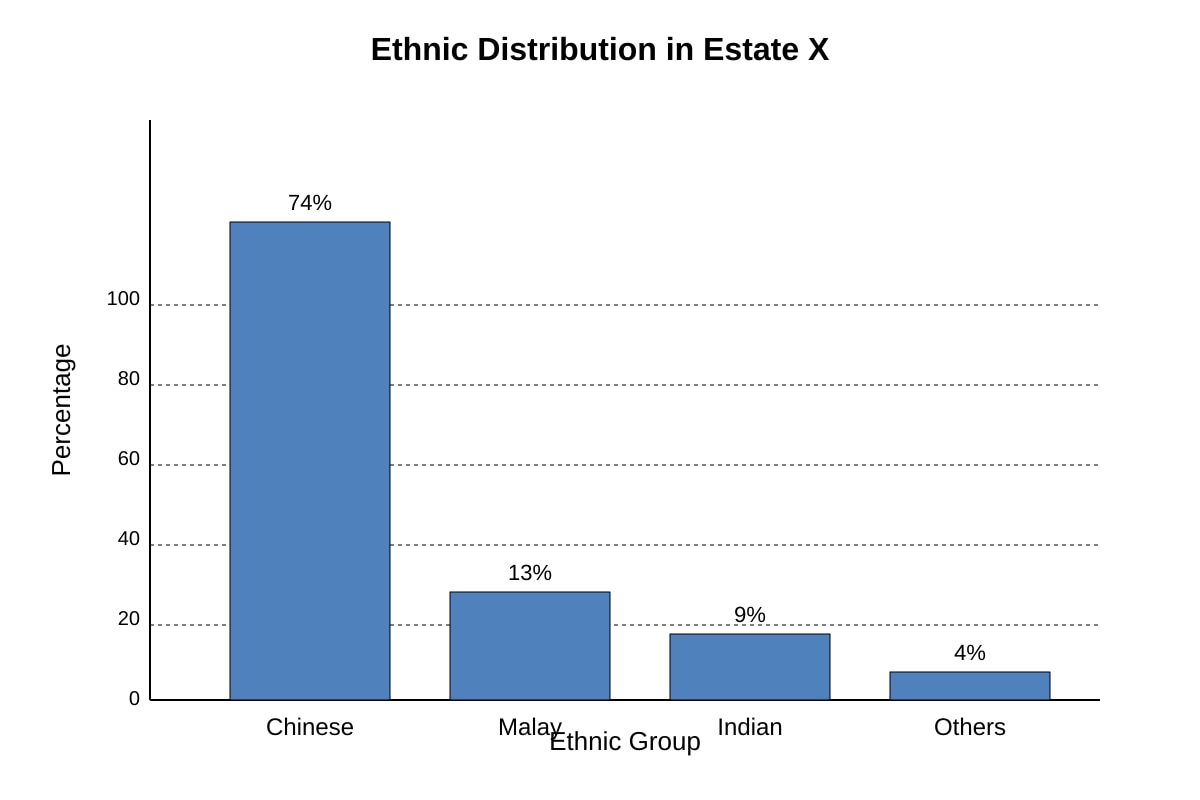
Answer: The estate reflects balanced mix close to national profile, suggesting EIP working.
Marking: 1 mark interpretation of balance, 1 mark link to policy/harmony.
Teaching note: Chart shows 74% Chinese etc.; not enclave, so mix is balanced. Image must show labelled bars as specified.
18. [2 marks]
Answer: Stereotypes cause prejudice/discrimination, reducing trust and cooperation.
Marking: 1 mark effect, 1 mark consequence.
Teaching note: Syllabus lists stereotypes as negative experience of diversity.
19. [2 marks]
Answer: Community groups organise activities that build bonds and belonging among residents.
Marking: 1 mark role, 1 mark outcome.
Teaching note: Civil society complements govt by strengthening belonging.
20. [2 marks]
Answer: Agree; e.g., building MRT may displace some shops (cost) for wider transport benefit.
Marking: 1 mark stance, 1 mark example of trade-off.
Teaching note: Trade-off = some bear cost for common good; example shows syllabus concept.