AI Generated Quiz
O Level Social Studies Singapore Society Quiz
Free O Level Social Studies Singapore Society quiz, AI version, with questions, answers, and O Level-style practice for Singapore students.
These static practice materials are generated from the site's syllabus and paper-generation workflow, with source and model context shown so students and parents can evaluate the material before use.
Questions
Free quiz and exam paper access
Enter your details to view this paper
Your access is remembered on this device.
Answers
O-Level Social Studies Quiz - Singapore Society (Answer Key)
Total Marks: 50
Section A: Citizenship and Governance (Questions 1–5)
1. Active citizenship refers to the participation of citizens in public affairs and community life to bring about positive change, based on shared values and a sense of responsibility. [1] Example: A Singaporean youth can practise active citizenship by volunteering at a local charity, participating in a dialogue session with Members of Parliament, or starting a community project to help the needy. [1]
Marking Notes: Award 1 mark for a clear definition that includes the idea of participation or responsibility. Award 1 mark for a relevant and specific example.
2. Any two of the following functions: [2]
- Makes and passes laws
- Implements and enforces laws
- Interprets and applies laws
- Maintains law and order
- Ensures economic and social well-being
- Protects national interests
Marking Notes: Award 1 mark for each correct function stated. Do not award marks for vague answers like "governs the country".
3. This principle means that the Government must be forward-looking and adapt to changes to remain relevant. [1] For example, Singapore invests heavily in research and development, and in upgrading the skills of its workforce through schemes like SkillsFuture. [1] This helps Singapore stay competitive by ensuring that its economy remains vibrant and its people are equipped with the skills needed for future industries. [1]
Marking Notes: Award 1 mark for explaining the principle, 1 mark for a relevant example, and 1 mark for explaining how it helps Singapore remain competitive.
4. (a) The principle of governance reflected is "Stake for Everyone, Opportunities for All". [1]
(b) The scheme helps to address the needs of lower-income families by providing financial support for their children's education. [1] This reduces the financial burden on these families and ensures that their children have equal opportunities to succeed in school, regardless of their background. [1]
Marking Notes: For (b), award 1 mark for identifying the group (lower-income families) and the need (financial support for education), and 1 mark for explaining how the scheme helps (reduces burden, ensures equal opportunities).
5. Way 1: Citizens can participate in public consultations and give feedback on government policies. For example, citizens can provide feedback on the Budget through REACH. [2] Way 2: Citizens can volunteer in community initiatives, such as grassroots organisations or charity drives. For example, citizens can volunteer at a Community Club to organise events for residents. [2]
Marking Notes: Award 1 mark for each way and 1 mark for each specific example. Accept other valid ways such as serving in National Service, participating in dialogue sessions, or starting ground-up initiatives.
Section B: Living in a Diverse Society (Questions 6–10)
6. A stereotype is a fixed, oversimplified, and generalised belief about a particular group of people. [1] Prejudice is a preconceived opinion or attitude about a person or group, often based on stereotypes, that is not based on reason or actual experience. [1]
Marking Notes: Award 1 mark for each correct definition. Ensure the definitions are distinct and capture the cognitive (stereotype) and attitudinal (prejudice) nature of the terms.
7. Any two of the following factors: [2]
- Race and ethnicity
- Religion
- Socioeconomic status
- Nationality
Marking Notes: Award 1 mark for each correct factor.
8. Cultural exchange allows people from different backgrounds to learn about and appreciate each other's cultures. [1] For example, during Racial Harmony Day, students in Singapore schools wear traditional costumes and try food from different ethnic groups. [1] This fosters mutual respect and understanding, which strengthens social cohesion. [1]
Marking Notes: Award 1 mark for explaining the concept, 1 mark for a relevant Singapore example, and 1 mark for explaining the positive outcome (e.g., mutual respect, social cohesion).
9. (a) The challenge is competition for jobs and public resources between locals and foreigners. [1]
(b) The Government's response aims to achieve harmony by managing the inflow of foreign workers to reduce competition and by encouraging integration between locals and foreigners. [1] By doing so, it seeks to reduce tensions and promote mutual understanding, which helps to maintain social harmony. [1]
Marking Notes: For (b), award 1 mark for explaining the purpose of the policy (managing inflow, encouraging integration) and 1 mark for explaining how it leads to harmony (reduces tension, promotes understanding).
10. An assimilation policy expects minority groups to adopt the culture and norms of the majority group, often giving up their own cultural identity. [2] An integration policy allows different cultural groups to maintain their own identities while encouraging them to interact and participate in the wider society. [2]
Marking Notes: Award 2 marks for a clear explanation of each policy. Award 1 mark for a partial or vague explanation of each.
Section C: Globalisation (Questions 11–15)
11. Globalisation is the process by which people, businesses, and governments around the world become more interconnected and interdependent through trade, investment, technology, and cultural exchange. [1]
Marking Notes: Award 1 mark for a definition that captures the idea of increasing interconnectedness and interdependence.
12. Any two of the following driving forces: [2]
- Technological advancements
- Increased international communication
- Developments in digital technology
- Growth of multinational corporations
Marking Notes: Award 1 mark for each correct driving force.
13. Positive impact: Globalisation has led to economic growth for Singapore by attracting foreign investments and creating jobs. For example, many multinational corporations have set up regional headquarters in Singapore. [2] Negative impact: Globalisation makes Singapore vulnerable to external economic shocks. For example, a global financial crisis can lead to job losses and a slowdown in Singapore's economy. [2]
Marking Notes: Award 2 marks for a well-explained positive impact (with example) and 2 marks for a well-explained negative impact (with example). Award 1 mark for each if the impact is stated but not explained or lacks an example.
14. (a) The challenge is automation and the need for workers to constantly upgrade their skills to remain relevant. [1]
(b) The Government's response helps Singaporeans cope by introducing schemes to help workers learn new skills and adapt to the changing economy. [1] For example, SkillsFuture provides subsidies for courses, allowing workers to upskill and remain employable. [1]
Marking Notes: For (b), award 1 mark for explaining the purpose of the response and 1 mark for a specific example or further explanation of how it helps.
15. Threat 1: Transnational terrorism. Singapore can respond by strengthening security at borders and public places, and by working with international partners to share intelligence. [2] Threat 2: Cyber threats. Singapore can respond by investing in cybersecurity measures, such as the Cyber Security Agency, and by educating the public on how to protect themselves online. [2]
Marking Notes: Award 1 mark for each correctly identified threat and 1 mark for each appropriate response. Accept other valid threats such as the spread of extremist ideologies or economic espionage.
Section D: Case Study – Singapore Society in Action (Questions 16–20)
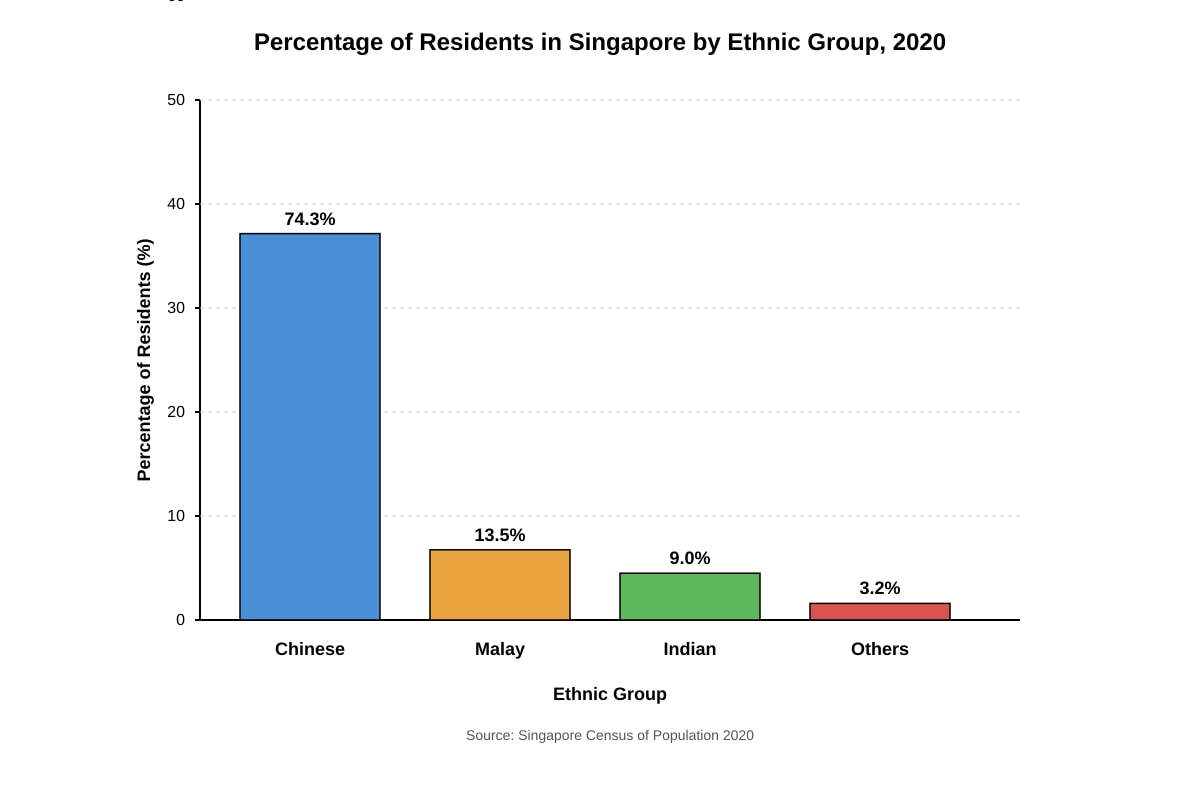
16. (a) 74.3% [1]
(b) The data shows that Singapore has residents from multiple ethnic groups, including Chinese (74.3%), Malay (13.5%), Indian (9.0%), and Others (3.2%). [1] This diversity in ethnic composition makes Singapore a multi-ethnic society. [1]
Marking Notes: For (b), award 1 mark for citing the data and 1 mark for explaining that the presence of multiple ethnic groups makes it multi-ethnic.
17. The Shared Responsibility Approach involves the Government, individuals, and the community working together to address socio-economic needs. [1] For example, under the Community Health Assist Scheme (CHAS), the Government subsidises medical costs for lower- and middle-income families, while individuals and families are encouraged to take responsibility for their own health. [1] This approach ensures that the burden is shared and that support is sustainable. [1]
Marking Notes: Award 1 mark for explaining the approach, 1 mark for a relevant example, and 1 mark for explaining its benefit (sustainability, shared burden).
18. (a) The youths are practising active citizenship by organising community projects to protect the environment. [1]
(b) This project contributes to strengthening the sense of belonging by bringing residents together to work towards a common goal. [1] Participants develop a sense of ownership and pride in their community, which fosters a stronger attachment to the neighbourhood. [1]
Marking Notes: For (b), award 1 mark for explaining how the project brings people together and 1 mark for explaining the outcome (sense of ownership, pride, attachment).
19. Level 5 (5 marks): A well-developed response that discusses both sides of the argument, provides a clear and reasoned judgement, and supports points with specific examples. Level 4 (4 marks): A developed response that discusses both sides but with a less clear judgement or less specific examples. Level 3 (3 marks): A response that discusses both sides but with limited development or examples. Level 2 (2 marks): A response that focuses on one side only, with some development. Level 1 (1 mark): A response that states a simple point of view without development.
Content Points:
- Government's role: The Government plays a crucial role in maintaining harmony through policies such as the Maintenance of Religious Harmony Act, which prevents religious conflict. It also promotes integration through policies like the Ethnic Integration Policy in public housing, which ensures a balanced mix of ethnic groups in HDB estates.
- Citizens' role: Citizens also play a vital role through everyday actions, such as showing respect for different cultures and religions, and participating in inter-ethnic activities. Grassroots efforts and community groups help to build trust and understanding.
- Judgement: A balanced view is that both play complementary roles. The Government provides the framework and policies, but citizens must practise tolerance and respect in their daily lives. Without citizen cooperation, government policies alone cannot achieve harmony.
Marking Notes: Use the level descriptors to award marks. For Level 5, the response must show a clear judgement and use specific examples from both sides.
20. Level 5 (5 marks): A well-developed response that evaluates the extent to which globalisation has been beneficial, discusses both benefits and drawbacks, and provides a clear and reasoned judgement with specific examples. Level 4 (4 marks): A developed response that discusses both benefits and drawbacks but with a less clear judgement or less specific examples. Level 3 (3 marks): A response that discusses both benefits and drawbacks but with limited development or examples. Level 2 (2 marks): A response that focuses on one side only, with some development. Level 1 (1 mark): A response that states a simple point of view without development.
Content Points:
- Benefits: Globalisation has brought significant economic growth to Singapore, attracting foreign investment and creating jobs. It has also facilitated cultural exchange, enriching Singapore's society. Singapore has benefited from technological advancements and access to global markets.
- Drawbacks: Globalisation has made Singapore vulnerable to external economic shocks, such as the 2008 financial crisis. It has also led to increased competition for jobs and resources, and has exposed Singapore to security threats like terrorism and cyber-attacks.
- Judgement: The extent to which globalisation has been beneficial depends on how well Singapore manages its risks. While the benefits are substantial, the drawbacks cannot be ignored. A balanced judgement might conclude that globalisation has been largely beneficial for Singapore, given its strong economic performance, but that it requires careful management to mitigate the negative impacts.
Marking Notes: Use the level descriptors to award marks. For Level 5, the response must show a clear judgement on the extent and use specific examples from both benefits and drawbacks.