AI Generated Quiz
O Level Social Studies Governance Citizenship Quiz
Free O Level Social Studies Governance Citizenship quiz, HY3 AI version, with questions, answers, and O Level-style practice for Singapore students.
These static practice materials are generated from the site's syllabus and paper-generation workflow, with source and model context shown so students and parents can evaluate the material before use.
Questions
Free quiz and exam paper access
Enter your details to view this paper
Your access is remembered on this device.
Answers
O-Level Social Studies Quiz - Governance Citizenship (Answer Key)
Total Marks: 40
Topic: Governance Citizenship
Section A Answers (Q1–5)
Q1 [2 marks]
Answer: One legal right is the right to vote in presidential and parliamentary elections.
Teaching note: Citizenship includes legal status with rights. A Singapore citizen aged 21+ can vote. Common mistake: stating "right to free education" as legal right only (it is a provision, not codified sole right). Mark: 2 for correct right; 1 if vague.
Q2 [2 marks]
Answer: The government maintains law and order by enforcing laws through the police and courts.
Teaching note: Functions of government include implement/enforce laws. Mark: 2 for clear function.
Q3 [2 marks]
Answer: Active citizenship means participating in public affairs and contributing to society beyond legal duties.
Teaching note: Syllabus defines active citizenship as shared values and civic participation. Mark: 2 for accurate sentence.
Q4 [2 marks]
Answer: Example: Building a park may cost taxpayers but benefit nearby residents more.
Teaching note: Trade-off = differing needs, unequal sharing of costs. Mark: 2 for valid example.
Q5 [2 marks]
Answer: One principle is meritocracy (or good leadership / stake for everyone / anticipating change).
Teaching note: Principles of governance listed in syllabus. Mark: 2 for named principle.
Section B Answers (Q6–10)
Q6 [2 marks]
Answer: Source A suggests citizens can shape local policies through participation.
Teaching: Inference from "came together… feedback sessions with MP". Mark: 2.
Q7 [2 marks]
Answer: Government passes laws for fair housing / provides subsidies.
Teaching: From Source B explicit. Mark: 2.
Q8 [3 marks]
Answer: Citizens initiate local action (Source A); government makes laws and gives help (Source B). They have complementary roles.
Marking: 1 for citizen role, 1 for gov role, 1 for compare/complement.
Q9 [2 marks]
Answer: Yes, likely reliable as it is a direct account from community leader; OR limited as it is one viewpoint.
Teaching: Reliability based on origin/purpose. Mark: 2 for reason.
Q10 [3 marks]
Answer: Citizens give feedback (A), government uses it to make fair laws (B); working together meets needs.
Marking: 1 ev A, 1 ev B, 1 synthesis.
Section C Answers (Q11–20)
Q11 [2 marks]
Answer: Meritocracy = people advanced by ability and effort, not background.
Mark: 2.
Q12 [2 marks]
Answer: Challenge: competing demands from different groups.
Mark: 2.
Q13 [2 marks]
Answer: Method: organise community events to build trust.
Mark: 2.
Q14 [2 marks]
Answer: Anticipating change keeps policies relevant and avoids crisis.
Mark: 2.
Q15 [2 marks]
Answer: Obligation: obey laws / national service for males.
Mark: 2.
Q16 [3 marks]
Answer: Government gives jobs via infrastructure; e.g., HDB builds homes, creates work.
Marking: 1 define economic well-being, 2 example.
Q17 [3 marks]
Answer: Attend town councils, give feedback online, join RC.
Marking: 1 each up to 3.
Q18 [3 marks]
Answer: Trade-off: higher tax payers bear cost, riders gain mobility; society balances need vs fairness.
Marking: 1 define, 2 apply.
Q19 [3 marks]
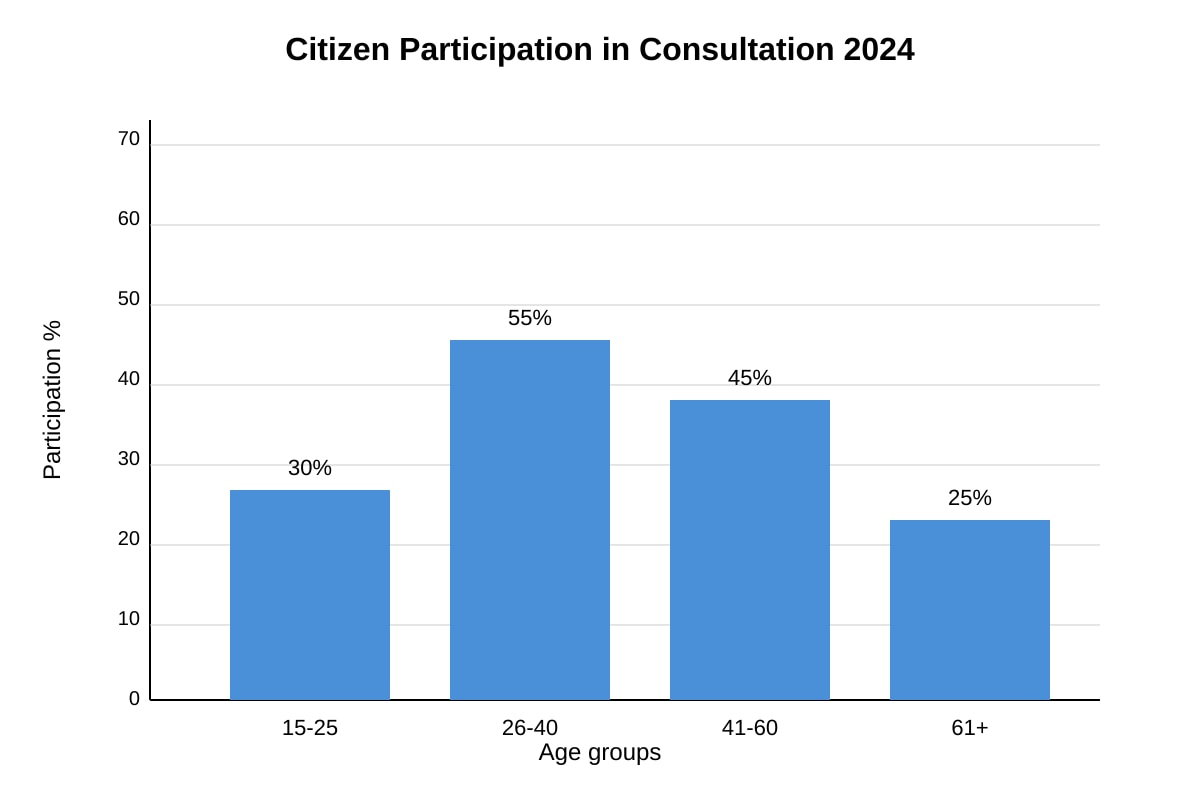
Answer: Trend: 26–40 highest (55%); meaning younger-middle engage more, gov should target youth.
Visual: chart shows bars as described. Marking: 1 trend, 2 explain.
Q20 [3 marks]
Answer: Agree: leaders make laws, citizens give input; both needed for good society.
Marking: 1 stance, 2 reasons.