AI Generated Exam Paper
O Level Social Studies Practice Paper 4
Free O Level Social Studies Practice Paper 4, HY3 AI version, with questions, answers, and O Level-style practice for Singapore students.
These static practice materials are generated from the site's syllabus and paper-generation workflow, with source and model context shown so students and parents can evaluate the material before use.
Questions
Free quiz and exam paper access
Enter your details to view this paper
Your access is remembered on this device.
Answers
TuitionGoWhere Practice Paper - Social Studies O-Level (Answers)
Version 4 Answer Key
Section A: Source-Based Case Study (35 marks)
Q1. [1]
Answer: The government believes harmony is strengthened by accepting differences, but citizens' daily actions are key.
Teaching note: Source A states government provides spaces but harmony depends on citizens. Mark for identifying citizen role.
Q2. [1]
Answer: 23%.
Teaching note: Direct read from Source B table. Common mistake: misreading 64% (friends) instead of 23%.
Q3. [2]
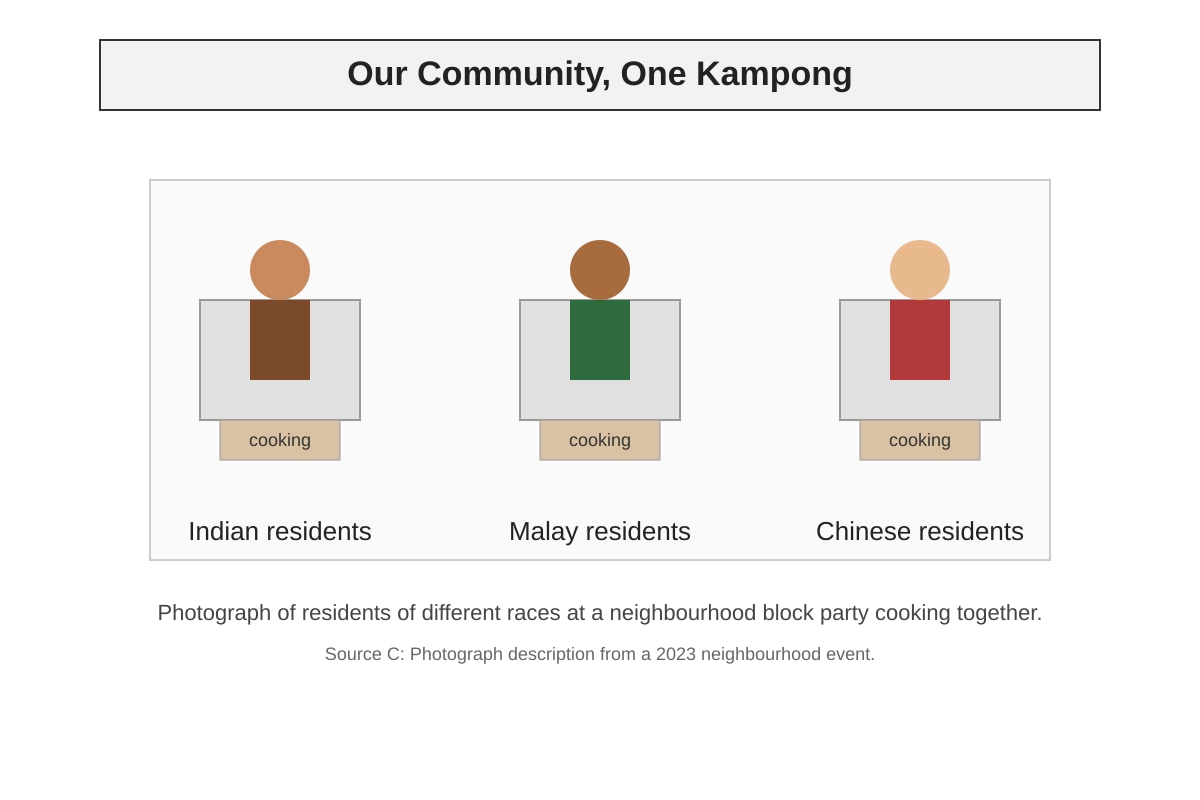
Answer: Shows residents of different races cooking together at a block party; banner promotes one community.
Marking: 1 mark for activity (cooking together), 1 mark for banner/unity message. Image must show labelled groups and banner.
Q4. [2]
Answer: Both suggest ordinary citizens experience or value interaction across differences (B: comfort with neighbours; D: neighbourly niceness).
Marking: 1 for identifying B point, 1 for D point.
Q5. [3]
Answer: Low reliability as representative public opinion. Origin: single citizen blog (personal). Purpose: express own view, not survey.
Marking: 1 origin, 1 purpose, 1 conclusion on limited representativeness.
Q6. [3]
Answer: Useful because NGO reaches youth distrusting state; but limited as one org view.
Marking: 1 usefulness (reach), 1 limitation (scope), 1 link to diversity response.
Q7. [3]
Answer: Yes, 82% comfortable with other races shows citizen behaviour supports harmony.
Marking: 1 agree, 2 explain with Source B evidence.
Q8. [2]
Answer: Not surprise; citizen blogs often mixed views. Or surprise if expecting only support.
Marking: 1 stance, 1 reason from text.
Q9. [3]
Answer: A: government provides spaces, citizens act. E: NGOs supplement state. Both see non-state roles as complementary.
Marking: 1 A, 1 E, 1 compare.
Q10. [4]
Answer: C shows visual harmony; E explains grassroots mechanism. Together useful for community harmony study.
Marking: 2 for C utility, 2 for E utility and combined value.
Q11. [4]
Answer: Claim supported. A says citizens key; D shows forced policy yet neighbourly ties remain. Evaluation: policy insufficient alone.
Marking: 2 evidence, 2 judgement.
Q12. [2]
Answer: Survey shows behaviour not deep attitudes; 23% stereotype may underreport.
Marking: 1 limitation, 1 explanation.
Q13. [2]
Answer: Most citizens accept diversity but minority face stereotypes.
Marking: 1 positive, 1 negative inference.
Q14. [3]
Answer: Mixed. A/E official/NGO credible; D personal. Student must use multiple source types.
Marking: 1 A/E, 1 D, 1 overall.
Section B: Structured Response (15 marks)
Q15. [2]
Answer: E.g., ensures economic well-being via jobs policy.
Marking: 1 function, 1 example.
Q16. [3]
Answer: Citizens engage in public affairs, join groups, government provides platform.
Marking: 3 points.
Q17. [4]
Answer: Assimilation: adopt dominant culture (e.g., uniform language). Integration: keep identity, share space (e.g., mixed housing).
Marking: 2 each with example.
Q18. [3]
Answer: E.g., MNCs bring jobs but vulnerability to global shocks.
Marking: 1 impact, 2 explain.
Q19. [1]
Answer: E.g., learn foreign cultures via media.
Q20. [2]
Answer: Yes, e.g., spending on health vs defence requires trade-off.
Marking: 1 yes, 1 example.
Total: 50 marks