AI Generated Exam Paper
O Level Social Studies Practice Paper 1
Free O Level Social Studies Practice Paper 1, AI version, with questions, answers, and O Level-style practice for Singapore students.
These static practice materials are generated from the site's syllabus and paper-generation workflow, with source and model context shown so students and parents can evaluate the material before use.
Questions
Free quiz and exam paper access
Enter your details to view this paper
Your access is remembered on this device.
Answers
TuitionGoWhere Practice Paper - Social Studies O-Level - Answer Key
Section A: Source-Based Case Study (35 marks)
1. Study Source A. What does the minister mean when he says that diversity is a "rich tapestry"? Explain your inference. [2]
Answer: The minister means that Singapore's society is made up of many different cultures, religions, and traditions that are woven together to create a vibrant and valuable whole. The word "tapestry" suggests that these different elements are not just separate parts, but are interconnected and contribute to the beauty and strength of the nation.
Marking Scheme:
- 1 mark for identifying that diversity is made up of different cultures/religions/traditions.
- 1 mark for explaining the idea of them being woven together to create something valuable/strong.
Teaching Note: Inference questions ask you to read between the lines. The minister is not just stating a fact; he is using a metaphor to convey a positive view of diversity. A good answer will explain the meaning of the metaphor itself.
2. Study Source B. According to the citizen, what is a limitation of the government's approach to promoting racial harmony? [2]
Answer: The citizen argues that the government's approach, such as the Ethnic Integration Policy (EIP), is too "top-down." While it ensures a racial mix in housing estates, it does not guarantee genuine interaction or friendship between neighbours of different races. The policy creates the conditions for integration but cannot force people to build relationships.
Marking Scheme:
- 1 mark for identifying the limitation (e.g., top-down, doesn't guarantee interaction).
- 1 mark for explaining the limitation (e.g., people in mixed blocks may still not know each other).
Teaching Note: This is a comprehension question. The answer should be directly lifted and paraphrased from the source. The key phrase is "too top-down" and the example of neighbours not knowing each other's names.
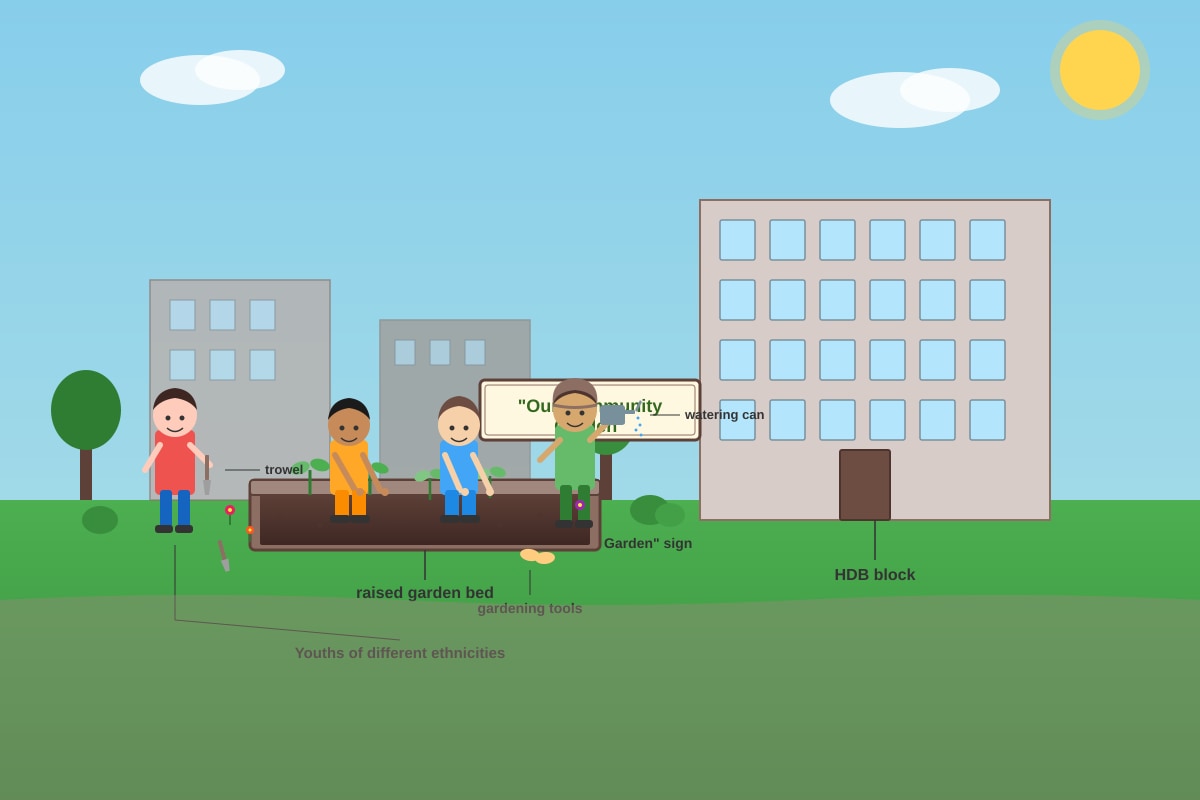
3. Study Source C. How does this photograph support the view expressed in Source A that "the most important work happens at the ground level"? [3]
Answer: The photograph supports this view by showing a concrete example of ground-level interaction. It depicts a multi-racial group of youths working together on a community gardening project. This is not a government policy or a top-down initiative; it is a voluntary, grassroots activity where people from different backgrounds are cooperating and building relationships. The image of them smiling and working side-by-side illustrates the kind of daily, meaningful interaction that the minister in Source A argues is crucial for strengthening social fabric.
Marking Scheme:
- 1 mark for identifying the photograph shows a ground-level/grassroots activity.
- 1 mark for explaining how it shows interaction (e.g., multi-racial group working together).
- 1 mark for linking it back to Source A's point about the importance of ground-level work.
Teaching Note: This is a cross-referencing question. You must use evidence from the photograph (the visual details) to support a claim from another source. Describe what you see and explain how it connects.
4. Study Source D. What does the research report suggest about the effectiveness of government policies in promoting social cohesion? [3]
Answer: The report suggests that government policies have been effective in creating "structural conditions" for integration (e.g., through the EIP and GRC system). However, it also suggests that these policies have limitations. The statistics show a gap between principle (85% agree racial harmony is important) and practice (only 60% have close friends from a different race). This implies that policies alone are not enough to foster deep, meaningful cross-cultural relationships.
Marking Scheme:
- 1 mark for stating that policies are effective in creating structural conditions.
- 1 mark for identifying the gap between principle and practice.
- 1 mark for concluding that policies alone are insufficient for deep integration.
Teaching Note: This question requires you to identify both the strengths and weaknesses of the policies as presented in the source. Do not just say the policies are "good" or "bad." Be specific about what they achieve and what they fail to achieve.
5. Compare Source A and Source B. How similar are their views on the role of the government in promoting racial harmony? [4]
Answer: The sources share a significant similarity: both acknowledge that the government has a role to play, but that it is not the only actor. Source A states that the government has put in place policies like the EIP, but emphasises that "the most important work happens at the ground level." Source B agrees that the government can "create the conditions" for integration. However, they differ in emphasis. Source A is more positive and focuses on the government's efforts and the need for citizens to complement them. Source B is more critical, arguing that the government's approach is "too top-down" and that policies do not guarantee real interaction. Source A sees the government's role as foundational, while Source B sees it as limited.
Marking Scheme:
- 1 mark for identifying a similarity (both see a role for government and citizens).
- 1 mark for providing evidence from both sources for the similarity.
- 1 mark for identifying a difference (e.g., tone, emphasis on effectiveness).
- 1 mark for providing evidence from both sources for the difference.
Teaching Note: A good comparison answer has two parts: similarity and difference. Use phrases like "both sources agree that..." and "however, they differ in that..." Always support your points with direct quotes or clear references to the sources.
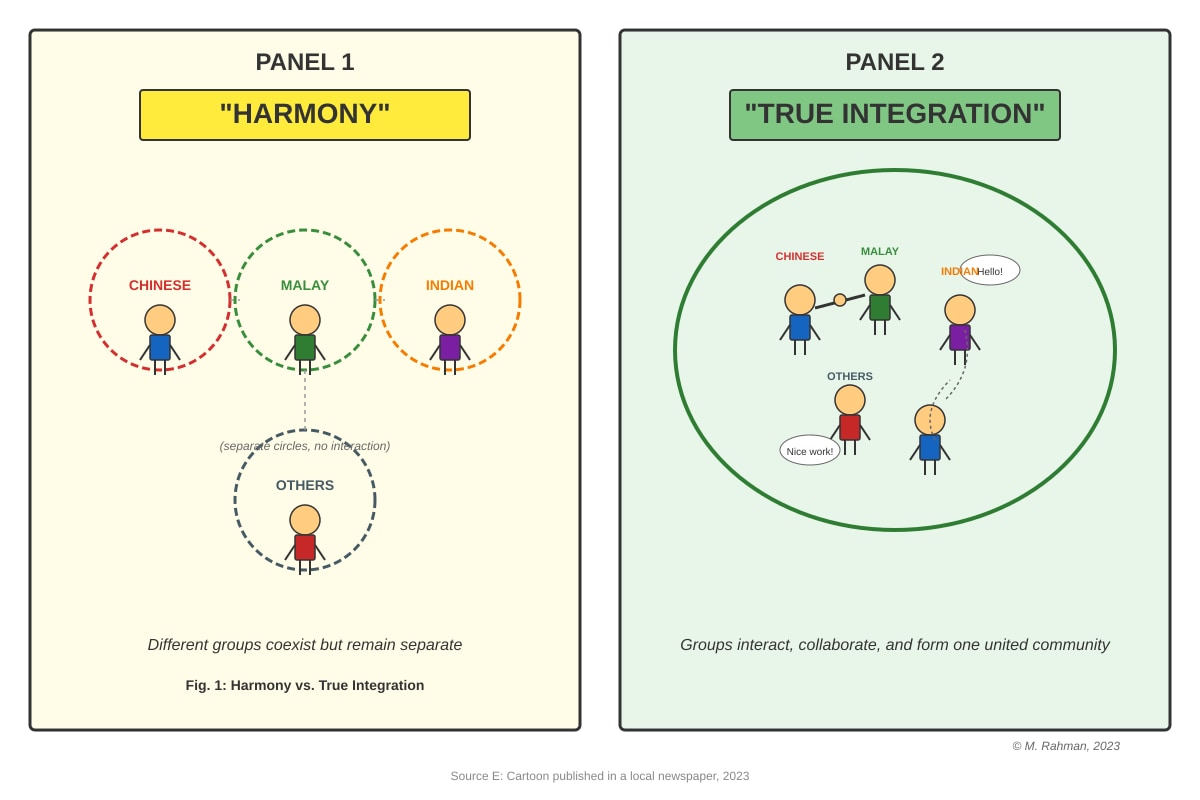
6. Study Source E. What message is the cartoonist trying to convey about the difference between "harmony" and "true integration"? [3]
Answer: The cartoonist is conveying that "harmony" as it is often understood is superficial. In Panel 1, people of different races are in separate circles, labelled "Harmony." They are not interacting, just coexisting. "True Integration," shown in Panel 2, is a deeper state where the circles have merged, and people are actively interacting, talking, and working together. The message is that simply having different races living side-by-side (harmony) is not enough; genuine effort and interaction are needed to achieve true integration.
Marking Scheme:
- 1 mark for describing the contrast between the two panels.
- 1 mark for explaining the meaning of "harmony" in the cartoon (superficial coexistence).
- 1 mark for explaining the meaning of "true integration" (active interaction/unity).
Teaching Note: When analysing a cartoon, look at the symbols, labels, and the contrast between elements. The cartoonist uses a simple visual metaphor to make a complex point. Your job is to decode that metaphor.
7. How far do you agree with the view in Source B that government policies alone are not enough to achieve racial harmony? Use Sources A, C, D, and E to support your answer. [10]
Answer:
Level 1 (1-3 marks): Simple agreement or disagreement with limited or no source support.
- Example: "I agree because the government cannot force people to be friends."
Level 2 (4-6 marks): Describes the view and uses one or two sources to support a one-sided argument.
- Example: "I agree. Source B says the EIP doesn't guarantee interaction. Source D shows only 60% have close friends of a different race. This shows policies are not enough."
Level 3 (7-8 marks): Develops a balanced argument, using multiple sources to agree and disagree.
- Example: "I largely agree that policies alone are not enough. Source B and Source D both show a gap between policy and practice. Source E's cartoon reinforces this by showing that 'harmony' without interaction is superficial. Source C provides a solution, showing that ground-up initiatives like community gardening can foster the interaction that policies miss. However, Source A reminds us that the government's role is still important. The minister says policies ensure fair treatment, which creates a foundation. Without the EIP, there might not even be the opportunity for the interaction shown in Source C. So, while policies are not sufficient, they are necessary."
Level 4 (9-10 marks): A well-developed, balanced, and evaluative argument that considers the complexity of the issue. The answer should weigh the evidence and come to a nuanced conclusion.
- Example: "The view in Source B is largely correct, but it is an oversimplification. Government policies are clearly not sufficient on their own, as Sources B, D, and E demonstrate. They create a framework for coexistence but cannot mandate friendship. However, to say they are 'not enough' undervalues their crucial role. As Source A argues, they create the necessary structural conditions. The EIP ensures diversity in housing, which is a prerequisite for the kind of ground-level interaction seen in Source C. Without the policy, many neighbourhoods might be segregated, making cross-cultural interaction far less likely. Therefore, the most accurate view is that government policies and citizen effort are complementary and mutually reinforcing. Policies provide the stage, but citizens must perform the play. The view in Source B is a valuable critique of a purely top-down approach, but it underestimates the foundational importance of the policies it criticises."
Marking Scheme (10 marks):
- Agreement (up to 5 marks): Use Sources B, D, and E to argue that policies have limitations.
- Disagreement (up to 5 marks): Use Sources A and C to argue that policies are necessary and create the foundation for ground-level work.
- Evaluation (2 marks): A clear, balanced conclusion that weighs the evidence.
Teaching Note: This is the highest-value question. It requires you to evaluate a claim using multiple sources. Do not just list what each source says. Use the sources as evidence to build your own argument. A strong answer will be balanced, showing you understand both sides of the argument before coming to a reasoned conclusion.
8. Study Source D. How useful is this source for understanding the challenges of achieving social cohesion in Singapore? Explain your answer. [8]
Answer:
Level 1 (1-2 marks): Simple statement of usefulness or limitation.
- Example: "It is useful because it has statistics."
Level 2 (3-4 marks): Describes the content of the source and states it is useful or not useful.
- Example: "The source is useful because it provides data showing a gap between principle and practice. This helps us understand that achieving social cohesion is difficult."
Level 3 (5-6 marks): Explains usefulness and limitations with reference to the source's content, provenance, and purpose.
- Example: "The source is useful because it is from a research report by a local university, which is a credible and expert source. It provides specific statistics (85% vs 60%) that give a clear, evidence-based picture of the challenge. It also offers a recommendation, which is useful for understanding potential solutions. However, the source has limitations. It is from 2022, so it may be slightly outdated. As a research report, it aims for objectivity, but it may not capture the full emotional or personal experience of social cohesion that a personal account (like Source B) might. Its purpose is to analyse and recommend, not to provide a complete picture of everyday life."
Level 4 (7-8 marks): A well-developed evaluation that considers both the strengths and weaknesses of the source for the specific purpose of understanding the challenges of achieving social cohesion. The answer should weigh the evidence and come to a nuanced conclusion about its overall usefulness.
- Example: "Source D is highly useful for understanding the challenges of social cohesion, but it is not the only source of understanding. Its main strength is its credibility as a university research report, which gives its data and analysis authority. The statistic showing a gap between principle (85%) and practice (60%) is a powerful and precise way to define the core challenge: it is not a lack of belief in harmony, but a lack of deep, cross-cultural relationships. This is a more nuanced challenge than simple prejudice. The source's recommendation for 'ground-up initiatives' also directly points to a key challenge—how to move from structural integration to meaningful interaction. However, its usefulness is limited by its nature. As a report, it provides a broad, aggregate picture. It cannot explain the why behind the 60% figure. It does not tell us about the specific barriers people face, such as language, cultural differences, or stereotypes. For that, we would need qualitative sources like interviews or personal accounts (e.g., Source B). Furthermore, its purpose is analytical, not prescriptive for every situation. Therefore, while it is an excellent source for identifying and measuring the challenge, it is less useful for understanding the lived, personal experience of that challenge. Overall, it is a very useful starting point, but must be supplemented by other types of sources for a complete understanding."
Marking Scheme (8 marks):
- Usefulness (up to 4 marks): Content (statistics, recommendation), Provenance (university, expert), Purpose (analysis).
- Limitations (up to 4 marks): Date (2022), Nature (broad/aggregate, not personal), Purpose (analytical, not descriptive).
- Evaluation (2 marks): A balanced conclusion that weighs the usefulness against the limitations for the specific purpose.
Teaching Note: This is a utility question. You must assess how helpful the source is for a specific purpose (understanding challenges). A good answer will discuss both the source's strengths (content, provenance, purpose) and its weaknesses (limitations of content, provenance, purpose) in relation to that purpose. Always come to a clear, reasoned conclusion.
Section B: Structured-Response Question (15 marks)
9. (a) Explain two ways in which globalisation has impacted the security of Singapore. [6]
Answer:
Impact 1: Transnational Terrorism Globalisation has increased interconnectedness, making it easier for terrorist networks to operate across borders. Singapore, as a global hub, is a potential target. The increased flow of people, ideas, and finance can facilitate the spread of extremist ideologies and the movement of terrorists. For example, Singapore has faced threats from regional terrorist groups like Jemaah Islamiyah (JI), which planned attacks in Singapore. This has required the government to enhance security measures, such as the Internal Security Act (ISA) and close cooperation with international intelligence agencies.
Impact 2: Cyber Threats Globalisation, driven by technological advancements, has made Singapore highly dependent on digital networks for its economy and daily life. This interconnectedness creates vulnerabilities to cyber-attacks from state and non-state actors. These attacks can target critical infrastructure (e.g., power grids, financial systems), steal sensitive data, or disrupt essential services. For example, Singapore has experienced significant cyber-attacks on its healthcare system (SingHealth) and government networks. This has led to the establishment of the Cyber Security Agency (CSA) and the implementation of the Cybersecurity Act to protect national security.
Marking Scheme (3 marks per impact):
- 1 mark for identifying a clear impact (e.g., transnational terrorism, cyber threats).
- 1 mark for explaining how globalisation leads to this impact (e.g., increased flow of people/ideas, digital dependence).
- 1 mark for providing a specific example from Singapore.
Teaching Note: This is a knowledge-based question. You must recall specific content from the syllabus on globalisation and security. Each explanation should follow a clear structure: identify the impact, explain the link to globalisation, and give a concrete example.
(b) To what extent do you agree that the benefits of globalisation outweigh its costs for Singapore? Explain your answer. [9]
Answer:
Level 1 (1-3 marks): Simple statement of agreement or disagreement with limited explanation.
- Example: "I agree because globalisation has made Singapore richer."
Level 2 (4-6 marks): Describes benefits and/or costs with some explanation and examples.
- Example: "Globalisation has brought many benefits to Singapore. It has led to economic growth by attracting MNCs and creating jobs. For example, the pharmaceutical and electronics industries have grown. However, it also has costs, such as increased competition for jobs from foreign talent. Some Singaporeans feel their jobs are at risk. Overall, the benefits are significant."
Level 3 (7-8 marks): Develops a balanced argument, discussing both benefits and costs in detail with specific examples. The answer should weigh the evidence.
- Example: "To a large extent, the benefits of globalisation have outweighed the costs for Singapore, but this is not without significant challenges. The economic benefits are undeniable. Globalisation has been the engine of Singapore's growth, transforming it into a global financial and trade hub. MNCs have brought investment, technology, and high-value jobs. This has raised living standards for most Singaporeans. However, the costs are real. Economic globalisation has led to greater income inequality and job displacement for lower-skilled workers. Culturally, there are concerns about the dilution of local traditions. The government has responded with measures like SkillsFuture to help workers adapt and with policies to promote local culture. While these costs are serious, the government's proactive approach has managed them effectively. The alternative—rejecting globalisation—would have been far more costly for a small, resource-scarce nation like Singapore. Therefore, while the costs must be managed, the net benefit has been overwhelmingly positive."
Level 4 (9 marks): A well-developed, balanced, and evaluative argument that considers the complexity of the issue. The answer should weigh the evidence and come to a nuanced conclusion, possibly arguing that the extent depends on the perspective (e.g., individual vs. national).
- Example: "The extent to which benefits outweigh costs is not a simple yes or no; it depends on the perspective and the specific dimension of globalisation being considered. From a national economic perspective, the benefits have clearly outweighed the costs. Globalisation has been fundamental to Singapore's survival and prosperity. Without it, Singapore would not have its current standard of living. The government has also been effective in mitigating the costs through policies like SkillsFuture and the Progressive Wage Model. However, from an individual perspective, the calculation can be different. A retrenched factory worker who cannot find a new job may feel the costs outweigh the benefits. Culturally, while there is a vibrant exchange, some may feel their identity is being eroded. Therefore, while I agree that on a macro, national level the benefits are greater, this conclusion must be tempered by an acknowledgement that the costs are not evenly shared. The true measure of success is not just the net benefit, but how well the costs are managed and distributed. Singapore has done this relatively well, but the challenge remains. Thus, I agree to a large extent, but with the important caveat that the experience of globalisation is not uniform for all Singaporeans."
Marking Scheme (9 marks):
- Benefits (up to 4 marks): Economic growth, jobs, cultural exchange, etc. with examples.
- Costs (up to 4 marks): Inequality, job displacement, cultural dilution, security threats, etc. with examples.
- Evaluation (2 marks): A clear, balanced conclusion that weighs the evidence and considers different perspectives.
Teaching Note: This is an essay-style question. It requires you to build a structured argument. Start with a clear thesis (your main argument). Then, present evidence for both sides. Finally, come to a reasoned conclusion that directly answers the "to what extent" part of the question. Use specific examples from Singapore to support your points.
10. (a) Explain two ways in which the Singapore government manages the competing needs of different groups in society. [6]
Answer:
Way 1: Practicing Meritocracy The government uses the principle of meritocracy to manage competing needs. This means that opportunities in education, jobs, and housing are awarded based on individual merit (e.g., exam results, skills) rather than on background, race, or family connections. This helps to manage the competing demands for resources by creating a system that is seen as fair and transparent. For example, the Education system uses national exams like the PSLE to stream students into different academic paths based on their performance, regardless of their socio-economic background.
Way 2: Providing a Stake for Everyone The government ensures that all citizens have a stake in the country's success and opportunities to improve their lives. This involves policies that provide a safety net and support for the less fortunate, while also encouraging self-reliance. For example, schemes like the Community Health Assist Scheme (CHAS) provide subsidised healthcare for lower- and middle-income families, while the Workfare Income Supplement (WIS) tops up the wages and CPF of lower-wage workers. This helps to manage the competing needs between different income groups by ensuring that growth benefits are shared more widely.
Marking Scheme (3 marks per way):
- 1 mark for identifying a clear way (e.g., meritocracy, providing a stake).
- 1 mark for explaining how this way manages competing needs.
- 1 mark for providing a specific example from Singapore.
Teaching Note: This is a direct knowledge recall question from the "Principles of Governance" part of the syllabus. You must be able to name the principle, explain how it works, and give a concrete policy example.
(b) "Citizens have a more important role than the government in building a cohesive society." How far do you agree? Explain your answer. [9]
Answer:
Level 1 (1-3 marks): Simple statement of agreement or disagreement with limited explanation.
- Example: "I disagree because the government makes the laws."
Level 2 (4-6 marks): Describes the role of citizens and/or the government with some explanation and examples.
- Example: "Citizens have an important role. They can volunteer in community activities and befriend people from other races. For example, Source C shows youths working in a community garden. The government also has a role. It makes policies like the EIP to ensure racial mixing. Both roles are important."
Level 3 (7-8 marks): Develops a balanced argument, discussing the roles of both citizens and the government in detail with specific examples from the syllabus and the sources in Section A.
- Example: "I disagree with the statement that citizens have a more important role. Both roles are essential and complementary. The government's role is foundational. It creates the structural conditions for cohesion through policies like the EIP and GRC system, as mentioned in Source D. Without these policies, there might be greater segregation and less opportunity for interaction. The government also provides resources and platforms for ground-up initiatives. However, the government's role is limited. As Source B and Source E argue, policies cannot force genuine friendship or interaction. This is where the citizen's role becomes crucial. Citizens are the ones who must take the initiative to build relationships, as shown in Source C. They can volunteer, participate in community events, and make an effort to understand their neighbours. Therefore, while the government sets the stage, citizens must perform the play. Neither role is 'more important'; they are interdependent. The government cannot achieve cohesion without active citizens, and citizens cannot build a cohesive society without a fair and stable framework provided by the government."
Level 4 (9 marks): A well-developed, balanced, and evaluative argument that considers the complexity of the issue. The answer should weigh the evidence and come to a nuanced conclusion, possibly arguing that the importance of each role varies depending on the specific challenge.
- Example: "The statement that citizens have a 'more important role' is an oversimplification of a complex relationship. The importance of each role depends on the specific challenge being addressed. For structural challenges, such as preventing racial enclaves or ensuring political representation for minorities, the government's role is paramount. The EIP and GRC system are top-down solutions that citizens cannot implement on their own. In this sense, the government's role is more important for creating the basic framework for cohesion. However, for challenges of interpersonal relationships and daily interaction, the citizen's role is more important. No government policy can make two neighbours become friends. This requires individual effort, open-mindedness, and a willingness to engage, as illustrated by the community garden in Source C and the critique in Source E. Therefore, I disagree with the statement as a general rule. The roles are not in competition; they are complementary. The government provides the necessary conditions, and citizens provide the necessary actions. To say one is 'more important' is to misunderstand how social cohesion is actually built. It is a partnership where each side has a distinct and indispensable part to play. The most cohesive societies are those where both the government and citizens are actively and effectively fulfilling their respective roles."
Marking Scheme (9 marks):
- Role of Government (up to 4 marks): Policies (EIP, GRC), laws, providing resources, creating conditions.
- Role of Citizens (up to 4 marks): Ground-up initiatives, daily interactions, volunteering, building relationships.
- Evaluation (2 marks): A clear, balanced conclusion that weighs the evidence and argues for a complementary relationship.
Teaching Note: This question requires you to synthesise knowledge from the syllabus with the sources from Section A. A strong answer will not just list roles, but will evaluate their relative importance. The best answers will argue that the roles are complementary, not competing, and that the "more important" role depends on the context.
END OF ANSWER KEY