AI Generated Quiz
O Level Physics Waves Sound Light Quiz
Free O Level Physics Waves Sound Light quiz, HY3 AI version, with questions, answers, and O Level-style practice for Singapore students.
These static practice materials are generated from the site's syllabus and paper-generation workflow, with source and model context shown so students and parents can evaluate the material before use.
Questions
Free quiz and exam paper access
Enter your details to view this paper
Your access is remembered on this device.
Answers
O-Level Physics Quiz - Waves Sound Light (Answer Key)
Total Marks: 40
Topic: Waves, Sound & Light (syllabus-first practice; not past-year derived)
Section A: General Properties of Waves
Q1 [1 mark]
Answer: In a transverse wave, the particles vibrate perpendicular to the direction of energy transfer; in a longitudinal wave, particles vibrate parallel to the direction of energy transfer.
Teaching note: Waves transfer energy without transferring matter. Transverse examples: water waves, light. Longitudinal examples: sound. Accept any valid single difference.
Q2 [2 marks]
Formula:
Substitute:
Answer:
Marking: 1 mark for correct formula and substitution, 1 mark for final answer with unit.
Common mistake: Using wrong unit or forgetting wavelength in metres.
Q3 [2 marks]
Answer: Refraction is the change in direction (bending) of a wave as it crosses a boundary between two media where its speed changes.
Teaching note: Caused by change in wave speed; frequency stays constant, wavelength changes. 1 mark for change of direction, 1 mark for link to speed change.
Q4 [2 marks]
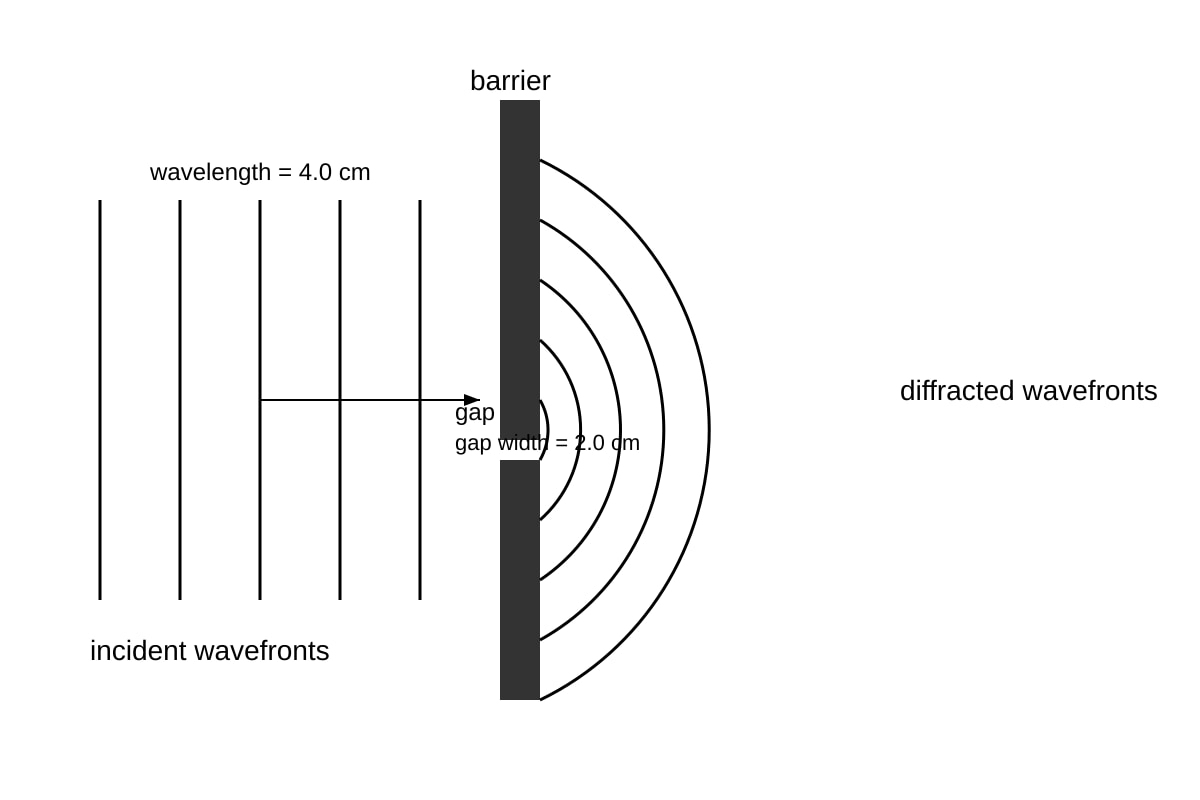
Answer: The wavefronts spread out in circular patterns after the gap (diffraction).
Marking: 1 mark for stating spreading/outward bending, 1 mark for describing circular wavefronts.
Note: Image shows gap smaller than wavelength so strong diffraction occurs.
Q5 [2 marks]
Total distance travelled by sound =
Distance to cliff =
Answer:
Marking: 1 mark for doubled-time correction, 1 mark for final value.
Common mistake: Forgetting echo travels to cliff and back.
Section B: Sound
Q6 [1 mark]
Answer: to (or ).
Teaching note: Below 20 Hz is infrasound, above 20 kHz is ultrasound.
Q7 [2 marks]
Answer: Sound is a mechanical longitudinal wave that needs a medium (particles) to vibrate; vacuum has no particles, so no wave can be transmitted.
Marking: 1 mark for mechanical/medium need, 1 mark for vacuum lack of particles.
Q8 [2 marks]
(3 s.f.)
Answer:
Marking: 1 mark method, 1 mark answer.
Q9 [2 marks]
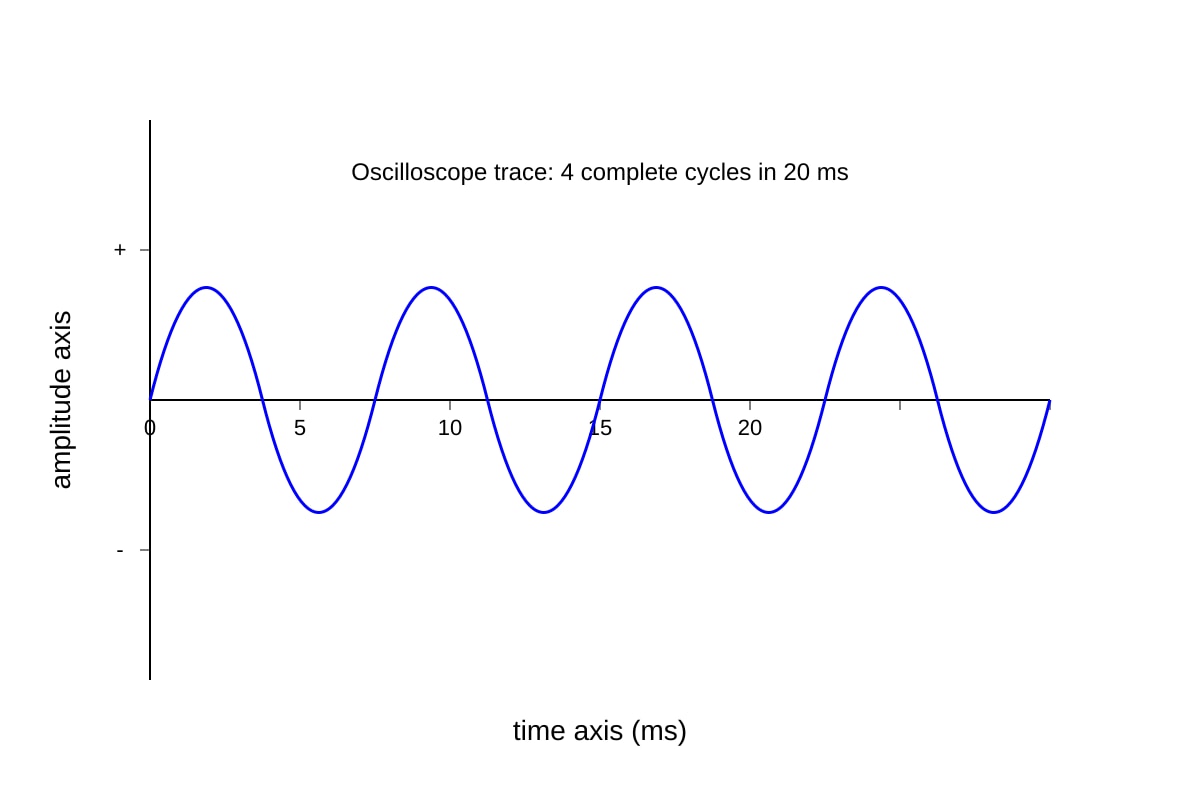
Time for 4 cycles =
Period
Answer:
Marking: 1 mark for period, 1 mark for frequency.
Q10 [2 marks]
Example: Ultrasound scanning in pregnancy. High-frequency sound waves are sent into the body; they reflect off tissues and the echoes are used to form an image.
Marking: 1 mark application, 1 mark brief mechanism.
Section C: Light
Q11 [1 mark]
Answer: Angle of incidence equals angle of reflection ().
Q12 [2 marks]
Answer:
Marking: 1 mark for formula and substitution, 1 mark answer.
Q13 [2 marks]
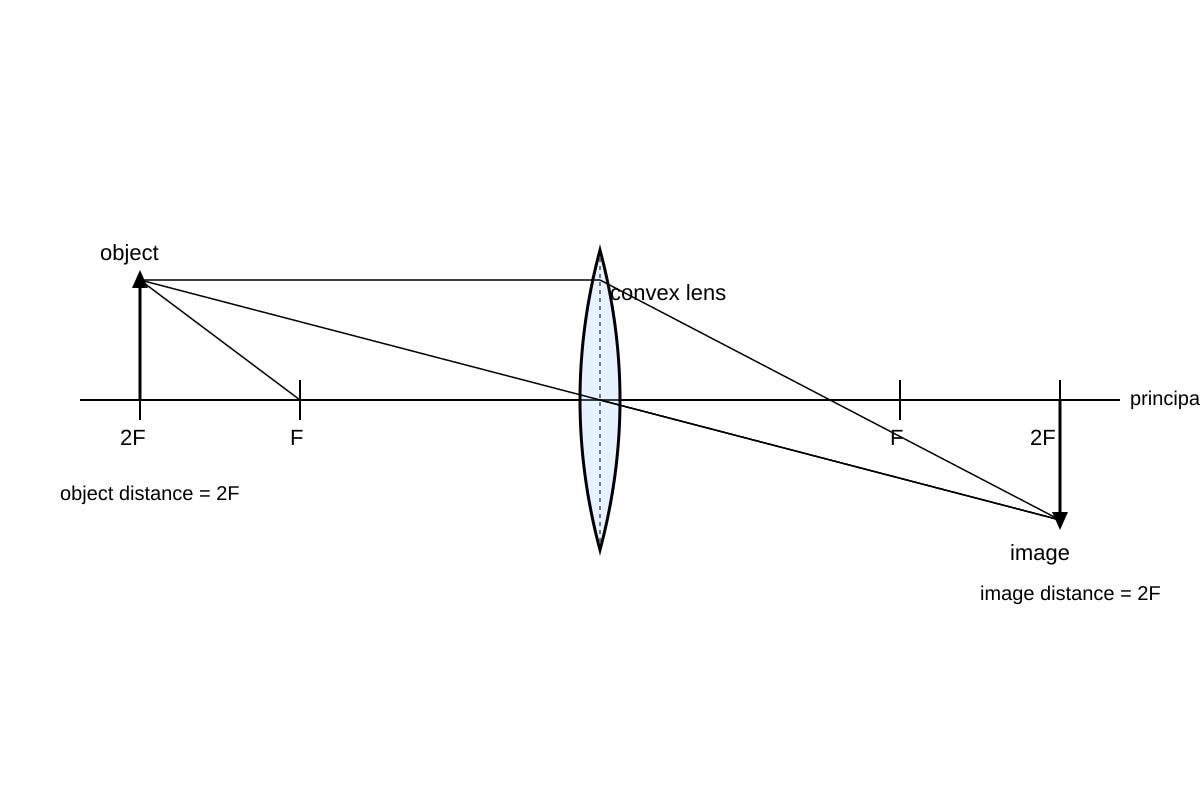
Answer: Real, inverted, same size as object, formed at on opposite side.
Marking: 1 mark real/inverted, 1 mark same size/at 2F.
Q14 [2 marks]
Answer: Total internal reflection is the complete reflection of light back into a denser medium when incident at angle greater than critical angle. Condition: light travelling from denser to less dense medium.
Marking: 1 mark definition, 1 mark condition.
Q15 [2 marks]
Answer:
Marking: 1 mark working, 1 mark answer.
Section D: Electromagnetic Spectrum & Mixed
Q16 [1 mark]
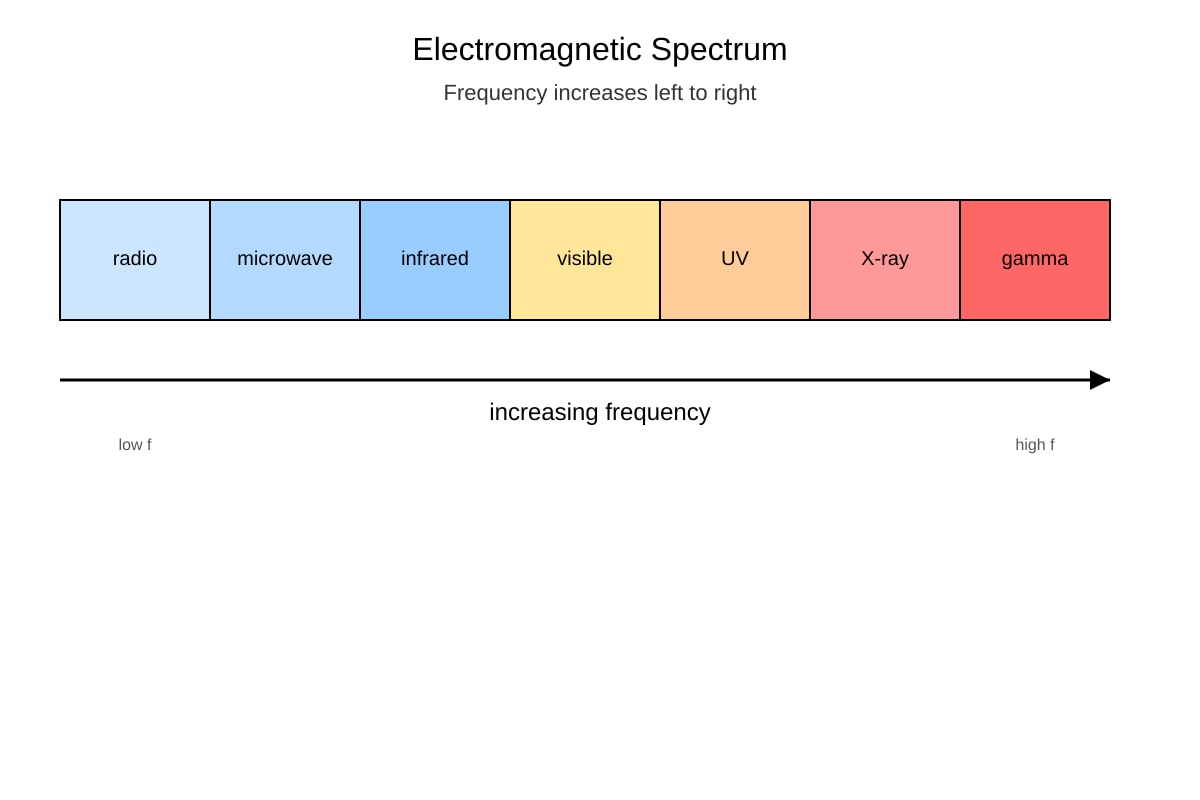
Answer: Radio waves.
Q17 [2 marks]
Infrared use: remote controls / thermal imaging. UV danger: causes skin cancer / eye damage.
Marking: 1 mark each.
Q18 [2 marks]
Order: microwaves, visible light, X-rays.
Marking: 2 marks for fully correct order (1 mark if only two correct).
Q19 [2 marks]
Answer:
Marking: 1 mark conversion and method, 1 mark answer.
Q20 [2 marks]
Answer: A prism refracts different colours by different amounts because refractive index varies with wavelength; violet bends most, red least, producing a spectrum.
Marking: 1 mark refraction differing, 1 mark dispersion explanation.