AI Generated Quiz
O Level Physics Thermal Physics Quiz
Free O Level Physics Thermal Physics quiz, HY3 AI version, with questions, answers, and O Level-style practice for Singapore students.
These static practice materials are generated from the site's syllabus and paper-generation workflow, with source and model context shown so students and parents can evaluate the material before use.
Questions
O-Level Physics Quiz - Thermal Physics
Name: ___________________________
Class: ___________________________
Date: ___________________________
Score: _______ / 40
Duration: 50 minutes
Total Marks: 40
Instructions:
- Answer all 20 questions.
- Section A: Multiple-choice (1 mark each).
- Section B: Structured questions (2–3 marks each).
- Section C: Extended calculation and explanation (4 marks each).
- Show your working where calculation is required.
- Use the spaces provided.
Section A (Questions 1–5, 1 mark each)
1. Which of the following best describes the arrangement of particles in a liquid?
A. Particles are tightly packed in fixed positions and vibrate.
B. Particles are far apart and move randomly with no attraction.
C. Particles are close together but can slide past one another.
D. Particles are arranged in a regular lattice and do not move.
2. The process by which thermal energy is transferred through the bulk movement of a fluid is called:
A. conduction
B. convection
C. radiation
D. evaporation
3. Which physical quantity is measured in joules per kilogram per degree Celsius (J kg⁻¹ °C⁻¹)?
A. Specific heat capacity
B. Specific latent heat
C. Thermal conductivity
D. Heat capacity
4. During boiling, the temperature of a liquid remains constant because the energy supplied is used to:
A. increase the kinetic energy of the particles
B. overcome the forces of attraction between particles
C. increase the temperature of the surroundings
D. decrease the internal energy of the liquid
5. A metal rod feels colder than a wooden rod at the same room temperature because metal has:
A. lower specific heat capacity
B. higher thermal conductivity
C. higher latent heat
D. lower density
Section B (Questions 6–15, 2–3 marks each)
6. State one difference between evaporation and boiling. [2]
7. Explain why a woollen blanket keeps a person warm in cold weather. [2]
8. A 2.0 kg block of aluminium (specific heat capacity = 900 J kg⁻¹ °C⁻¹) is heated from 20 °C to 45 °C. Calculate the thermal energy absorbed. [3]
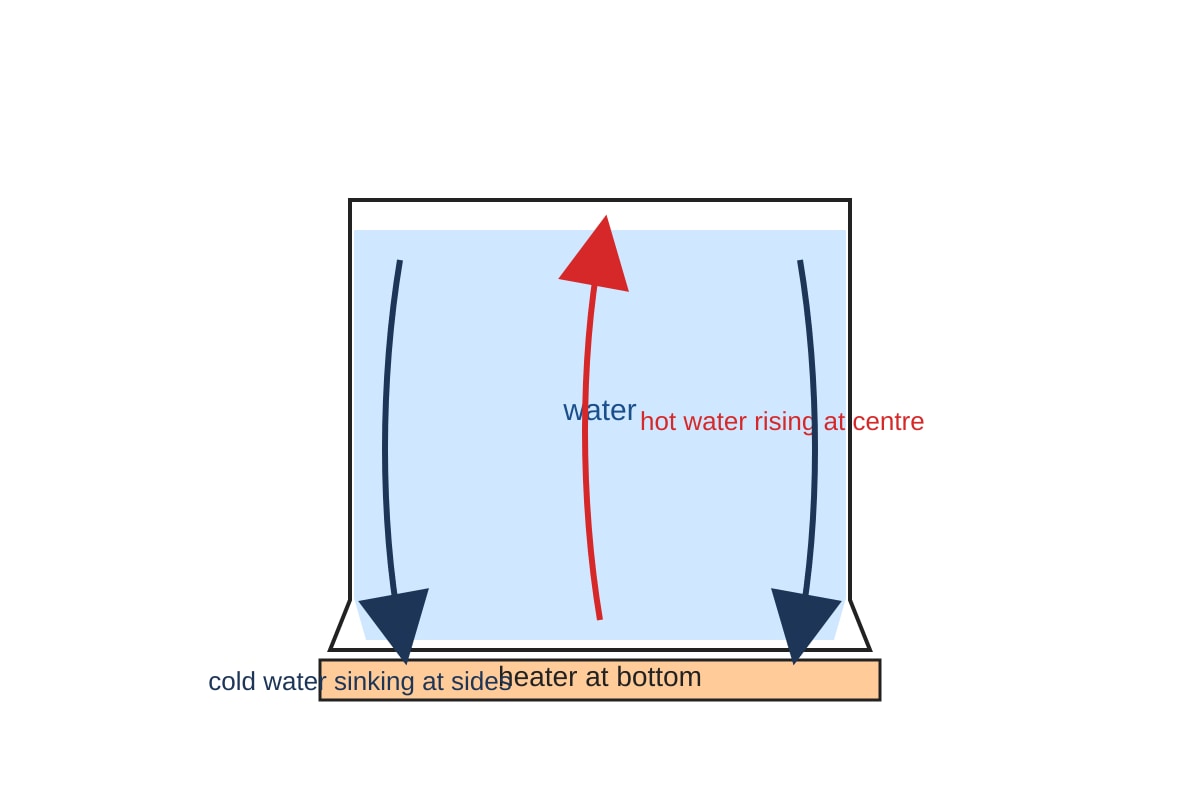
9. The diagram below shows a simple convection current in a beaker of water heated from below.
Image pending generation: diagram for Q9.
Describe the path of a single water particle from the bottom to the top. [2]
10. Define specific latent heat of fusion. [2]
11. A 0.50 kg piece of ice at 0 °C is changed to water at 0 °C. The specific latent heat of fusion of ice is 3.34 × 10⁵ J kg⁻¹. Calculate the energy needed. [2]
12. State two ways to increase the rate of evaporation of a liquid. [2]
13. Explain, in terms of particles, why a gas can be compressed easily but a solid cannot. [3]
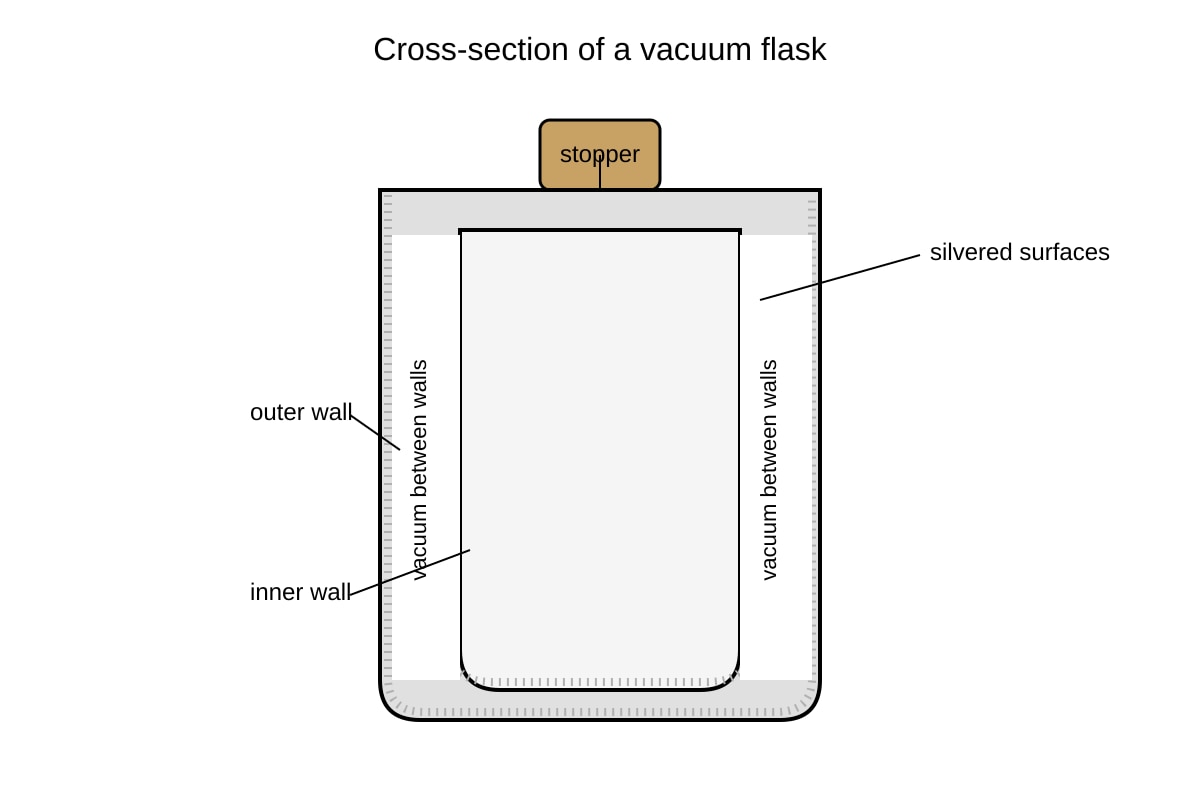
14. The figure shows a vacuum flask.
Image pending generation: diagram for Q14.
State two features of the flask that reduce energy loss by radiation. [2]
15. A student claims that dark, rough surfaces are better radiators of heat than light, shiny surfaces. State whether this is correct and give one example of use. [2]
Section C (Questions 16–20, 4 marks each)
16. A 1.5 kg copper calorimeter (specific heat capacity = 390 J kg⁻¹ °C⁻¹) contains 0.80 kg of water (specific heat capacity = 4200 J kg⁻¹ °C⁻¹) at 15 °C. Hot water at 80 °C is added and the final temperature is 35 °C. Assuming no heat loss, calculate the mass of hot water added. [4]
17. Explain how the kinetic particle model accounts for the expansion of a solid when heated. [4]
18. A liquid of mass 0.20 kg is heated using a 60 W heater for 5.0 minutes. The temperature rises from 22 °C to 37 °C. Calculate the specific heat capacity of the liquid and state one assumption made. [4]
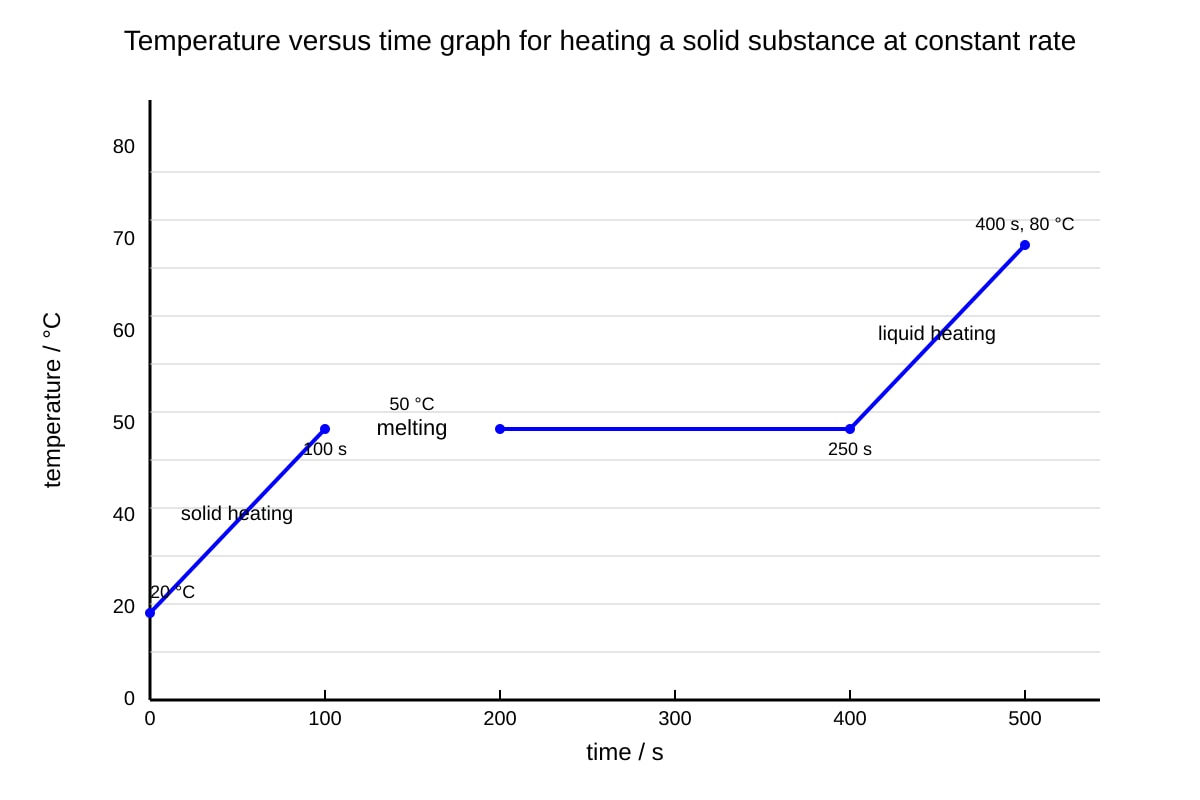
19. The graph shows the heating curve of a pure substance.
Image pending generation: graph for Q19.
(a) What is the melting point of the substance? [1]
(b) Explain why the temperature stays constant during the plateau. [3]
20. Compare conduction in metals and non-metals. Use particle theory and include the role of free electrons. [4]
Answers
O-Level Physics Quiz - Thermal Physics (Answer Key)
Total Marks: 40
Topic: Thermal Physics (Syllabus 6091, Section III)
Section A Answers (1 mark each)
1. C
Teaching note: In a liquid, particles are close together with attractive forces but are not fixed in a lattice; they can slide past one another. A describes a solid; B describes a gas; D describes a solid.
2. B
Teaching note: Convection is transfer of thermal energy by bulk movement of fluid (liquid or gas). Conduction is through vibrations/electrons, radiation via EM waves.
3. A
Teaching note: Specific heat capacity unit is J kg⁻¹ °C⁻¹ (or J kg⁻¹ K⁻¹). Specific latent heat is J kg⁻¹.
4. B
Teaching note: At boiling, supplied energy breaks intermolecular bonds (latent heat), not raising kinetic energy, so temperature constant.
5. B
Teaching note: Metal conducts heat away from hand faster (higher thermal conductivity), feeling colder though same temp.
Section B Answers (2–3 marks each)
6. [2]
Any one correct difference, e.g.:
- Evaporation occurs at surface and below boiling point; boiling occurs throughout liquid at fixed temperature.
- Boiling needs external heating to boiling point; evaporation happens at any temperature.
(Mark: 1 for each clear point, max 2)
7. [2]
Woollen blanket traps air (1) which is a poor conductor / insulator (1), reducing heat loss from body by conduction/convection.
8. [3]
Formula: Q=mcΔT
m=2.0 kg, c=900 J kg⁻¹ °C⁻¹, ΔT=45−20=25 °C
Q=2.0×900×25=45000 J
Marks: 1 for formula, 1 for substitution, 1 for answer.
9. [2]
Particle at bottom is heated, expands, becomes less dense (1), rises upward at centre (1). (Cold water from sides sinks to replace it.)
10. [2]
Specific latent heat of fusion is the thermal energy required to change 1 kg of a substance from solid to liquid at its melting point without temperature change. (1 for per kg, 1 for solid→liquid at constant temp)
11. [2]
Q=mL=0.50×3.34×105=1.67×10⁵ J.
Marks: 1 formula/sub, 1 answer.
12. [2]
Any two: increase temperature, increase surface area, increase air flow / wind, reduce humidity. (1 each)
13. [3]
Gas particles far apart with weak forces (1), large empty space so particles pushed closer (1). Solid particles tightly packed in fixed positions with strong forces, no space to compress (1).
14. [2]
Silvered surfaces reflect radiation (1); vacuum between walls prevents conduction/convection (1). (Both reduce radiation loss via silvering)
15. [2]
Correct (1). Example: black radiator paint, solar heater absorber (1).
Section C Answers (4 marks each)
16. [4]
Let m = mass hot water.
Heat lost by hot water = m×4200×(80−35)=m×4200×45.
Heat gained by calorimeter = 1.5×390×(35−15)=1.5×390×20=11700 J.
Heat gained by cold water = 0.80×4200×20=67200 J.
Total gain = 78900 J.
m×189000=78900⇒m=0.417 kg.
Marks: 1 calorimeter gain, 1 cold water gain, 1 hot water loss eqn, 1 solve + unit.
17. [4]
When heated, particles gain kinetic energy and vibrate more (1). Average separation increases (1). In solid, this expands the lattice (1). Macroscopic expansion is sum of particle spacing increase (1).
18. [4]
Energy supplied: P×t=60×(5×60)=18000 J.
ΔT=37−22=15 °C.
c=Q/(mΔT)=18000/(0.20×15)=6000 J kg⁻¹ °C⁻¹.
Assumption: no heat loss to surroundings / all heater energy absorbed.
Marks: 1 energy, 1 ΔT, 1 calc, 1 assumption.
19. [4]
(a) 50 °C [1]
(b) Energy supplied used to break forces between particles (1), changes state solid→liquid (1), kinetic energy unchanged so temp constant (1).
Marks as shown.
20. [4]
Metals: free electrons transfer kinetic energy rapidly (2). Non-metals: only vibrations passed via neighbours, slower (1). Particle theory: both have vibrating particles but metal has mobile electrons (1).
Free quiz and exam paper access
Enter your details to view this paper
Your access is remembered on this device.