AI Generated Quiz
O Level Physics Modern Physics Quiz
Free O Level Physics Modern Physics quiz, HY3 AI version, with questions, answers, and O Level-style practice for Singapore students.
These static practice materials are generated from the site's syllabus and paper-generation workflow, with source and model context shown so students and parents can evaluate the material before use.
Questions
Free quiz and exam paper access
Enter your details to view this paper
Your access is remembered on this device.
Answers
O-Level Physics Quiz - Modern Physics (Answer Key)
Total Marks: 40
Topic: Modern Physics (Radioactivity / nuclear model)
Note: Content generated from syllabus-first LLM templates (Stage 4/5). Past-paper evidence for this topic was very weak (0.2% of corpus); this quiz is NOT claimed to be exam-derived.
Section A: Multiple-Choice (1 mark each)
1. C – Gamma ray.
Teaching note: Gamma rays are electromagnetic waves (photons) with no rest mass and no charge. Alpha = 2 protons + 2 neutrons (charge +2). Beta = electron (charge –1). Proton is a nucleon, not a radiation type here.
2. B – half the nuclei present to decay.
Teaching note: Half-life is defined as the time for the activity (or number of undecayed nuclei) to fall to half its initial value. Not all decay at once.
3. B – Beta.
Teaching note: Charged particles deflect in magnetic fields. Beta (electron, low mass, charge –1) deflects more than alpha (heavy, charge +2) and gamma (no charge) does not deflect.
4. B – 146.
Method: Neutrons = mass number – proton number = 238 – 92 = 146.
5. B – Using gamma rays to sterilise medical equipment.
Teaching note: Gamma sterilisation is a safe controlled industrial use. Radium paint and food irradiation for flavour are not safe/approved everyday uses at O-Level.
Section B: Structured Short Answers (2 marks each)
6. [1 mark each]
Alpha: positively charged, heavy, low penetration, high ionising. (any one)
Gamma: no charge/mass, high penetration, low ionising. (any one)
7. Half-life = 4 days; 8 days = 2 half-lives.
After 1st: 800 ÷ 2 = 400 counts/s
After 2nd: 400 ÷ 2 = 200 counts/s
Answer: 200 counts/s [2 marks: 1 for 2 half-lives, 1 for correct value]
8. Missing particle is alpha: (or ).
Check: 222 = 218 + 4; 86 = 84 + 2. [2 marks]
9. Beta particles are electrons emitted when a neutron in the nucleus changes into a proton and an electron:
. The electron is ejected from the nucleus. [2 marks]
10. Beta stopper: aluminium (few mm). Gamma stopper: thick lead/concrete. [1+1]
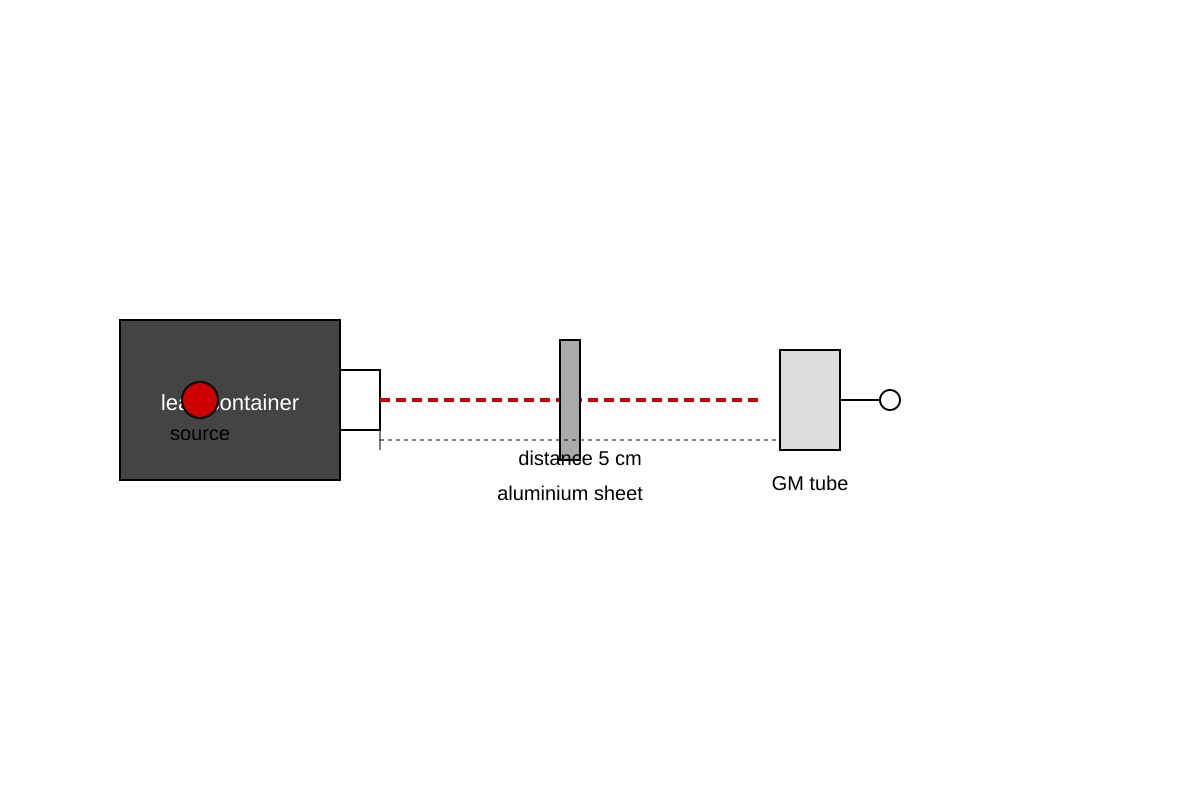
11. Mainly beta radiation.
Reason: Aluminium stops alpha but not beta; sharp drop means beta was being blocked. [1+1]
Image note: Source→aluminium→GM tube; with aluminium, count drops → beta.
12. Charge: +2 (or +2e). Mass: 4 (approx 4 × proton). [1+1]
13. After 3 half-lives, fraction remaining = .
Remaining = . [2 marks]
14. Lead absorbs gamma and reduces exposure; protects user from radiation. [2 marks]
15. Natural: cosmic rays / rocks / radon gas. Artificial: medical X-rays / nuclear tests. [1+1]
Section C: Extended Responses (3 marks each)
16. [3 marks]
- Place source at fixed distance from GM tube, record counts over time intervals. (1)
- Subtract background count, plot activity vs time. (1)
- Find time for count to halve repeatedly; average gives half-life. (1)
17. [3 marks]
Alpha: least penetration (paper), most ionising.
Beta: medium (aluminium), medium ionising.
Gamma: most penetration (lead), least ionising. (1 mark each)
18. 6 h = 3 half-lives (2 h each).
Activity = Bq. [2 for working, 1 for unit/answer]
Answer: 150 Bq
19. [3 marks]
Smoke detector has Am-241 alpha source ionising air between plates, causing small current. (1) Smoke enters, absorbs alpha, current drops, alarm sounds. (1) Alpha suitable: short range, safe if enclosed, strong ioniser. (1)
20. [3 marks]
U-235 absorbs neutron, splits into two smaller nuclei + 2–3 neutrons + energy. (1) Released neutrons cause further fissions. (1) If each fission releases enough neutrons to sustain next, chain reaction continues. (1)