O-Level Physics Quiz - Energy Power
Name: ______________________
Class: ______________________
Date: ______________________
Score: _______ / 40
Duration: 50 minutes
Total Marks: 40
Instructions:
- Answer all 20 questions.
- Section A: Multiple-choice (1 mark each). Write the letter of the correct option.
- Section B: Structured questions (2–3 marks each). Show your working where calculation is required.
- Section C: Extended response (4 marks each). Explain your reasoning clearly.
- Use g=10 m/s2 where needed.
- This quiz is syllabus-first practice generated from inferred templates; it is not derived from past-year exam papers.
Section A: Multiple-Choice (Questions 1–5)
1. Which of the following is a correct unit for power?
A. Joule (J)
B. Watt (W)
C. Newton (N)
D. Pascal (Pa)
[____]
2. A lamp transfers 60 J of energy in 12 s. What is its power?
A. 5 W
B. 720 W
C. 0.2 W
D. 12 W
[____]
3. The efficiency of a device is 0.25. This means:
A. 25% of input energy is wasted
B. 25% of input energy is useful output
C. 75% of input energy is useful output
D. The device uses 25 J per second
[____]
4. Which energy store is associated with an object due to its height above the ground?
A. Kinetic
B. Chemical
C. Gravitational potential
D. Elastic
[____]
5. Work done is calculated as:
A. Force ÷ distance
B. Force × distance (in direction of force)
C. Mass × velocity
D. Power × time
[____]
Section B: Structured Questions (Questions 6–15)
6. A crane lifts a 200 kg load vertically by 15 m in 20 s.
(a) Calculate the gain in gravitational potential energy. [2]
(b) Calculate the useful power output of the crane. [1]
7. A student pushes a box with a force of 50 N over a distance of 4 m in the direction of the force. Calculate the work done. [2]
8. A kettle is rated at 2.0 kW. It takes 100 s to boil water, using 1.8×10⁵ J of useful energy.
(a) Calculate the total energy supplied by the kettle. [2]
(b) Calculate the efficiency of the kettle as a percentage. [1]
9. A ball of mass 0.5 kg is dropped from a height of 8 m. Calculate its kinetic energy just before it hits the ground. (Assume no air resistance.) [2]
10. A solar panel delivers 300 W of power. How much energy does it transfer in 2 hours? Give your answer in kJ. [2]
11. The diagram shows a rollercoaster at two positions.
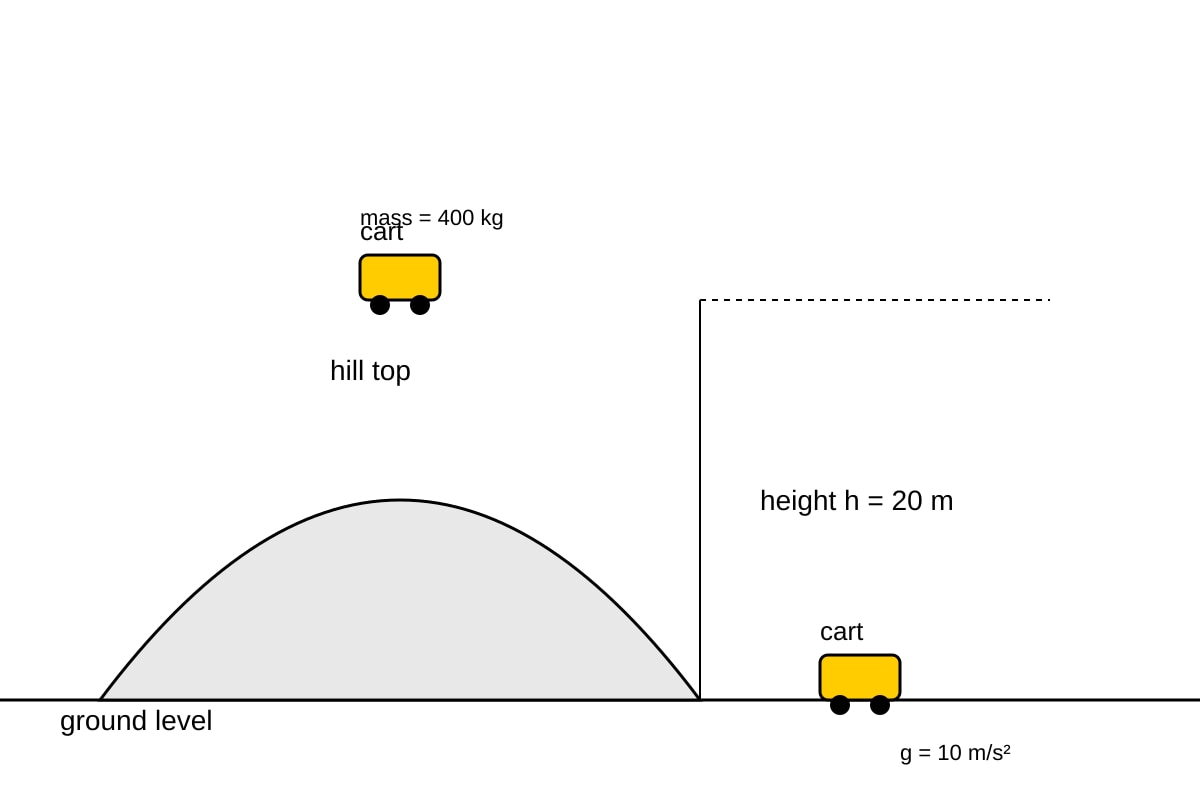
Generated diagram for Q11.
Assuming no friction, state the energy transformation from top to bottom and calculate the speed at the bottom. [3]
12. A car engine produces 40 kW of useful power and has an efficiency of 20%. Calculate the total power input from fuel. [2]
13. A 1.2 kW heater runs for 15 minutes. Calculate the energy used in kWh and in J. [2]
14. Explain why a falling object reaches terminal velocity and what happens to its kinetic energy then. [2]
15. A battery supplies 120 J of energy to a motor. The motor lifts a 2 kg mass by 3 m.
(a) Calculate useful energy output. [1]
(b) Calculate efficiency. [1]
Section C: Extended Response (Questions 16–20)
16. A hydroelectric dam stores water in a reservoir 50 m above the turbines. Water of total mass 2.0×10⁶ kg is released.
(a) Calculate the gravitational potential energy stored. [2]
(b) If all this energy is converted to electrical energy at 80% efficiency, calculate the electrical energy output. [1]
(c) If the generation lasts 100 s, calculate the average power output. [1]
17. Compare renewable and non-renewable energy resources. Use examples and mention one advantage and one disadvantage of each type. [4]
18. A boy of mass 50 kg runs up a staircase of height 5 m in 10 s.
(a) Calculate his power output. [2]
(b) State one assumption made and how it affects the result if wrong. [2]
19. Describe an experiment to determine the efficiency of a small electric motor lifting a load. Include measurements and calculations. [4]
20. The figure shows a pendulum.
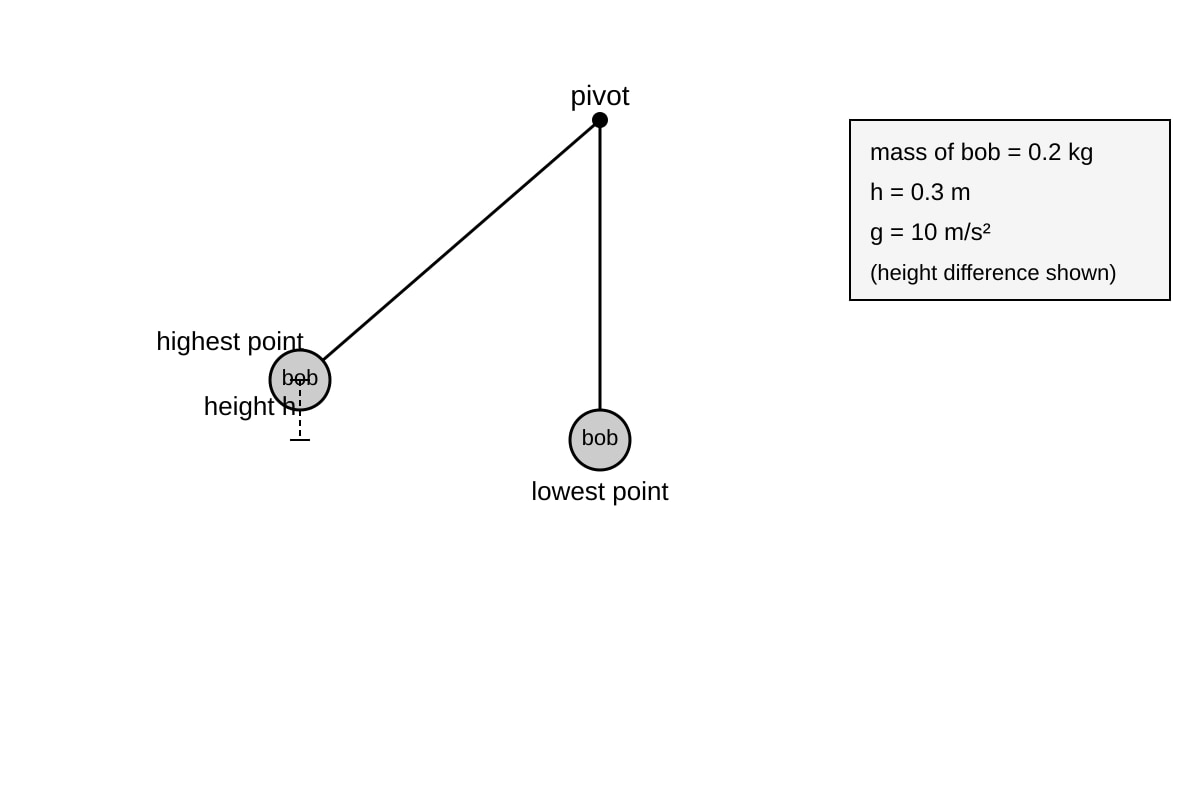
Generated diagram for Q20.
(a) State the energy change from highest to lowest point. [1]
(b) Calculate speed at lowest point. [2]
(c) Explain why the pendulum eventually stops. [1]