From Real Exams Quiz
O Level Physics Waves Sound Light Quiz
Free O Level Physics Waves Sound Light quiz, HY3 Exam version, with questions, answers, and O Level-style practice for Singapore students.
These static practice materials are generated from the site's syllabus and paper-generation workflow, with source and model context shown so students and parents can evaluate the material before use.
Questions
O-Level Physics Quiz - Waves Sound Light
Name: ___________________________
Class: ___________________________
Date: ___________________________
Score: ___________ / 40
Duration: 50 minutes
Total Marks: 40
Instructions:
- Answer all 20 questions.
- Section A: Multiple-choice style short responses (1 mark each).
- Section B: Structured short answers (2 marks each).
- Section C: Calculation and explanation (3 marks each).
- Show working where calculation is required.
- Use SI units in your answers.
Section A (Questions 1–5, 1 mark each)
-
A transverse wave transfers energy. Which of the following is true about the direction of particle vibration?
-
State one property of sound waves that makes them unable to travel through a vacuum.
-
Name the part of the electromagnetic spectrum used in remote controls for televisions.
-
In total internal reflection, the angle of incidence must be greater than the _______________.
-
Ultrasound is sound of frequency above _______________ Hz.
Section B (Questions 6–10, 2 marks each)
-
A ripple tank shows straight water waves passing from deep to shallow water. Describe what happens to the speed and wavelength of the waves.
-
A student places a tuning fork near a tube of water and hears resonance at a certain water level. Explain what is meant by resonance in this context.
-
State two differences between a converging lens and a plane mirror in how they form images.
-
Light travels from air into glass at an angle of incidence of 30°. The refractive index of glass is 1.5. Calculate the angle of refraction.
-
A bat emits a sound pulse and receives the echo 0.08 s later. The speed of sound in air is 340 m/s. Calculate the distance to the object.
Section C (Questions 11–20, 3 marks each)
- A wave has a frequency of 50 Hz and a wavelength of 4 m.
(a) Calculate the speed of the wave.
(b) State whether this is more likely a sound wave or a light wave and why.
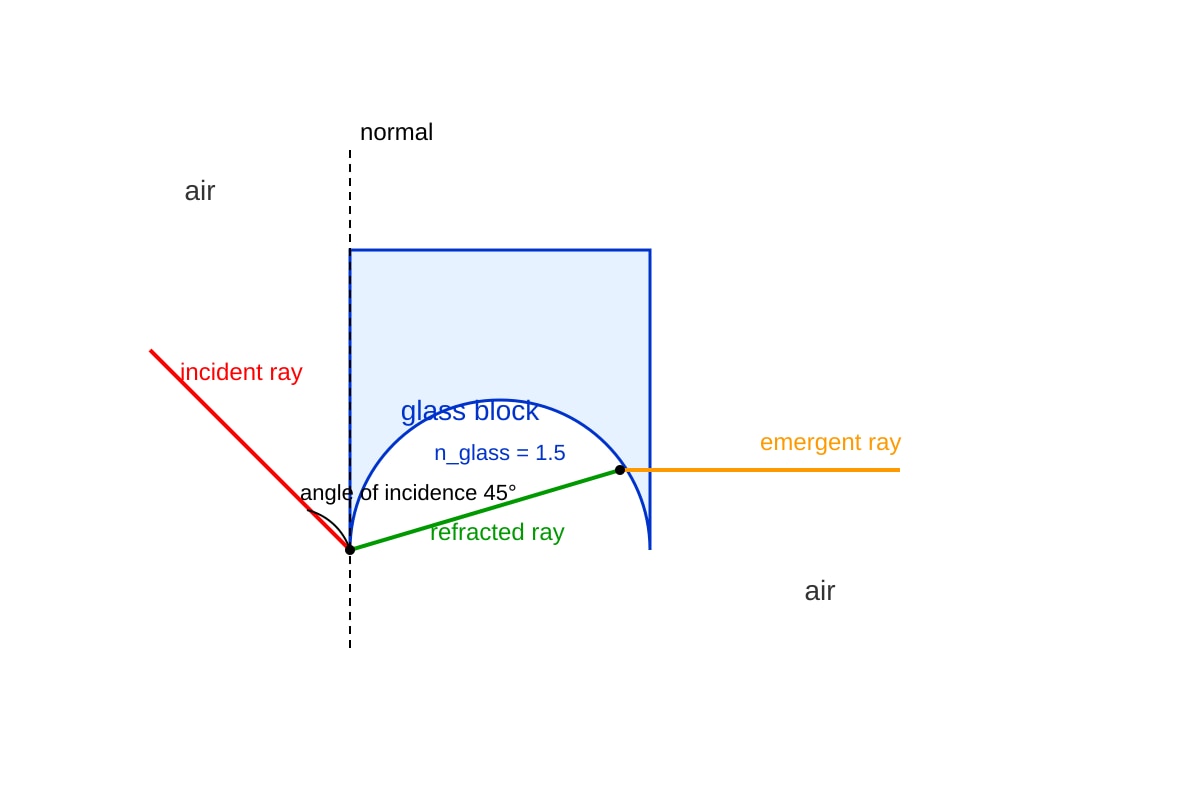
- The diagram shows a ray of light entering a semicircular glass block.
Image pending generation: diagram for Q12.
Calculate the angle of refraction at the air–glass boundary.
- A string is fixed at both ends and vibrates at its fundamental frequency of 120 Hz. The length of the string is 0.75 m.
(a) State the wavelength of the stationary wave on the string.
(b) Calculate the speed of the wave on the string.
- Explain how ultrasound is used in medical scanning and why it is safer than X-rays for fetus imaging.
- A concave mirror has a focal length of 10 cm. An object is placed 15 cm in front of it.
(a) Use the mirror formula f1=u1+v1 to find the image distance v.
(b) State one property of the image formed.
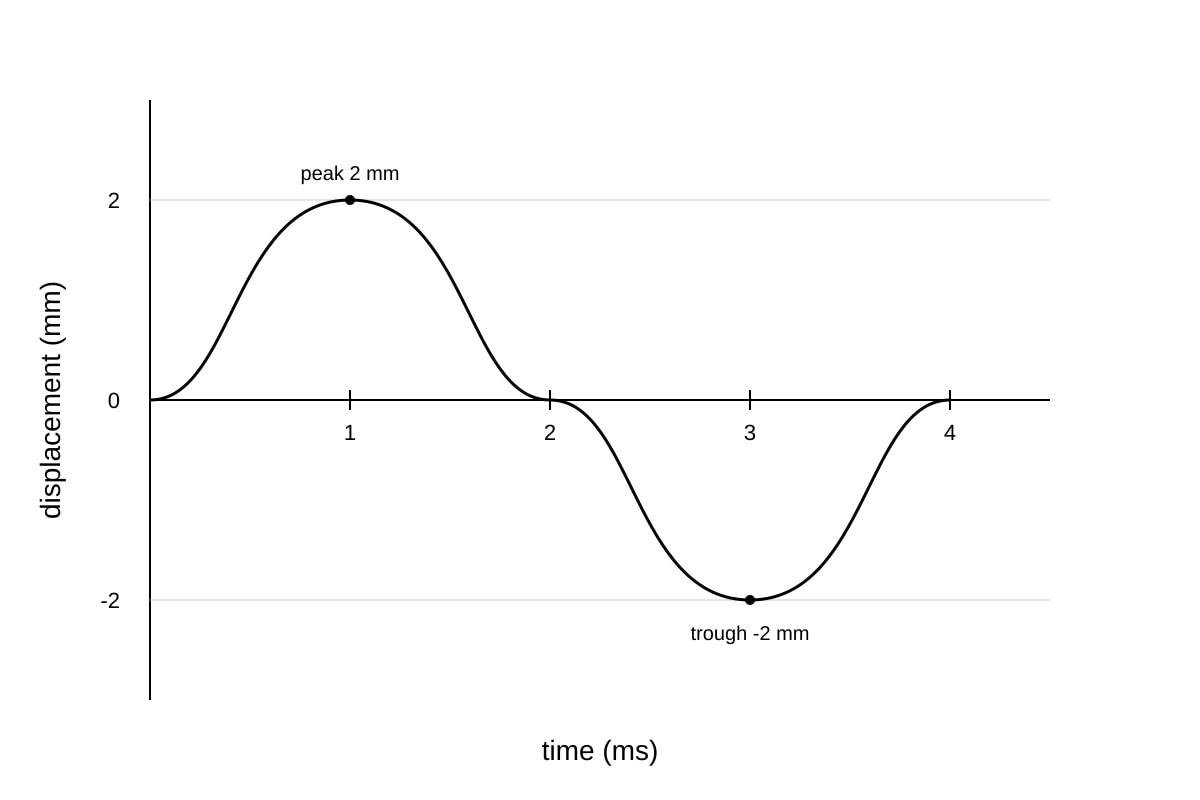
- The graph shows displacement against time for a sound wave.
Image pending generation: graph for Q16.
(a) Determine the frequency of the wave.
(b) State the amplitude.
- A student shines a laser through a double slit and observes fringes on a screen. The slit separation is 0.5 mm, distance to screen 2.0 m, fringe spacing 2.4 mm. Calculate the wavelength of the light. Use λ=Dax.
- Compare longitudinal and transverse waves with one example each.
- A convex lens of focal length 20 cm forms a real image 60 cm from the lens. Calculate the object distance.
- Explain why red light is bent less than violet light when passing through a prism.
Answers
O-Level Physics Quiz - Waves Sound Light: Answer Key
Total Marks: 40
Topic: Waves, Sound & Light
Section A (1 mark each)
Q1. Particle vibration is perpendicular to the direction of energy transfer.
Teaching note: Transverse waves (e.g. water, light) have particles oscillating at right angles to wave travel. Mark: 1 for "perpendicular".
Q2. Sound waves are mechanical / need a medium.
Teaching note: Sound requires particles to vibrate; vacuum has no particles. Mark: 1 for "mechanical / needs medium".
Q3. Infrared.
Teaching note: TV remotes use infrared radiation, part of EM spectrum. Mark: 1.
Q4. Critical angle.
Teaching note: TIR occurs when incidence > critical angle at dense-to-less-dense boundary. Mark: 1.
Q5. 20 000 (or 2×10⁴).
Teaching note: Ultrasound > human hearing range (~20 kHz). Mark: 1.
Section B (2 marks each)
Q6. Speed decreases; wavelength decreases.
Teaching note: Shallow water slows waves; frequency constant so λ=v/f drops. [1] for speed, [1] for wavelength. Total 2.
Q7. Resonance is when forced frequency matches natural frequency, giving maximum amplitude.
Teaching note: Air column resonates at specific length. [1] match of freq, [1] large amplitude. Total 2.
Q8. Lens refracts light to form real/inverted image; plane mirror reflects to form virtual/upright image.
Teaching note: Any two valid differences. [1] each. Total 2.
Q9. n=sinrsini⇒sinr=1.5sin30°=0.333⇒r=19.5°.
Working: sin30°=0.5; 0.5/1.5=0.333; sin−1(0.333)≈19.5°. [1] formula, [1] answer. Total 2.
Q10. d=2vt=2340×0.08=13.6 m.
Working: echo time is return trip, halve it. [1] method, [1] answer. Total 2.
Section C (3 marks each)
Q11. (a) v=fλ=50×4=200 m/s. [1]
(b) Sound wave; light is 3×10⁸ m/s, this is far slower. [2] for identification + reason. Total 3.
Q12. sinr=1.5sin45°=0.471⇒r=28.1°.
Working: sin45°=0.707; /1.5 = 0.471; sin−1=28.1°. [3] for steps + answer. Total 3.
Q13. (a) λ=2L=1.5 m. [1]
(b) v=fλ=120×1.5=180 m/s. [2] formula + calc. Total 3.
Q14. Ultrasound uses high-freq sound reflected from tissues to form image. [1] Safer because non-ionising, unlike X-ray. [2] for med use + safety reason. Total 3.
Q15. (a) 101=151+v1⇒v1=101−151=301⇒v=30 cm. [2]
(b) Real, inverted. [1] Total 3.
Q16. (a) f=1/T=1/(4×10−3)=250 Hz. [2]
(b) Amplitude = 2 mm. [1] Total 3.
Q17. λ=Dax=2.00.5×10−3×2.4×10−3=6.0×10⁻⁷ m.
Working: convert mm to m; multiply; divide. [3] Total 3.
Q18. Longitudinal: particles parallel to travel (sound). Transverse: perpendicular (water). [1.5] each. Total 3.
Q19. 201=u1+601⇒u1=201−601=602⇒u=30 cm. [3] Total 3.
Q20. Red has longer wavelength / lower refractive index; less bending. [1.5] each. Total 3.
Free quiz and exam paper access
Enter your details to view this paper
Your access is remembered on this device.