From Real Exams Quiz
O Level Physics Thermal Physics Quiz
Free O Level Physics Thermal Physics quiz, HY3 Exam version, with questions, answers, and O Level-style practice for Singapore students.
These static practice materials are generated from the site's syllabus and paper-generation workflow, with source and model context shown so students and parents can evaluate the material before use.
Questions
Free quiz and exam paper access
Enter your details to view this paper
Your access is remembered on this device.
Answers
O-Level Physics Quiz - Thermal Physics (Answer Key)
Total Marks: 40
Topic: Thermal Physics
Section A: Short Answer (Q1–5)
Q1. [1 mark]
Solid, liquid, gas.
Teaching note: Matter exists in three common states. Marks awarded for naming all three. Common mistake: omitting one state.
Q2. [1 mark]
Evaporation.
Teaching note: Evaporation occurs at the surface below boiling point; boiling is throughout the liquid at boiling point.
Q3. [1 mark]
Thermometer.
Teaching note: A thermometer measures temperature; types include mercury, alcohol, digital.
Q4. [1 mark]
Internal energy (or thermal energy).
Teaching note: Internal energy = sum of kinetic and potential energies of particles. For this level, "internal energy" accepted.
Q5. [1 mark]
J/(kg·°C) or J kg⁻¹ °C⁻¹.
Teaching note: Specific heat capacity unit from E = mcΔT → J / (kg·°C).
Section B: Structured Questions (Q6–10)
Q6. [2 marks]
- Solid: particles closely packed in fixed positions, strong forces, vibrate only → fixed shape. [1]
- Gas: particles far apart, weak forces, move randomly and fill container → no fixed shape. [1]
Teaching note: Use kinetic model: arrangement and motion explain macroscopic properties.
Q7. [2 marks]
State of matter: Solid. [1]
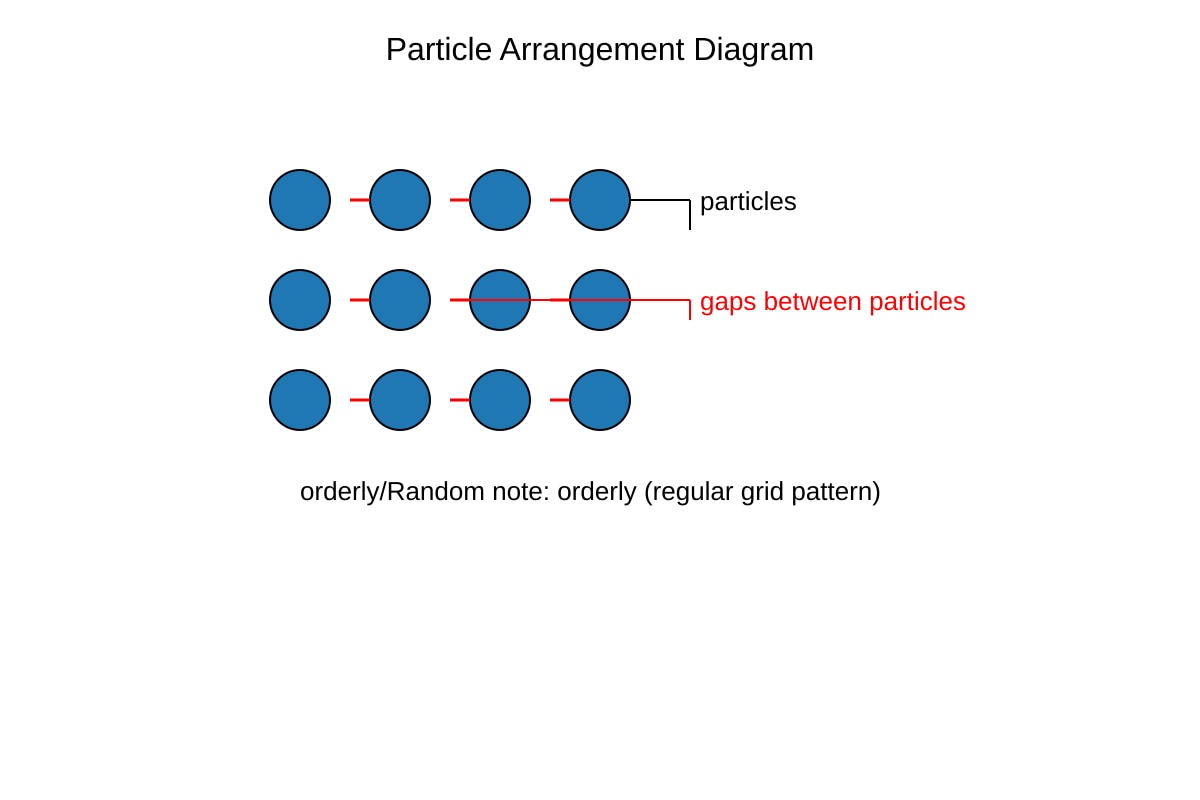
Reason: Particles are in a regular grid with small equal gaps, showing fixed arrangement. [1]
Image note: Diagram shows 12 circles in regular grid; this is solid lattice.
Q8. [2 marks]
- Conduction needs matter/contact; convection needs fluid movement. [1]
- Conduction by particle vibration/electron transfer; convection by bulk fluid circulation. [1]
Teaching note: Accept any two clear differences.
Q9. [2 marks]
Phenomenon: Diffusion. [1]
Suggestion: Particles of ink and water move randomly and mix. [1]
Teaching note: Brownian/ diffusion shows particle motion.
Q10. [2 marks]
Mercury expands when heated and contracts when cooled, so column length changes with temperature. [1] Calibrated scale gives reading. [1]
Teaching note: Thermal expansion principle.
Section C: Calculation and Explanation (Q11–20)
Q11. [3 marks]
Formula: E = mcΔT [1]
m = 2.0 kg, c = 4200, ΔT = 100−20 = 80 °C [1]
E = 2.0 × 4200 × 80 = 672 000 J [1]
Answer: 6.72 × 10⁵ J
Teaching note: ΔT must be final−initial.
Q12. [3 marks]
E = mcΔT [1]
m = 0.50, c = 900, ΔT = 80−20 = 60 [1]
E = 0.50 × 900 × 60 = 27 000 J lost [1]
Answer: 2.7 × 10⁴ J
Teaching note: Cooling → energy lost.
Q13. [3 marks]
Steam at 100 °C releases latent heat of vaporisation when condensing to water at 100 °C. [1] This extra energy (no temp drop) transfers to skin. [1] Water at 100 °C only gives sensible heat on cooling. [1]
Teaching note: Latent heat = phase change energy without ΔT.
Q14. [3 marks]
Q = mL → m = Q/L [1]
Q = 12 600 J, L = 3.34×10⁵ [1]
m = 12 600 / 334 000 = 0.0377 kg [1]
Answer: 3.77×10⁻² kg
Teaching note: Only mass melted, not all if insufficient.
Q15. [3 marks]
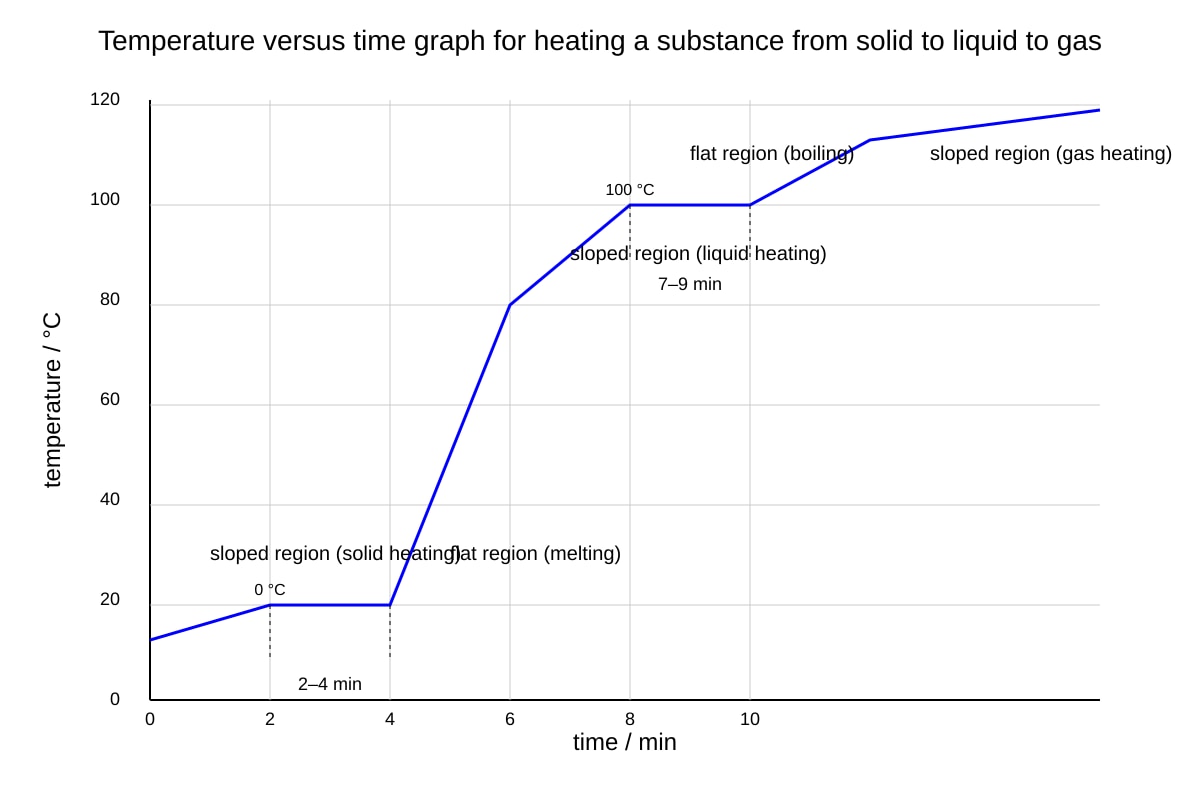
Melting point: 0 °C [1]
Boiling point: 100 °C [1]
Explanation: Flat regions at constant temp are phase changes. [1]
Image note: Graph plateaus at 0 and 100 °C.
Q16. [3 marks]
E = mcΔT = 1.0×4200×(100−25)=315 000 J [1]
P = 1.5 kW = 1500 W, t = E/P [1]
t = 315 000/1500 = 210 s [1]
Answer: 210 s (3.5 min)
Teaching note: Convert kW to W.
Q17. [3 marks]
- Wrap block in insulation, insert heater and thermometer. [1]
- Record initial T, supply known V,I for time t, record final T. [1]
- Use E=VIt=mcΔT to calculate c. [1]
Teaching note: Reduces heat loss, measures energy input.
Q18. [3 marks]
Internal energy increases as bonds break. [1] Temperature stays constant during boiling. [1] Energy goes to potential not kinetic. [1]
Teaching note: At phase change, KE constant, PE rises.
Q19. [3 marks]
Heat lost by metal = heat gained by water [1]
0.80×c×(90−30) = 0.50×4200×(30−20)
48c = 21 000 → c = 437.5 J/(kg·°C) [2]
Answer: 438 J/(kg·°C)
Teaching note: Equilibrium method.
Q20. [3 marks]
Advantage: cheap, no battery, visual. [1]
Disadvantage: slower, less precise, breakable. [1+1 for two distinct]
Teaching note: Accept any valid pair.