From Real Exams Quiz
O Level Physics Modern Physics Quiz
Free O Level Physics Modern Physics quiz, HY3 Exam version, with questions, answers, and O Level-style practice for Singapore students.
These static practice materials are generated from the site's syllabus and paper-generation workflow, with source and model context shown so students and parents can evaluate the material before use.
Questions
O-Level Physics Quiz - Modern Physics
Name: ___________________________
Class: ___________________________
Date: ___________________________
Score: ___________ / 40
Duration: 50 minutes
Total Marks: 40
Instructions:
- Answer all 20 questions.
- Section A: Multiple-choice (1 mark each).
- Section B: Structured questions (2 marks each).
- Section C: Extended response (3–4 marks each).
- Show all working where calculation is required.
- Use SI units and proper notation.
Section A: Multiple Choice (Questions 1–5)
-
Which of the following is a type of nuclear radiation that has no mass and no charge? [1]
A. Alpha particle
B. Beta particle
C. Gamma ray
D. ProtonAnswer: ______
-
The half-life of a radioactive isotope is the time taken for [1]
A. all the nuclei to decay.
B. half the nuclei present to decay.
C. the mass to double.
D. the radiation to stop.Answer: ______
-
In a smoke detector, the radioactive source commonly used is [1]
A. uranium-238.
B. americium-241.
C. carbon-14.
D. cobalt-60.Answer: ______
-
Which radiation is most easily stopped by a sheet of paper? [1]
A. Gamma ray
B. Beta particle
C. Alpha particle
D. NeutronAnswer: ______
-
A nucleus emits a beta particle. The atomic number of the nucleus [1]
A. decreases by 1.
B. increases by 1.
C. stays the same.
D. decreases by 2.Answer: ______
Section B: Structured Questions (Questions 6–15)
-
State one use of gamma rays in medicine. [2]
-
A radioactive sample has a half-life of 4 hours. Calculate the fraction of the sample remaining after 12 hours. [2]
Working: ______________________________________________________
Answer: ______ -
Complete the nuclear equation for alpha decay of radon-222:
86222Rn→ZAPo+24α [2]
A = ______ Z = ______ -
Explain why alpha radiation is unsuitable for medical imaging inside the body but suitable for smoke detectors. [2]
-
A Geiger-Müller tube is used to detect radiation. State what type of radiation it can detect. [2]
-
The count rate from a source is 800 counts/s. After 2 half-lives, what is the count rate? [2]
Working: ______________________________________________________
Answer: ______ counts/s -
State the penetration power of beta particles in order from least to most stopping material. [2]
-
A sample contains 4.0×10¹² radioactive nuclei. After one half-life, how many remain? [2]
Working: ______________________________________________________
Answer: ______ -
Give one safety precaution when handling radioactive sources in school labs. [2]
- Identify the radiation that is deflected towards a negatively charged plate in an electric field. [2]
Answer: ______
Section C: Extended Response (Questions 16–20)
- A hospital uses cobalt-60 to sterilise medical equipment.
(a) State the type of radiation emitted. [1]
(b) Explain why this radiation is effective for sterilisation. [2]
(c) State one safety measure for workers. [1]
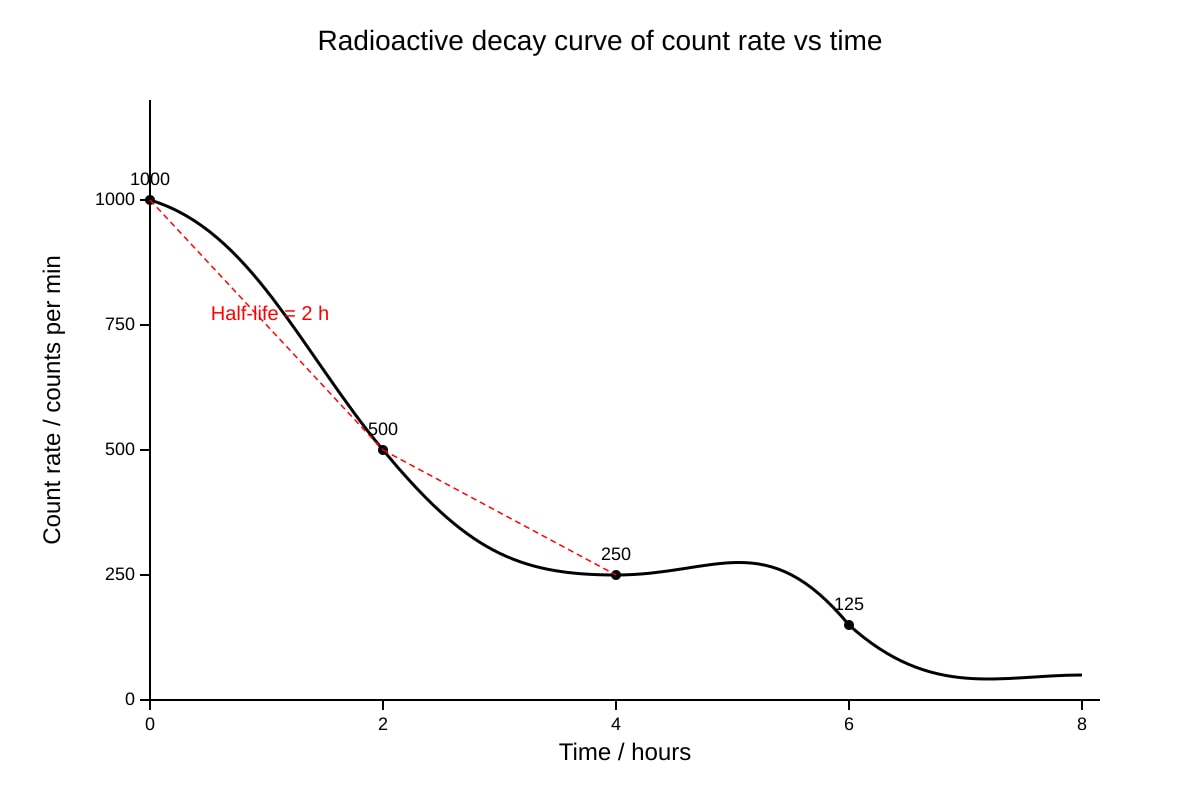
- The graph shows the decay of a radioactive isotope.
Image pending generation: graph for 17.
(a) Determine the half-life from the graph. [1]
(b) Calculate the count rate at 8 hours. [2]
(c) Explain why the curve never reaches zero. [1]
- Compare alpha, beta, and gamma radiation in terms of:
(a) nature,
(b) penetration,
(c) ionising power. [3]
- A rock contains uranium-238 which decays to lead-206. Explain how this is used to estimate the age of the rock. [3]
- A student suggests using beta radiation to check the thickness of paper in a factory.
(a) Explain how this works. [2]
(b) State why gamma would be less suitable than beta for thin paper. [2]
Answers
O-Level Physics Quiz - Modern Physics: Answer Key
Total Marks: 40
Topic: Modern Physics (Radioactivity)
Section A: Multiple Choice
-
C [1]
Gamma ray is electromagnetic radiation with no mass and no charge. Alpha is helium nucleus (24α), beta is electron (−10β), proton has charge. -
B [1]
Half-life = time for half the radioactive nuclei present to decay. Not all decay at once. -
B [1]
Americium-241 emits alpha used in ionization chamber of smoke detectors. -
C [1]
Alpha stopped by paper; beta needs aluminium; gamma needs lead. -
B [1]
Beta decay: neutron → proton + electron, so atomic number Z increases by 1.
Section B: Structured
-
[2]
Use: killing cancer cells / tumour treatment (radiotherapy).
Mark: 1 for context, 1 for correct medical use. -
[2]
Working: 12 h ÷ 4 h = 3 half-lives. Fraction = (1/2)3=1/8.
Answer: 1/8.
Mark: 1 for number of half-lives, 1 for fraction. -
[2]
A = 222 – 4 = 218; Z = 86 – 2 = 84.
Mark: 1 each. -
[2]
Alpha absorbed by few cm air / paper, cannot exit body for imaging; in smoke detector, alpha ionises air in small chamber to detect smoke.
Mark: 1 each point. -
[2]
Detects alpha, beta, gamma (all ionising radiation).
Mark: 2 for all three, 1 for partial. -
[2]
Working: after 1 half-life: 400; after 2: 200.
Answer: 200 counts/s.
Mark: 1 working, 1 answer. -
[2]
Paper (alpha) → aluminium (beta) → thick lead (gamma).
Mark: 2 for correct order, 1 partial. -
[2]
Working: 4.0×10¹²÷2=2.0×10¹².
Answer: 2.0×10¹².
Mark: 1 working, 1 answer. -
[2]
Use tongs / store in lead box / limit exposure time.
Mark: 2 for specific, 1 vague. -
[2]
Alpha (positive) deflected to negative plate; beta negative to positive. Answer: alpha.
Mark: 2 correct, 1 wrong sign.
Section C: Extended
-
[4 total: 1+2+1]
(a) Gamma rays. [1]
(b) High penetration kills microbes on equipment without contact. [2]
(c) Lead shielding / remote handling. [1] -
[4 total: 1+2+1]
(a) Half-life = 2 h (from 1000→500). [1]
(b) At 8 h = 4 half-lives: 1000→500→250→125→62.5. [2]
(c) Random decay; some nuclei always remain. [1] -
[3]
(a) Alpha: helium nucleus; Beta: electron; Gamma: EM wave. [1]
(b) Alpha: paper; Beta: aluminium; Gamma: lead. [1]
(c) Alpha strongest ionising, gamma weakest. [1] -
[3]
Measure ratio U-238/Pb-206; assume no initial lead; use half-life to calculate elapsed time. [3 points] -
[4 total: 2+2]
(a) Beta passes through paper; thickness change alters count detected, feedback controls roller. [2]
(b) Gamma too penetrating, less change in count for thin paper, poor sensitivity. [2]
Free quiz and exam paper access
Enter your details to view this paper
Your access is remembered on this device.