From Real Exams Quiz
O Level Physics Mechanics Quiz
Free O Level Physics Mechanics quiz, HY3 Exam version, with questions, answers, and O Level-style practice for Singapore students.
These static practice materials are generated from the site's syllabus and paper-generation workflow, with source and model context shown so students and parents can evaluate the material before use.
Questions
O-Level Physics Quiz - Mechanics
Name: ___________________________
Class: ___________________________
Date: ___________________________
Score: _______ / 40
Duration: 50 minutes
Total Marks: 40
Topic: Mechanics (Kinematics, Dynamics, Turning Effect of Forces, Pressure, Energy)
Instructions:
- Answer all 20 questions.
- Show your working clearly where calculation is required.
- Use g=10 m/s2 unless stated otherwise.
- Write units in your final answers.
Section A: Multiple Choice and Short Answer (Questions 1–5)
1. [1 mark] Which of the following quantities is a vector?
A. Speed
B. Distance
C. Mass
D. Velocity
2. [1 mark] A car travels 100 m in 5 s at constant speed. What is its average speed? _____ m/s
3. [1 mark] State the formula for calculating the moment of a force about a pivot.
4. [1 mark] A box of mass 2 kg is at rest on a table. What is the magnitude of its weight? (Use g=10 m/s2) _____ N
5. [1 mark] Pressure in a liquid increases with depth because of the weight of the ________ above.
Section B: Structured Calculation (Questions 6–12)
6. [2 marks] A cyclist accelerates uniformly from 2 m/s to 8 m/s in 3 s. Calculate the acceleration.
7. [2 marks] A force of 12 N is applied to a 3 kg block on a smooth surface. Find the acceleration of the block using F=ma.
8. [2 marks] A uniform metre rule is pivoted at its centre (50 cm mark). A 4 N weight is hung at the 20 cm mark. Calculate the moment of this weight about the pivot.
9. [2 marks] A hydraulic press has a small piston of area 0.01 m2 and a large piston of area 0.5 m2. A force of 20 N is applied to the small piston. Calculate the force exerted by the large piston.
10. [2 marks] A 5 kg object is lifted vertically by 4 m. Calculate the increase in gravitational potential energy. (g=10 m/s2)
11. [3 marks] A car of mass 800 kg moves at a constant speed of 20 m/s. It then accelerates with a resultant force of 1600 N for 5 s. (a) Find the acceleration. (b) Find the final speed.
12. [3 marks] A ball is dropped from rest from a height of 45 m. Assume g=10 m/s2 and no air resistance. (a) How long does it take to reach the ground? (b) What is its speed just before impact?
Section C: Data Interpretation and Extended Response (Questions 13–20)
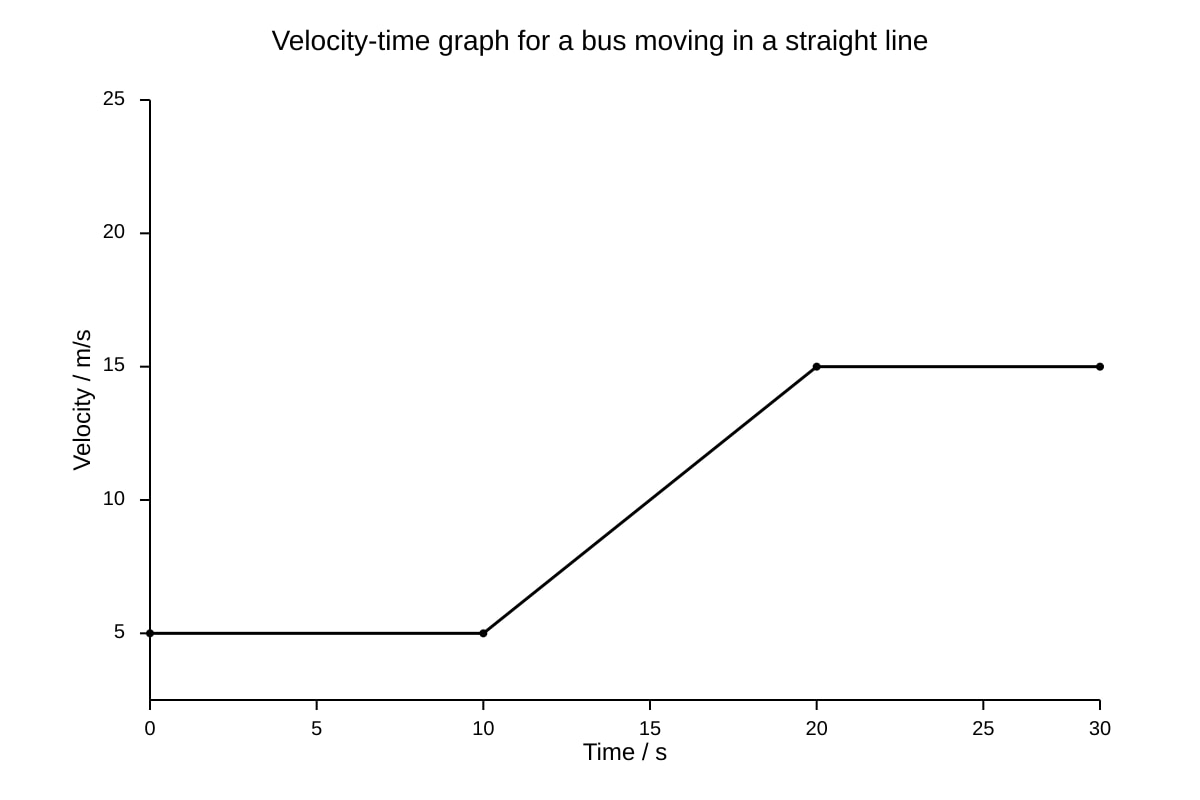
13. [2 marks]
Image pending generation: graph for Q13.
Using the graph, calculate the acceleration of the bus between 10 s and 20 s.
14. [2 marks] Using the same graph in Q13, calculate the total distance travelled by the bus in 30 s.
15. [2 marks] Explain why a truck loaded with heavy cargo is more stable than the same truck empty, using the concept of centre of gravity.
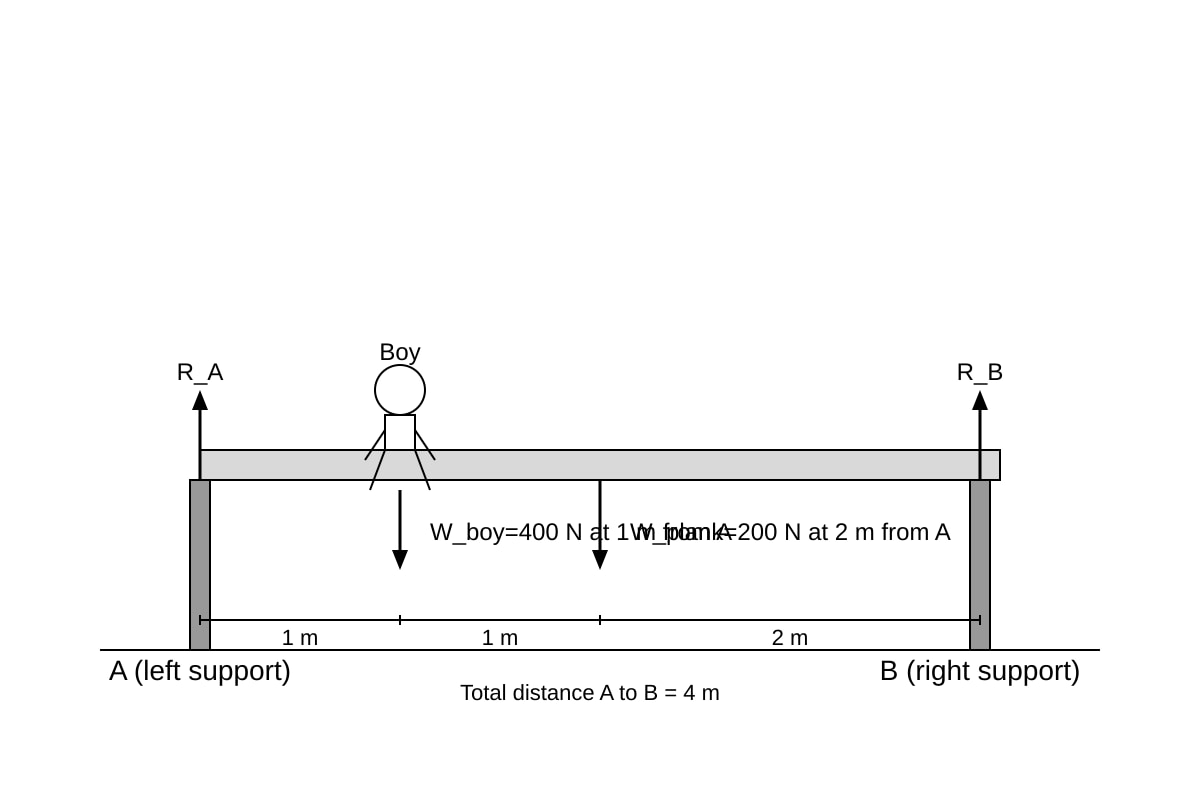
16. [3 marks] A uniform plank of length 4 m and weight 200 N is supported at both ends. A boy of weight 400 N stands 1 m from the left support. (a) Draw a labelled diagram showing forces and distances. (b) Calculate the reaction force at the left support.
Image pending generation: diagram for Q16.
17. [3 marks] A crane lifts a 500 kg container at a constant speed of 2 m/s. (g=10 m/s2) (a) Calculate the power output of the crane. (b) If the crane motor is 50% efficient, what is the input power required?
18. [2 marks] State two differences between mass and weight.
19. [3 marks] A block of mass 10 kg is pulled up a frictionless slope of height 3 m using a force parallel to the slope. The slope length is 5 m. (a) Calculate the gain in gravitational potential energy. (b) Calculate the magnitude of the pulling force.
20. [3 marks] A student uses a lever to lift a 300 N rock. The pivot is 0.2 m from the rock and 0.8 m from the effort applied. (a) Calculate the effort needed to balance the rock. (b) State one reason why the actual effort needed is greater than your answer in (a).
Answers
O-Level Physics Quiz - Mechanics: Answer Key
Total Marks: 40
Topic: Mechanics
Section A
1. [1 mark] D. Velocity
Teaching note: Velocity is a vector because it has both magnitude and direction. Speed, distance, and mass are scalars (magnitude only). Common mistake: choosing speed because it is related to motion.
2. [1 mark] 20 m/s
Working: Average speed = distance / time = 100 m/5 s=20 m/s.
Teaching note: Remind students to use total distance over total time for average speed.
3. [1 mark] Moment = Force × perpendicular distance from pivot
Teaching note: The perpendicular distance is critical; if force is not perpendicular, use the component perpendicular to the lever arm.
4. [1 mark] 20 N
Working: Weight = m×g=2 kg×10 m/s2=20 N.
Teaching note: Weight is a force due to gravity; mass is constant but weight depends on g.
5. [1 mark] liquid (or water / fluid)
Teaching note: Pressure in liquid = hρg; greater depth means more liquid weight above exerting downward force.
Section B
6. [2 marks]
Working: a=(v−u)/t=(8−2)/3=6/3=2 m/s2.
Answer: 2 m/s2.
Marking: 1 mark for correct formula, 1 mark for correct substitution and answer.
7. [2 marks]
Working: F=ma⇒a=F/m=12/3=4 m/s2.
Answer: 4 m/s2.
Teaching note: Smooth surface means no friction; resultant force = applied force.
8. [2 marks]
Working: Distance from pivot = 50−20=30 cm=0.30 m.
Moment = F×d=4×0.30=1.2 Nm.
Answer: 1.2 Nm.
Marking: 1 mark for distance conversion, 1 mark for moment.
9. [2 marks]
Working: Pressure same in liquid: F1/A1=F2/A2.
F2=F1×(A2/A1)=20×(0.5/0.01)=20×50=1000 N.
Answer: 1000 N.
Teaching note: Hydraulic system multiplies force by area ratio.
10. [2 marks]
Working: ΔEp=mgh=5×10×4=200 J.
Answer: 200 J.
Marking: 1 mark formula, 1 mark answer.
11. [3 marks]
(a) a=F/m=1600/800=2 m/s2 (1 mark)
(b) v=u+at=20+2×5=30 m/s (2 marks: 1 for method, 1 for answer)
Teaching note: Constant speed initially means u = 20 m/s; resultant force causes acceleration.
12. [3 marks]
(a) s=21gt2⇒45=21×10×t2=5t2⇒t2=9⇒t=3 s (2 marks)
(b) v=gt=10×3=30 m/s (1 mark)
Teaching note: Dropped from rest so u=0; free fall uses g=10.
Section C
13. [2 marks]
Working: Acceleration = change in velocity / time = (15−5)/(20−10)=10/10=1 m/s2.
Answer: 1 m/s2.
From graph: slope of line between 10 and 20 s.
14. [2 marks]
Working: Distance = area under graph.
0–10 s: 5×10=50 m
10–20 s: trapezium = 21(5+15)×10=100 m
20–30 s: 15×10=150 m
Total = 50+100+150=300 m.
Answer: 300 m.
Marking: 1 mark for area method, 1 mark total.
15. [2 marks]
Answer points:
- Loaded truck has lower centre of gravity (cargo low). (1 mark)
- Lower CG means line of action of weight falls within base of support more easily, increasing stability. (1 mark)
Teaching note: Stability improves when CG is low and base wide.
16. [3 marks]
(a) Diagram: show plank AB, reaction R_A up at A, R_B up at B, 200 N down at 2 m, 400 N down at 1 m from A. (1 mark)
(b) Take moments about B: RA×4=400×3+200×2=1200+400=1600⇒RA=400 N. (2 marks)
Teaching note: Use principle of moments for equilibrium.
17. [3 marks]
(a) Constant speed → force = weight = 500×10=5000 N. Power = Fv=5000×2=10000 W. (2 marks)
(b) Efficiency = useful output / input → input = 10000 / 0.5 = 20000 W. (1 mark)
Answer: (a) 10000 W, (b) 20000 W.
18. [2 marks]
- Mass is amount of matter, weight is gravitational force. (1 mark)
- Mass is scalar and constant, weight is vector and varies with g. (1 mark)
Other acceptable: measured in kg vs N.
19. [3 marks]
(a) ΔEp=mgh=10×10×3=300 J. (1 mark)
(b) Work done by force = F×5=300⇒F=60 N. (2 marks)
Teaching note: Frictionless so all work becomes PE.
20. [3 marks]
(a) Moments: 300×0.2=E×0.8⇒E=60/0.8=75 N. (2 marks)
(b) Friction at pivot / weight of lever / effort not perfectly perpendicular. (1 mark)
Answer: (a) 75 N.
Free quiz and exam paper access
Enter your details to view this paper
Your access is remembered on this device.