O-Level Physics Quiz - Energy Power
Name: ________________________
Class: ________________________
Date: ________________________
Score: ________________________
Duration: 60 minutes
Total Marks: 40
Instructions:
- Answer all 20 questions.
- Show your working clearly where calculation is required.
- Use the spaces provided.
- Marks for each question are shown in brackets.
Section A: Multiple Choice and Short Answer (Questions 1–5)
1. Which of the following is a correct unit for energy? [1]
A. Watt
B. Joule
C. Newton
D. Ampere
2. State the formula for gravitational potential energy. [1]
3. A 2 kg ball is lifted to a height of 5 m. Calculate its gain in gravitational potential energy. (Take g = 10 m/s²) [2]
4. Define power in terms of energy and time. [1]
5. A device transfers 600 J of energy in 20 s. Calculate its power. [2]
Section B: Structured Calculation and Interpretation (Questions 6–15)
6. A car of mass 1000 kg moves at a constant speed of 20 m/s.
(a) Calculate its kinetic energy. [2]
(b) State what happens to this energy when the car brakes to rest. [1]
7. A crane lifts a 500 kg load through 8 m in 10 s. (Take g = 10 m/s²)
(a) Calculate the work done by the crane. [2]
(b) Calculate the power of the crane. [2]
8. The efficiency of a motor is 40%. If it is supplied with 2000 J of energy, calculate the useful energy output. [2]
9. A student claims that energy can be created in a closed system. State whether this is correct and give the physics principle that applies. [2]
10. A 12 V battery supplies a current of 3 A to a heater for 5 minutes.
(a) Calculate the electrical energy transferred. [2]
(b) If the heater is 80% efficient, calculate the useful heat energy produced. [2]
11.
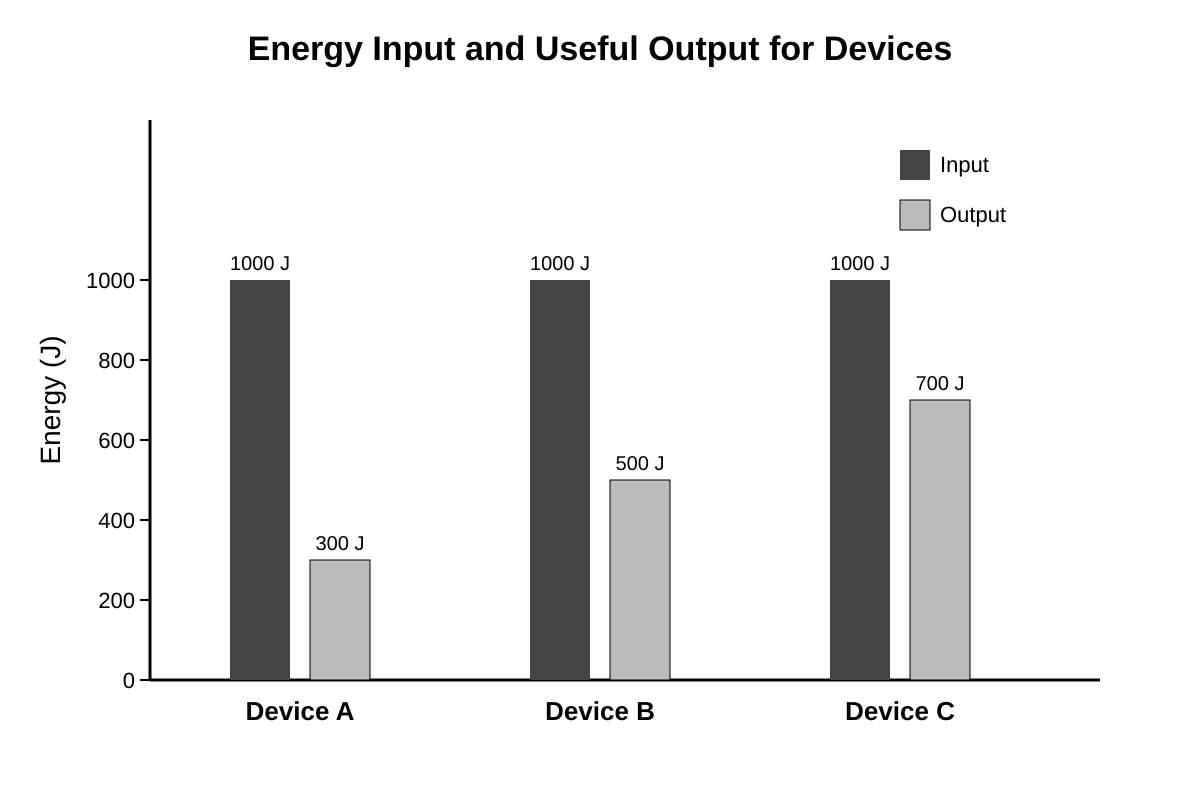
Generated graph for 11.
Using the graph, which device has the highest efficiency? Calculate its efficiency as a percentage. [2]
12. A ball of mass 0.5 kg is dropped from a height of 4 m. (Take g = 10 m/s²)
(a) Calculate its initial gravitational potential energy. [2]
(b) Assuming no air resistance, state its kinetic energy just before hitting the ground. [1]
13. Explain why a falling object reaches terminal velocity and what happens to its gravitational potential energy. [3]
14. A solar panel receives 5000 J of light energy and produces 1000 J of electrical energy. Calculate its efficiency. [2]
15. A machine does 400 J of useful work and wastes 100 J as heat. Calculate the total energy input and the efficiency. [3]
Section C: Data Interpretation and Extended Response (Questions 16–20)
16.
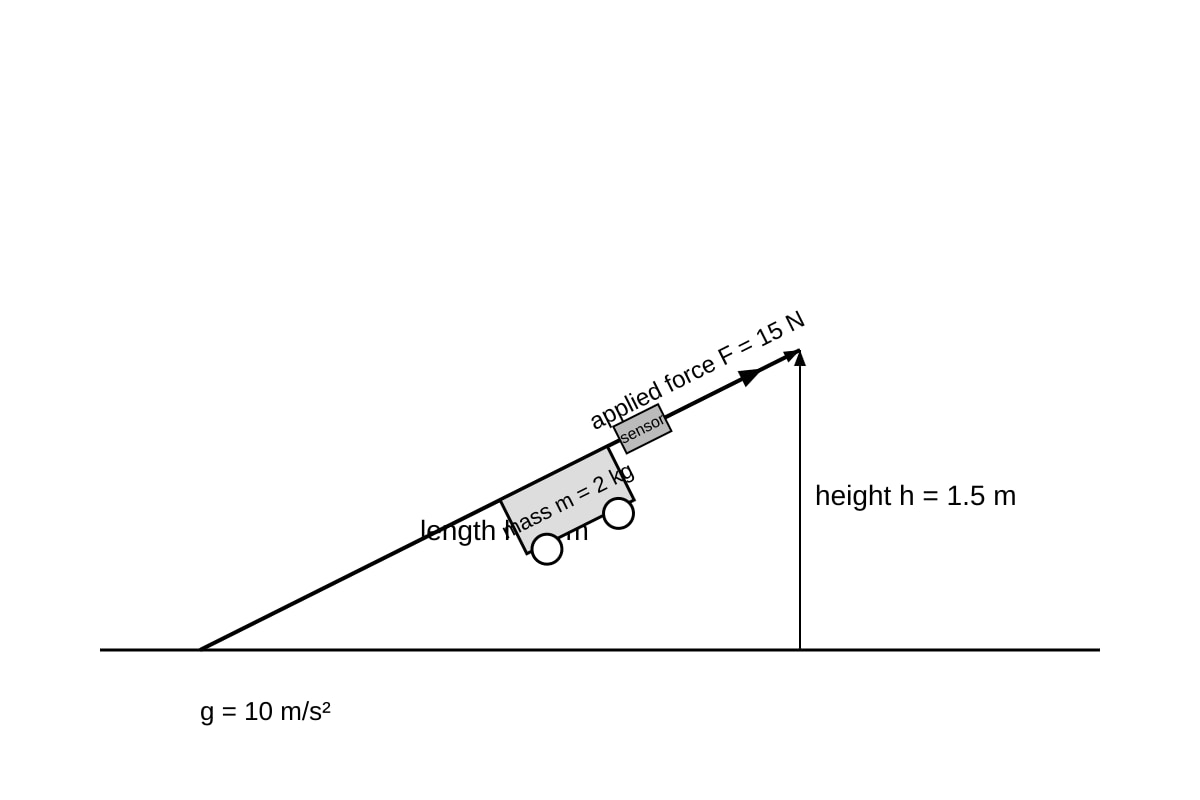
Generated experimental_setup for 16.
(a) Calculate the work done against gravity to lift the trolley vertically. [2]
(b) Calculate the work done by the applied force along the ramp. [2]
(c) Explain why the two values differ. [1]
17. Compare renewable and non-renewable energy resources using two criteria: environmental impact and reliability. [4]
18. A hydroelectric dam converts gravitational potential energy of water to electrical energy. Describe the energy transfer chain and state one advantage and one disadvantage. [4]
19.
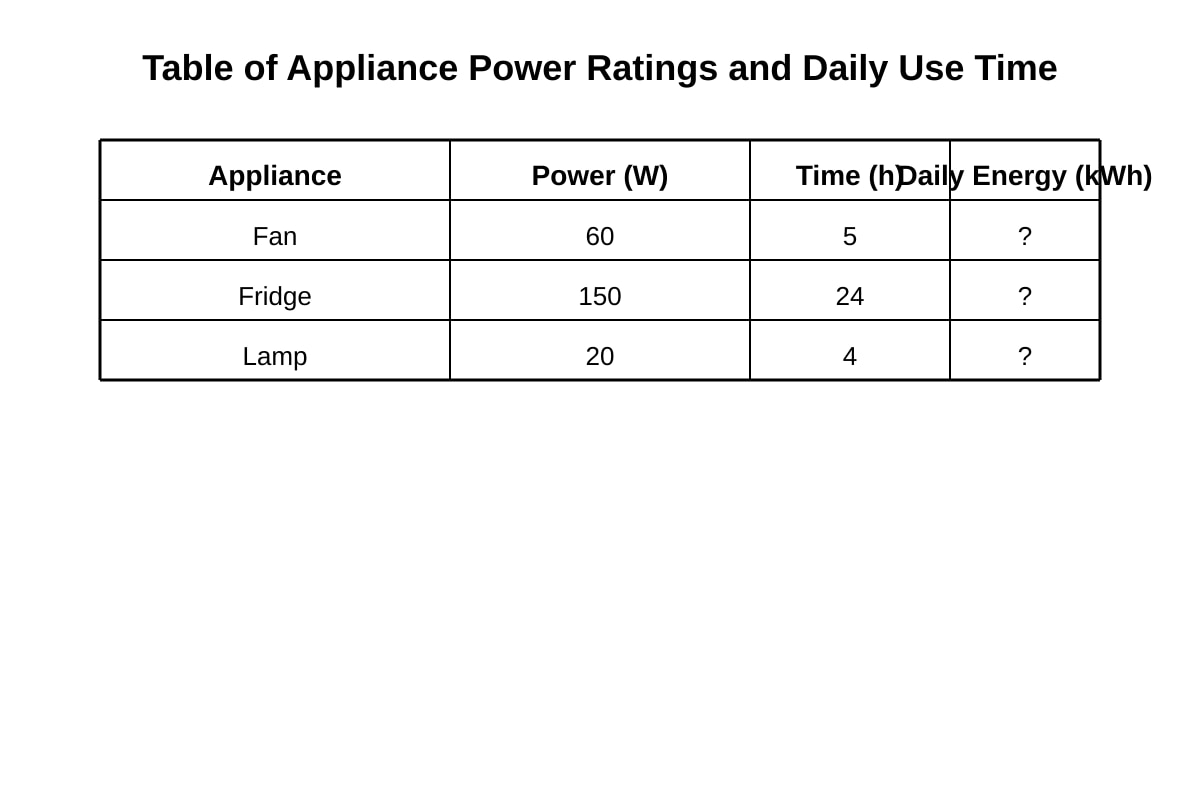
Generated table for 19.
Calculate the total electrical energy used per day by these three appliances in kWh. [3]
20. A roller coaster car of mass 300 kg starts from rest at height 20 m and descends to 5 m. (Take g = 10 m/s²)
(a) Calculate initial gravitational potential energy. [2]
(b) Calculate gravitational potential energy at 5 m. [2]
(c) State the kinetic energy at 5 m assuming no friction losses. [1]
</stage3_quiz_answers_md>
O-Level Physics Quiz - Energy Power (Answer Key)
Total Marks: 40
Topic: Energy Power
Section A
1. [1] B. Joule
Teaching note: Energy is measured in joules (J). Watt is unit of power, Newton is force, Ampere is current.
2. [1] Ep=mgh
Teaching note: Gravitational potential energy = mass × gravitational field strength × height.
3. [2]
Ep=mgh=2×10×5=100 J
Marks: 1 for correct substitution, 1 for answer with unit.
4. [1] Power is the rate of energy transfer (or work done per unit time): P=tE.
5. [2]
P=tE=20600=30 W
Marks: 1 for formula, 1 for answer.
Section B
6. [3]
(a) Ek=21mv2=21×1000×202=200000 J [2]
(b) Converted to heat and sound at brakes / dissipated [1]
7. [4]
(a) Work = mgh=500×10×8=40000 J [2]
(b) Power = tW=1040000=4000 W [2]
8. [2]
Useful output = 0.40×2000=800 J
Marks: 1 for efficiency conversion, 1 for answer.
9. [2]
Incorrect [1]. Law of conservation of energy: energy cannot be created or destroyed, only transferred/transformed [1].
10. [4]
(a) E=VIt=12×3×(5×60)=12×3×300=10800 J [2]
(b) Useful = 0.80×10800=8640 J [2]
11. [2]
Device C has highest output (700 J of 1000 J).
Efficiency = 1000700×100%=70% [2]
12. [3]
(a) Ep=mgh=0.5×10×4=20 J [2]
(b) 20 J [1] (all GPE → KE)
13. [3]
Terminal velocity occurs when air resistance equals weight, resultant force zero, constant speed [1]. GPE decreases and is transferred to internal energy of air/object via friction [2].
14. [2]
Efficiency = 50001000×100%=20% [2]
15. [3]
Total input = 400+100=500 J [1]
Efficiency = 500400×100%=80% [2]
Section C
16. [5]
(a) Vertical work = mgh=2×10×1.5=30 J [2]
(b) Along ramp = F×l=15×3=45 J [2]
(c) Extra work done against friction [1]
17. [4]
Renewable: lower environmental impact (e.g. solar/wind no emissions) [1], less reliable (weather-dependent) [1].
Non-renewable: higher impact (CO₂, pollution) [1], more reliable (constant supply) [1].
18. [4]
Chain: GPE of water → KE of falling water → KE of turbine → electrical energy [2].
Advantage: clean renewable [1]; Disadvantage: habitat disruption / high cost [1].
19. [3]
Fan: 0.060×5=0.30 kWh
Fridge: 0.150×24=3.60 kWh
Lamp: 0.020×4=0.08 kWh
Total = 3.98 kWh [3]
20. [5]
(a) Ep1=300×10×20=60000 J [2]
(b) Ep2=300×10×5=15000 J [2]
(c) KE = 60000−15000=45000 J [1]
</stage3_quiz_answers_md>
<stage3_quiz_md>
O-Level Physics Quiz - Energy Power
Name: ________________________
Class: ________________________
Date: ________________________
Score: ________________________
Duration: 60 minutes
Total Marks: 40
Instructions:
- Answer all 20 questions.
- Show your working clearly where calculation is required.
- Use the spaces provided.
- Marks for each question are shown in brackets.
Section A: Multiple Choice and Short Answer (Questions 1–5)
1. Which of the following is a correct unit for energy? [1]
A. Watt
B. Joule
C. Newton
D. Ampere
2. State the formula for gravitational potential energy. [1]
3. A 2 kg ball is lifted to a height of 5 m. Calculate its gain in gravitational potential energy. (Take g = 10 m/s²) [2]
4. Define power in terms of energy and time. [1]
5. A device transfers 600 J of energy in 20 s. Calculate its power. [2]
Section B: Structured Calculation and Interpretation (Questions 6–15)
6. A car of mass 1000 kg moves at a constant speed of 20 m/s.
(a) Calculate its kinetic energy. [2]
(b) State what happens to this energy when the car brakes to rest. [1]
7. A crane lifts a 500 kg load through 8 m in 10 s. (Take g = 10 m/s²)
(a) Calculate the work done by the crane. [2]
(b) Calculate the power of the crane. [2]
8. The efficiency of a motor is 40%. If it is supplied with 2000 J of energy, calculate the useful energy output. [2]
9. A student claims that energy can be created in a closed system. State whether this is correct and give the physics principle that applies. [2]
10. A 12 V battery supplies a current of 3 A to a heater for 5 minutes.
(a) Calculate the electrical energy transferred. [2]
(b) If the heater is 80% efficient, calculate the useful heat energy produced. [2]
11.
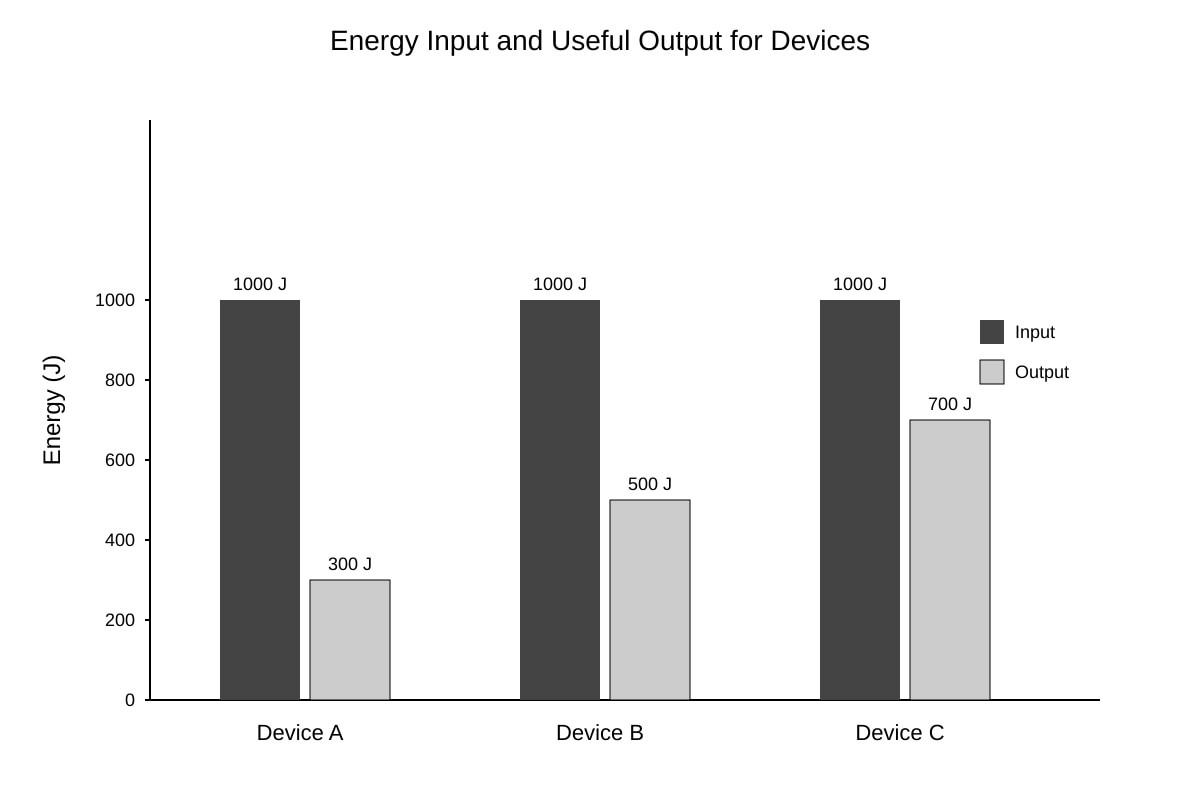
Generated graph for 11.
Using the graph, which device has the highest efficiency? Calculate its efficiency as a percentage. [2]
12. A ball of mass 0.5 kg is dropped from a height of 4 m. (Take g = 10 m/s²)
(a) Calculate its initial gravitational potential energy. [2]
(b) Assuming no air resistance, state its kinetic energy just before hitting the ground. [1]
13. Explain why a falling object reaches terminal velocity and what happens to its gravitational potential energy. [3]
14. A solar panel receives 5000 J of light energy and produces 1000 J of electrical energy. Calculate its efficiency. [2]
15. A machine does 400 J of useful work and wastes 100 J as heat. Calculate the total energy input and the efficiency. [3]
Section C: Data Interpretation and Extended Response (Questions 16–20)
16.
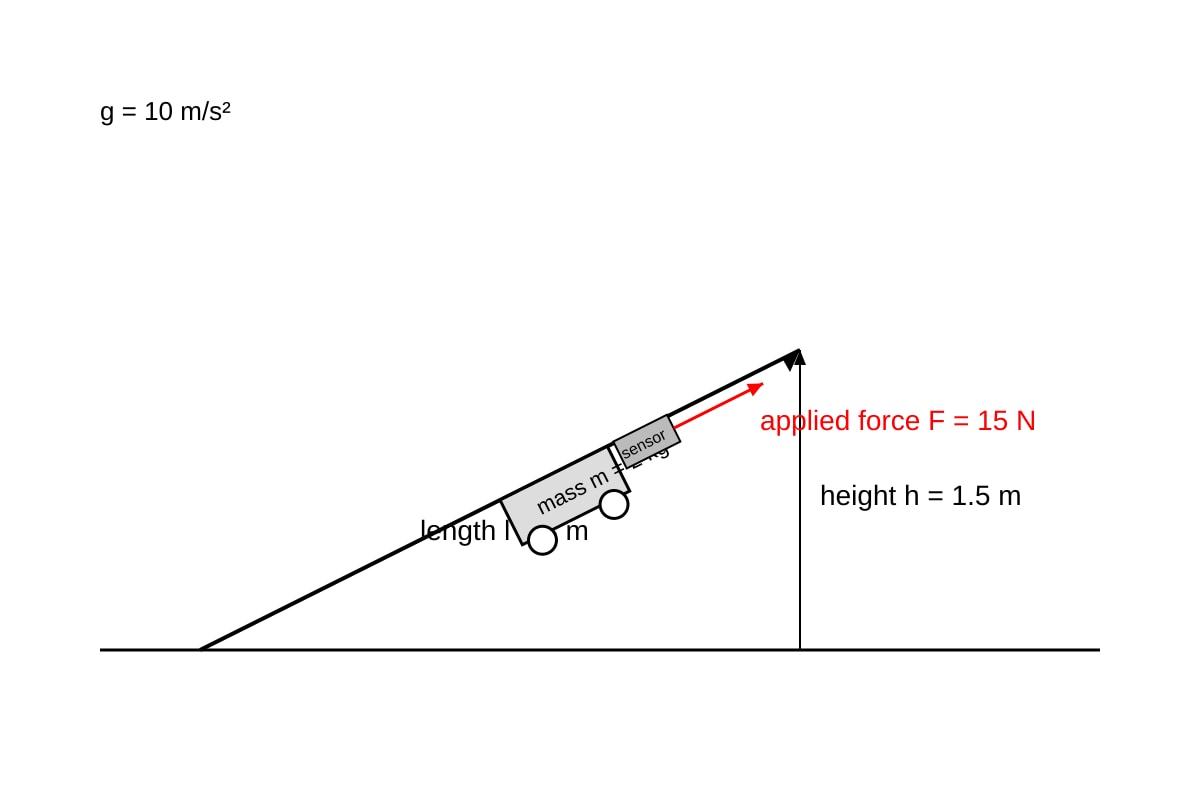
Generated experimental_setup for 16.
(a) Calculate the work done against gravity to lift the trolley vertically. [2]
(b) Calculate the work done by the applied force along the ramp. [2]
(c) Explain why the two values differ. [1]
17. Compare renewable and non-renewable energy resources using two criteria: environmental impact and reliability. [4]
18. A hydroelectric dam converts gravitational potential energy of water to electrical energy. Describe the energy transfer chain and state one advantage and one disadvantage. [4]
19.
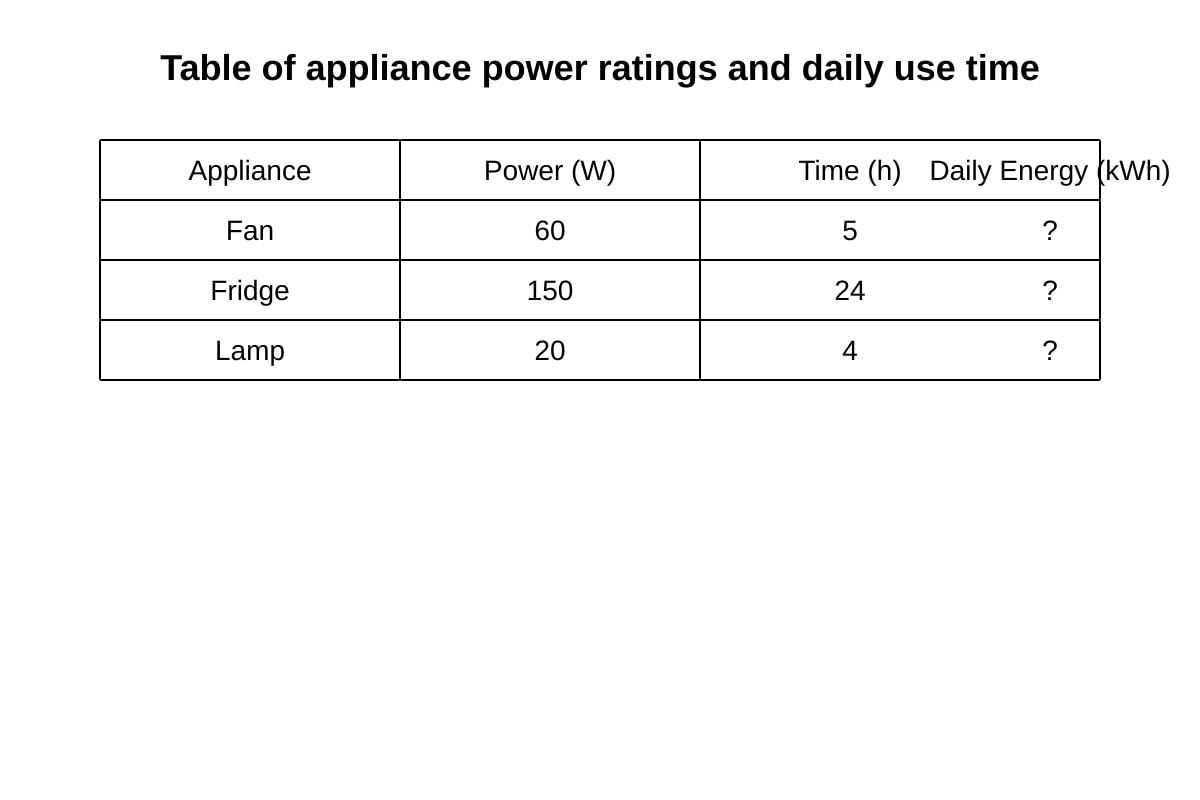
Generated table for 19.
Calculate the total electrical energy used per day by these three appliances in kWh. [3]
20. A roller coaster car of mass 300 kg starts from rest at height 20 m and descends to 5 m. (Take g = 10 m/s²)
(a) Calculate initial gravitational potential energy. [2]
(b) Calculate gravitational potential energy at 5 m. [2]
(c) State the kinetic energy at 5 m assuming no friction losses. [1]