From Real Exams Quiz
O Level Physics Electricity Magnetism Quiz
Free Exam-Derived Qwen3.7 Plus O Level Physics Electricity Magnetism quiz with questions and answers for Singapore students. This page is rendered as a direct URL so the questions and answers can be discovered without pressing in-page buttons.
These static practice materials are generated from the site's syllabus and paper-generation workflow, with source and model context shown so students and parents can evaluate the material before use.
Questions
O-Level Physics Quiz - Electricity Magnetism
Name: __________________________
Class: __________________________
Date: __________________________
Score: ________ / 40
Duration: 45 minutes
Total Marks: 40
Instructions:
- Answer all questions.
- Write your answers in the spaces provided.
- For calculation questions, show all working clearly.
- Use where necessary.
- The use of an approved scientific calculator is expected.
Section A: Multiple Choice (10 marks)
For each question there are four possible answers A, B, C and D. Choose the one you consider correct.
1. Which of the following materials is most suitable for making the core of an electromagnet used in a scrapyard crane?
A. Steel
B. Soft iron
C. Copper
D. Aluminium
2. A negatively charged rod is brought near a neutral metal sphere suspended on an insulating thread. The sphere is attracted to the rod. What is the charge distribution on the sphere?
A. The side near the rod is positive, the far side is negative.
B. The side near the rod is negative, the far side is positive.
C. The entire sphere becomes positively charged.
D. The entire sphere becomes negatively charged.
3. In a series circuit containing two resistors and , which of the following statements is always true?
A. The potential difference across is equal to the potential difference across .
B. The current through is equal to the current through .
C. The resistance of is equal to the resistance of .
D. The power dissipated by is equal to the power dissipated by .
4. A transformer has 500 turns on the primary coil and 100 turns on the secondary coil. If the input voltage is , what is the output voltage?
A.
B.
C.
D.
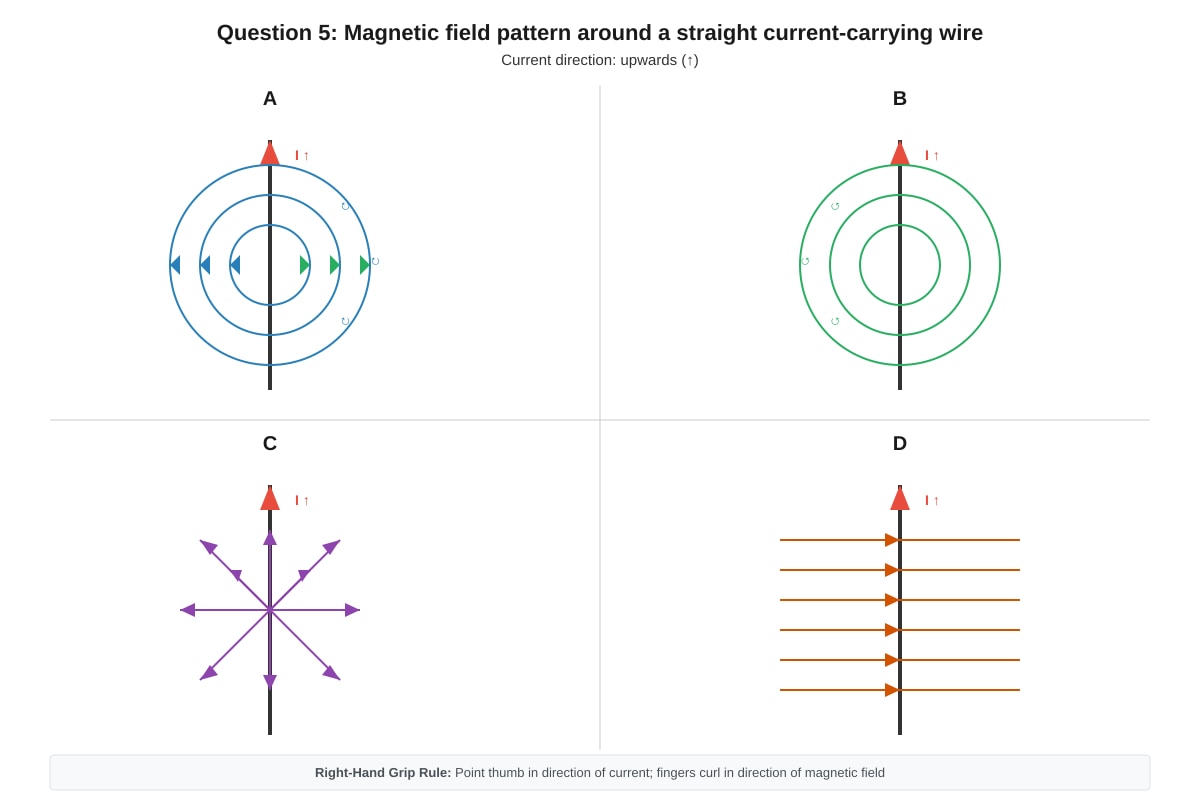
5. Which diagram correctly shows the magnetic field pattern around a straight current-carrying wire?
<image_placeholder>
id: Q5-fig1
type: diagram
linked_question: Q5
description: Four options (A, B, C, D) showing a straight vertical wire with current flowing upwards. Option A shows concentric circles with clockwise arrows. Option B shows concentric circles with counter-clockwise arrows. Option C shows radial lines pointing outwards. Option D shows parallel horizontal lines.
labels: Current direction (upwards)
must_show: Direction of magnetic field lines relative to current direction using Right-Hand Grip Rule.
</image_placeholder>
A. Option A
B. Option B
C. Option C
D. Option D
6. A resistor has a resistance of . If a current of flows through it for , how much energy is dissipated?
A.
B.
C.
D.
7. Why is electrical energy transmitted at high voltage in national power grids?
A. To increase the current in the cables.
B. To reduce the resistance of the cables.
C. To reduce energy loss due to heating in the cables.
D. To make the transmission faster.
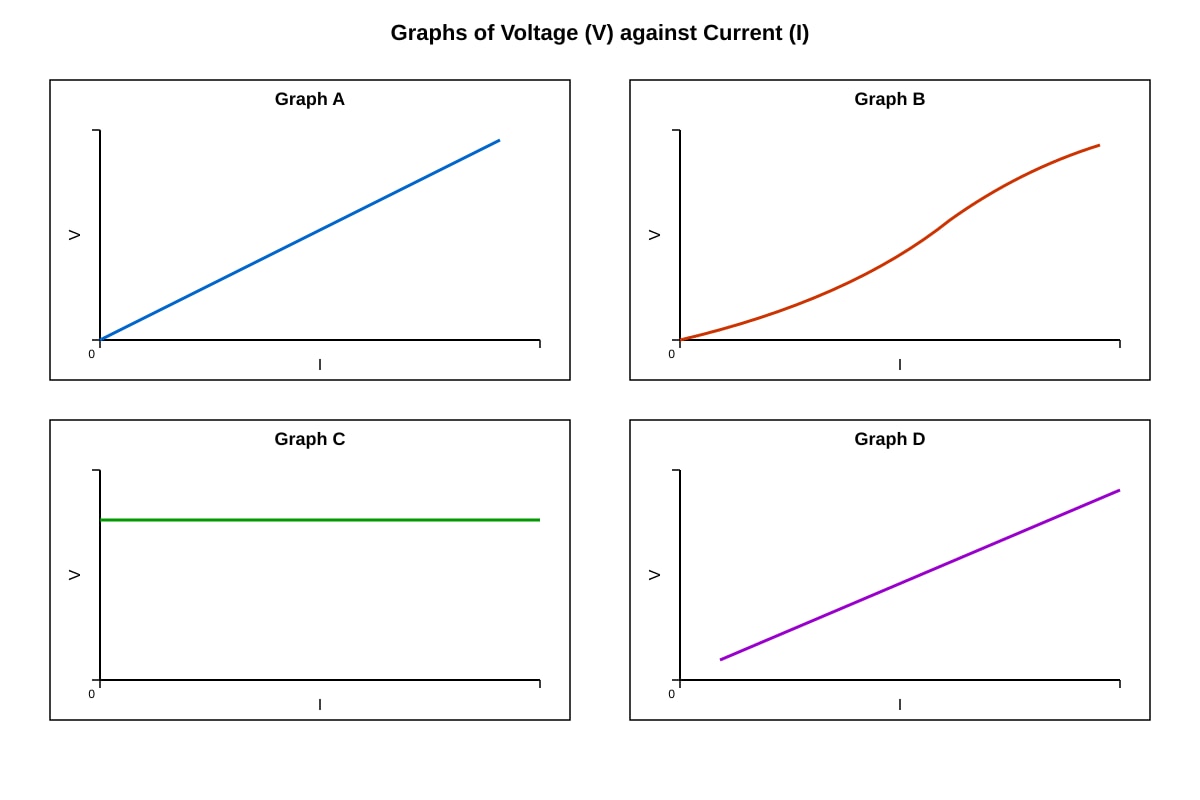
8. A student investigates the resistance of a wire. She measures the voltage across the wire and the current through it. Which graph correctly represents the relationship between voltage () and current () for an ohmic conductor at constant temperature?
<image_placeholder>
id: Q8-fig1
type: graph
linked_question: Q8
description: Four graphs with Current (I) on x-axis and Voltage (V) on y-axis. Graph A is a straight line through the origin. Graph B is a curve starting at origin and bending towards the x-axis. Graph C is a horizontal line. Graph D is a straight line not passing through the origin.
labels: Axes: V (y), I (x)
must_show: Linear proportionality for Ohm's Law.
</image_placeholder>
A. Graph A
B. Graph B
C. Graph C
D. Graph D
9. A fuse is rated at . Which of the following appliances is most suitable to be protected by this fuse?
A. An electric kettle ()
B. A hair dryer ()
C. A table lamp ()
D. An electric heater ()
(Assume mains voltage is )
10. A bar magnet is dropped through a solenoid connected to a sensitive galvanometer. What is observed on the galvanometer?
A. A steady deflection in one direction.
B. A momentary deflection in one direction, then zero.
C. A momentary deflection in one direction, then a momentary deflection in the opposite direction.
D. No deflection.
Section B: Structured Questions (30 marks)
11. A circuit consists of a battery, a switch, and two resistors and connected in series.
(a) Calculate the total resistance of the circuit.
[1]
(b) Calculate the current flowing through the circuit.
[2]
(c) Calculate the potential difference across resistor .
[2]
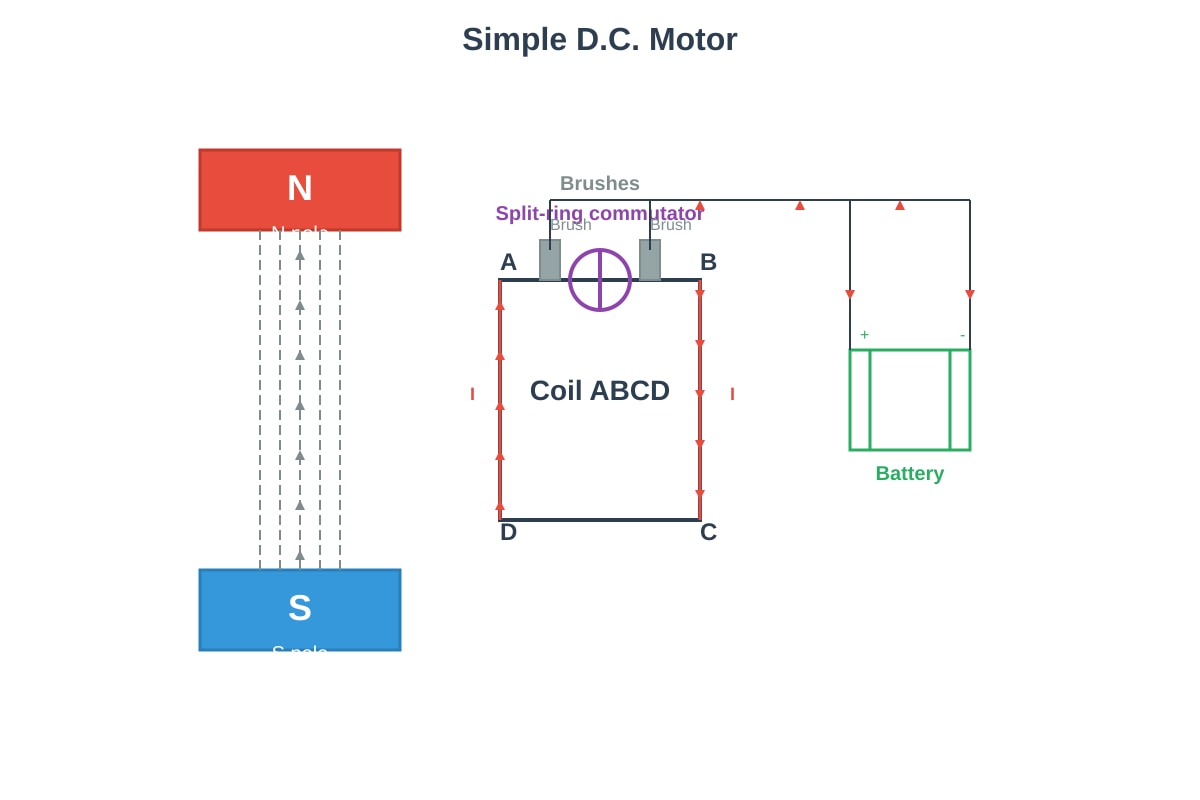
12. The diagram below shows a simple d.c. motor.
<image_placeholder>
id: Q12-fig1
type: diagram
linked_question: Q12
description: A rectangular coil ABCD placed between the North and South poles of a magnet. The coil is connected to a split-ring commutator and carbon brushes. Current flows from the battery into the coil.
labels: N pole, S pole, Coil ABCD, Split-ring commutator, Brushes, Battery
must_show: Direction of current in arms AB and CD. Magnetic field lines from N to S.
</image_placeholder>
(a) State the rule used to determine the direction of the force on the current-carrying coil.
[1]
(b) Explain why the coil rotates continuously in one direction. In your answer, refer to the function of the split-ring commutator.
[3]
(c) Suggest two ways to increase the speed of rotation of the motor.
[2]
13. A transformer is used to step down the voltage from to to power a lamp. The primary coil has 1000 turns.
(a) Calculate the number of turns on the secondary coil.
[2]
(b) The lamp is rated at , . Assuming the transformer is 100% efficient, calculate the current in the primary coil.
[3]
(c) Explain why the core of the transformer is made of laminated soft iron rather than solid steel.
[2]
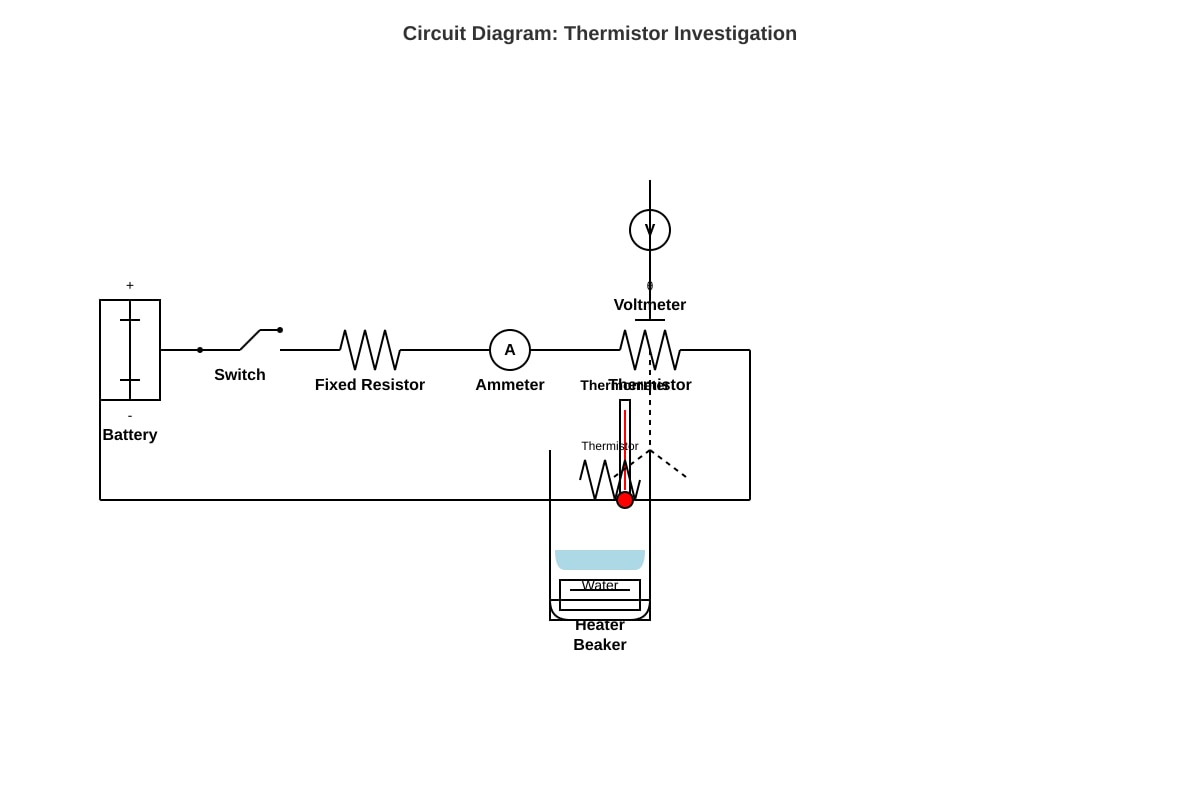
14. A student sets up a circuit to investigate how the resistance of a thermistor changes with temperature.
<image_placeholder>
id: Q14-fig1
type: diagram
linked_question: Q14
description: A circuit diagram showing a battery, a switch, a fixed resistor, a thermistor, an ammeter in series, and a voltmeter connected in parallel across the thermistor. A beaker of water with a thermometer and a heater surrounds the thermistor.
labels: Battery, Switch, Fixed Resistor, Thermistor, Ammeter, Voltmeter, Beaker, Water, Heater
must_show: Correct placement of ammeter (series) and voltmeter (parallel to thermistor).
</image_placeholder>
(a) The student records the following data:
| Temperature () | Voltage () | Current () |
|---|---|---|
| 20 | 6.0 | 0.02 |
| 40 | 5.0 | 0.05 |
| 60 | 4.0 | 0.10 |
| 80 | 3.0 | 0.20 |
Calculate the resistance of the thermistor at .
[2]
(b) Describe the relationship between the temperature and the resistance of the thermistor based on the data.
[1]
(c) Explain, in terms of electron movement, why the resistance of the thermistor changes as the temperature increases.
[2]
15. Two charged spheres, A and B, are suspended on insulating threads. Sphere A is positively charged. Sphere B is neutral.
(a) Describe what happens when Sphere A is brought close to Sphere B without touching it. Explain your answer in terms of charge separation.
[3]
(b) Sphere A then touches Sphere B. Describe the final charge on both spheres.
[2]
16. A household electrical circuit includes a live wire, a neutral wire, and an earth wire.
(a) State the color code for the live wire in a standard 3-pin plug.
[1]
(b) Explain the function of the earth wire in an appliance with a metal casing.
[3]
(c) Why is a switch always placed in the live wire rather than the neutral wire?
[2]
17. A student connects three identical lamps in parallel to a battery. Each lamp has a resistance of .
(a) Calculate the total resistance of the circuit.
[2]
(b) Calculate the total current supplied by the battery.
[2]
(c) If one lamp blows, state and explain what happens to the brightness of the remaining two lamps.
[2]
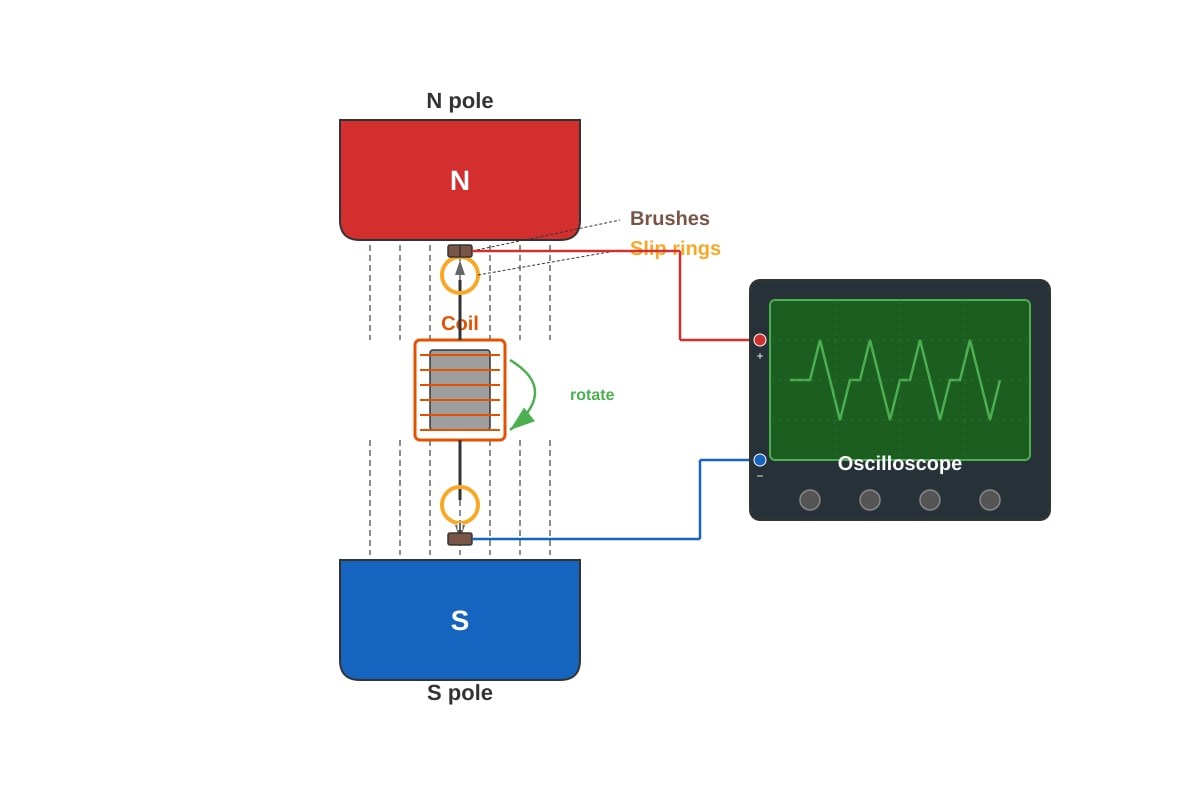
18. The diagram below shows a simple a.c. generator.
<image_placeholder>
id: Q18-fig1
type: diagram
linked_question: Q18
description: A rectangular coil rotating between magnetic poles, connected to slip rings and brushes, leading to an oscilloscope.
labels: N pole, S pole, Coil, Slip rings, Brushes, Oscilloscope
must_show: Coil rotating in magnetic field.
</image_placeholder>
(a) State the principle of electromagnetic induction.
[1]
(b) Explain why an alternating current is produced in the external circuit.
[2]
(c) State two changes that would increase the maximum induced voltage.
[2]
19. A cathode ray oscilloscope (CRO) displays a waveform from a microphone detecting a sound.
(a) Define the term 'frequency' of a wave.
[1]
(b) The time-base setting is . One complete wave occupies horizontally on the screen. Calculate the frequency of the sound.
[3]
(c) If the sound becomes louder but the pitch remains the same, describe how the trace on the CRO screen changes.
[2]
20. A relay switch is used to control a high-voltage motor using a low-voltage circuit.
(a) Describe the sequence of events that closes the high-voltage switch when the low-voltage circuit is switched on.
[3]
(b) State one advantage of using a relay in this situation.
[1]
(c) Why is soft iron used for the armature of the relay?
[2]
Answers
O-Level Physics Quiz - Electricity Magnetism (Answer Key)
Section A: Multiple Choice
1. B
Reasoning: Soft iron is a magnetic material that can be easily magnetized and demagnetized. Steel retains magnetism (permanent magnet), which is undesirable for a crane that needs to release scrap. Copper and Aluminium are non-magnetic.
2. A
Reasoning: This is electrostatic induction. The negative rod repels electrons in the metal sphere to the far side, leaving the near side with a net positive charge. The attraction between the rod and the near positive side is stronger than the repulsion from the far negative side due to distance.
3. B
Reasoning: In a series circuit, the current is the same at all points. Potential difference and power depend on the individual resistance values, which may differ.
4. A
Reasoning: Using the transformer equation :
.
5. B
Reasoning: Using the Right-Hand Grip Rule: Thumb points in the direction of current (upwards), fingers curl in the direction of the magnetic field. Looking from above, the field is counter-clockwise. Option B shows counter-clockwise arrows.
6. D
Reasoning: Energy .
.
Alternatively, , .
7. C
Reasoning: Power loss in cables is . By increasing voltage (), the current () is reduced for the same power transmitted. Lower current significantly reduces heat loss ().
8. A
Reasoning: For an ohmic conductor at constant temperature, is directly proportional to (). This produces a straight line graph passing through the origin.
9. C
Reasoning: Calculate current .
Kettle:
Hair dryer:
Lamp:
Heater:
The fuse must be rated slightly higher than the operating current. A fuse is suitable for the lamp (). The others would blow the fuse immediately.
10. C
Reasoning: As the magnet enters the solenoid, the changing magnetic flux induces a current in one direction. As it leaves, the flux changes in the opposite manner, inducing a current in the opposite direction.
Section B: Structured Questions
11.
(a) Total Resistance:
In series,
[1 mark for correct answer]
(b) Current:
Using Ohm's Law
[1 mark for formula/substitution, 1 mark for answer with unit]
(c) Potential Difference across :
[1 mark for substitution, 1 mark for answer]
12.
(a) Rule:
Fleming’s Left-Hand Rule.
[1 mark]
(b) Continuous Rotation:
- Current flows through the coil, creating forces on arms AB and CD in opposite directions (due to opposite current directions relative to the field), causing rotation.
- When the coil passes the vertical position, the split-ring commutator reverses the direction of the current in the coil.
- This reverses the direction of the forces, ensuring the torque continues to act in the same rotational direction, allowing continuous rotation.
[1 mark for forces causing rotation, 1 mark for commutator reversing current, 1 mark for maintaining same direction of torque]
(c) Increase Speed:
Any two of:
- Increase the current.
- Increase the strength of the magnetic field (stronger magnets).
- Increase the number of turns on the coil.
[1 mark each, max 2]
13.
(a) Number of Turns:
turns.
[1 mark for formula/substitution, 1 mark for answer]
(b) Primary Current:
Power in secondary .
Assuming 100% efficiency, .
.
[1 mark for efficiency concept, 1 mark for substitution, 1 mark for answer]
(c) Laminated Core:
- To reduce eddy currents induced in the core.
- Eddy currents cause energy loss through heating. Lamination increases resistance to these currents, reducing heat loss and improving efficiency.
[1 mark for eddy currents, 1 mark for reducing heat/energy loss]
14.
(a) Resistance at :
From table, at , and .
.
[1 mark for substitution, 1 mark for answer]
(b) Relationship:
As temperature increases, resistance decreases. (Negative Temperature Coefficient).
[1 mark]
(c) Explanation:
- As temperature increases, the number of charge carriers (free electrons) in the thermistor material increases significantly.
- Although lattice vibrations increase (which tends to increase resistance), the increase in charge carriers dominates, leading to a decrease in overall resistance.
[1 mark for increase in charge carriers, 1 mark for linking to decreased resistance]
15.
(a) Induction:
- Sphere B is neutral but contains equal positive and negative charges.
- When positive Sphere A approaches, it attracts electrons in Sphere B to the side nearest A, and repels positive charges to the far side.
- The attractive force between A and the near negative side is stronger than the repulsive force from the far positive side (due to distance), resulting in net attraction.
[1 mark for charge separation, 1 mark for correct distribution, 1 mark for net attraction explanation]
(b) Contact:
- Upon touching, electrons flow from B to A (or charge shares).
- Both spheres end up with the same type of charge (positive), as the total positive charge is distributed between them. They will now repel each other.
[1 mark for same charge type, 1 mark for repulsion/sharing]
16.
(a) Color Code:
Brown.
[1 mark]
(b) Earth Wire Function:
- The earth wire is connected to the metal casing of the appliance.
- If a fault occurs (e.g., live wire touches the casing), the current flows through the earth wire (low resistance path) to the ground.
- This large current blows the fuse/circuit breaker, disconnecting the live supply and preventing the user from receiving an electric shock.
[1 mark for connection to casing, 1 mark for low resistance path/fuse blowing, 1 mark for safety/shock prevention]
(c) Switch in Live Wire:
- Placing the switch in the live wire ensures that when the switch is off, the appliance is disconnected from the high voltage source.
- If the switch were in the neutral wire, the appliance would still be at live potential even when off, posing a shock hazard if touched.
[1 mark for disconnection from high voltage, 1 mark for safety/hazard explanation]
17.
(a) Total Resistance:
For parallel resistors:
.
[1 mark for formula/setup, 1 mark for answer]
(b) Total Current:
.
[1 mark for substitution, 1 mark for answer]
(c) Brightness Change:
- The brightness remains the same.
- In a parallel circuit, each branch receives the full voltage of the source (). Removing one branch does not change the voltage across or current through the other branches.
[1 mark for 'same', 1 mark for explanation regarding voltage independence]
18.
(a) Principle:
An e.m.f. (or current) is induced in a conductor when it cuts magnetic field lines (or when there is a change in magnetic flux linkage).
[1 mark]
(b) Alternating Current:
- As the coil rotates, side AB moves up then down relative to the magnetic field.
- This reverses the direction of the induced current every half rotation, producing an alternating current.
[1 mark for direction change, 1 mark for link to rotation]
(c) Increase Voltage:
Any two of:
- Rotate the coil faster.
- Use stronger magnets.
- Increase the number of turns on the coil.
[1 mark each, max 2]
19.
(a) Frequency:
The number of complete waves (or oscillations) passing a point per second.
[1 mark]
(b) Calculation:
Time period .
Frequency
.
[1 mark for T calculation, 1 mark for formula, 1 mark for answer]
(c) Trace Change:
- The amplitude (height) of the wave increases.
- The wavelength (horizontal length) remains the same (since pitch/frequency is unchanged).
[1 mark for amplitude increase, 1 mark for wavelength same]
20.
(a) Sequence:
- Current flows in the low-voltage circuit, magnetizing the soft iron core.
- The electromagnet attracts the soft iron armature.
- The armature pivots, closing the contacts in the high-voltage circuit.
[1 mark for each step]
(b) Advantage:
Allows a low-voltage/safe circuit to control a high-voltage/dangerous circuit. (Or: Allows switching from a distance).
[1 mark]
(c) Soft Iron:
- Soft iron is easily magnetized and demagnetized.
- This ensures the relay switches off quickly when the control current is removed (does not retain magnetism).
[1 mark for easy magnetization/demagnetization, 1 mark for switching off capability]