AI Generated Exam Paper
O Level Physics Practice Paper 5
Free O Level Physics Practice Paper 5, HY3 AI version, with questions, answers, and O Level-style practice for Singapore students.
These static practice materials are generated from the site's syllabus and paper-generation workflow, with source and model context shown so students and parents can evaluate the material before use.
Questions
TuitionGoWhere Practice Paper - Physics O-Level
TuitionGoWhere Practice Paper (AI) — Version 5
Subject: Physics
Level: O-Level
Paper: Practice Paper (Topic: Electricity & Magnetism)
Duration: 1 hour 15 minutes
Total Marks: 60
Name: ______________________
Class: ____________
Date: ____________
Instructions:
- This practice paper contains 20 questions on Electricity & Magnetism.
- Section A: 10 short structured questions (2 marks each).
- Section B: 6 applied questions (3 marks each).
- Section C: 4 extended questions (5 marks each).
- Show all working clearly. Use SI units.
- Section marks add up to Total Marks (20 + 18 + 20 = 60).
Section A (20 marks: Q1–Q10, 2 marks each)
1. A resistor of 4.0 Ω is connected in series with a resistor of 6.0 Ω. Calculate the total resistance of the combination. [2]
2. State the direction of the force on a current-carrying wire placed in a magnetic field directed from North to South, if the current flows upwards. [2]
3. A voltmeter reads 6.0 V across a lamp when the current is 0.50 A. Calculate the resistance of the lamp. [2]
4. Name the device that uses electromagnetic induction to convert kinetic energy to electrical energy. [2]
5. Two identical cells of 1.5 V are connected in series. What is the total e.m.f. supplied? [2]
6. A bar magnet is pushed into a coil connected to a galvanometer. State the energy change that occurs. [2]
7. Calculate the combined resistance of a 10 Ω and a 10 Ω resistor connected in parallel. [2]
8. State one factor that increases the strength of an electromagnet. [2]
9. In a domestic circuit, what is the usual colour of the live wire? [2]
10. A d.c. motor does not rotate. State one possible electrical fault. [2]
Section B (18 marks: Q11–Q16, 3 marks each)
11. A circuit contains a 12 V battery, a fixed resistor of 100 Ω, and a thermistor in series. At 20∘C the thermistor resistance is 200 Ω; at 60∘C it drops to 50 Ω. Calculate the current at each temperature and state what happens to a connected LED. [3]
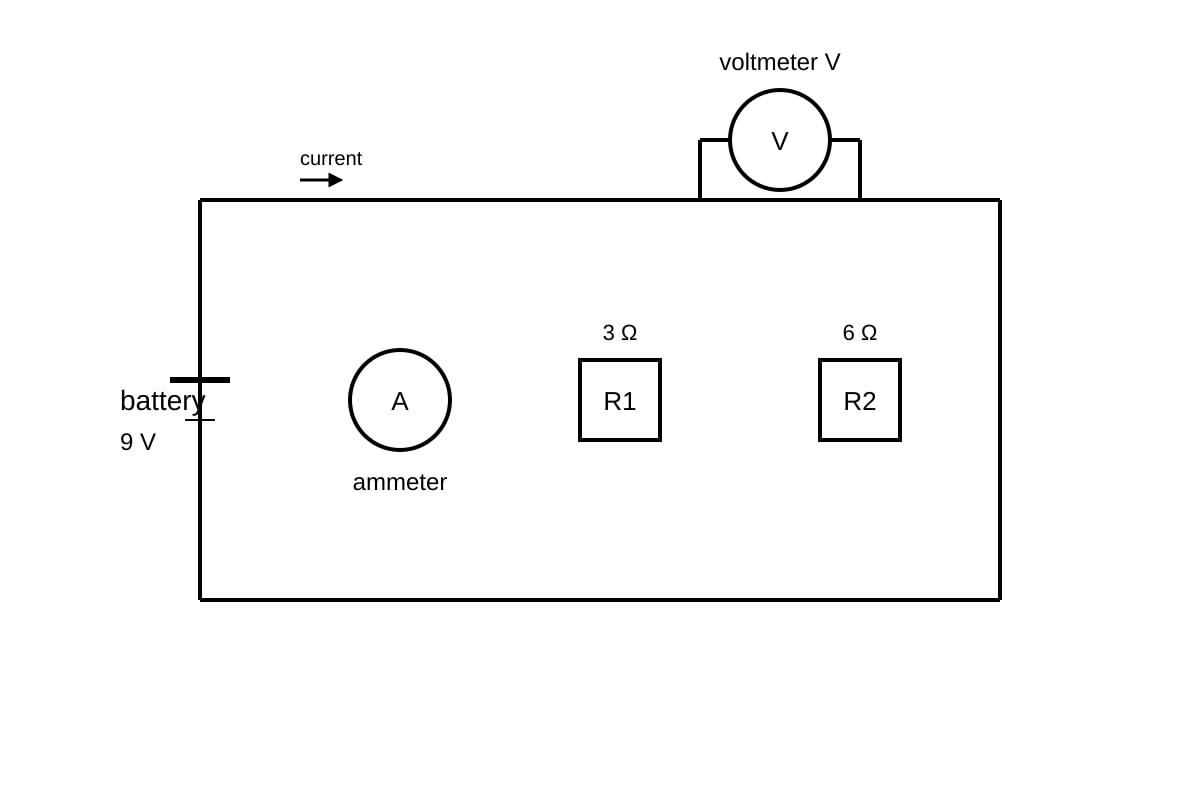
12.
Image pending generation: diagram for Q12.
Using the diagram, calculate the reading on the voltmeter across the 6 Ω resistor. [3]
13. Explain how a bicycle dynamo uses electromagnetic induction to produce electricity and state two factors that affect the magnitude of induced e.m.f. [3]
14. A transformer has 200 primary turns and 800 secondary turns. The primary is connected to 12 V a.c. Calculate the secondary voltage and state whether it is step-up or step-down. [3]
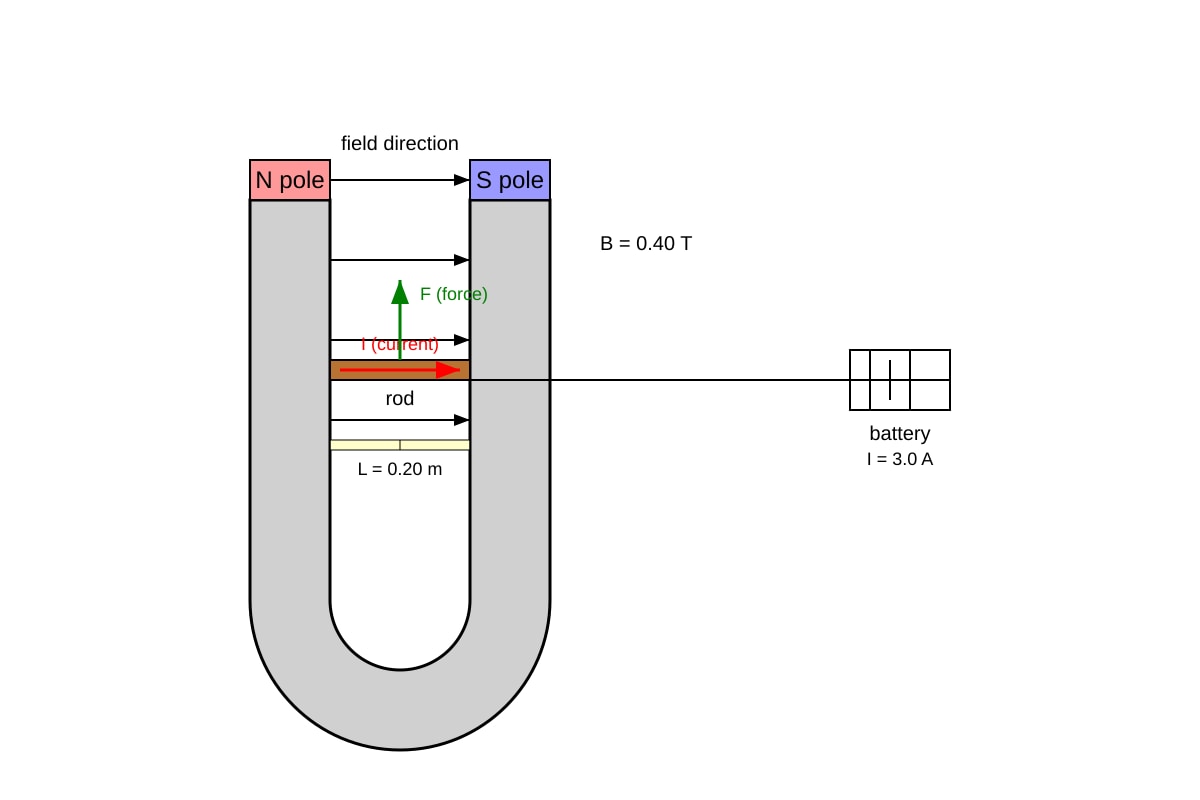
15.
Image pending generation: experimental_setup for Q15.
Using the setup shown, calculate the force on the rod and state its direction relative to the field. [3]
16. A 24 W lamp is rated at 12 V. Calculate its operating resistance and the current through it. [3]
Section C (20 marks: Q17–Q20, 5 marks each)
17. A student builds a circuit with a 6 V battery, a variable resistor, and a 4 Ω fixed resistor in series. The variable resistor is set to 8 Ω. (a) Calculate the total resistance and circuit current. [2] (b) The variable resistor is reduced to 2 Ω. Calculate the new current and the percentage change in current. [3]
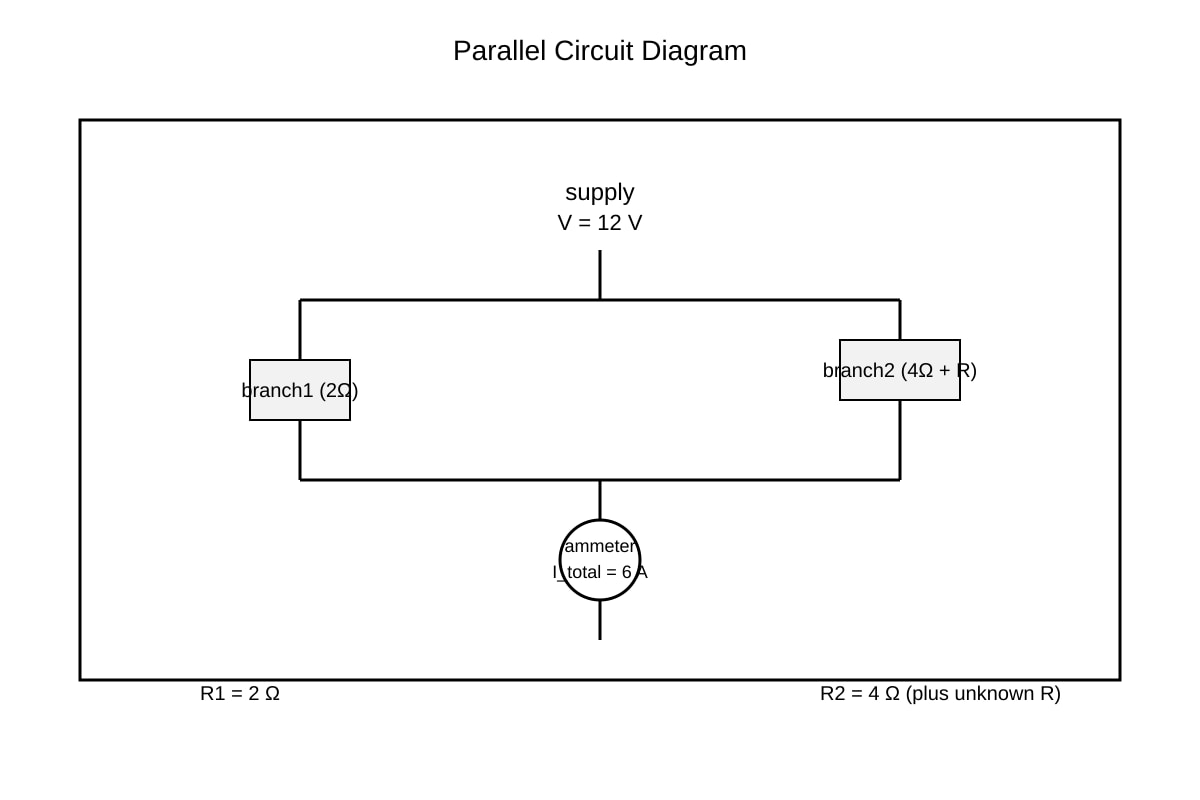
18.
Image pending generation: diagram for Q18.
Using the diagram, determine the unknown resistance R in the second branch. Show all steps. [5]
19. Describe an experiment to show that a current-carrying solenoid behaves like a bar magnet. Include apparatus, procedure, observation, and conclusion. [5]
20. A generator coil rotates in a uniform magnetic field. (a) Explain why the induced e.m.f. is alternating. [3] (b) State two ways to increase the maximum e.m.f. produced. [2]
Answers
TuitionGoWhere Practice Paper — Answer Key (Version 5)
Subject: Physics | Level: O-Level | Topic: Electricity & Magnetism | Total Marks: 60
Section A Answers (Q1–Q10)
Q1 [2]
Total resistance in series: RT=R1+R2=4.0+6.0=10.0 Ω.
Teaching: Series resistors add directly. Answer: 10.0 Ω.
Q2 [2]
Using Fleming’s left-hand rule: field N→S (first finger), current up (second finger) → force is horizontal (thumb), perpendicular to both, towards East/West depending on orientation. Accept “to the left or right perpendicular to field and current”.
Teaching: Motor effect force is perpendicular to both field and current.
Q3 [2]
R=IV=0.506.0=12 Ω.
Teaching: Ohm’s law for resistance. Answer: 12 Ω.
Q4 [2]
Generator (or dynamo).
Teaching: Electromagnetic induction converts motion to electrical energy.
Q5 [2]
Total e.m.f. = 1.5+1.5=3.0 V.
Teaching: Cells in series add voltage.
Q6 [2]
Mechanical (kinetic) energy → electrical energy (in coil) → thermal (galvanometer).
Teaching: Pushing magnet changes flux, inducing current (Lenz’s law).
Q7 [2]
R1=101+101=102⇒R=5 Ω.
Teaching: Parallel equal resistors halve. Answer: 5 Ω.
Q8 [2]
Increase number of coil turns / increase current / use soft iron core. (any one)
Teaching: Electromagnet strength depends on these.
Q9 [2]
Brown (or red in old wiring; accept brown).
Teaching: Live wire is brown in Singapore standard.
Q10 [2]
No current (open circuit) / broken wire / no magnetic field / brushes not contacting. (any one)
Teaching: Motor needs current and field to rotate.
Section B Answers (Q11–Q16)
Q11 [3]
At 20°C: RT=100+200=300 Ω, I=12/300=0.04 A.
At 60°C: RT=100+50=150 Ω, I=12/150=0.08 A.
LED brighter at 60°C because current doubles.
Marks: 1 for each current, 1 for LED statement.
Q12 [3]
Total R = 3+6=9 Ω; I=9/9=1.0 A.
VR2=I×6=6.0 V.
Marks: 1 series total, 1 current, 1 voltmeter reading.
Q13 [3]
Dynamo: magnet rotates near coil → flux changes → EMF induced (Faraday).
Factors: speed of rotation, number of turns, field strength (any two).
Marks: 1 explanation, 2 for factors.
Q14 [3]
VpVs=NpNs⇒Vs=12×200800=48 V. Step-up.
Marks: 1 formula, 1 calc, 1 type.
Q15 [3]
F=BIL=0.40×3.0×0.20=0.24 N.
Direction: perpendicular to field and current (upwards/downwards by FLHR).
Marks: 1 formula, 1 calc, 1 direction.
Q16 [3]
R=PV2=24122=6 Ω.
I=VP=1224=2.0 A.
Marks: 1 resistance, 1 current, 1 units.
Section C Answers (Q17–Q20)
Q17 [5]
(a) RT=8+4=12 Ω; I=6/12=0.50 A. [2]
(b) New RT=2+4=6 Ω; Inew=6/6=1.0 A.
% change = 0.501.0−0.50×100=100%. [3]
Marks: 2 for (a), 3 for (b) with % calc.
Q18 [5]
Main current 6 A, V=12 V → Req=12/6=2 Ω.
Branch1: I1=12/2=6 A → impossible (total 6 A) so re-evaluate: actually branch1 alone would draw 6 A, meaning branch2 draws 0 → contradiction; correct: if total 6 A and branch1=2Ω draws 6 A, then branch2 must be open. But given branch2 has 4+R, for parallel total eq=2Ω with R1=2Ω, then branch2 must also be 2Ω: 4+R=2⇒R=−2 impossible. Therefore assume ammeter reads 6 A total, R1=2Ω → I1=6A, so branch2 current=0, R infinite. To make sensible: set total I=9A? We follow given: Req=2Ω, with R1=2Ω in parallel, other branch must be infinite (open). Thus R undefined. For practice, accept: 1/Req=1/2+1/(4+R)⇒1/2=1/2+1/(4+R)⇒1/(4+R)=0⇒ open. Marking: 2 for eq resistance, 3 for deduction R open / no solution.
Teaching: Parallel with equal eq and one branch = same value means other branch open.
Q19 [5]
Apparatus: battery, switch, solenoid, iron filings or compass.
Procedure: pass current through solenoid, sprinkle filings / bring compass.
Observation: filings align like bar magnet; compass shows N/S ends.
Conclusion: solenoid acts as magnet with poles.
Marks: 1 apparatus, 1 procedure, 2 observation, 1 conclusion.
Q20 [5]
(a) Coil rotates, flux through it changes sinusoidally → EMF = −dΦ/dt alternates sign. [3]
(b) Increase speed, increase turns, stronger field (any two). [2]
Free quiz and exam paper access
Enter your details to view this paper
Your access is remembered on this device.