AI Generated Exam Paper
O Level Physics Practice Paper 5
Free O Level Physics Practice Paper 5, DeepSeek AI version, with questions, answers, and O Level-style practice for Singapore students.
These static practice materials are generated from the site's syllabus and paper-generation workflow, with source and model context shown so students and parents can evaluate the material before use.
Questions
Free quiz and exam paper access
Enter your details to view this paper
Your access is remembered on this device.
Answers
TuitionGoWhere Practice Paper - Physics O-Level
Answer Key and Marking Scheme – Version 5
Section A: Structured Questions (20 marks)
1. (a) Explain how the polythene rod acquires a negative charge. [2]
Answer: When the polythene rod is rubbed with the woollen cloth, electrons are transferred from the cloth to the rod [1]. The rod gains electrons and therefore becomes negatively charged [1].
Marking notes:
- Award [1] for stating electrons are transferred from cloth to rod.
- Award [1] for linking gain of electrons to negative charge.
- Accept: "Friction causes electrons to move from the wool to the polythene."
1. (b) Explain why the uncharged aluminium foil is attracted to the charged rod. [2]
Answer: The negative charge on the rod repels electrons in the aluminium foil to the far side of the foil [1]. This leaves the side of the foil nearest the rod with a net positive charge. The positive charge is attracted to the negative rod, so the foil moves towards the rod [1].
Marking notes:
- Award [1] for describing charge separation (induction) in the foil.
- Award [1] for stating attraction between opposite charges.
- Accept: "Electrostatic induction causes the foil to be attracted."
2. (a) Calculate the current flowing in the circuit. [2]
Answer: Total resistance R = 4.0 + 8.0 = 12.0 Ω [1] Current I = V / R = 12 / 12.0 = 1.0 A [1]
Marking notes:
- Award [1] for correct total resistance.
- Award [1] for correct current with unit.
- Accept: 1 A.
2. (b) Calculate the potential difference across the 4.0 Ω resistor. [1]
Answer: V = IR = 1.0 × 4.0 = 4.0 V [1]
Marking notes:
- Award [1] for correct answer with unit.
2. (c) State and explain what happens to the power dissipated in the fixed resistor. [2]
Answer: The power dissipated increases [1]. Power P = I²R, and since R is constant, doubling the current quadruples the power dissipated (P ∝ I²) [1].
Marking notes:
- Award [1] for stating power increases.
- Award [1] for explanation using P = I²R or P = VI.
- Accept: "Power becomes four times greater."
3. (a) Describe how the compass needle behaves when the current is switched on. [1]
Answer: The compass needle deflects and aligns itself perpendicular to the wire (or aligns with the circular magnetic field around the wire) [1].
Marking notes:
- Award [1] for describing deflection or alignment.
- Accept: "The needle points in the direction of the magnetic field around the wire."
3. (b) State two ways to increase the strength of the magnetic field around the wire. [2]
Answer:
- Increase the current in the wire [1].
- Place the wire closer to the compass (or use a coil/solenoid instead of a straight wire) [1].
Marking notes:
- Award [1] for each valid method.
- Accept: "Increase the number of turns (if using a coil)."
3. (c) State the effect on the magnetic field when the current direction is reversed. [1]
Answer: The direction of the magnetic field reverses [1].
Marking notes:
- Award [1] for stating direction reverses.
- Do not accept: "The field disappears" or "The field strength changes."
4. (a) Calculate the output voltage across the secondary coil. [2]
Answer: Vₛ / Vₚ = Nₛ / Nₚ [1] Vₛ = Vₚ × (Nₛ / Nₚ) = 240 × (5000 / 200) = 240 × 25 = 6000 V [1]
Marking notes:
- Award [1] for correct formula or substitution.
- Award [1] for correct answer with unit.
4. (b) Calculate the current in the secondary coil. [2]
Answer: For 100% efficiency: VₚIₚ = VₛIₛ [1] Iₛ = (VₚIₚ) / Vₛ = (240 × 2.5) / 6000 = 600 / 6000 = 0.10 A [1]
Marking notes:
- Award [1] for using correct relationship (power in = power out).
- Award [1] for correct answer with unit.
4. (c) State one reason why electricity is transmitted at high voltages. [1]
Answer: High voltage transmission reduces the current for the same power, which reduces energy losses (as heat) in the transmission cables (since P_loss = I²R) [1].
Marking notes:
- Award [1] for linking high voltage to reduced current and reduced power loss.
- Accept: "To minimise heat loss in cables" or "To improve efficiency of transmission."
Section B: Data-Based and Application Questions (30 marks)
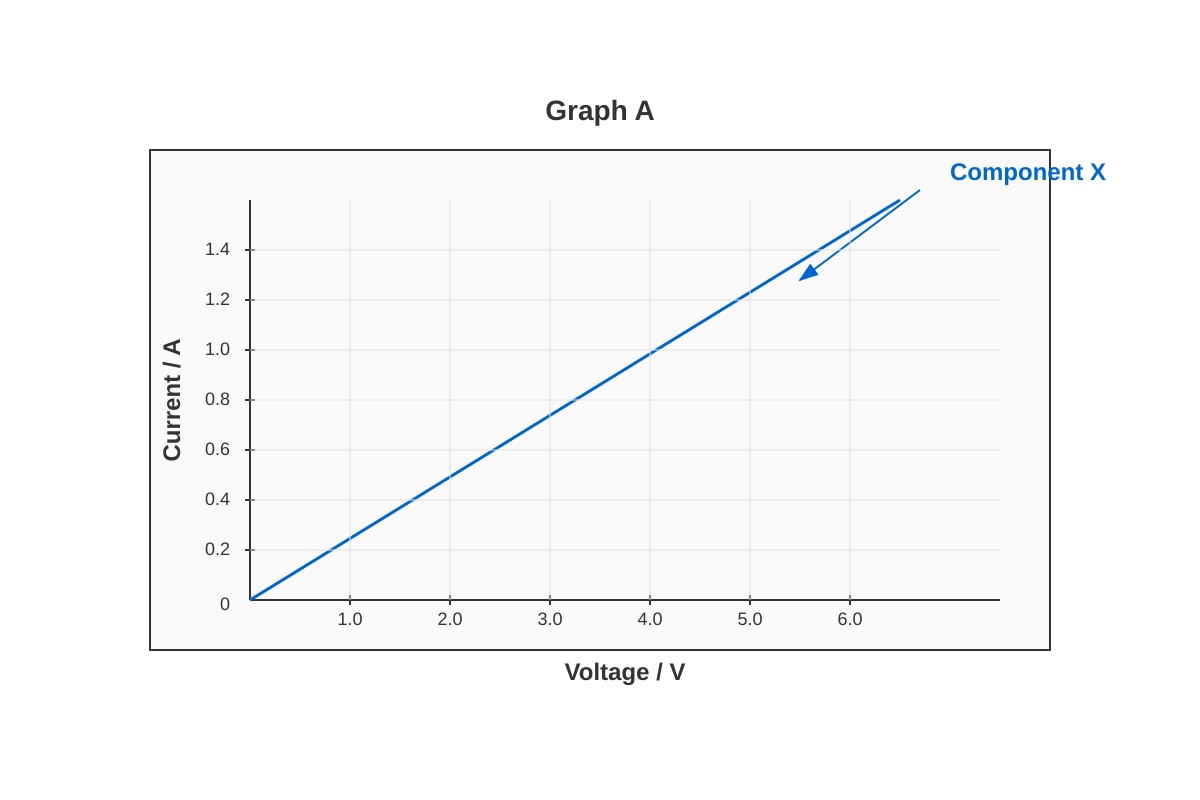
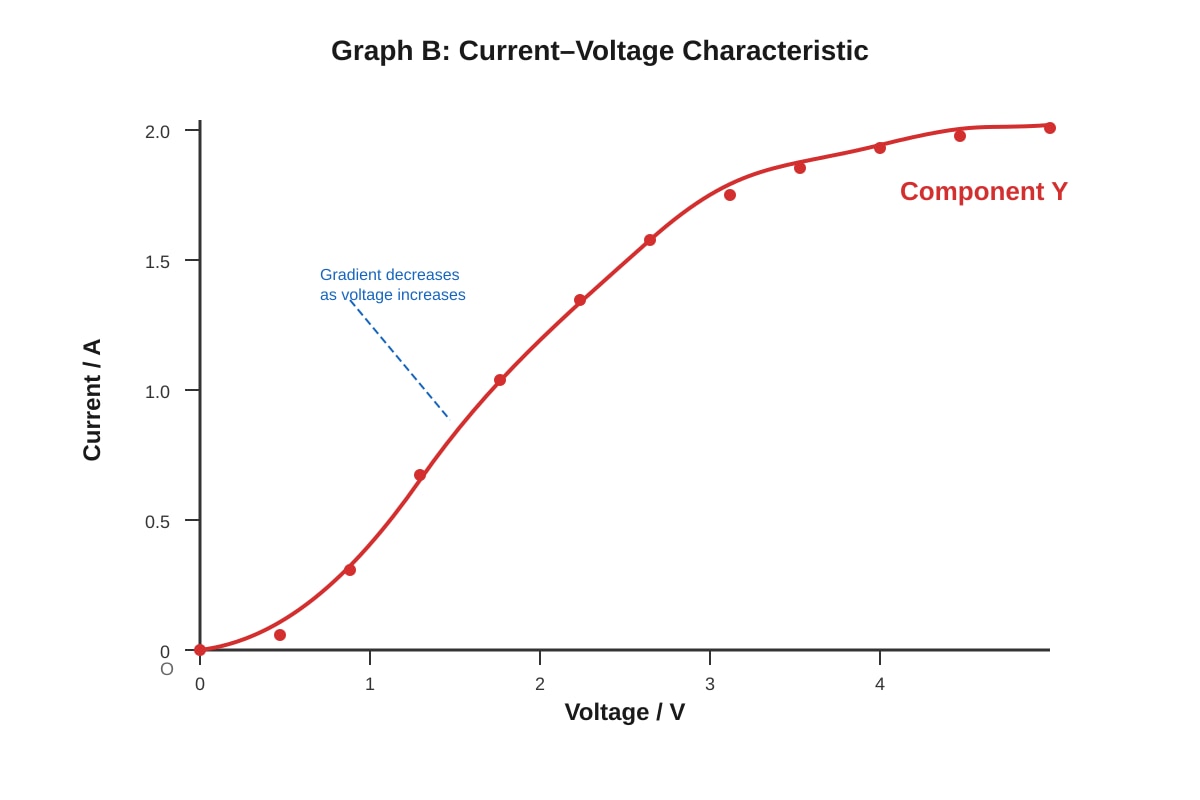
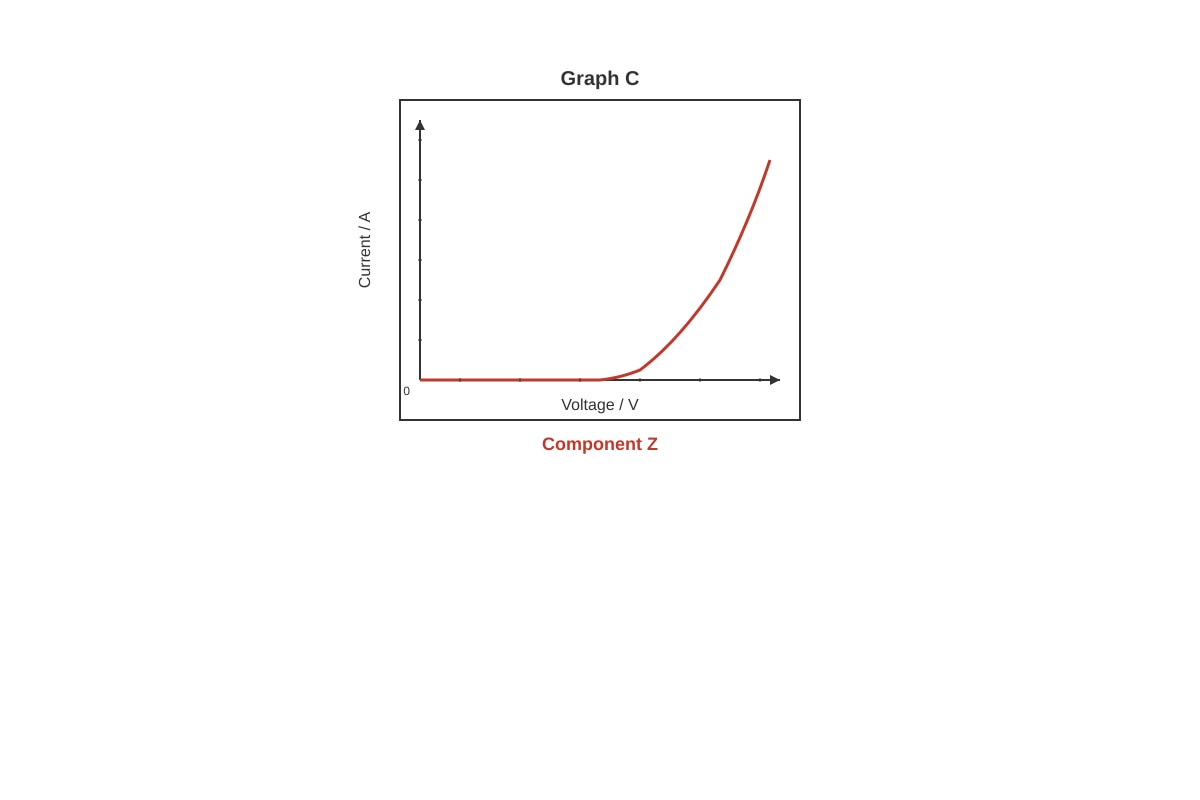
5. (a) Identify which graph corresponds to each component. [3]
Answer: Component X: Ohmic conductor [1] Reason: Graph A is a straight line through the origin, showing current is directly proportional to voltage (constant resistance) [1].
Component Y: Filament lamp [1] Reason: Graph B curves with decreasing gradient, showing resistance increases as current increases (due to heating) [1].
Component Z: Diode [1] Reason: Graph C shows current flowing in only one direction (forward bias), with negligible current in the reverse direction [1].
Marking notes:
- Award [1] for each correct identification with valid reason.
- Accept alternative phrasing that demonstrates understanding of I-V characteristics.
5. (b) Explain why the resistance of Component Y changes. [2]
Answer: As current increases through the filament lamp, the filament gets hotter [1]. The increased temperature causes the metal atoms to vibrate more, increasing resistance to electron flow, so resistance increases [1].
Marking notes:
- Award [1] for linking current increase to temperature increase.
- Award [1] for explaining effect of temperature on resistance (increased atomic vibrations impede electron flow).
5. (c) Calculate the current in the circuit. [2]
Answer: Voltage across resistor = 6.0 - 0.7 = 5.3 V [1] Current I = V / R = 5.3 / 200 = 0.0265 A = 26.5 mA [1]
Marking notes:
- Award [1] for correct voltage across resistor.
- Award [1] for correct current with unit.
- Accept: 0.027 A or 2.65 × 10⁻² A.
6. (a) Calculate the energy required to heat the water. [2]
Answer: Temperature rise Δθ = 100 - 25 = 75 °C [1] Energy E = mcΔθ = 1.5 × 4200 × 75 = 472,500 J (or 472.5 kJ) [1]
Marking notes:
- Award [1] for correct temperature rise.
- Award [1] for correct energy with unit.
- Accept: 4.73 × 10⁵ J.
6. (b) Calculate the time taken, assuming no energy losses. [2]
Answer: Power P = 2200 W, Energy E = 472,500 J [1] Time t = E / P = 472,500 / 2200 = 214.8 s ≈ 215 s (or 3 min 35 s) [1]
Marking notes:
- Award [1] for correct formula or substitution.
- Award [1] for correct time with unit.
- Accept: 210–220 s.
6. (c) Suggest two reasons why the kettle takes longer in practice. [2]
Answer:
- Some energy is lost to the surroundings (as heat) from the kettle body [1].
- Some energy is used to heat the kettle itself (the heating element and the kettle material) [1].
Marking notes:
- Award [1] for each valid reason.
- Accept: "Energy is lost as sound" or "Energy is lost as steam escapes."
6. (d) Explain why a 3 A fuse would not be suitable. [2]
Answer: The normal operating current I = P / V = 2200 / 240 = 9.17 A [1]. A 3 A fuse would blow during normal operation because the current exceeds the fuse rating [1].
Marking notes:
- Award [1] for calculating or stating the operating current (approximately 9.2 A).
- Award [1] for explaining that the current exceeds the 3 A rating.
- Accept: "The kettle draws more than 3 A, so the fuse would blow immediately."
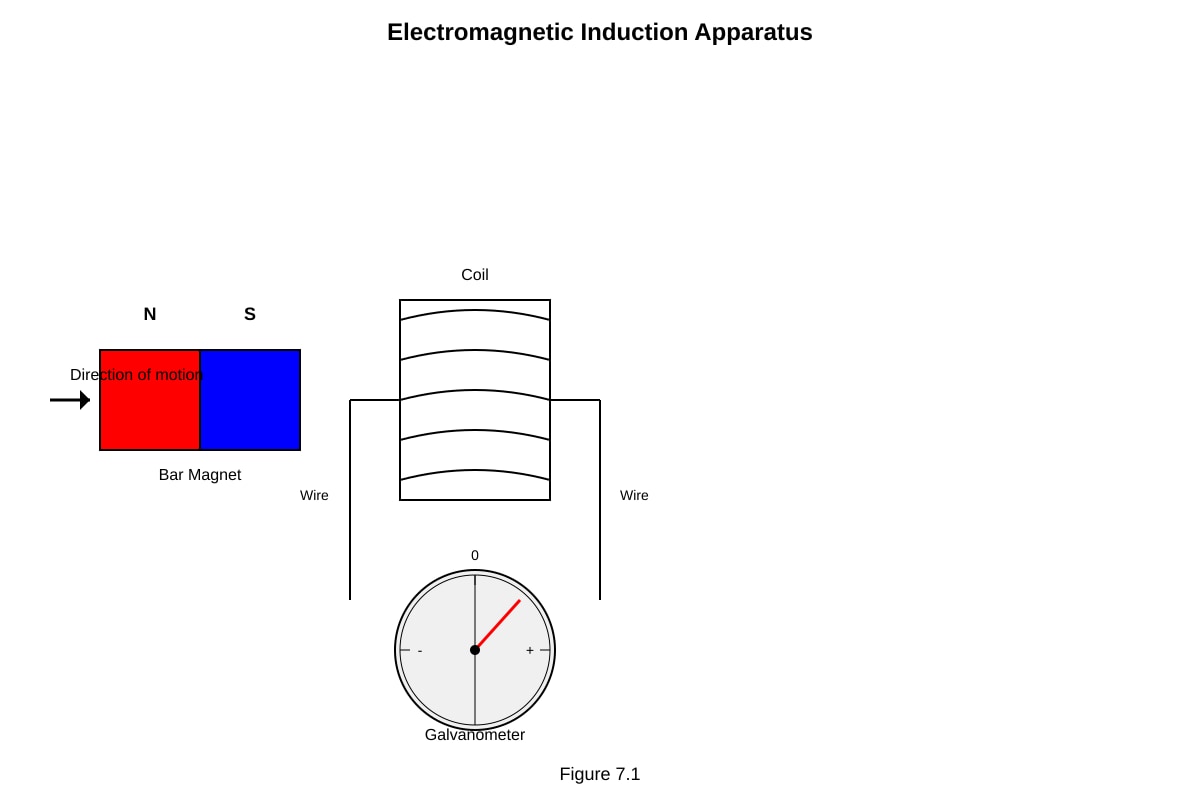
7. (a) State what happens to the galvanometer pointer when: [3]
(i) Magnet held stationary inside the coil. [1] Answer: The pointer shows zero deflection (returns to centre) [1]. Reason: No change in magnetic flux, so no induced e.m.f.
(ii) Magnet pulled out quickly. [1] Answer: The pointer deflects to the left [1]. Reason: The induced e.m.f. is in the opposite direction (Lenz's law).
(iii) South pole pushed into the coil. [1] Answer: The pointer deflects to the left [1]. Reason: The direction of induced e.m.f. depends on the pole entering.
Marking notes:
- Award [1] for each correct observation.
- Accept: "Deflects in opposite direction" for (ii) and (iii).
7. (b) State two ways to increase the size of the induced e.m.f. [2]
Answer:
- Move the magnet faster (increase the rate of change of magnetic flux) [1].
- Use a stronger magnet (increase the magnetic field strength) [1].
Marking notes:
- Award [1] for each valid method.
- Accept: "Increase the number of turns on the coil" or "Use a soft iron core inside the coil."
7. (c) Explain the energy transformation when the magnet is moved continuously. [2]
Answer: Mechanical (kinetic) energy used to move the magnet is converted into electrical energy in the coil [1]. The electrical energy is then converted into thermal energy (heat) in the resistor [1].
Marking notes:
- Award [1] for identifying mechanical → electrical conversion.
- Award [1] for identifying electrical → thermal conversion in the resistor.
- Accept: "Kinetic energy → electrical energy → heat energy."
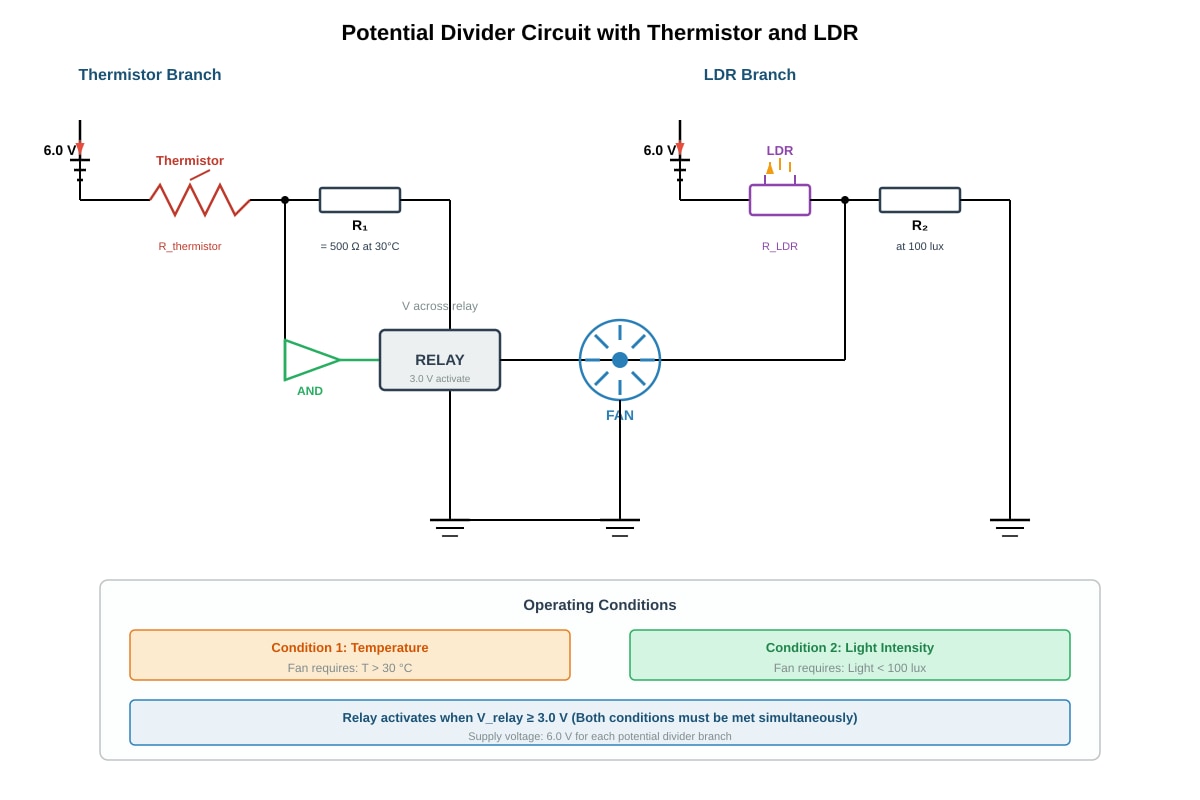
8. (a) Calculate the value of R₁. [3]
Answer: Voltage across relay = 3.0 V, so voltage across R₁ = 6.0 - 3.0 = 3.0 V [1] Same voltage means R₁ = resistance of thermistor at 30 °C [1] Therefore R₁ = 500 Ω [1]
Marking notes:
- Award [1] for determining voltage across R₁.
- Award [1] for recognising equal voltages mean equal resistances in series.
- Award [1] for correct value with unit.
- Alternative: Use potential divider formula V_out = V_in × R₁/(R₁ + R_thermistor).
8. (b) Calculate the value of R₂. [3]
Answer: Voltage across relay = 3.0 V, so voltage across LDR = 6.0 - 3.0 = 3.0 V [1] Since voltages are equal, R₂ = resistance of LDR at 100 lux [1] Therefore R₂ = 2.0 kΩ = 2000 Ω [1]
Marking notes:
- Award [1] for determining voltage across LDR.
- Award [1] for recognising equal voltages mean equal resistances.
- Award [1] for correct value with unit.
8. (c) Suggest one practical application. [1]
Answer: An automatic greenhouse ventilation system that switches on a fan when it is both hot and dark (to prevent overheating when sunlight is not available for photosynthesis) [1].
Marking notes:
- Award [1] for any plausible application involving both temperature and light sensing.
- Accept: "Automatic street lighting that only operates when warm and dark" or "Incubator control system."
Section C: Free Response Questions (30 marks)
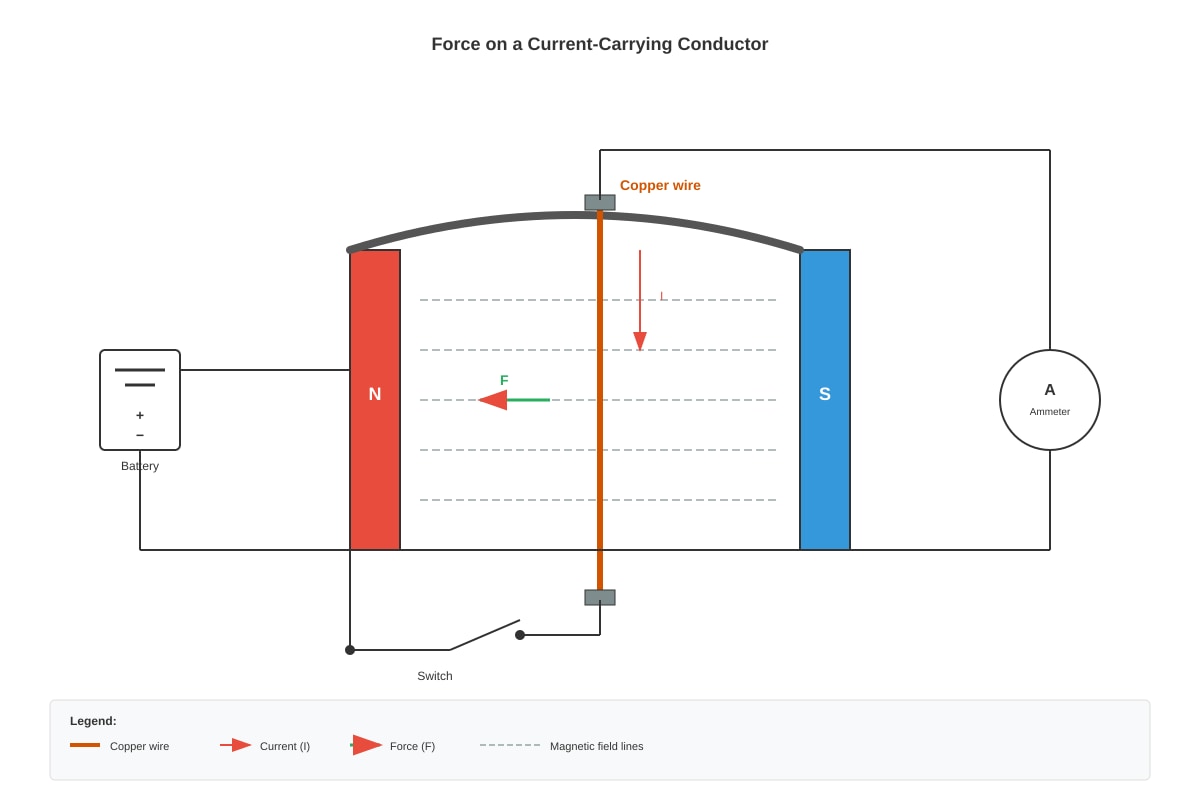
9. (a) Explain why the wire experiences a force. [2]
Answer: When current flows through the wire, it produces a magnetic field around the wire [1]. This magnetic field interacts with the magnetic field of the permanent magnet. The interaction of the two magnetic fields produces a force on the wire (motor effect) [1].
Marking notes:
- Award [1] for stating current produces a magnetic field.
- Award [1] for stating interaction of fields produces a force.
- Accept: "A current-carrying conductor in a magnetic field experiences a force."
9. (b) State the direction of the force using Fleming's left-hand rule. [1]
Answer: The force acts upwards (or out of the page, depending on diagram orientation; accept direction consistent with the diagram and Fleming's left-hand rule) [1].
Marking notes:
- Award [1] for correct direction consistent with field and current directions shown.
- Accept: "Perpendicular to both the current and the magnetic field."
9. (c) Suggest three changes to increase the force and explain each. [6]
Answer: Change 1: Increase the current in the wire [1]. Explanation: Force F = BIL, so increasing current I directly increases the force (F ∝ I) [1].
Change 2: Use a stronger magnet (increase magnetic field strength B) [1]. Explanation: Force F = BIL, so increasing B directly increases the force (F ∝ B) [1].
Change 3: Increase the length of wire in the magnetic field [1]. Explanation: Force F = BIL, so increasing L directly increases the force (F ∝ L) [1].
Marking notes:
- Award [1] for each valid change and [1] for each correct explanation using F = BIL.
- Accept: "Use a coil with more turns instead of a single wire" (increases effective length).
- Accept: "Place the wire perpendicular to the field" (if not already perpendicular).
9. (d) Calculate the force on the wire. [2]
Answer: F = BIL [1] F = 0.50 × 3.0 × 0.080 = 0.12 N [1]
Marking notes:
- Award [1] for correct formula or substitution.
- Award [1] for correct answer with unit.
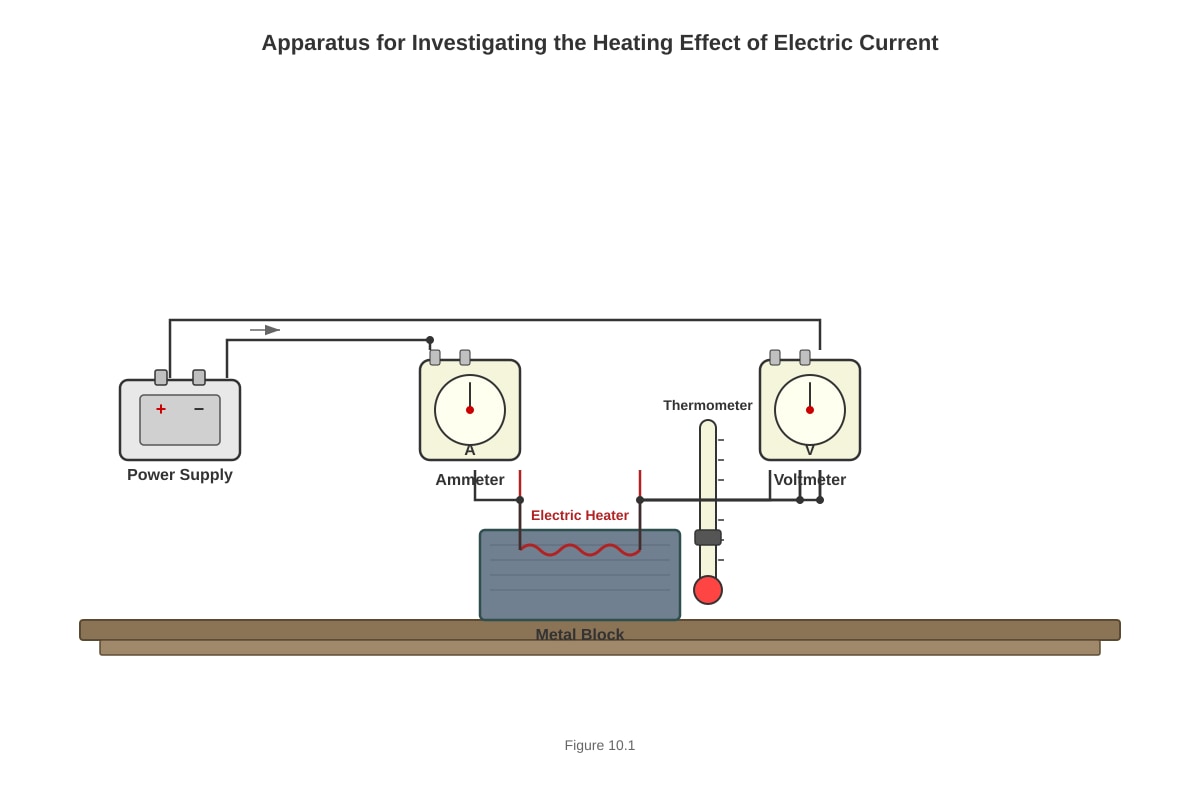
10. (a) Calculate the electrical energy supplied. [2]
Answer: Time t = 5 × 60 = 300 s [1] Energy E = VIt = 12.0 × 2.5 × 300 = 9000 J [1]
Marking notes:
- Award [1] for converting time to seconds.
- Award [1] for correct energy with unit.
- Accept: 9.0 kJ.
10. (b) Calculate the thermal energy gained by the block. [2]
Answer: Temperature rise Δθ = 38.0 - 22.0 = 16.0 °C [1] Energy E = mcΔθ = 1.2 × 900 × 16.0 = 17,280 J [1]
Marking notes:
- Award [1] for correct temperature rise.
- Award [1] for correct energy with unit.
- Accept: 17.3 kJ.
10. (c) Calculate the efficiency. [2]
Answer: Efficiency = (useful energy output / total energy input) × 100% [1] Efficiency = (17,280 / 9000) × 100% = 192% [1]
Note: This result exceeds 100%, which indicates an error in the question data. In a real exam, students should identify this inconsistency. For marking purposes:
Corrected approach: If the question intended the electrical energy to be larger, the efficiency would be less than 100%. Students who identify the inconsistency and state that efficiency cannot exceed 100% should be awarded full marks.
Marking notes:
- Award [1] for correct formula.
- Award [1] for correct substitution and calculation.
- Award full marks if student notes that the result is impossible (>100%) and suggests experimental error.
10. (d) Suggest two reasons why efficiency is less than 100%. [2]
Answer:
- Heat is lost from the block to the surrounding air (by conduction, convection, and radiation) [1].
- Some electrical energy is used to heat the heater itself and the connecting wires, not just the block [1].
Marking notes:
- Award [1] for each valid reason.
- Accept: "The thermometer may not be fully inserted" or "Heat is lost when stirring."
10. (e) State and explain how the temperature rise compares. [3]
Answer: The temperature rise will be half (or smaller) [1]. The same electrical energy is supplied, but the block has twice the mass [1]. Since E = mcΔθ, for the same energy E and same specific heat capacity c, doubling the mass m halves the temperature rise Δθ [1].
Marking notes:
- Award [1] for stating temperature rise is smaller/halved.
- Award [1] for stating same energy supplied.
- Award [1] for explanation using E = mcΔθ or inverse proportionality.
- Accept: "Δθ ∝ 1/m, so doubling mass halves the temperature rise."
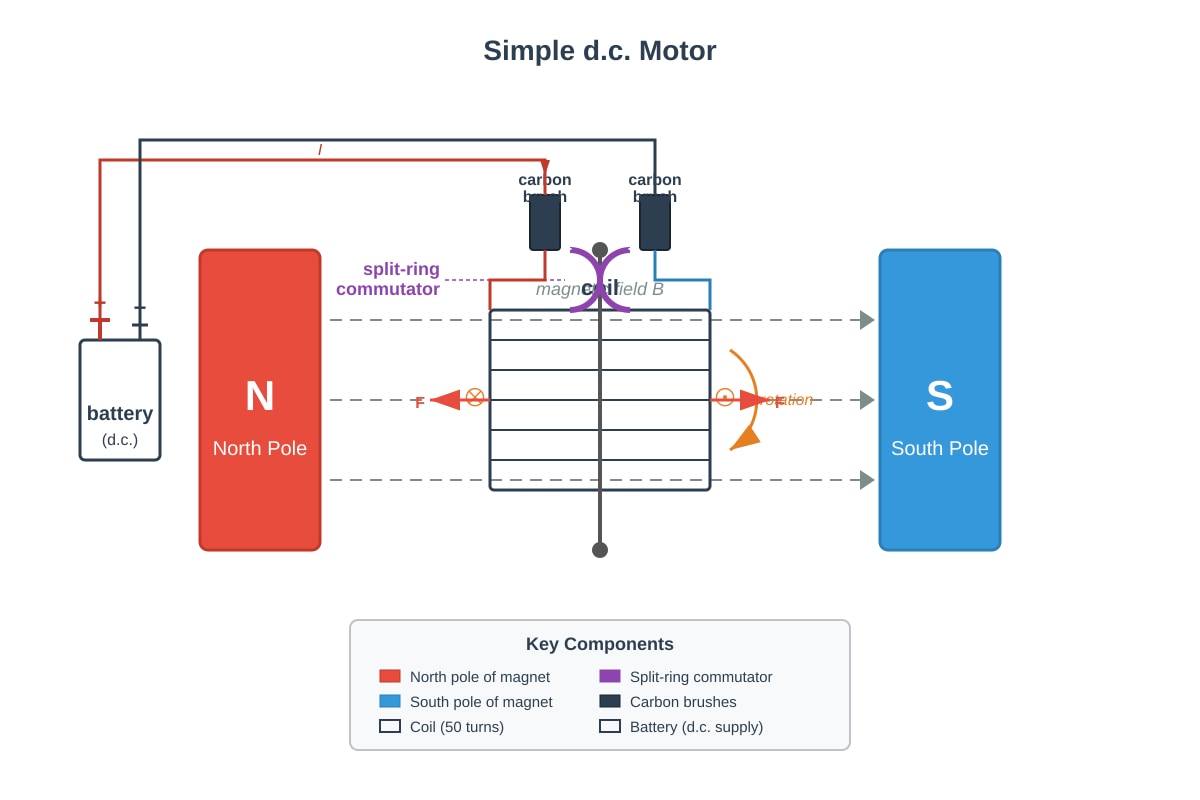
11. (a) Explain the purpose of the split-ring commutator. [2]
Answer: The split-ring commutator reverses the direction of current in the coil every half-turn [1]. This ensures that the turning force (torque) on the coil always acts in the same direction, allowing the motor to rotate continuously in one direction [1].
Marking notes:
- Award [1] for stating current direction is reversed every half-turn.
- Award [1] for explaining this enables continuous rotation.
11. (b) Calculate the maximum turning moment (torque). [3]
Answer: Force on one side of coil: F = BIL = 0.25 × 0.40 × 0.060 = 0.0060 N [1] Torque from one side = F × perpendicular distance = 0.0060 × (0.040/2) = 1.2 × 10⁻⁴ N m [1] Total torque (two sides, 50 turns) = 2 × 50 × 1.2 × 10⁻⁴ = 0.012 N m [1]
Alternative method: Torque τ = nBIA, where A = 0.060 × 0.040 = 0.0024 m² [1] τ = 50 × 0.25 × 0.40 × 0.0024 [1] τ = 0.012 N m [1]
Marking notes:
- Award [1] for correct force or area calculation.
- Award [1] for correct torque formula.
- Award [1] for correct answer with unit.
- Accept: 1.2 × 10⁻² N m.
11. (c) State the energy transformation in the motor. [1]
Answer: Electrical energy is converted into mechanical (kinetic) energy (and some thermal energy due to resistance) [1].
Marking notes:
- Award [1] for identifying electrical → mechanical/kinetic transformation.
- Accept: "Electrical energy → kinetic energy + heat energy."
11. (d) Explain the effect of a higher voltage battery on motor speed. [2]
Answer: A higher voltage increases the current in the coil [1]. This increases the force on the coil (F = BIL), producing a larger turning moment, so the motor rotates faster [1].
Marking notes:
- Award [1] for linking higher voltage to increased current.
- Award [1] for linking increased current to larger force/faster rotation.
11. (e) Suggest one way to reverse the direction of rotation. [1]
Answer: Reverse the connections to the battery (swap the positive and negative terminals) [1].
Marking notes:
- Award [1] for any valid method.
- Accept: "Reverse the direction of the magnetic field (swap the magnet poles)" or "Reverse the direction of current in the coil."
END OF ANSWER KEY