AI Generated Exam Paper
O Level Physics Practice Paper 4
Free O Level Physics Practice Paper 4, HY3 AI version, with questions, answers, and O Level-style practice for Singapore students.
These static practice materials are generated from the site's syllabus and paper-generation workflow, with source and model context shown so students and parents can evaluate the material before use.
Questions
TuitionGoWhere Practice Paper - Physics O-Level
TuitionGoWhere Practice Paper (AI) — Version 4 of 5
Subject: Physics
Level: O-Level
Paper: Practice Paper (Electricity & Magnetism Focus)
Duration: 1 hour 15 minutes
Total Marks: 60
Name: ______________________
Class: ______________________
Date: ______________________
Instructions:
- This practice paper contains 20 questions across three sections.
- Answer all questions in the spaces provided.
- Show all working clearly where calculation is required.
- Use the provided answer spaces; additional paper may be used if needed.
- Marks for each question are shown in brackets [ ].
- Section marks and question marks total exactly 60.
Section A: Multiple-Choice and Short Structured (Questions 1–8) [24 marks]
1. A wire has resistance 8 Ω and is connected in parallel with a 12 Ω resistor. What is the combined resistance? [2]
( ) A. 4.8 Ω
( ) B. 20 Ω
( ) C. 10 Ω
( ) D. 6.0 Ω
2. State the formula for total resistance of two resistors R1 and R2 in parallel. [1]
3. A voltmeter across a lamp reads 6.0 V and an ammeter in series reads 0.50 A. Calculate the lamp resistance. [2]
4. In a series circuit with a 9 V battery and two resistors (4 Ω and 5 Ω), what is the current? [2]
5. Name the device that uses electromagnetic induction to convert kinetic energy to electrical energy. [1]
6. A thermistor is placed in a circuit. As temperature rises, its resistance decreases. State what happens to the current if voltage is fixed. [1]
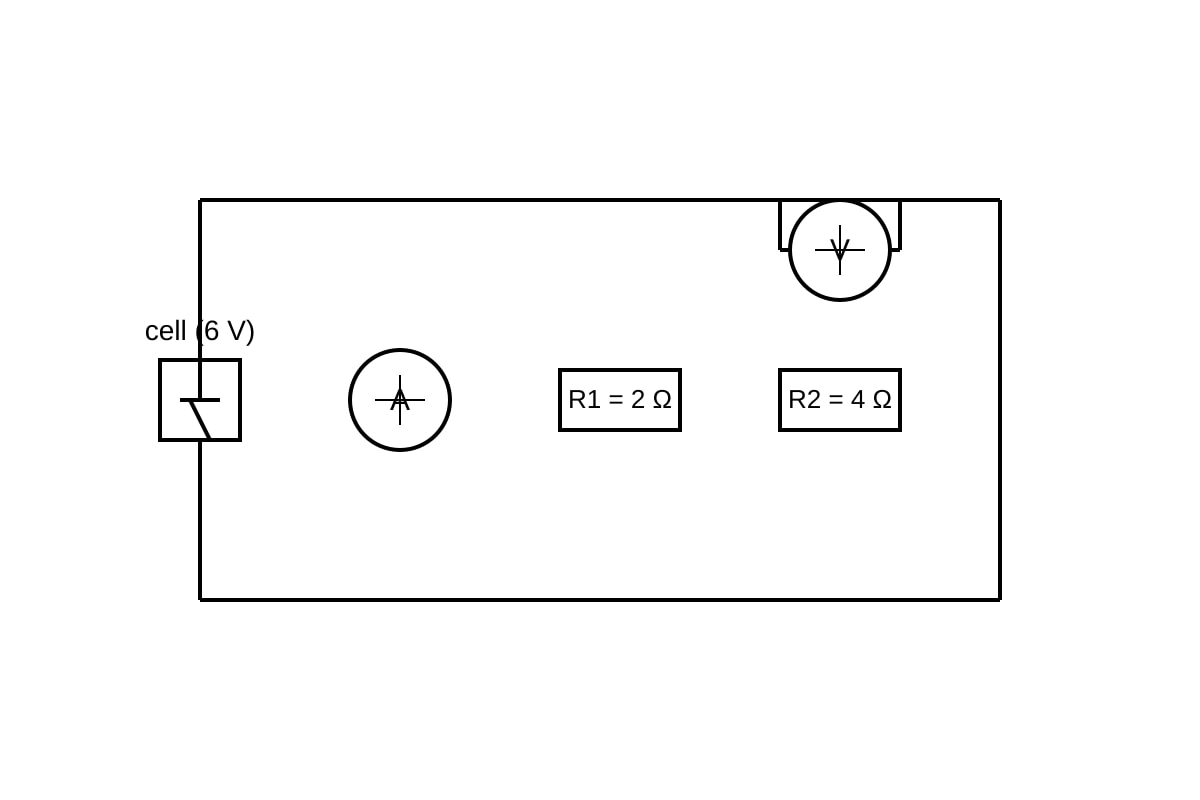
7.
Image pending generation: diagram for 7.
Using the diagram above, calculate the reading on voltmeter V. [3]
8. Give one factor that increases the magnitude of induced EMF in a coil. [1]
Section B: Structured Response and Calculation (Questions 9–15) [24 marks]
9. A circuit contains a 12 V battery, a fixed 100 Ω resistor and a thermistor in series. At 20 °C the thermistor is 200 Ω; at 60 °C it is 50 Ω.
(a) Calculate current at 20 °C. [2]
(b) Calculate current at 60 °C. [2]
(c) Explain the change in brightness of an LED in the circuit. [1]
10. A voltmeter across a resistance wire reads the same as a voltmeter across a 30 Ω resistor in a series circuit with total 90 Ω. Find the wire resistance if the other series resistor is 30 Ω. [3]
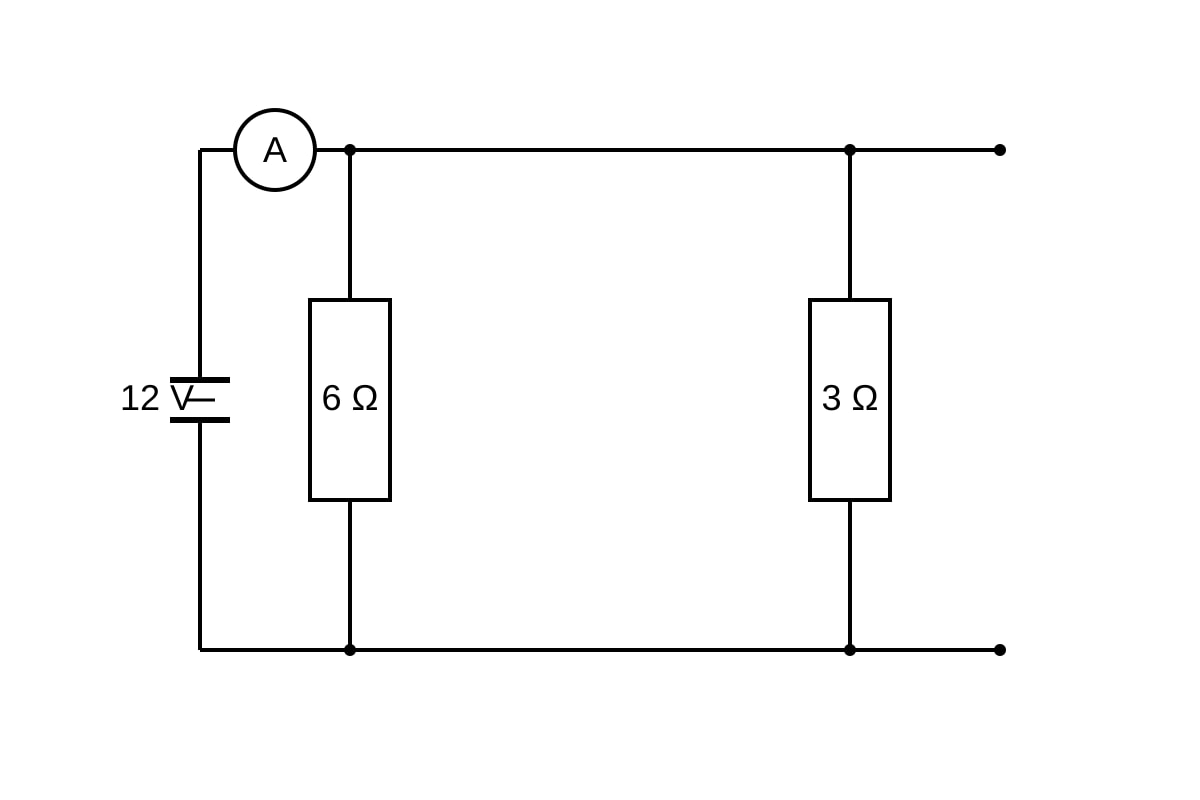
11.
Image pending generation: experimental_setup for 11.
Using the diagram, find equivalent resistance and total current. [4]
12. A lamp is rated 12 V, 24 W. Find its operating resistance. [2]
13. Compare the current in Fig. X (series 10 Ω + 10 Ω from 12 V) with Fig. Y (parallel 10 Ω | 10 Ω from 12 V). Explain. [3]
14. State Lenz’s law in one sentence. [1]
15. A bicycle dynamo produces 3.0 V at slow pedalling and 6.0 V at fast pedalling. State the physics principle and one reason for voltage increase. [2]
Section C: Extended Application (Questions 16–20) [12 marks]
16. Explain how a transformer uses electromagnetic induction and why it only works with a.c. [3]
17. A hall has 10 lamps each 60 W, used 4 h daily. Calculate daily energy in kWh. [2]
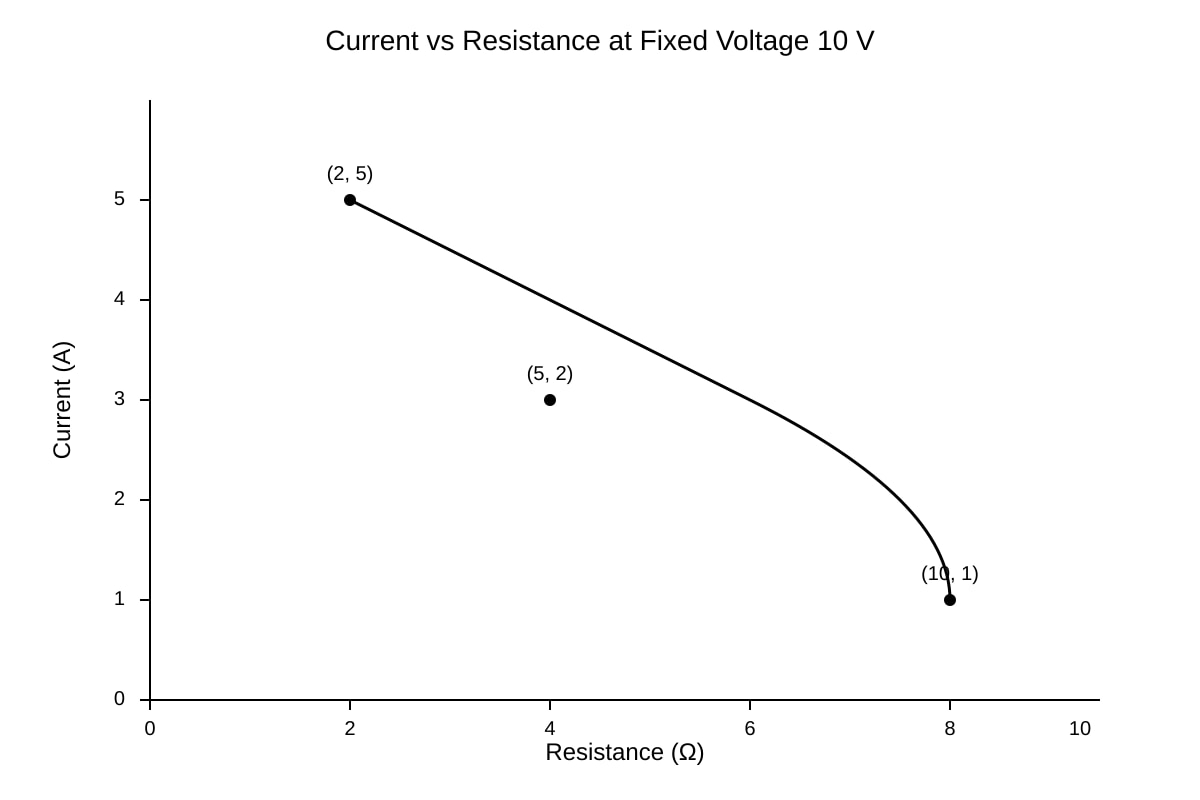
18.
Image pending generation: graph for 18.
Using the graph, state the current at 5 Ω and explain the relationship. [2]
19. A motor rotates a coil in a magnetic field. Name the force causing rotation and state one way to reverse direction. [2]
20. A student says parallel circuits always have lower total resistance than series. Explain if this is true with an example. [3]
Answers
TuitionGoWhere Practice Paper - Physics O-Level (Answers)
Version 4 of 5 — Answer Key
Total Marks: 60
Section A Answers (24 marks)
1. [2] A. 4.8 Ω
Working: R1=81+121=243+2=245 → R=24/5=4.8 Ω.
Teaching: Parallel resistance is always less than smallest branch. Common trap: adding instead of using reciprocal formula.
2. [1] Rtotal1=R11+R21
Teaching: This is the parallel formula; for more than two, keep adding terms.
3. [2] R=V/I=6.0/0.50=12 Ω
Teaching: Ohm’s law for resistance. Mark: 1 for formula, 1 for answer with unit.
4. [2] Rtotal=4+5=9 Ω; I=9/9=1.0 A
Teaching: Series adds resistances; current same everywhere.
5. [1] Generator (or dynamo)
Teaching: Electromagnetic induction converts motion to electricity.
6. [1] Current increases
Teaching: Fixed V, I=V/R, lower R → higher I.
7. [3] Total R = 2+4 = 6 Ω; I = 6/6 = 1 A; V across 4 Ω = I×4 = 4 V.
Marks: 1 for total R, 1 for current, 1 for voltmeter reading.
Teaching: Voltmeter across resistor measures its share of voltage.
8. [1] Increase speed of motion / more coil turns / stronger magnet
Teaching: Any one factor from Faraday’s law.
Section B Answers (24 marks)
9. [5]
(a) [2] Rtot=100+200=300 Ω; I=12/300=0.04 A
(b) [2] Rtot=100+50=150 Ω; I=12/150=0.08 A
(c) [1] LED brighter because current doubles.
Teaching: Thermistor NTC; series current rises as total R falls.
10. [3] Let wire = Rw. Equal V means Rw+30Rw=30+3030=0.5 → Rw=30 Ω.
Marks: 1 setup, 2 solve. Teaching: Equal volt drop in series means equal resistance if same current.
11. [4] Req1=1/6+1/3=1/2 → Req=2 Ω; I=12/2=6 A.
Marks: 2 formula, 1 Req, 1 current. Teaching: Parallel branches share voltage.
12. [2] R=V2/P=122/24=144/24=6 Ω.
Teaching: Use power form of Ohm’s law.
13. [3] Fig X: R=20 Ω, I=0.6 A; Fig Y: R=5 Ω, I=2.4 A. Y current larger (4×). Explanation: parallel lower R.
Marks: 1 each config, 1 compare.
14. [1] Induced current direction opposes change producing it.
15. [2] Electromagnetic induction; faster rotation → faster flux change → higher EMF.
Marks: 1 principle, 1 reason.
Section C Answers (12 marks)
16. [3] Primary a.c. creates changing flux in core; secondary coil induces EMF by Faraday’s law. a.c. needed because constant d.c. gives no flux change.
Marks: 1 changing flux, 1 secondary induce, 1 a.c. reason.
17. [2] Total W = 10×60 = 600 W = 0.6 kW; Energy = 0.6×4 = 2.4 kWh.
Teaching: kWh = kW × h.
18. [2] At 5 Ω, I = 2 A; relationship inverse (I=V/R).
Marks: 1 read, 1 explain.
19. [2] Motor effect (magnetic force on current); reverse battery polarity or field direction.
Marks: 1 force, 1 reverse method.
20. [3] True for same resistors: e.g., two 10 Ω in series = 20 Ω, in parallel = 5 Ω. Parallel provides more paths.
Marks: 1 claim, 2 example.
Free quiz and exam paper access
Enter your details to view this paper
Your access is remembered on this device.